




Abstract

P
One approach to understand how these two retroviruses exploit distinct or common strategies to subvert cellular pathways toward disease progression is to investigate protein–protein interactions (PPi) between the viral and the host proteins. Viral transactivators HIV-1 Tat and HTLV-1 Tax have been extensively studied and numerous interacting factors have been identified. The results are collected in various databases including the HIV-1 Human Interaction Database, VirusMINT, and VirHostNet. HIV-1 Tat and HTLV-1 Tax interact with several transcription regulators for their ability to modulate transcription of viral and cellular genes. To better visualize and compare HIV-1 Tat and HTLV-1 Tax interactomes with the transcription machinery, we collected HIV-1 Tat and HTLV-1 Tax partners involved in the transcriptional regulation from different databases. 1 –3 We found 258 and 77 interactions involving HIV-1 Tat and HTLV-1 Tax, respectively (Fig. 1). These interactions are visualized using Cytoscape.
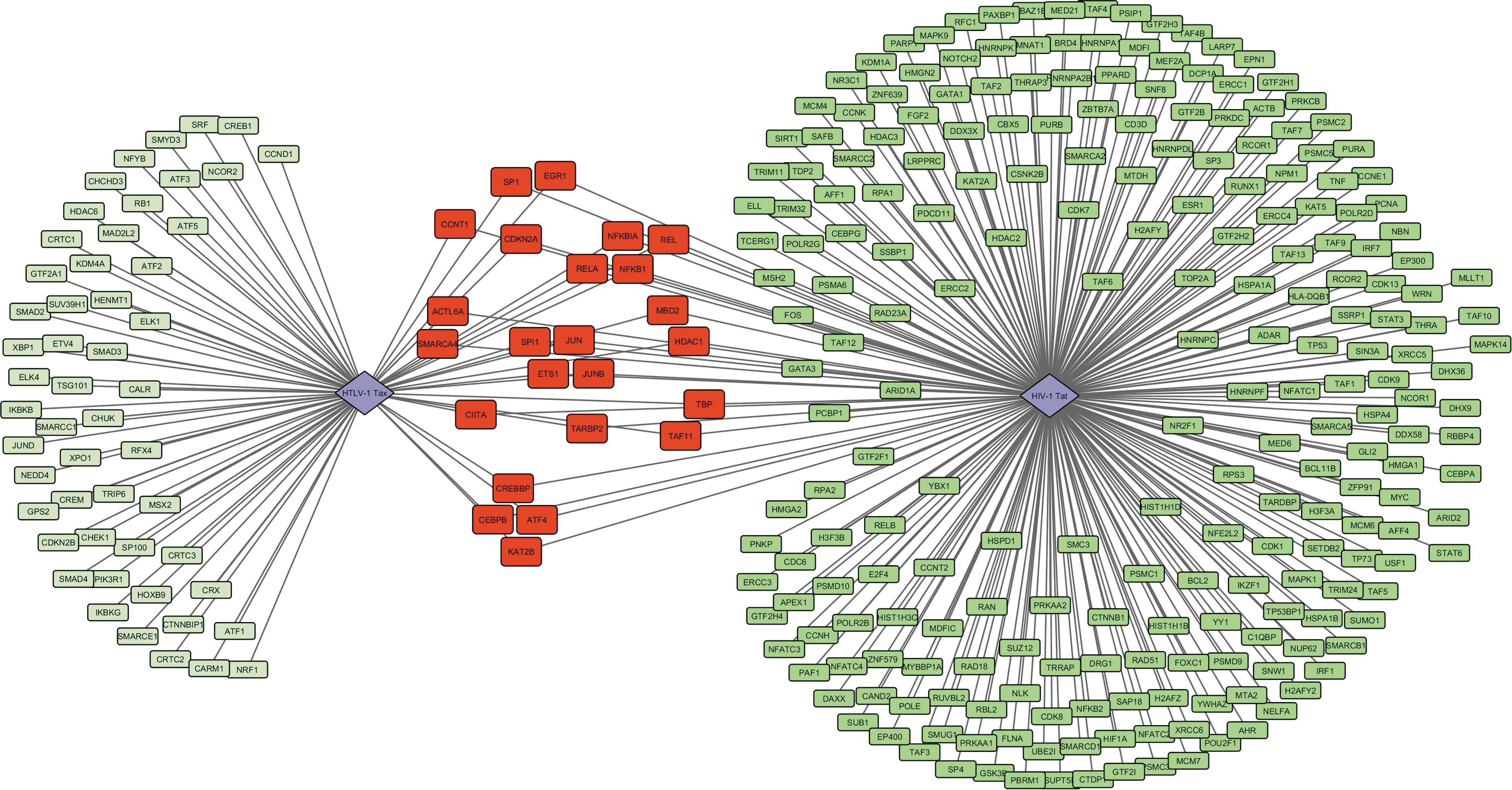
Interactome map of HIV-1 Tat and human T lymphotropic virus type-1 (HTLV-1) Tax and transcription regulation factors. A Cytoscape map of HIV-1 Tat and HTLV-1 Tax interactions with cellular proteins involved in transcription regulation. Interactions were collected from different databases: HIV-1 Tat interacts with 258 cellular partners (green) and HTLV-1 Tax interacts with 77 partners (light green). Twenty-two shared partners are shown in red. Arrows indicate protein–protein interactions (PPi).
The mechanistic models of HIV-1 Tat and HTLV-1 Tax transcriptional regulation of viral expression are different: HIV-1 Tat activity is dependent on its direct binding to the stem-loop structure viral RNA (called TAR), while HTLV-1 Tax acts through cellular proteins such as CREB/ATFs able to bind the Tax-responsive elements (TRE) of the HTLV-1 LTR promoter. Our comparative map also highlights distinct cellular cofactors recruited by both retroviral proteins to subvert cellular pathways.
Twenty-two common targets were identified and include members of the NF-κB pathway (REL, RELA, NFKB1, NFKBIA), the transcription factor (TF) Sp1, the SWI/SNF complex (SMARCA4, ACTL6A), elements of the serum-responsive factors (SRF) (SPI1, ETS, JUN), the CREB/ATF factors (ATF4, CEBBP, KAT2B), chromatin modifying enzymes (HDAC1 and MBD2), and cyclin T1, a member of the positive transcription elongation factor pTEF-B.
Our visualization map of HIV-1 Tat and HTLV-1 Tax interactomes could be used to create new hypotheses regarding pathologies induced by HIV and HTLV viruses.
Footnotes
Author Disclosure Statement
No competing financial interests exist.