AIDS education and prevention targeting adolescents can take many forms.1–4 Early efforts focused on promoting abstinence and faithfulness, combining condom use and suppression of sexually transmitted diseases. Later efforts added focused interventions targeting populations that were particularly at risk, or particularly important in sustaining the epidemic. More recently, these approaches have been further augmented with more biomedical interventions, and implementation of treatment itself as prevention. All these approaches together have shown some impressive successes, but spotlight the challenges; in 2012 an estimated 2.1 million adolescents were living with HIV.2
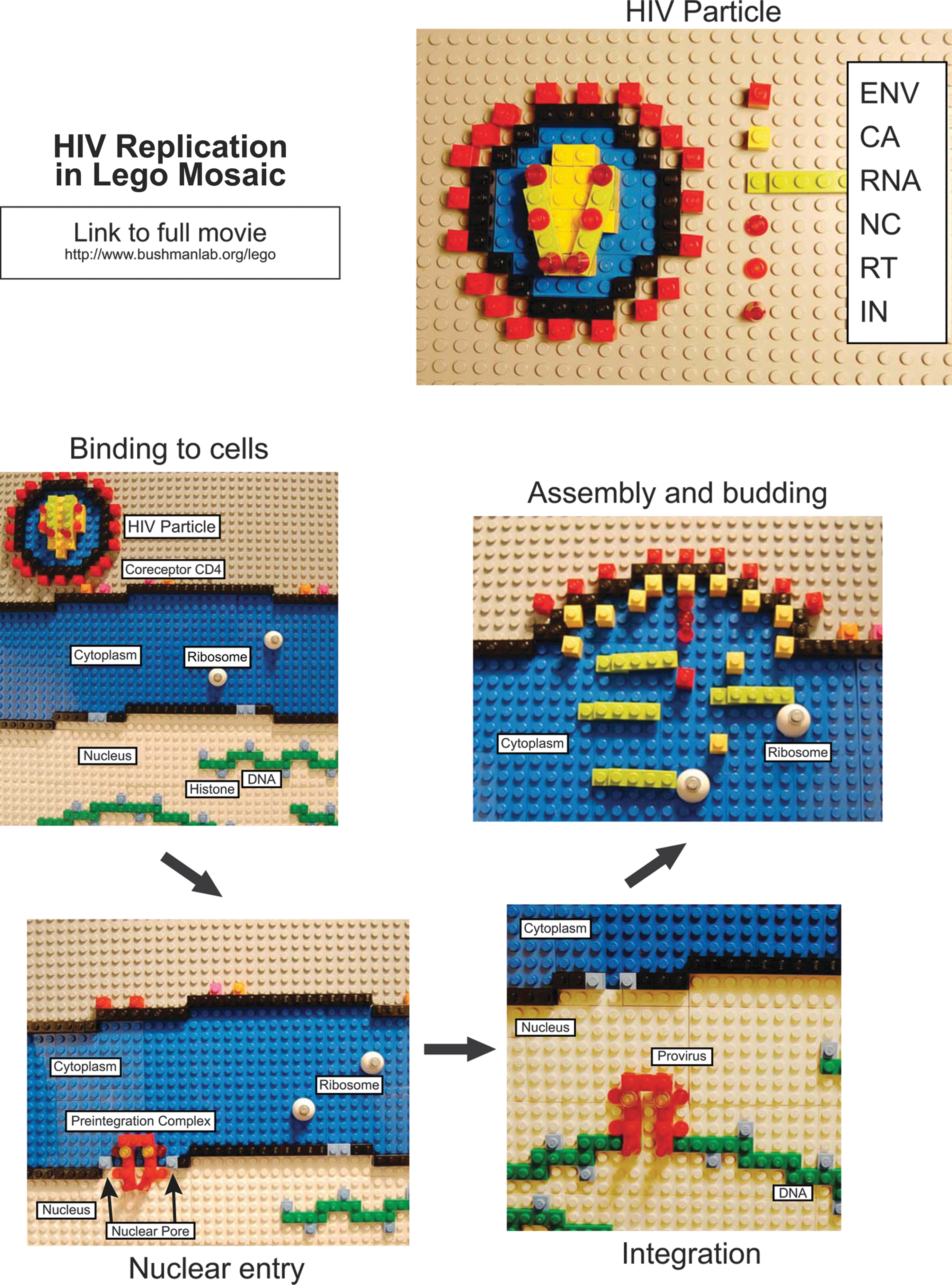
In an effort to interest children and adolescents in learning more about HIV, we have created a description of the HIV replication cycle in LEGO mosaic. Figure 1 summarizes the replication cycle, and a stop-action movie version can be seen at www.bushmanlab.org/lego. The hope is to draw in children and adolescents, and maybe adults, with interesting visuals and jumpy music, with a goal of motivating further investigation of the subject. More information targeted at children, adolescents, and adults learning about HIV/AIDS for the first time can be found in the following links: www.cdc.gov/hiv/risk/age/youth/index.html, www.aidsinfo.nih.gov/education-materials, www.aidsmap.com/, and http://hivsystemsbiology.org/wiki/index.php/Introduction.
The image shows the HIV replication cycle, illustrated in LEGO mosaic. A full movie in stop action LEGO can be viewed at www.bushmanlab.org/lego. The video displays how the HIV virus binds to cells, how preintegration complexes enter the nucleus, how HIV DNA becomes integrated into human DNA, and how HIV particles assemble. The movie was made using frames made of LEGO pieces, which were rearranged in between photos. The video was made to explain the process to younger children, and also as a way to generate interest in the topic.
Footnotes
Author Disclosure Statement
No competing financial interests exist.
References
1.
RyanCA, ConlySR, StantonDL, and HasenNS: Prevention of sexually transmitted HIV infections through the President's Emergency Plan for AIDS Relief: A history of achievements and lessons learned. J Acquir Immune Defic Syndr, 2012; 60(Suppl 3):S70–77.
2.
MavedzengeSN, LueckeE, and RossDA: Effective approaches for programming to reduce adolescent vulnerability to HIV infection, HIV risk, and HIV-related morbidity and mortality: A systematic review of systematic reviews. J Acquir Immune Defic Syndr, 2014; 66(Suppl 2):S154–169.
3.
RoxbyAC, UngerJA, SlykerJA, et al.: A lifecycle approach to HIV prevention in African women and children. Curr HIV/AIDS Rep, 2014; 11(2):119–127.
4.
BushmanFD, BartonS, BaileyA, et al.: Bringing it all together: Big data and HIV research. AIDS, 2013; 27(5):835–838.