




Abstract

U
We generated a simian human immunodeficiency virus (SHIV)-based replication-defective lentivector DNA vaccine whose antigen expression was driven by the 5′ CAEV LTR and found that this DNA vaccine induces potent immune responses both in mice and macaques. 3 To augment the immunogenicity we engineered a novel nonintegrative one-cycle SHIV-based lentivector vaccine driven by both 5′ and 3′ LTRs of CAEV (Fig. 1). This vaccine was designed to be delivered as DNA whose expression in in vivo-transfected cells produces viral proteins used either directly as antigen for immune stimulation or for assembly into released virions, and also used as another source of antigen or in mature infectious virions that infect only target cells without integration of the vaccine genome to amplify the vaccine's antigen further. This design synergizes the advantages of both DNA and live-attenuated vaccines but lacks their associated inconvenience.
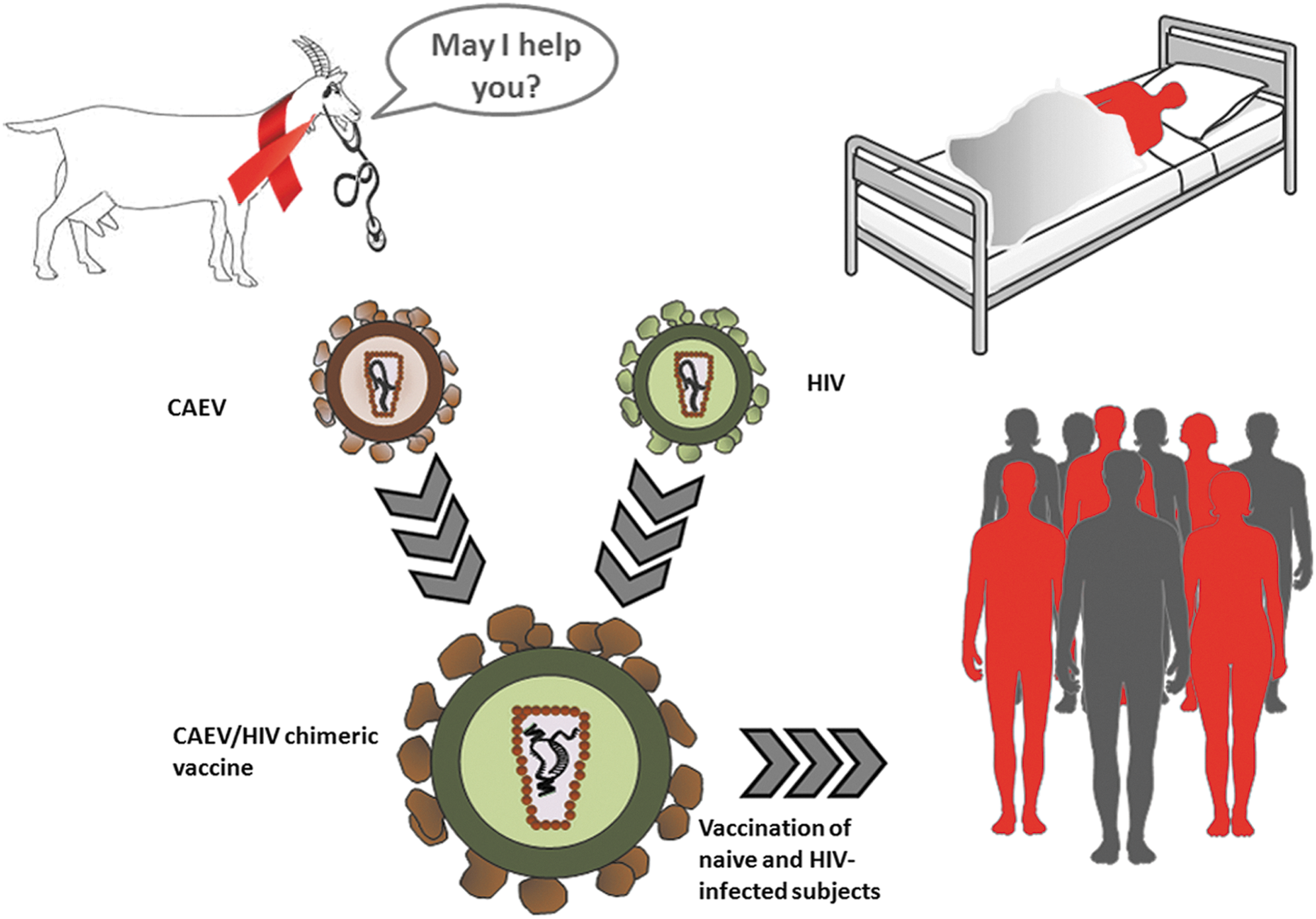
Development of a caprine arthritis encephalitis virus (CAEV)/HIV chimera as an anti-HIV vaccine for humans. The naturally attenuated genome of CAEV is used as a source to isolate key sequences to generate a CAEV/HIV chimeric genome used as a lentivector DNA vaccine. The latter is used to immunize HIV-free (prophylactic) or HIV-infected individuals (therapeutic).
This novel lentivector vaccine was found to be highly immunogenic in PBL hu-SCID mice and induced potent and persistent CD4+ and CD8+ T cells in macaques immunized with a single dose (5 mg) of DNA in the absence of any boost. T cell responses contained effector, memory effector, and central and stem memory T cells with a high recall capacity. Antibody to the major capsid Gag and Env proteins was also repeatedly detected. 4 Repeated low-dose challenge of vaccine and control animals with the heterologous highly pathogenic SIVmac251 showed efficient control of virus replication in all (6/6) vaccinated macaques. The absence of vaccine-induced neutralizing antibody responses resulted in a lack of protection against virus acquisition.
These data clearly demonstrate that CAEV may provide key elements in the design of safe and efficacious HIV vaccine prototypes for the protection of human populations. The recent findings in the development of HIV broadly neutralizing antibodies with increased breadth and potency in immunized Llamas may provide winning anti-HIV vaccine combination strategies against virus replication and acquisition as well.
Footnotes
Acknowledgments
We thank the National Institutes of Health AIDS Research and Reference Reagent Program for providing HIV and SIV overlapping peptides, DNA constructs and cell lines. We thank the Agence Nationale de Recherche sur le SIDA (ANRS), EU Marie Curie, the Institut National de la Recherche Agronomique (INRA), and University Joseph Fourier for supporting this work.
Author Disclosure Statement
No competing financial interests exist.