




Abstract
We report a unique HIV-1 recombinant strain (URF) from an HIV-positive man who has sex with men (MSM) in Beijing, China. This virus genome has insertions and multiple drug-resistant mutations to both nucleoside reverse transcriptase inhibitors (NRTIs) and nonnucleoside reverse transcriptase inhibitors (NNRTIs), as well as a complex intersubtype recombinant structure with 11 breakpoints. Phylogenetic analysis of the near full-length genome (NFLG) shows that this URF is comprised of gene regions originating from three circulating viral strains: CRF01_AE, subtype B, and subtype C. The parental CRF01_AE regions of the recombinant cluster with a previously described cluster 4 sublineage of CRF01_AE. The B regions of the recombinant cluster within the B (United States–European origin) subtype and the three subtype C regions cluster with a strain detected in China in 1998. The detection and characterization of this complex drug-resistant URF indicate an ongoing generation of recombinant strains among MSM, and will help to provide insight into our understanding of the dynamics and complexity of the HIV-1 epidemic in China.
HIV-1
The number of reported HIV infections has been increasing rapidly among men who have sex with men (MSM) in China in recent years, especially in large and medium sized cities. Of note, the origins of the HIV-1 strains circulating among MSM are remarkable complex. Three predominant strains (subtype B, CRF01_AE, and CRF07_BC) and many other lineages and sublineages of HIV-1 strains are cocirculating together. Two new CRFs (CRF55_01B and CRF59_01B) and many URFs have been characterized among MSM in this population. 2
As the largest city in China, Beijing becomes a microcosm of the HIV-1 epidemic among MSM in China. The prevalence of HIV among MSM in Beijing increased from 3.1% in 2002 to 7.8% in 2010, 3 which is much higher than that found in most of the other cities in China (1.3–1.6%). 4 –6 The HIV-1 genotype distribution among MSM in Beijing was first studied in 2005–2006. 7 Subtype B was predominant among MSM (71.1%), followed by CRF01_AE (24.4%) and CRF07_BC (4.4%). Surveys that followed have shown that subtype B infections decreased to 41.9% in 2007 and to 30.8% in 2010. In contrast, CRF01_AE increased from 3.7% in 2005 to 56.0% in 2010 and CRF07_BC increased from <5% in 2005 to 12.6% in 2010. 8 The cocirculation of viruses from different subtypes and/or CRFs in the same region and risk groups fosters the emergence of new intersubtype recombinant strains. 9 In the present study, a novel near full-length genome (NFLG) sequence of an HIV-1 URF consisting of gene regions from CRF01_AE and subtypes B and C has been characterized in Beijing MSM.
This sample was collected from an MSM Beijing resident in September 2014. He was diagnosed as HIV-1 positive in April 2014 and began highly active antiretroviral therapy (HAART) 2 months later. RNA was exacted and then the NFLGs were amplified as we have done previously. 10 –12 Because of the short time (3 months) between the start of therapy and obtaining this sample for sequencing, we believe the patient was infected with a drug-resistant strain rather than believing that drug resistance arose in this short period of time in this patient. The patient's viral load was 15,600 copies/ml at the time of sampling, and this in part motivated the sequencing of his virus. The positive polymerase chain reaction (PCR) products were purified by the QIAquick Gel Extraction Kit (QIAGEN, Germany) and sequenced by an ABI 3730XL sequencer using BigDye terminators (Applied Biosystems, Foster City, CA). The sequenced data were cleaned and assembled with Sequencher v.4.9 (Gene Codes, Ann Arbor, MI). To avoid possible cross-contamination events, the NFLG was queried against all sequences obtained in the laboratory.
The NFLG sequence was then aligned against standard Los Alamos National Laboratory (
In the phylogenetic tree reconstructed with NFLG reference sequences, the URF clustered with a 01BC recombinant URF reference sequence sampling from Anhui province in 2011 with bootstrap value (86%) (Fig. 1).
16
Rip, Bootscan, and similarity plot analysis of the NFLG sequence show a very complex mosaic structure composed of six CRF01_AE fragments arranged with three B and C intervals (Fig. 2). The breakpoints of the NFLG sequence are described as follows (Supplementary Fig. S1; Supplementary Data are available online at
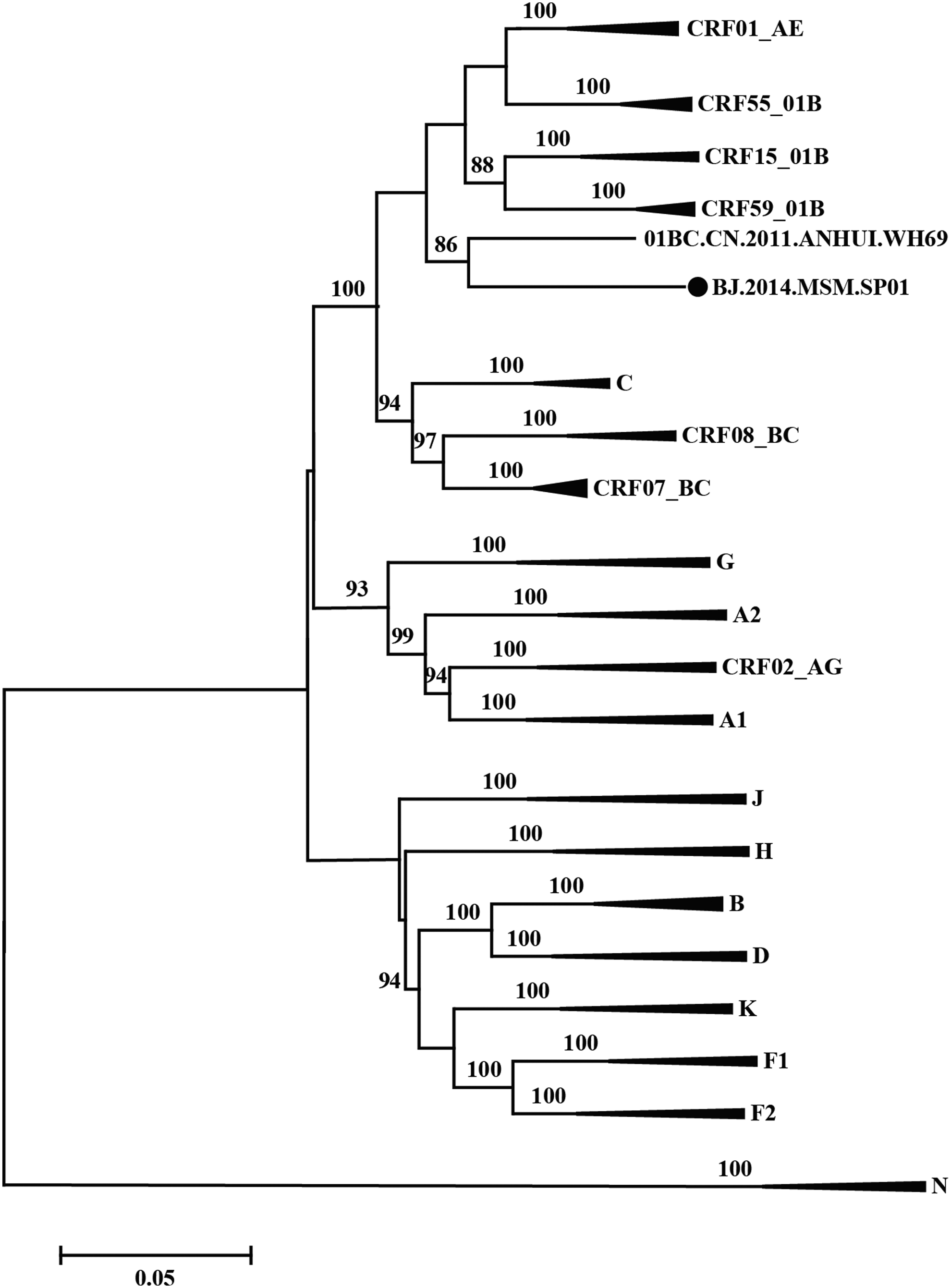
A neighbor-joining phylogenetic tree of BJ.2014.MSM.SP01 with reference sequences constructed using MEGA 6.06. A solid circle (●) marks BJ.2014.MSM.SP01 throughout the article. The stability of each node was assessed by bootstrap analyses with 1,000 replicates and only significant bootstrap values of 70% or greater are shown at the corresponding nodes. The scale bar represents 5% genetic distance.
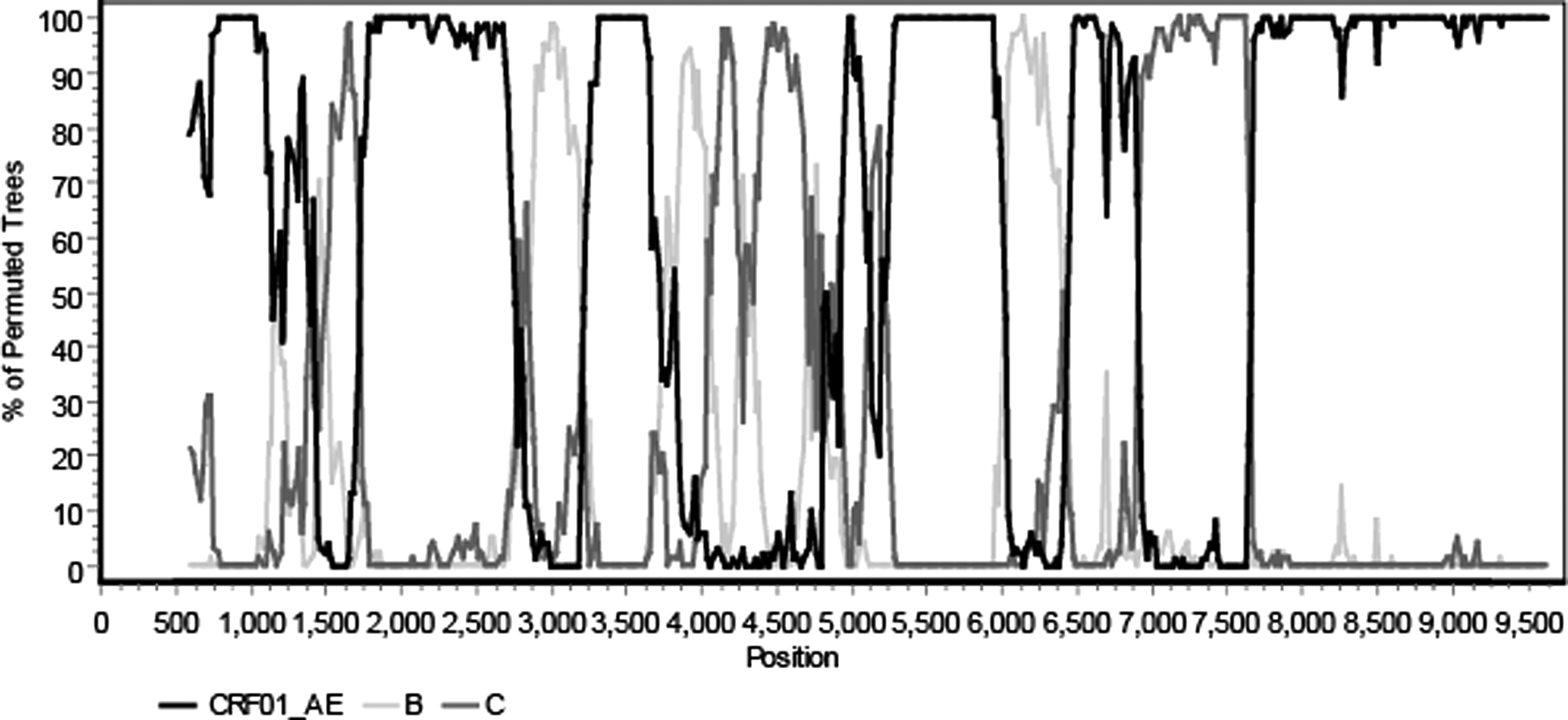
Bootscan analysis was performed using CRF01_AE, B, and C reference sequences. The bootscan window was 300 bp with a step size of 10 bp using SimPlot 3.5.1 software. The x-axis is the nucleotide position in the HIV genomic sequence; the y-axis indicates the percentage supporting the clustering with reference sequences.

The recombinant mapper results of BJ.2014.MSM.SP01. The schematic structure was created using the Recombinant HIV-1 Drawing Tool (
The mosaic structure of the recombinant genome is distinct from Anhui URF and any other known CRF or URF. Analysis of the subregion phylogenetic trees confirms the breakpoints described above and indicates that the parental origin of all CRF01_AE regions of the NFLG derived from the MSM-related CRF01_AE cluster 4 lineage, which is circulating primarily among MSM in Beijing 17 (Supplementary Fig. S1). The subtype B regions clustered with B (United States–European origin) reference sequences and the three subtype C regions clustered with the strain that was detected in China in 1998 among injection drug users (IDUs). 18
Multiple drug-resistant mutations were identified in this NFLG based on the Stanford HIV Drug Resistance Database (
The multiple drug resistance and recombination indicate the importance of this sample. The identification of this sample prompts us to pay more attention to the transmission of these new recombined strains. Increasing genetic diversity is a characteristic of HIV-1, resulting from both the accumulation of point mutations and recombination. HIV-1 recombination is an ongoing event and can significantly contribute to the epidemic in different regions. 19 –23 URFs are not strains of epidemic importance, but they hold the potential to enter high-risk transmission networks and become new CRFs. It is also of importance to note that recombination requires coinfection or superinfection of viral strains within an individual. Our detection found this NFLG had complicated breakpoints and insertions. In addition, multiple drug resistance to nucleoside reverse transcriptase inhibitors (NRTIs) and nonnucleoside reverse transcriptase inhibitors (NNRTIs) is also illustrated in it. To our knowledge, what we detected (CRF01_AE/B/C) is a novel HIV-1 recombinant in MSM in Beijing, China. Both acquired and transmitted drug resistance of such a complicated URF necessitate more attention and further research.
Sequence Data
The NFLG sequence of BJ.2014.MSM.SP01 has been deposited in GenBank with accession number KP668994.
Footnotes
Acknowledgments
This study was supported by Chinese National Science and Technology Major Projects for Infectious Diseases Control and Prevention (2012ZX1001-002) and National Natural Science Foundation of China (81273136, 81471962). The funders had no role in the study design, data collection and analysis, decision to publish, or preparation of the manuscript.
Author Disclosure Statement
No competing financial interests exist.
References
Supplementary Material
Please find the following supplemental material available below.
For Open Access articles published under a Creative Commons License, all supplemental material carries the same license as the article it is associated with.
For non-Open Access articles published, all supplemental material carries a non-exclusive license, and permission requests for re-use of supplemental material or any part of supplemental material shall be sent directly to the copyright owner as specified in the copyright notice associated with the article.
