




Abstract
TRIM5α is an antiviral factor that can greatly limit HIV-1 infection. Although several researchers have investigated whether TRIM5α H43Y polymorphism influences the risk of HIV-1 infection, no definite conclusion has ever been drawn. In this research, we performed a meta-analysis to generate a more robust estimate of the association between TRIM5α H43Y and susceptibility to HIV-1 infection. In total, six studies including 1,713 HIV-1 patients and 1,814 controls were included. TRIM5α H43Y polymorphisms of all individuals were genotyped. Odds ratios (ORs) with 95% confidence intervals were presented as the result of analysis. ORs for the main analysis were 0.82 (95% CI: 0.63–1.08) in the allelic comparison, 0.57 (95% CI: 0.34–0.95) in the homozygote comparison, 0.82 (95% CI: 0.57–1.16) in the dominant model, and 0.56 (95% CI: 0.33–0.93) in the recessive model. In the subgroup analysis by ethnicity, significantly decreased risks of infection were detected in the Asian population (homozygote comparison: 0.50, 95% CI: 0.28–0.89; recessive model: 0.49, 95% CI: 0.28–0.87), whereas such effects were not observed in the non-Asian population. Our meta-analysis indicates that TRIM5α H43Y polymorphism is associated with a decreased risk of HIV-1 infection in the homozygote comparison and recessive model. This polymorphism may act as a protective factor against HIV-1 infection, especially in Asians.
Introduction
R
This discovery has attracted wide attention even though TRIM5α in human cells was not as effective as in monkey cells. 2 The difference is considered to be generated by different single nucleotide polymorphisms (SNPs). The genetic variations may influence the antiviral function of TRIM5α. Yap et al. reported that a single amino acid substitution (R332P) in human TRIM5α can confer the ability to restrict HIV-1 infection. 8
Another amino acid variation associated with the susceptibility of HIV-1 is H43Y. It has been reported that H43Y impairs TRIM5α restriction of HIV-1 in vitro. 9 However, researchers have found contradictory results when investigating the association between this polymorphism and HIV-1 susceptibility in vivo. One study reported that H43Y had no effect on the susceptibility to HIV-1 resulting from the fact that there was no significant difference in frequency of genotype between HIV-1-infected subjects and exposed seronegatives (ES). 10 Van Manen et al. later found that the homozygote of 43Y is correlated with an accelerated disease progression of HIV-1. 11 In 2010, a group reported that H43Y might account for the resistance of HIV-1 in Chinese injection drug users (IDUs). 12
Obviously, no definite conclusion can be drawn among these studies concerning the association between TRIM5α H43Y and susceptibility to HIV-1 infection. Therefore, we performed this meta-analysis of eligible studies to explore a more robust estimate of the association.
Materials and Methods
Literature research
Literature studies were screened through Google Scholar (GS), PubMed, and ISI Web of Knowledge up to January 2015, using the key words “TRIM5,” “H43Y,” and “HIV-1” in various combinations. Titles and abstracts were reviewed to estimate the relevance of investigations. Full texts of the primary selected literature were downloaded for further evaluation. The references in these literature studies were manually searched for potential related investigation.
Inclusion and exclusion criteria
Literature studies were included under the following criteria: (1) case-control studies reporting the association of TRIM5α and susceptibility to HIV-1 infection, (2) distribution of the TRIM5α H43Y genotype between the cohorts, and (3) published in English.
The major exclusion criteria were (1) insufficient data, (2) reviews, and (3) duplication of previous studies.
Data extraction
The eligible literature studies were identified through inclusion and exclusion criteria. The following information was extracted from the eligible studies: authors, year of publication, country of study population, ethnicity, sample size, method of TRIM5α H43Y genotyping, and distribution of the TRIM5α H43Y genotype in cases and controls.
Statistical analysis
Crude ORs with 95% CIs were calculated to assess the association of TRIM5α H43Y and susceptibility to HIV-1 infection. The pooled ORs were respectively calculated in four genetic models: the allelic comparison (Y vs. H), homozygote comparison (YY vs. HH), dominant model (YY + HY vs. HH), and recessive model (YY vs. HH + HY). Analyses of stratified groups were performed according to the source and ethnicity of the controls. A chi-square-based Q-test was carried out to assess heterogeneity across studies. 13 Comparison with p-value less than 0.10 was used to denote statistical significance. A fixed effects (Mantel and Haenszel) model was used to pool the effects of studies without heterogeneity 14 ; otherwise the random effects (Dersirmonian and Laird) model was applied. 15 Publication bias was evaluated by Egger's and Begg's tests with visual inspection of funnel plots and was considered significant if p < 0.05. 16,17 One-way sensitivity analyses were performed to examine the influence of individual studies on meta-analysis results. 18 All statistical analyses were performed using Stata version 14.0 (StataCorp, College Station, TX).
Results
Study selection process and characteristics
Figure 1 summarizes the selection process of the literature. Sixty-eight relevant articles were identified by searching PubMed, the ISI Web of Knowledge, and Google Scholar. After screening the titles and/or abstracts, 45 articles were excluded; the full texts of the remaining articles were obtained for further analysis. During the further analysis (full-text screening), 11 articles were excluded because they were reviews or reports, four articles were excluded due to improper controls, and three articles were excluded because they lacked extractable data. Finally, five articles 10,12,19 –21 (including six studies) involving 1,713 HIV-1-infected patients and 1,814 HIV-1 uninfected healthy donors were included in the meta-analysis. The study sample size ranged from 200 to 1,293. The study characteristics of the six eligible studies are summarized in Table 1. The distribution of TRIM5α H43Y among subjects is shown in Table 2. Four studies included the highly exposed seronegative (HESN) controls, while three studies included healthy controls. To increase the sample size and the power of the meta-analysis, both of them were included in the meta-analysis.

Flow diagram of the meta-analysis.
African American.
African American.
HESN, highly exposed seronegative.
Meta-analysis results
After the data from the six studies were pooled into a meta-analysis, the results were presented in a homozygote comparison (OR = 0.57, 95% CI: 0.34–0.95, p = 0.899 for heterogeneity) (Fig. 2A), in an allelic comparison (OR = 0.82, 95% CI: 0.63–1.08, p = 0.039 for heterogeneity, by random effects model) (Fig. 2B), in a recessive model (OR = 0.56, 95% CI: 0.33–0.93, p = 0.896 for heterogeneity) (Fig. 2C), and in a dominant model (OR = 0.82, 95% CI: 0.57–1.16, p = 0.008 for heterogeneity, by random effects model) (Fig. 2D). No publication bias was observed in any genetic model for total population according to the funnel plot (Fig. 3) and Begg's test. Sensitivity analysis was conducted to examine the influence of individual datasets on the pooled OR. The pooled OR of any genetic model in the total population was not substantially altered in the sensitivity analysis (data not shown).
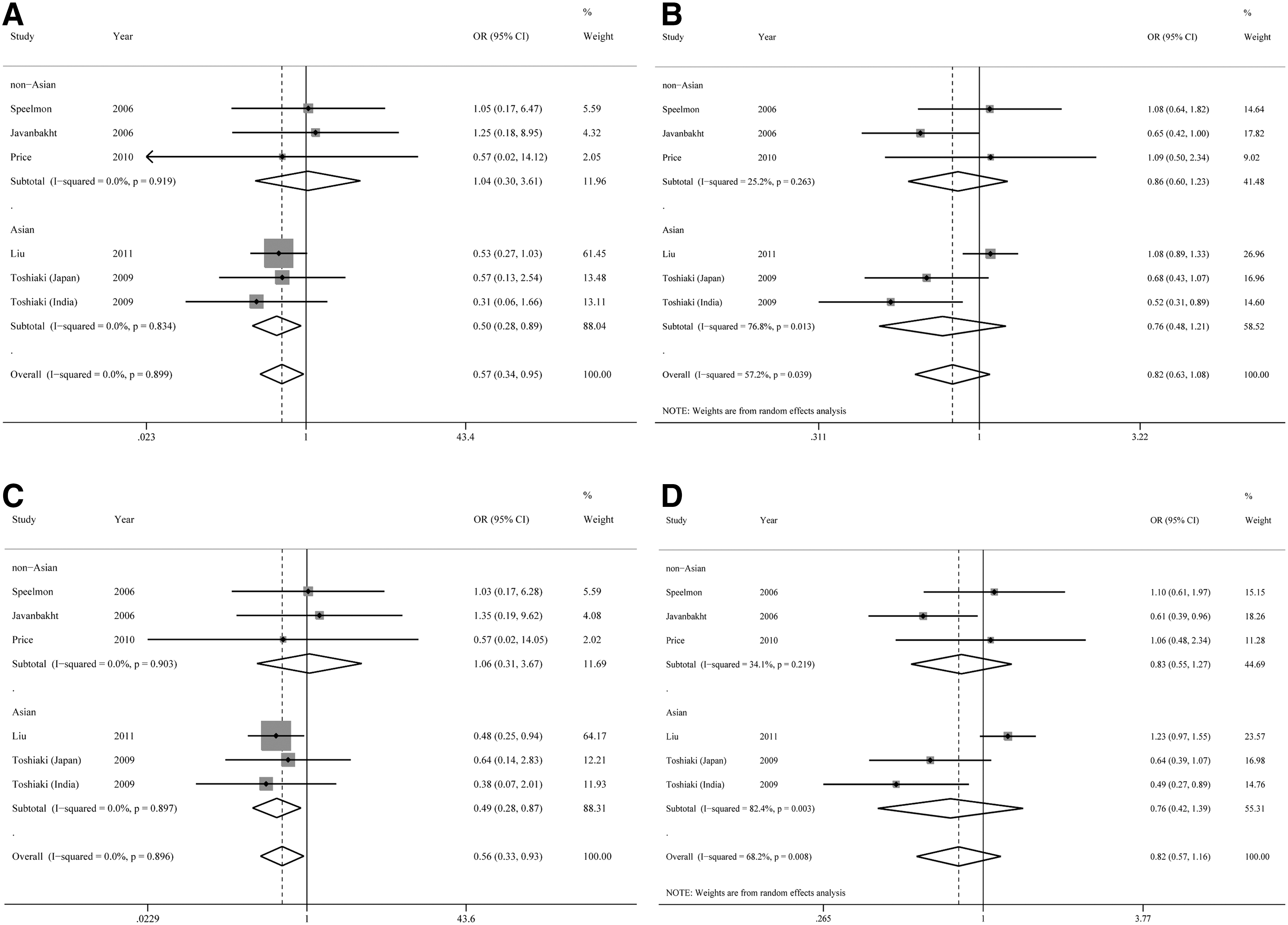
Forest plots of the relationship between TRIM5α H43Y polymorphism and HIV-1 infection using

Funnel plots to detect publication bias in the meta-analysis.
Stratified analysis results
Stratified analyses were performed by the division of controls and ethnicity. The results are shown in Table 3 and in Supplementary Table S1 (Supplementary Data are available online at
Number of comparison.
p value of Q-test for heterogeneity test.
The bold values indicate a significant association.
HESN, highly exposed seronegative.
Sensitivity analyses and Egger's tests were not performed for subgroups because the small number of included studies decreased the power of the tests.
Discussion
Meta-analysis provides a powerful method to synthesize information from independent studies with a similar target. 22 Considering that a number of studies investigating the association between TRIM5α H43Y polymorphism and susceptibility to HIV-1 infection have generated conflicting results, we performed this meta-analysis involving six eligible studies with 1,713 cases and 1,814 controls. The results suggest a significant association between TRIM5α H43Y polymorphism and susceptibility to HIV-1 infection in the total population, primarily in the homozygote comparison and recessive model. It is possible that H43Y is a recessive variation that exerts a protective effect against HIV-1 infection only in homozygous individuals.
In the subgroup of HESNs, H43Y polymorphism showed a protective effect against HIV-1 infection only in the recessive model. This result was in accordance with that in the total population. But in the subgroup of healthy controls, H43Y polymorphism showed a protective effect in the allelic comparison and dominant model, which was contradictory to the result showed in the total population. However, this result may be unreliable as the protective effect of this gene could not be fully manifest in healthy subjects unexposed to HIV-1. In addition, the size of the healthy controls subgroup was relatively smaller than other subgroups.
The result from the Asian population subgroup was in accord with that of the total population, while the result of the non-Asian population subgroup suggested no significant association between TRIM5α H43Y polymorphism and susceptibility to HIV-1 infection in any genetic model. This indicates that H43Y exerts a significant protective effect in Asian people, while no significant effect was observed in the non-Asian population. The negative result may be due to the heterogeneity in the non-Asian population, which consists of European American (EA), African American (AA), and African populations. We grouped the EA, AA, and African individuals into the non-Asian population due to a lack of samples.
H43Y lies in the RING domain of TRIM5α, which has E3 ubiquitin ligase activity. In cooperation with the E2 enzymes, E3 can attach ubiquitin to TRIM5α. 23 Ubiquitination of TRIM5 promotes the proteasome-dependent degradation of itself, contributing to the short half-life of this protein. 24 It has been demonstrated that E3 ubiquitin ligase activity has a role in HIV-1 restriction by TRIM5α. 25 –27 But HIV-1 restriction activity has been identified in the absence of the RING domain, which has E3 activity. 26,28 Similarly, mutations of the Zn-coordinating Cys residues in the RING motif that abolish E3 ligase activity do not abolish TRIM5α restriction of HIV-1. 2 In addition, disrupting the proteasome function does not prevent the restriction by TRIM5α. 29 These findings suggest that proteasome-dependent degradation is not the only pathway leading to HIV-1 restriction. The RING domain variant H43Y may impair E3 ubiquitin ligase activity of TRIM5α. 9 On the one hand, impaired E3 ubiquitin ligase activity may decrease the degradation of the HIV-1 capsid and alleviate restriction to some extent. On the other hand, it may reduce the self-ubiquitination of TRIM5α, resulting in decreased degradation of TRIM5α and increased concentration of this antiviral factor in the cytoplasm. Because of these two possible contrary consequences of impaired E3 ubiquitin ligase activity, it is reasonable that the results from different studies are inconsistent. 30 –32 Thus, we need to perform a meta-analysis of all studies to provide a more robust result and to confirm which consequence is dominant in vivo.
However, our present analysis found that the H43Y polymorphism has a protective effect on HIV-1 infection. The two contrary mechanisms mentioned above might account for this association. Impaired E3 ubiquitin ligase activity induced by H43Y disrupts the proteasome-dependent degradation of the HIV-1 capsid, but TRIM5α could inhibit other key steps of the HIV-1 life cycle, such as trafficking of the viral core, nuclear entry, and integration. Degradation of TRIM5α is also decreased due to impaired E3 activity and high expression of human TRIM5α is associated with reduced susceptibility to HIV-1. 33 Overall, in spite of the slightly decreasing activity of TRIM5α, variant H43Y may strengthen HIV-1 restriction through increased expression of TRIM5α.
There are two other factors that might contribute to the observed protective effect of the H43Y polymorphism on HIV-1 infection. One is that the H43Y polymorphism may have negative selective pressure on HIV-1-infected subjects. Van Manen et al. observed an accelerated disease progression for individuals who were homozygous for the 43Y. 11 Thus, we can infer that the frequency of 43Y in the infected population might be decreased due to the death caused by the accelerated disease progression. However, this negative selective pressure may be limited, because no significant difference in the H43Y minor allele frequencies was observed between the HIV-1-seropositive individuals and the healthy controls in their study. The other is that the H43Y polymorphism may not decrease susceptibility to HIV-1 infection but it is associated with some factors that could decrease susceptibility to HIV-1 infection. For example, the H43Y polymorphism may influence the interaction between TRIM5α and cyclophilin A (Cyp A). Cyp A can enhance the anti-HIV-1 activity of TRIM5α, especially some TRIM5α mutants. 34 In addition, the H43Y polymorphism may have linkage disequilibrium (LD) with alleles in intron 1 of TRIM5alpha, which could regulate TRIM5alpha expression. 35
There are a number of limitations to our meta-analysis. First, the articles involved in our study were limited to those published in English and therefore some other studies published in non-English languages may have been neglected. Furthermore, sensitivity analyses and Egger's tests were not powerful for subgroups due to the small sample size. Therefore, additional studies with the recruitment of larger populations from other specific regions are required to evaluate the publication bias and the sensitivity of subgroups. Lastly, susceptibility to HIV-1 is probably influenced by other factors, which may have an impact on our analysis, but we did not have enough data to eliminate these interfering factors.
In conclusion, our results suggest that the TRIM5α H43Y polymorphism has a significant effect in protection against HIV-1 infection primarily in the homozygote comparison and recessive model. Moreover, this protective effect is significant in Asian populations, but is not identified in non-Asian populations. Hence, our findings can provide greater understanding of the association between the TRIM5α H43Y polymorphism and susceptibility to HIV-1 infection.
Footnotes
Acknowledgments
This work is supported by the National Grand Program on Key Infectious Disease (2014ZX10001003).
Author Disclosure Statement
No competing financial interests exist.
References
Supplementary Material
Please find the following supplemental material available below.
For Open Access articles published under a Creative Commons License, all supplemental material carries the same license as the article it is associated with.
For non-Open Access articles published, all supplemental material carries a non-exclusive license, and permission requests for re-use of supplemental material or any part of supplemental material shall be sent directly to the copyright owner as specified in the copyright notice associated with the article.
