




Abstract

L
Plasmacytoid dendritic cells (pDCs) are the major source of type I interferon following HIV infection and largely contribute to the reduction of viral spread. 2 pDCs express the principal receptor for HIV-1 (CD4) as well as the two coreceptors (CXCR4 and CCR5). Surprisingly, pDCs poorly replicate human immunodeficiency virus type 1 (HIV-1), and no more than 5% of pDCs cultured in vitro with HIV become productively infected. 3 Under HIV activation, pDCs migrate from blood to lymphoid tissues where they produce high levels of type I interferon (IFN). We thus explored whether pDCs could form MGCs in vitro with high titers of HIV proteins.
We show here using confocal microscopy that purified pDCs from uninfected healthy donors (HD) cultured in the presence of HIV-1 form MGCs in vitro. Purified pDCs were cultured overnight with HIV-1 and stained with DAPI (nucleus) and anti-p24 antibodies (green). Among the 50,000 cells in culture we found several multinuclear cells in a “bicycle wheel” shape. This very specific and recognizable formation can be detected in experiments using purified pDCs and HIV virions.
In Fig. 1, we show a giant cell with three nuclei that is grabbing a fourth one. The number of cells in these formations grows over time in a “snowball effect.” We observed up to 15 cells forming the MGC.
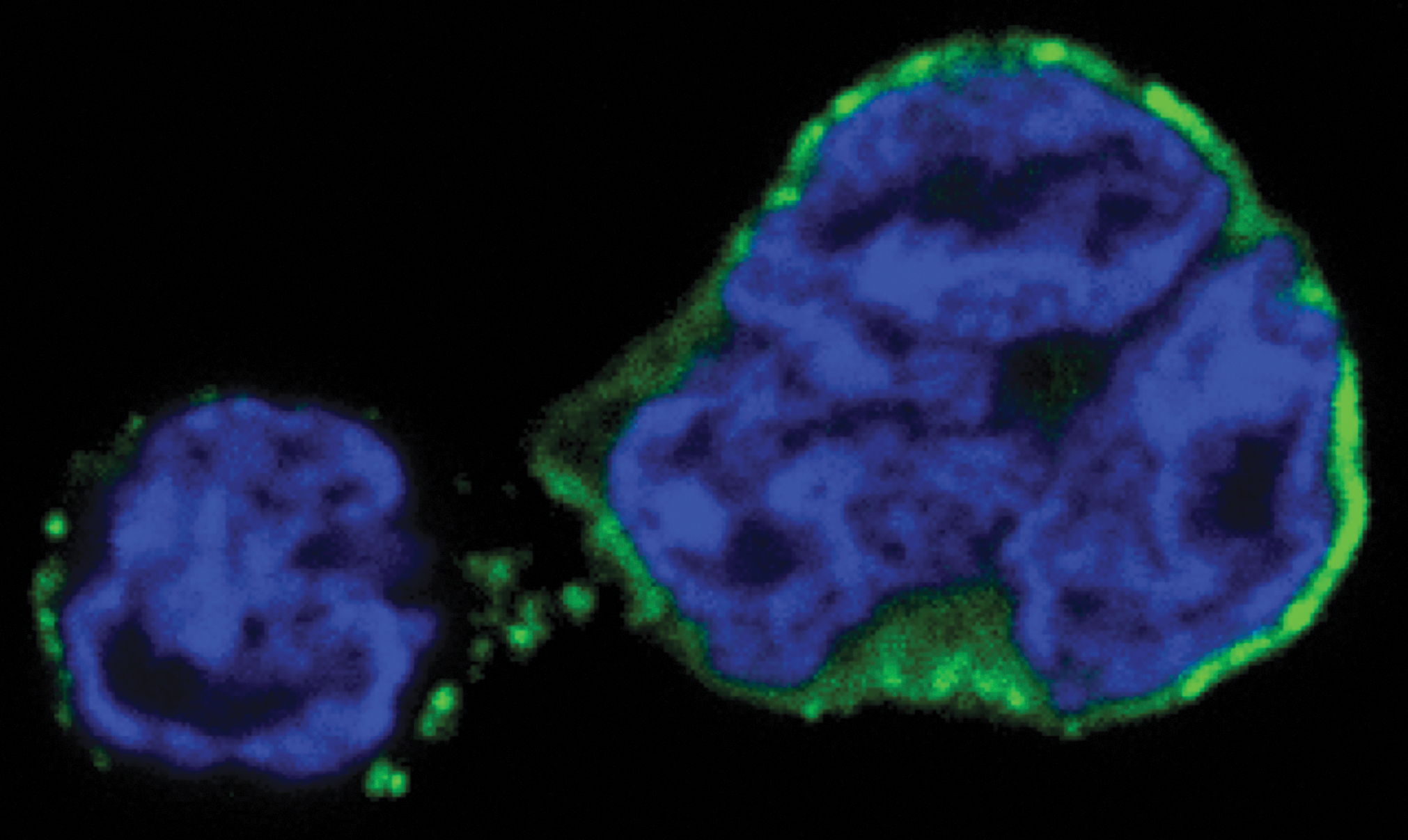
Transformation of plasmacytoid dendritic cells (pDCs) into giant multinuclear cells (MGCs) by HIV-1. Human pDCs purified from healthy donors were cultured overnight in the presence of HIV. pDCs were stained with antibodies against HIV protein p24 (green) and with DAPI (blue). Cells were acquired using a confocal microscope. Analysis was performed using ImageJ software.
Our findings show that in addition to monocytes and macrophages, pDCs could form, at least in vitro, multinuclear giant cells containing high levels of p24 HIV proteins. Furthermore, the in vivo mechanism of giant cell formation by pDCs is not characterized yet, and we will further investigate whether giant cells are productively infected by HIV. In vitro assays showed that pDCs poorly replicate HIV; however, we can speculate that giant cells may represent the fraction of HIV-infected pDCs.
Footnotes
Author Disclosure Statement
No competing financial interests exist.