




Abstract
We previously reported a high prevalence of HIV-1 infection in Warao Amerindians from Venezuela due to the rapid spread of a single B subtype strain. In this study we evaluated the coreceptor use of the HIV-1 strains infecting this Amerindian community. Sequences of the HIV-1 V3 loop from 56 plasma samples were genotyped for coreceptor use. An extremely high frequency of CXCR4 strains was found among HIV-1-infecting Waraos (47/49, 96%), compared to HIV-1 strains infecting the non-Amerindian Venezuelan population (35/79, 44%, p < 0.00001). Evolutionary analysis showed that a significant number of infections occurred between 1 and 12 months before collection and that a great proportion (50–70%) of HIV-1 transmissions occurred within the very early phase of infection (≤12 months). This is consistent with an initial infection dominated by an X4 strain or a very rapid selection of X4 variants after infection. This Amerindian population also exhibits the highest prevalence of tuberculosis in Venezuela, being synergistically bad prognostic factors for the evolution of morbidity and mortality in this vulnerable population.
A
During the HIV-1 cycle, the envelope (Env) virus protein interacts with the CD4 receptor and CCR5 (R5) and/or CXCR4 (X4) coreceptors on the cell. This later interaction triggers membrane fusion, one of the most critical steps in cell infection. 5 The R5 viruses can infect macrophages, T-lymphocytes, monocytes, and peripheral blood mononuclear cells (PBMCs) but not T cells lines, whereas X4 viruses can infect T-lymphocytes, T cell lines, but not monocytes and macrophages. 6 R5 strains are selected in primary infection through sexual transmission 7 and during the course of the infection around 50% of the patients gradually switch to X4. This molecular switch has also been related to a worse clinical prognosis. 6 The aim of this study was to evaluate HIV-1 coreceptor use of subtype B viral strains infecting Warao Amerindians.
The study and sanitary conditions of this population
2,4,8
were previously described. The V3 loop of the env gene was amplified from plasma samples of 49 HIV-1-positive Warao Amerindians collected in 2009 (n = 7) and 2011 (n = 42), as previously described.
9
Env sequences from Warao Amerindians were compared to those from 79 HIV-1 strains infecting previously described non-Amerindian patients from Venezuela.
10
Coreceptor use was determined by the Geno2Pheno algorithm (
Analysis was performed using the GTR + I + Γ4 nucleotide substitution model, a prior Bayesian Skyline coalescent tree, 14 and an uncorrelated log normal relaxed molecular clock model 15 with an informative substitution rate prior to the env fragment (4.0 × 10⁻³–10.0 × 10⁻³ substitution/site/year). The MCMC chain was run for 20 × 106 generations and adequate chain mixing was checked, after excluding an initial 10%, by calculating the effective sample size (ESS) using the TRACER v.1.6 program. 16 The env maximum clade credibility (MCC) tree was summarized from the posterior distribution of trees with Tree Annotator and visualized with FigTree v.1.3.1. 17 Mean estimates of the number of HIV-1 pol and env lineages through time (LTT) and 95% highest probability density (HPD) interval of the estimates were inspected using Tracer v.1.6.
Nucleotide sequence data have been deposited into the GenBank database under accession numbers KR094009–KR094065. Env sequences used for comparison are included within the accession numbers FJ659197–FJ659409.
Analysis of the results of Geno2pheno for coreceptor use in each sample indicates that the prevalence of X4 strains in the HIV-1-infected Warao Amerindians was 96% (47/49), compared to 44% in non-Amerindian Venezuelans (35/79) (p < 0.00001). When the Geno2pheno algorithm's cut-off was modified to 10% or 5%, the X4 prevalence in the Warao population still remained significantly higher (p < 0.001) than in non-Amerindian Venezuelans (data not shown). Two hypotheses could explain the extremely high prevalence of HIV-1 strains with X4 use in the Warao population: (1) an initial infection of the individuals with X4 HIV-1 strains; or (2) rapid intrahost R5-X4 switches in nearly all individuals.
To estimate the intrahost evolutionary period of HIV-1 subtype B infections in Warao Amerindians, a time-scaled phylogeny from the env sequences was reconstructed and compared to that previously obtained from pol sequences. 2 This analysis revealed that many patients harboring X4 viruses shared most recent common ancestors that traced back to only between 1 and 12 months before the collection date (Fig. 1A and B). Analysis of the proportion of the total number of LTT present in pol and env HIV-1 phylogenies also supports the recent origin of some X4 lineages, showing that between 10% and 35% of the viral lineages emerged after 2009 (Fig. 1C and D). Thus, a significant proportion of the Warao Amerindians carrying X4 HIV-1 strains was probably infected between 1 and 24 months before the date of sampling.
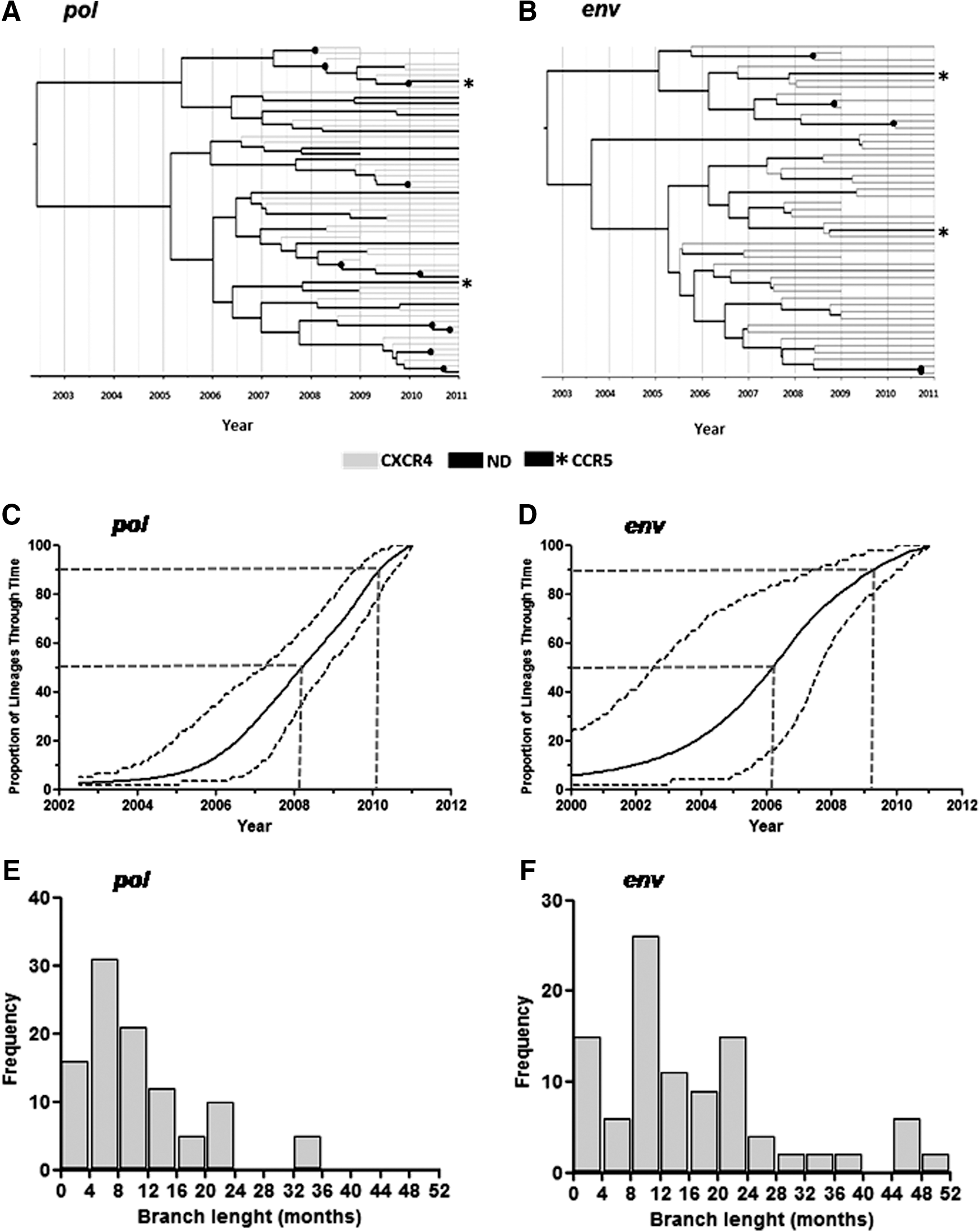
Time scaled phylogenies of HIV-1 subtype B in Waraos Amerindians.
Because each HIV-1 sequence from the Warao population was obtained from a different patient, maximum estimates of the time between transmissions could be deduced from the analysis of the overall distribution of internode intervals of time-scaled pol and env phylogenies. 18,19 According to the pol/env phylogenies, the median time between transmissions in the Warao population was estimated at 8.4/17.6 months of infection with 16%/15%, 47%/21%, and 68%/47% of transmissions occurring within 4, 8, and 12 months of infection, respectively (Fig. 1E and F). Thus, a great proportion (50–70%) of HIV-1 transmissions in the Warao population occurred within the very early (≤12 months) phase of infection.
The transmission intervals estimated for the Warao Amerindians (8–18 months) were similar to the one estimated for networks of men having sex with men (MSM) in London (14 months), 18 and were much lower than that estimated for transmission networks of heterosexual individuals in the United Kingdom (22–32 months). 19 This suggests that despite the great differences in the network sizes between MSM populations in London and the Warao Amerindian populations, the rate of viral transmission was remarkably similar in both populations. Notably, a significantly higher HIV-1 prevalence was found among males (15.6%) compared to females (2.6%) in the Warao population, supporting the hypothesis of the importance of homosexual/bisexual practices for HIV-1 subtype B spread among Warao Amerindians. 3 Other risk practices that may contribute to the fast spread of HIV such as tattooing have not been described in Warao tribes (J. Villalba and W. Werner, personal communication), while intravenous drug use was admitted by only one HIV patient. While hepatitis B virus (HBV) infection is common in Warao Amerindians, hepatitis C virus (HCV) infection has not been detected yet (F.H. Pujol, personal communication).
Differences in the median time scale of pol and env phylogenies have probably resulted from the larger interval of the env substitution rate (4.0 × 10³–10.0 × 10⁻³ substitution/site/year) compared to that previously used for pol (1.5 × 10⁻³–2.5 × 10⁻³ substitution/site/year). 2 Because the temporal information contained in the sequence data was low, the estimated time of the most recent common ancestor of the pol time-scaled phylogeny (2002: 1998–2005) was much more precise than that of the env time-scaled phylogeny (1999: 1989–2004). The credibility interval of both estimated, however, displayed a significant overlap (1998–2004) and should not be considered as significantly different. Additionally, the different number of patients included in pol (n = 59) and env (n = 49 patients) analysis may also explain the differences in the median proportion of the total number of LTT and maximum estimates of the time between transmissions inferred from both data sets.
Despite those differences, both pol and env analyses clearly point to very short intrahost evolutionary times and short HIV transmission intervals in Warao Amerindians, thus supporting the notion that the large proportion of HIV-1 X4 viruses observed in this population most probably resulted from the rapid transmission of X4 viruses, rather than from the recurrent intrahost switch from R5 to X4 viruses.
Additional data that may support this hypothesis came from the analysis of the sequences of the V3 loop of this population, where two amino acid signatures were found in positions 11 and 21. Serine in position 11 was conserved and histidine (H) in position 21 was conserved in all but two sequences (w49 and w14) (Supplementary Data; Supplementary Data are available online at
In summary, the devastating HIV-1 epidemic in Warao Amerindians is accompanied by an extremely high prevalence of X4 strains, very short HIV transmission intervals, a high prevalence of tuberculosis, and limited access to antiretroviral therapy and overall health care. 8 These factors combined could have important implications in accelerating the time to reach the AIDS stage and greatly reducing the life span of HIV-infected Warao individuals. This evidence points to the need for urgent intervention to control the spread of the disease in this isolated and vulnerable Amerindian population.
Footnotes
Acknowledgment
This work was supported by grant G-2012000822 by PEI-FONACIT, Venezuela
Author Disclosure Statement
No competing financial interests exist.
References
Supplementary Material
Please find the following supplemental material available below.
For Open Access articles published under a Creative Commons License, all supplemental material carries the same license as the article it is associated with.
For non-Open Access articles published, all supplemental material carries a non-exclusive license, and permission requests for re-use of supplemental material or any part of supplemental material shall be sent directly to the copyright owner as specified in the copyright notice associated with the article.
