




Abstract
HIV-1 CRF07_BC became prevalent in Taiwan after the epidemic among injection drug users (IDUs). We describe a unique recombinant form (URF) consisting of CRF01_AE and CRF07_BC (named URF_0107-H8) genes detected from an IDU. The 8.8 kb near full-length genome of URF_0107-H8 had a CRF01_AE backbone with two CRF07_BC fragments in the reverse transcriptase and integrase region [RT-Int; HXB2 nucleotide (nt) positions 2942–4709] and within the envelop (nt 8467–8722) gene. Phylogenetic analyses revealed that its 1.8 kb RT-Int sequence clustered with those of CRF07_BC strains from Taiwan, while sequences of CRF01_AE portions were more similar to those of Central African origin than contemporaneous CRF01_AE isolates in Taiwan or prevalent in East or Southeast Asia. Recombination breakpoints and phylogenetic relationships of URF_0107-H8 were different from those of CRF01_AE/CRF07_BC URFs previously reported from China. This highlighted the importance of continual monitoring of genetic evolution of HIV strains and the emergence of new recombinants.
T
Written informed consents (IRB HR95-80) were obtained from HIV patients at the National Cheng Kung University Hospital (NCKUH), the largest medical center and a designated HIV-AIDS treatment hospital in Tainan, Taiwan. Patients were recruited for the sequence analysis of antiretroviral (ARV)-associated drug resistance mutations in the protease (PR) gene and the first 250 a.a. of the RT gene.
3
Nucleotide (nt) and a.a. positions were referred to the HXB2. ARV resistance was analyzed using algorithms by the Stanford HIV drug resistance database and the International Antiviral Society. HIV-1 subtype was determined using the Los Alamos HIV database (
Patient TN08H8 was a 33-year-old male IDU that first tested positive for HIV-1 in a local hospital in August 2005 and was later referred to the NCKUH Infectious Disease Clinic. His viral loads and CD4 counts ranged between 104 and 1.4 × 10⁵ copies/ml and 429 and 754 cells/mm, 3 respectively, before September 2006 when he was transferred to another HIV-designated hospital in central Taiwan due to job relocation. When he returned to NCKUH in November 2007, his viral load was 6 × 10⁵ copies/ml and CD4 counts were 310 cells/mm3. Patient TN08H8 had never travelled abroad nor did he manage his drug injection behaviors. Analyses of a 1.8 kb HIV-1 Gag–Pol sequence using his plasma in November 2007 revealed a possible recombination between 01AE and 07BC in the RT region. Because his CD4 counts at the first diagnosis were not low, we suspected that he might have been first infected with 07BC and superinfected with 01AE. To examine that, HIV-1 sequence analyses were performed for plasma from other time points; samples collected in August 2006 and early 2008 before ARV therapy were available. An 8.8 kb near full-length genome (NFLG) of URF_0107-H8 was obtained from editing and assembling five fragments of 0.7–4.2 kb with 100–400 bp of overlaps and it corresponded to nt 699–9531 of HXB2. Using his plasma collected in 2006, we obtained amplicons from the Gag, PR-RT, integrase (Int), Vif, and Vpr genes that shared 98.1%–99.2% nt sequence homology with corresponding regions of the URF_0107 strain from his plasma after November 2007. This suggested that the URF_0107 was already in patient TN08H8 as early as August 2006, and we were unable to determine if the source was due to a superinfection or coinfection or from another person.
In our previous experiments to characterize viral replication difference among major HIV-1 subtypes in Taiwan, we cloned a 4.2 kb continuous coding sequence from the 3′ half of Gag-capsid (CA) up to the 5′ half of Vpr (nt 1514–5782) from few HIV patients during the same period as the patient TN08H8, including two with 01AE strains (TN08H73 and TN08H51, both reported heterosexual risks) and two with 07BC strains (TN08H60 and TN09H192, both IDUs). 3 The 4.2 kb sequence of URF_0107-H8 strain was a 01AE backbone with a 1.8 kb 07BC sequence in the 3′ half of RT and the 5′ half of Int, but lacked p6Δ7 (30-PIDKELY-36) present in most of 07BC isolates in Taiwan. The 4.2 kb coding sequences of these patients' strains were investigated within the context of the prototype B pNL4.3 in the transfection and infection experiments, and the clone of URF_0107-H8 displayed virion production levels similar to that of the 01AE-H73 and significantly higher than two 07BC clones. 3 Our in vitro results suggested that the native URF_0107-H8 strain would have a higher replication rate than 07BC strains, which was consistent with findings that the median time for CD4 counts falling below 350 cells/mm3 was 74.3 months among patients with 07BC strains, longer than 27 months for patient TN08H8. 5
The intersubtype mosaic pattern of URF_0107-H8 was examined using programs such as boot-scanning, SimPlot, and jumping profile Hidden Markov Model (jpHMM;
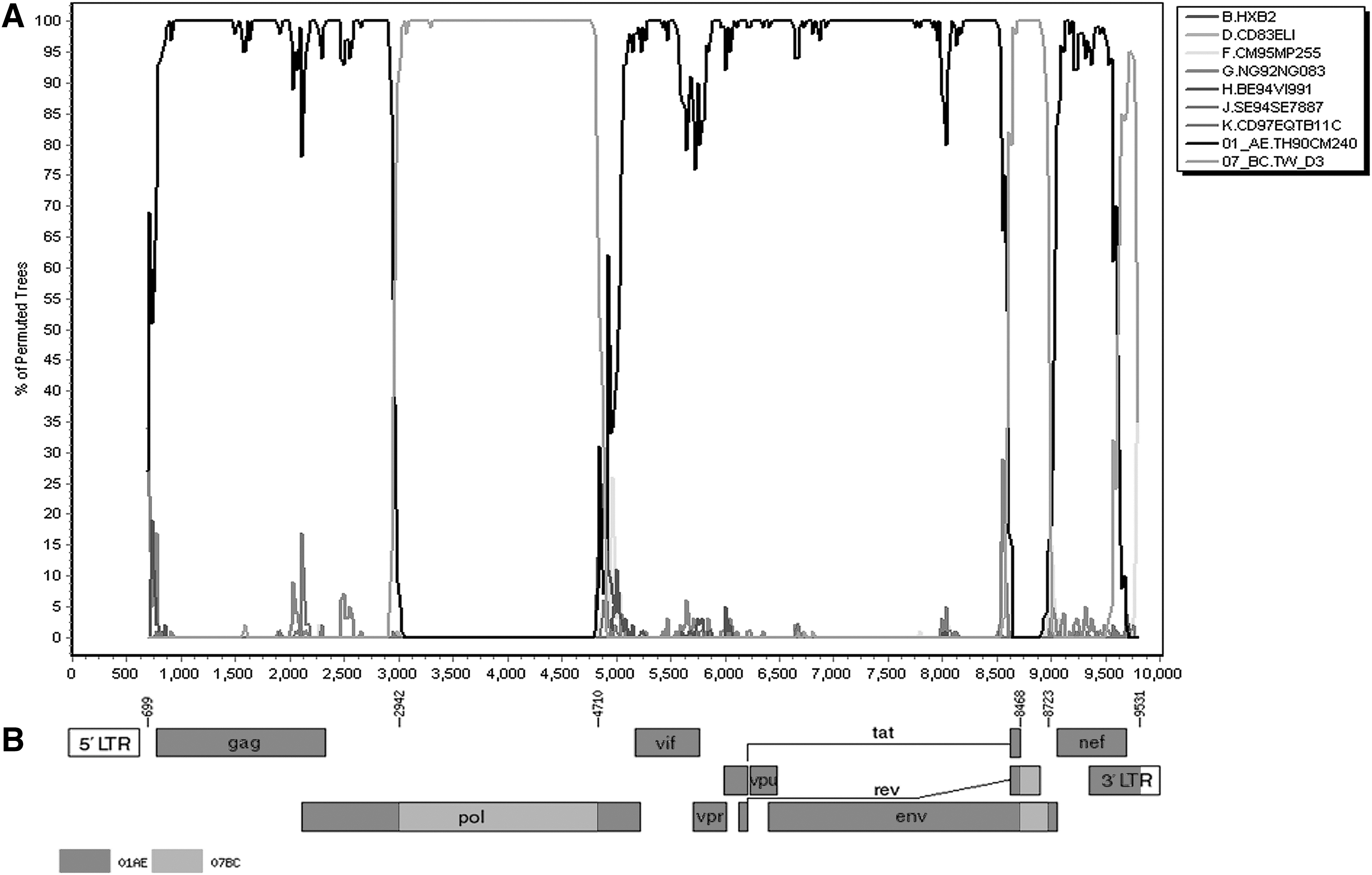
The genetic composition of the NFLG of a novel URF strain between CRF01_AE and CRF07_BC, TN08H8, from Taiwan.
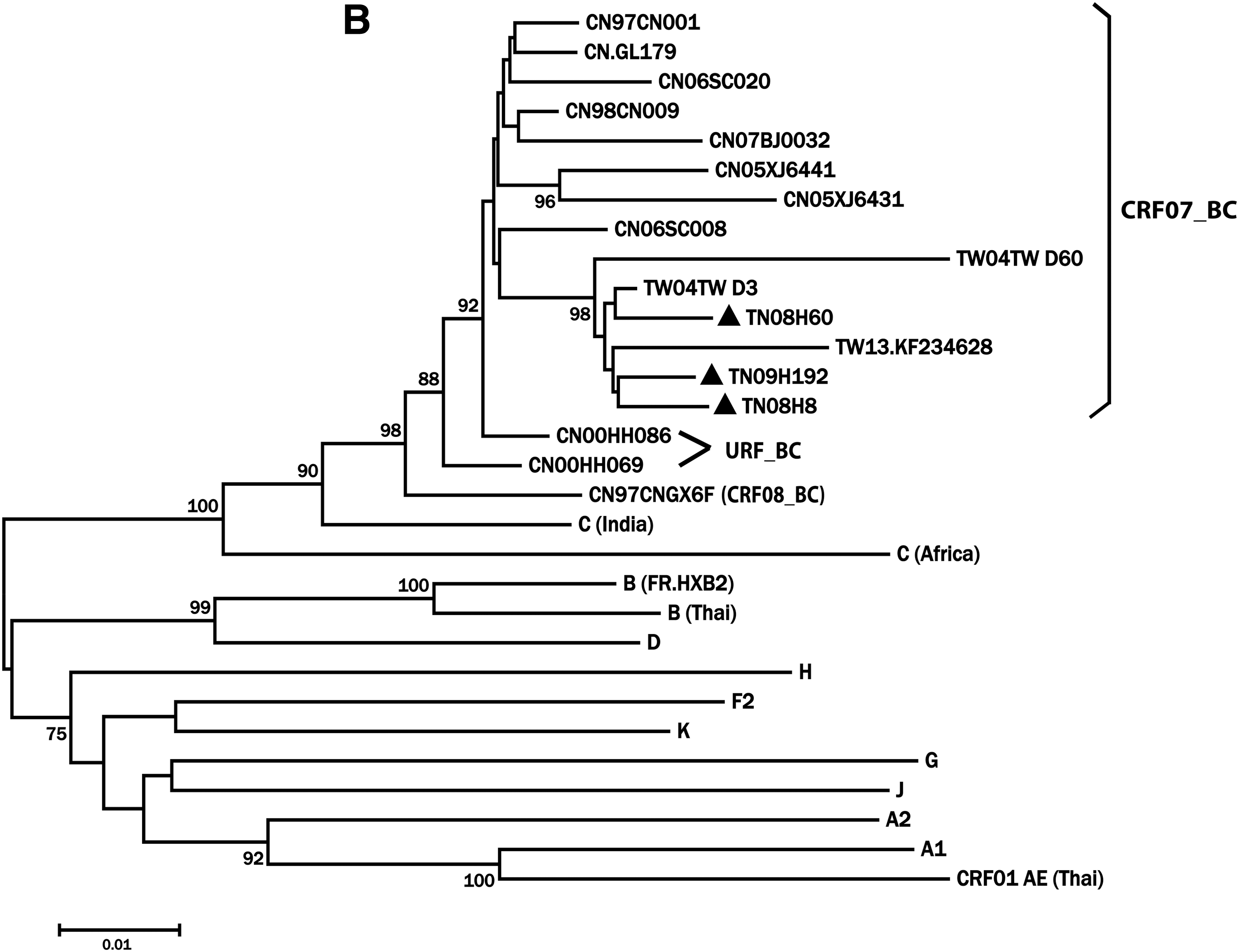
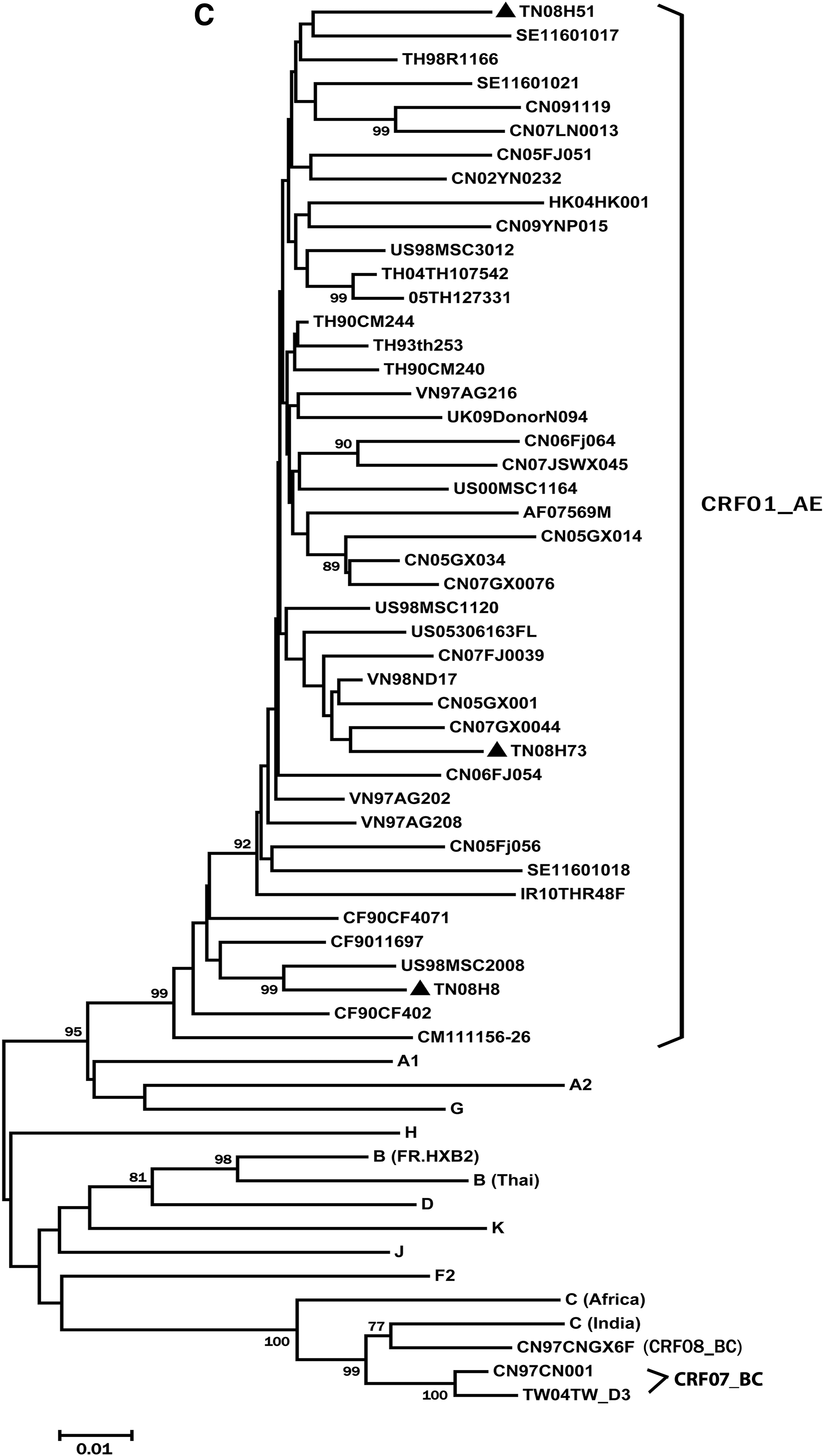
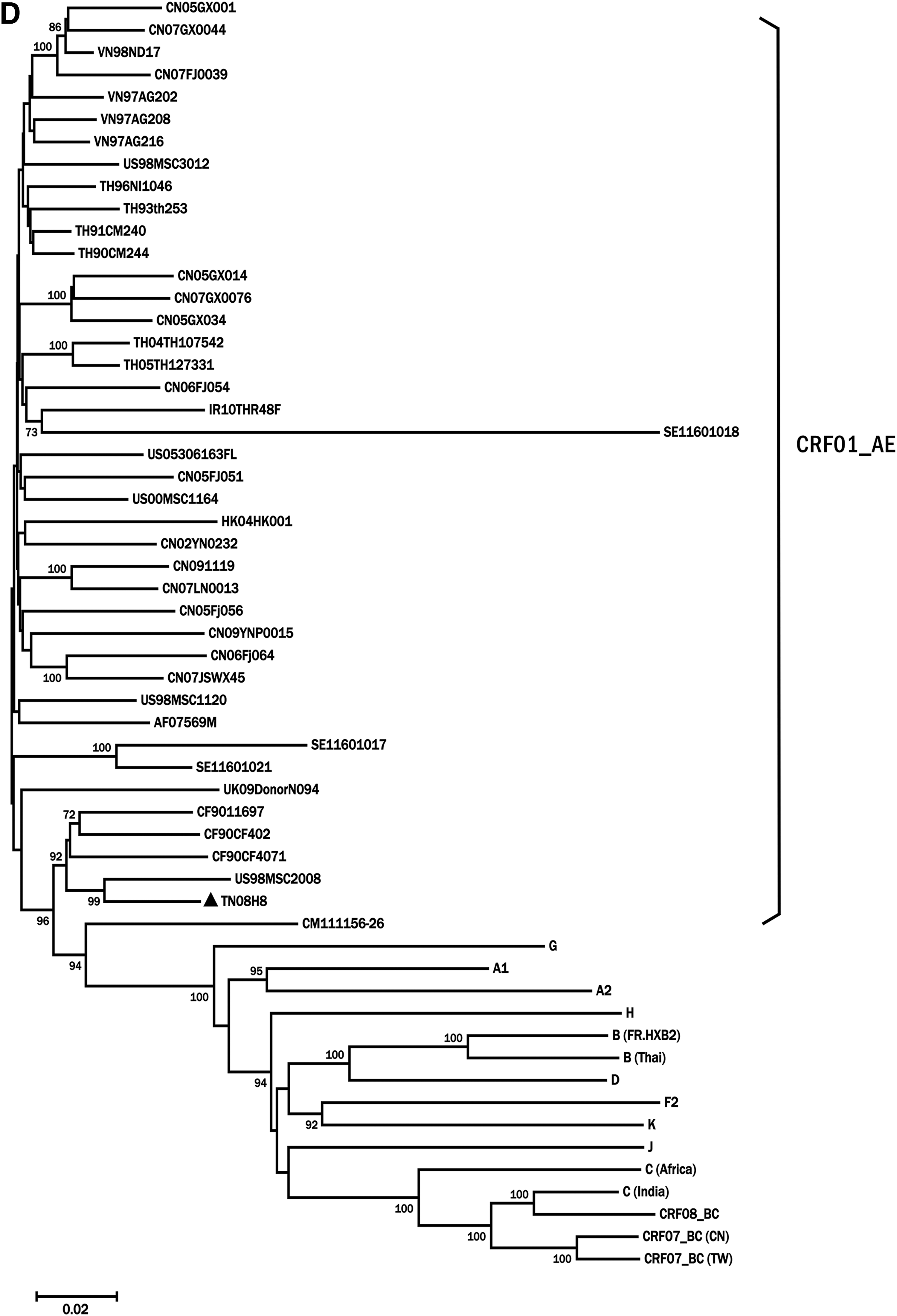
The 1.8 kb RT-Int fragment of URF_0107-H8 diverged from the 07BC strains in China and clustered with those from Taiwan (bootstrap value = 98), including TN08H60 and TN09H192 detected in Tainan (Fig. 2B). This observation agreed with the previous finding that most 07BC isolates in Taiwan were related to a lineage likely introduced through IDUs from China around 2000. 18 Phylogenetic analyses of 01AE fragments of URF_0107-H8 and two 01AE strains from Tainan revealed three different genetic origins (Fig. 2A, C, D). These portions of URF_0107-H8 formed branches (bootstrap values ≥89) with the “98US.MSC2008” strain, which was transmitted in the Philippines, but was more closely related to strains of the Central African origin than to 01AE lineages prevalent in Asia. 17 TN08H73 clustered within a tentative 01AE subclade that was mainly detected among IDUs from northern Vietnam and Guangxi, China. 13 TN08H51 was genetically related to some strains detected in southeast coastal China (Fujian), Thailand, or Sweden; the Swedish reported the HIV-1 acquisition in Thailand. 16,19 Overall, recombination breakpoints and phylogenetic relatedness of gene fragments indicated that the URF_0107-H8 was distinct from the 01AE/07BC URFs previously reported from China, likely being generated in Taiwan. 6 –10
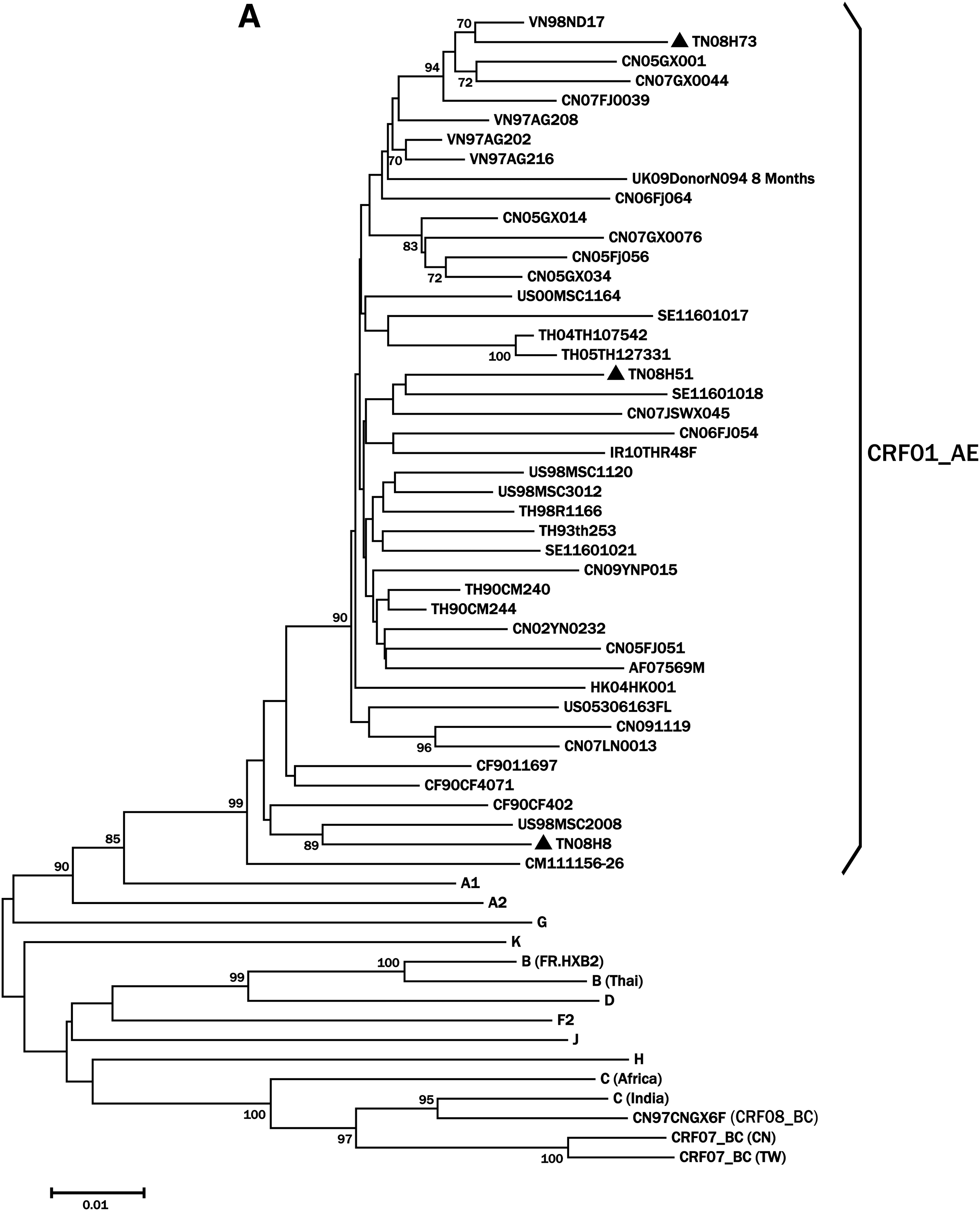
Phylogenetic analyses of the URF_0107-TN08H8 from Taiwan, for four gene regions along with sequences from contemporaneous local strains, representative strains of CRF01_AE (01AE), CRF07_BC (07BC), CRF08_BC (08BC), unique BC recombinant, and HIV-1 M subtype references from GenBank. Phylogenetic trees were constructed using MEGA 6 neighbor-joining methods with 1,000 replicates; numbers at nodes denoted bootstrap values >70; and scale bars represented percentages of genetic distance. Reference strains in figures
In Taiwan, 01AE had been detected in <10% of HIV cases in the last decade and was mostly associated with heterosexual transmission and occasionally found in IDUs. 1,2 Phylogenetic studies conducted in China had identified several tentative lineages and independent introductions of 01AE strains, and we now found three lineages of 01AE strains (or backbone strains) in Taiwan, similar to the findings in China. 14,20,21 The epidemic of 01AE in China has increased over the past decade: a nationwide survey in 2006 showed that this subtype accounted for 28% of new HIV patients and was present in substantial percentage of cases associated with sexual transmission and in IDUs; then in a study among men who had sex with men, 2009–2011, it comprised 62% of the HIV infected. 20,22 The broad geographic distribution and populations infected with 01AE may have facilitated the generation of several URFs and CRFs involving this subtype in China and the Southeast Asia, with some of the recombinants becoming prevalent in the area. 23 –25 Due to intense traffic communications with these areas, Taiwan should be watching out for the emergence of these new recombinants.
The percentage of HIV cases with novel recombinant forms may be higher than what we observed here with limited numbers of patients. Coinfections of 07BC and B′ had been detected in 4% of newly HIV-diagnosed individuals in Taiwan between 2005 and 2008, although recombinant forms between these two had not been reported yet. 2 Around the same period, we detected URF in 1 out of 120 patients and it had recombination breakpoint(s) in the RT region that we sequenced. Now, our in-house ARV genotypic resistance tests are extended to include the Int gene, thereby increasing the likelihood of detecting possible URFs. In Taiwan, HIV sequence analyses for treatment-naive patients primarily focused on parts of the Pol gene that was related to ARV resistance and were done on a selective basis. 1 More frequent surveillance designed to examine HIV-1 subtype distributions and associated genetic relationships, preferentially covering several or larger gene regions, should be conducted to rapidly identify new CRFs or URFs that may potentially give rise to a new epidemic in at-risk populations.
Sequence Data
The NFLG of TN08H8 and the 4.2 kb sequence of TN08H51, TN08H73, TN08H60, and TN09H192 have been deposited in GenBank with accession numbers KT372798 and KT372794–KT372797.
Footnotes
Acknowledgments
The authors thank physicians and medical staff of the Infectious Disease Division, National Cheng Kung University Hospital. This work was supported by National Health Research Institute intramural funding to F.-C.T.
Author Disclosure Statement
No competing financial interests exist.