




Abstract
The effects of antiretroviral therapy (ART) on the performance of HIV incidence assays have been well documented. To improve upon current assay approaches or focus the development of future assays, studies are needed to characterize the effects of ART on all candidate HIV incidence assays. In this study, we compared the performance of three antibody avidity-based HIV incidence assays, the Limiting Antigen (LAg), Bio-Rad Avidity, and HIV-1 Multiplex assays, using a well-defined cohort of recent HIV-1 seroconverters composed of ART-naive HIV-1-infected individuals and those who received ART early or delayed in the course of infection. Differences in the performance of all three avidity-based incidence assays were noted with study subjects who received ART. The LAg assay and Multiplex total antibody measurements (nMFI) exhibited similar kinetics in reactivity, as these assays tended to fluctuate with changes in viral load. In the early ART group, all seven subjects remained recent by both assays at time points >1 year postseroconversion, and assay values declined dramatically postdelayed ART initiation. In contrast, the two-well, antibody-dissociation avidity assays, Bio-Rad Avidity and Multiplex avidity index (AI) measurements, continued to mature in the early ART group, although blunted relative to the ART-naive group, and assay values remained stable after delayed ART initiation. In summary, although the HIV incidence assays evaluated in this study are all designed to measure antibody avidity, each assay is affected differently by ART-induced virus suppression, presumably because of the distinct assay formats and procedures for measuring avidity.
H
All serology-based HIV incidence assays are subject to some degree of misclassification, typically because of innate immune variation, differences in HIV-1 subtypes, and prolonged use of antiretroviral therapy (ART). 9 To date, we have limited knowledge of the dynamics of HIV incidence assay performance in the presence of ART and whether virus suppression alone is responsible for increased false-recent rates (FRRs). Studies are also needed to elucidate the specific effects of ART initiation and viral load (VL) suppression on the immunologic parameters measured by HIV incidence assays and to determine whether different assay approaches are affected in distinct ways. In this study, we compared the performance of three HIV incidence assays, the HIV-1 Limiting Antigen (LAg)-Avidity EIA (Sedia Biosciences Corporation, Portland, OR; Maxim Biomedical, Inc., Rockville, MD), Bio-Rad Avidity, 6 and HIV-1 Multiplex assays, 7 using a well-defined cohort of recent HIV-1 seroconverters. The cohort is composed of HIV-1-infected individuals who fall into one of three groups: ART naive, early initiation of ART, and delayed initiation of ART. The effects of ART use on the performance of these assays were assessed in relation to VL.
Longitudinal HIV seroconversion panels were collected as part of the Seroconversion Incidence Panel Project (SIPP) in collaboration with SeraCare Life Sciences, Inc. (Milford, MA). The specimen collection protocol and characteristics of the cohort have been described in detail elsewhere. 10 The cohort consists of specimens from 19 HIV-1 recent seroconverters, with total follow-up time ranging from 189 to 989 days (median = 699 days). According to medical records, seven subjects (76 specimens) were ART naive during the entire sample collection period, seven subjects (82 specimens) received ART within the first 6 months of seroconversion (“early ART”; median = 64.5 days), and five subjects (60 specimens) initiated ART >6 months postseroconversion (“delayed ART”; median = 488.5 days). An estimated date of seroconversion was defined as the midpoint between the last negative HIV antibody test and first positive antibody test.
The Sedia HIV-1 LAg-Avidity EIA was performed according to the manufacturer's instructions (Sedia Biosciences Corporation). All specimens with a normalized optical density (ODn) ≤2.0 were subjected to confirmatory testing. Specimens that yielded an ODn ≤1.5 during the confirmatory testing were considered recent infections. The Bio-Rad Avidity assay is based on the Genetic Systems HIV-1/HIV-2 PLUS O EIA (Bio-Rad Laboratories, Hercules, CA), with a few modifications for the measurement of antibody avidity. 6 All specimens with an avidity index (AI) of 20%–50% were subjected to confirmatory testing in duplicate. For specimens that required confirmatory testing, the final interpretation was determined by the mean of the duplicate results. Specimens that yielded a final AI ≤30% were considered recent. The HIV-1 Bio-Plex assay is based on the Bio-Rad Bio-Plex Multiplex System and has been described previously. 7 Cutoff values for each analyte were calculated as previously described, using an HIV-1 Incidence/Prevalence Performance Panel (SeraCare Life Sciences, Inc.). 10 All specimens with assay values below the cutoff were considered recent. The cutoff values are as follows: gp120n = 4.2%, gp160n = 3.1%, gp120a = 24.9%, gp160a = 31.8%, and gp41a = 31.8%. The VL for each specimen in the SIPP cohort was quantitated using the COBAS AmpliPrep/COBAS TaqMan® HIV-1 Test, v2.0 (Roche Molecular Diagnostics, Pleasanton, CA), according to the manufacturer's instructions.
Longitudinal reactivity over days since seroconversion is shown in Figure 1 for the LAg, Bio-Rad Avidity, and HIV Multiplex assays (gp120n, gp160n, gp120a, gp160a, and gp41a). All of the seven subjects who received early ART were virally suppressed or had undetectable VLs within 1 year postseroconversion (data not shown). The LAg assay exhibited a similar pattern of reactivity or little to no antibody maturation, as the Multiplex analytes gp120n and gp160n, which are measures of total antigen-specific antibody as opposed to antibody avidity. Surprisingly, avidity index, as measured by the Bio-Rad Avidity and Multiplex assays, continued to develop in absence of detectable VL, although the maturation curve was blunted relative to the ART-naive group. One subject exhibited a viral breakthrough of 100,000 copies/ml at 390 days, which coincided with a sharp increase in the LAg ODn that returned to prebreakthrough levels after the VL declined. For this subject, an increase in assay values could also be observed for gp120n, gp160n, and gp41a, but to a much lesser extent.
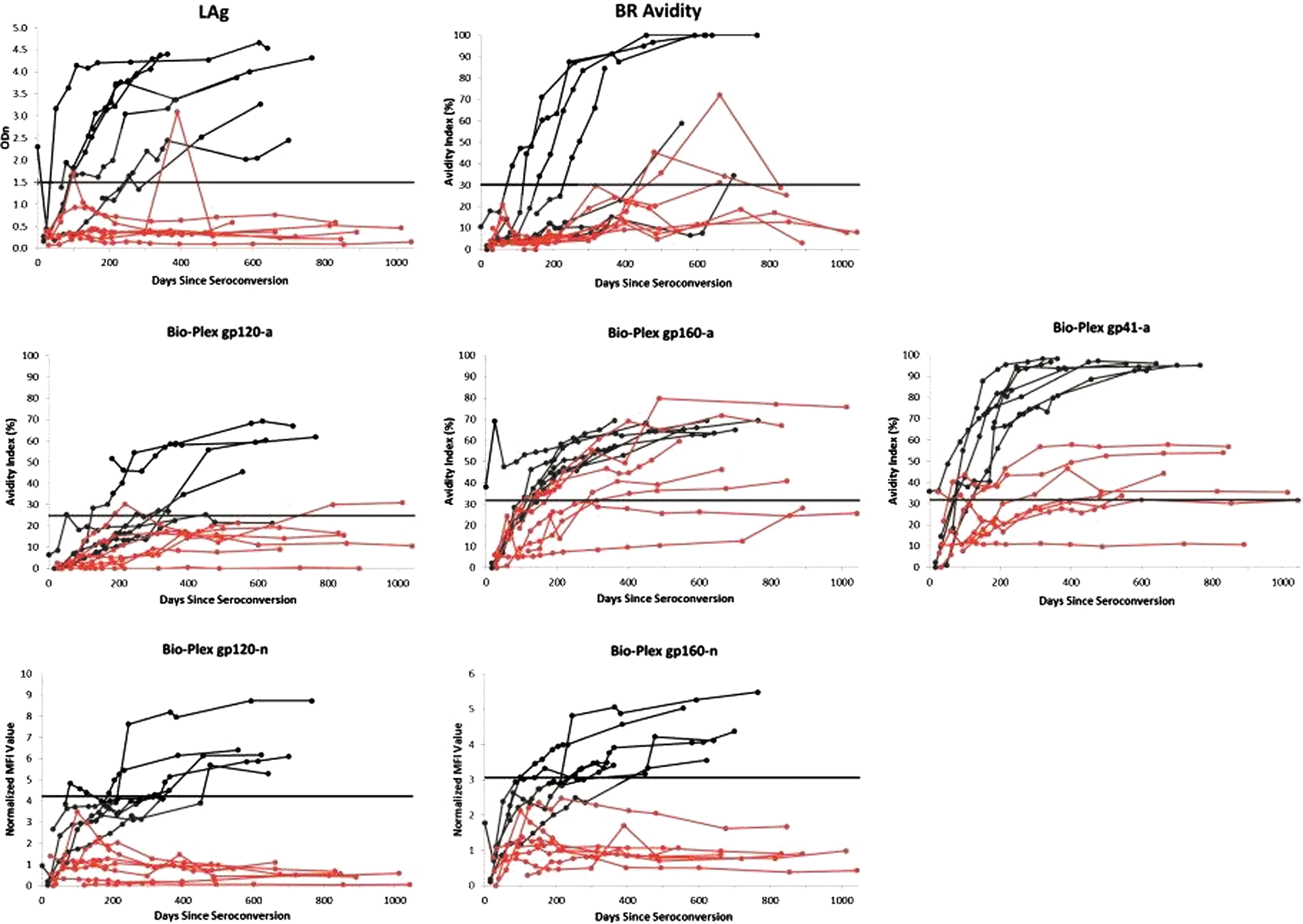
The effect of early ART on LAg, Bio-Rad Avidity, and Multiplex assay performance. Assay values for each subject are plotted over days since seroconversion for seven ART naive (black lines) and seven early ART (red lines) subjects. Each circle represents an individual time point. The horizontal black line denotes the cutoff value for each assay. ART, antiretroviral therapy; LAg, Limiting Antigen.
In the late ART group, the LAg assay and Multiplex nMFI (direct antibody binding) measurements began to decline shortly after ART initiation, whereas the assays that measure avidity index remained relatively stable after ART initiation (Supplementary Fig. S1; Supplementary Data are available online at
Initiation of ART early in the course of HIV infection is associated with a greater impact on the FRR of HIV incidence assays, presumably because virus suppression reduces or eliminates the antigenic stimulation necessary for antibody maturation during early infection. The data presented here support this conclusion for all assays evaluated. Since the LAg, Bio-Rad Avidity, and Multiplex assays are all designed to measure antibody avidity, the differences in assay performance may be explained by the distinct chemistries or test formats. For the LAg assay, the recombinant gp41 protein (rIDR-M) is “limited” on the surface of the test plate to promote binding of high-avidity antibodies to the antigen. 4 The assay protocol entails a single-well measurement; therefore, it is likely that the assay is measuring the amount of high-avidity antibodies that bind to the antigen. Alternatively, the Bio-Rad Avidity and Multiplex assays involve a dual-well measurement, which includes a reference well and a “treatment” well for the dissociative agent. Avidity index is expressed as a ratio of these two measurements or the percentage of antibody dissociation. During early HIV infection, avidity maturation in the absence of detectable VL may be the result of low levels of antigenic stimulation occurring at local sites, even though total antibody levels in the blood remain low or undetectable.
One major limitation of this study is the small number of subjects included in each study group. The cohort was also obtained from a U.S. study; therefore, all study participants were likely infected with subtype B HIV. Further studies are needed to address whether similar effects in assay performance will occur in cases where ART is not fully suppressive and to determine whether specific VL levels can be identified that correspond to changes in assay performance.
Footnotes
Author Disclosure Statement
No competing financial interests exist. The findings and conclusions in this report are those of the authors and do not necessarily represent the views of the Centers for Disease Control and Prevention.
References
Supplementary Material
Please find the following supplemental material available below.
For Open Access articles published under a Creative Commons License, all supplemental material carries the same license as the article it is associated with.
For non-Open Access articles published, all supplemental material carries a non-exclusive license, and permission requests for re-use of supplemental material or any part of supplemental material shall be sent directly to the copyright owner as specified in the copyright notice associated with the article.
