




Abstract
In this research, we reported a new second generation recombinant form (GXDY460B) between circulating recombinant form (CRF)01_AE and CRF07_BC in a seroconversion couple who obtained the virus from her husband by heterosexual behavior. The analysis result of the near full-length genomic characterization showed that the genome comprises at least 12 interlaced segments, including six CRF07_BC and six CRF01_AE segments, with CRF07_BC as the main framework. Cocirculation of multiple virus subtypes and multiple infection routes have existed for a long time in Guangxi, but the recombinant strain was rarely reported among heterosexual transmission population because of its lower crowd confounding degree than men who have sex with men and injecting drug user population. It is the first time that the unique recombinant form (URF) between CRF01_AE and CRF07_BC was identified among heterosexual transmission in Guangxi. The emergence of the novel recombinant helps to understand the pattern of the URF virus.
H
In recent years, many different patterns of recombinant forms have been reported in China especially in regions like Yunnan and Jilin provinces where many different genotypes of HIV-1 strains cocirculated among the same risk population 2,3 . Heterosexual transmission more than injecting drug users (IDUs) has become the major infection routes of HIV-1 epidemic since 2007 in China, and the CRF01_AE subtype is ascendant viral strain among heterosexual transmission population 4,5 . Guangxi province, located in southwestern China near to Yunnan province and bordering Vietnam in the south, is one of the earliest areas of where cocirculation of multiple HIV-1 strains has been characterized. In previous researches, CRF01_AE and CRF08_BC were the major genotypes in Guangxi, followed by CRF07_BC 6 –8 . Cocirculation of multiple virus subtypes could create opportunities for the emergence of novel CRFs and URFs. But for many years, novel recombinant form of HIV-1 in Guangxi was rarely found 9 .
In this study, we identify new URFs composed of CRF01_AE and CRF07_BC. The sample was collected in November 2014 from a transmission event among the seroconversion couples in Wuzhou, Guangxi province. Epidemiological data reveal that the patient was female, married, and has no history of blood transfusion, injection drug use, or extramarital heterosexual activity. It's most likely that the husband became infected through intravenous drug use, then transmitted HIV virus to his wife, who has no risk factors for transmission beyond their sexual relationship. The sequence of the index (the husband) was not obtained because of antiviral therapy. The near full-length gene of the patient was amplified because of her different subtypes between pol and gag genes sequences.
The near full-length genome (NFLG) was amplified from the viral RNA, which was extracted from the blood plasma sample using a QIAamp Viral Mini Kit (QIAGEN, Hilden, Germany). The viral RNA was reverse transcribed into cDNA by the SuperScript III First-stand synthesis system Transcriptase (Invitrogen, Carlsbad, CA) following the instructions. The NFLGs were amplified with the template of near-endpoint diluted cDNA by the TaKaRa LA Taq (TaKaRa, Dalian, China) using the same nested polymerase chain reaction amplification conditions in both of the two rounds, as in the literature
10
. The positive products were purified using a QIAquick Gel Extraction Kit (QIAGEN) and sequenced by an ABI 3730XL sequencer using BigDye terminators (Applied Biosystems, Foster City, CA). All the sequences data were cleaned and assembled using Sequencher v5.1 (Gene Codes, Ann Arbor, MI). A BLAST search was conducted to exclude the potential laboratory cross-contamination. Finally, the sequence was aligned with HIV type 1 group M reference genotypes (A–D, F–H, J, K) and the CRFs (CRF01_AE, CRF08_BC, and CRF07_BC) reported in a previous study in China, which were downloaded from the Los Alamos national Laboratory HIV database (
As shown in the Figure 1, the sequence of GXDA460B is closely related to CRF07_BC reference sequences, but clustered outside of the monophyletic branch. According to the results of that, the Recombinant Identification Program (RIP) (

Phylogenetic analysis of the NFLG. A neighbor-joining tree with 1,000 bootstrap replications was performed with the GXDY460B strain and standard reference sequences of HIV type 1 group M downloaded from HIV databases (
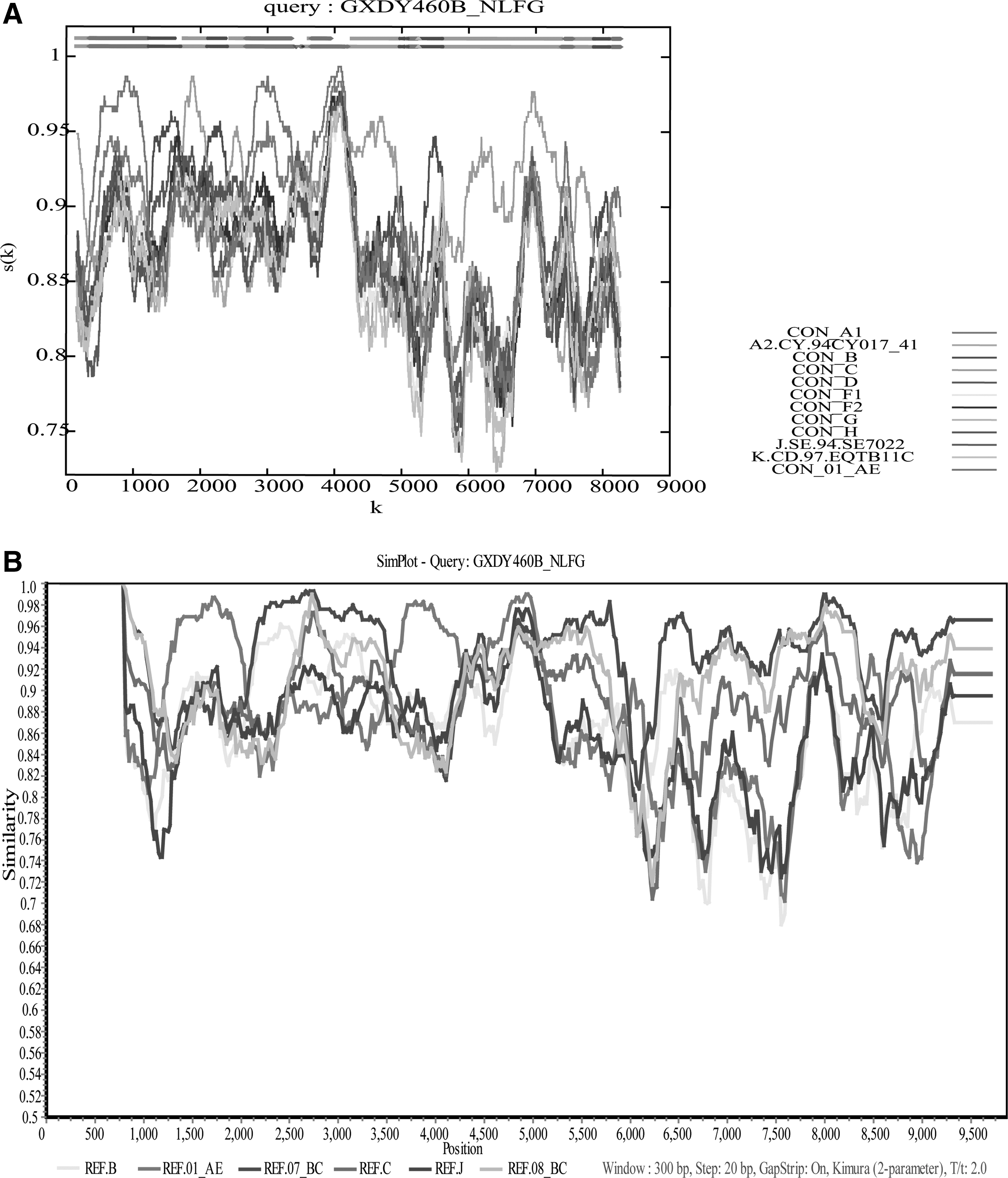
Recombinant Identification Program (RIP) and similarity plots analysis were performed for GXDY460B to identify parental subtypes.
The NFLG of GXDY460B contained about 12 interlaced segments coinciding with CRF07_BC (I, III, V, VII, IX, and XI) and CRF01_AE(II, IV, VI, VIII, X, and XII) (Fig. 3A).Five mosaic CRF07_BC (I, III, VII, IX, and XI)and six CRF01_AE (II, IV, VI, VIII, X, and XII;) were well identified by phylogenetic trees that the segments could cluster together with the reference strains of CRF07_BC or CRF01_AE with high bootstrap values (Supplementary Figure: Phylogenetic Analyses; Supplementary Data available online at
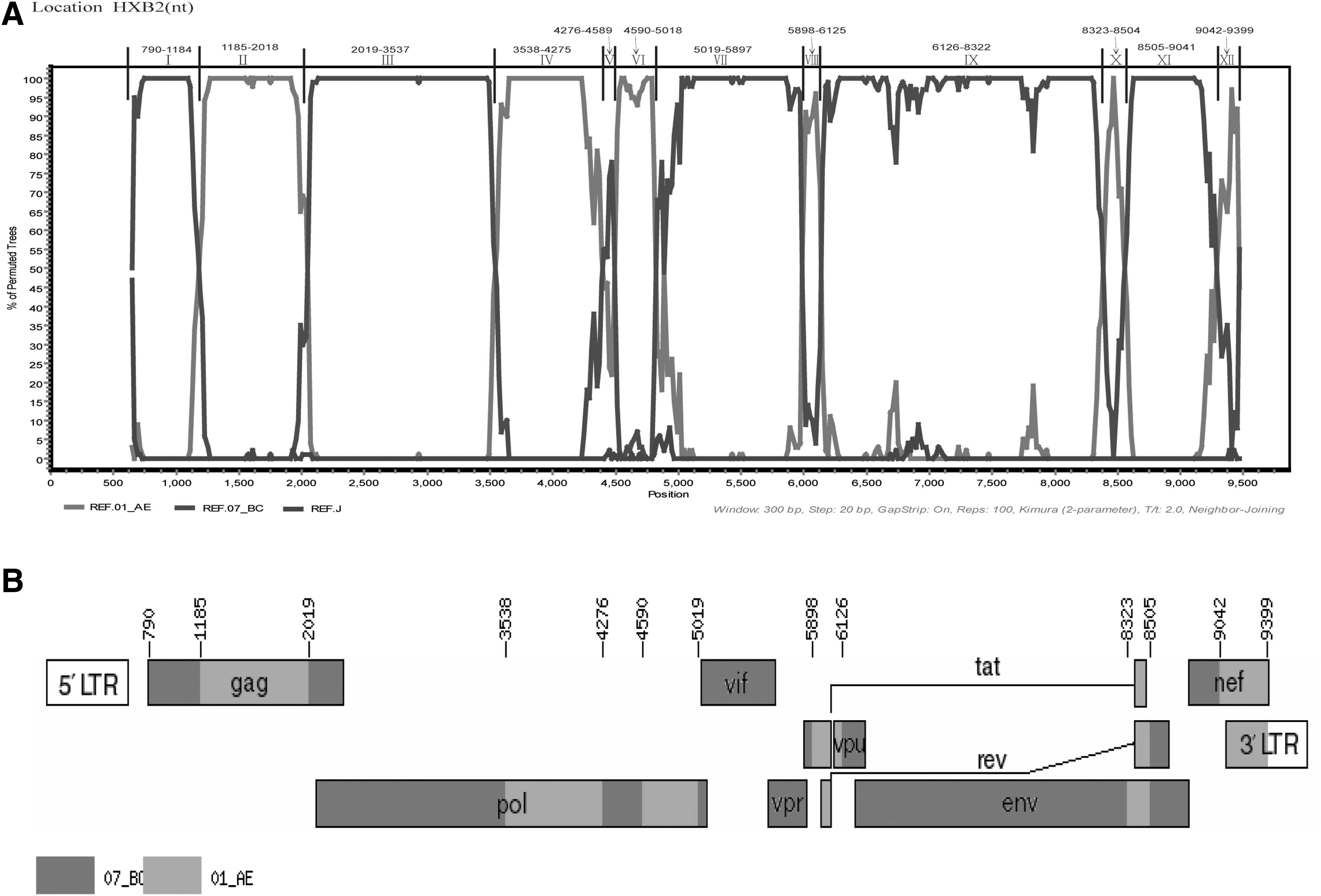
Bootscan plots and schematic representation of the GXDY460B NFLG's mosaic structure.
The predominant genotypes of HIV-1 including CRF01_AE, CRF08_BC, and CRF07_BC circulating in Guangxi mostly originated in IDU populations 13 . But in recent years, the main risk factor of HIV-1 infection has been transferred to the heterosexual population. CRF01_AE was first identified in China among the population of sexual transmission and IDUs in Yunnan and Guangxi province 14 –16 . It has been reported that CRF01_AE is a predominant genotype and is infected by heterosexuals in Guangxi province. CRF07_BC is one of the four major subtypes in Guangxi associated with heterosexual activity and IDUs. Although HIV-1 in Guangxi was found relatively late, its multiple transmission mode brings a big challenge to the prevention and control of HIV-117–20. According to previous research, the interaction of different infected population may produce a new recombination form 9,21,22 . The recombinant strain has been reported among IDUs in southwest and northwest China 23 . Furthermore, the recombination form between CRF01_AE and CRF07_BC has been found among men who have sex with men (MSM) population in Yunnan, Jilin, and Beijing 22,24,25 . Cocirculation of multiple virus subtypes and multiple infection routes have existed for many years in Guangxi, but the recombinant strain was rarely reported among heterosexual transmission population because of its lower crowd confounding degree than MSM and IDUs. It is the first time that the URF between CRF01_AE and CRF07_BC was identified during heterosexual transmission in Guangxi.
In summary, we identified a new recombination form among heterosexual couple in Guangxi, which shows a new URF has emerged. Recombination between HIV-1 genotypes is the important mechanism to increase the viral strains complexity of HIV-1. URFs are associated with dual infections or super-infections in IV drug users and they are a symptom of an IVDU epidemic problem, but studying them will not end the problem or reduce new infections. The solutions involve drug treatment, needle exchange programs, and/or other ways to slow the spread of HIV within the IVDU and perhaps education methods or other interventions to help prevent the spread of the viruses out of the IVDU communities and into the heterosexual populations.
Sequence Data
The nucleotide sequence of GXDY460B used in this study is available in GenBank with accession number KT619126.
Footnotes
Acknowledgments
This work was supported by National Major Projects for Infectious Diseases Control and Prevention (grant 2012ZX10001002); Guangxi Bagui Honor Scholars.
Author Disclosure Statement
No competing financial interests exist.
References
Supplementary Material
Please find the following supplemental material available below.
For Open Access articles published under a Creative Commons License, all supplemental material carries the same license as the article it is associated with.
For non-Open Access articles published, all supplemental material carries a non-exclusive license, and permission requests for re-use of supplemental material or any part of supplemental material shall be sent directly to the copyright owner as specified in the copyright notice associated with the article.
