




Abstract
Increasing second-generation recombinant forms (CRF01_AE/07_BC) have been detected in China recently. Here, we isolated a novel CRF01_AE/07_BC second-generation recombinant form in HIV-1-positive Nei Monggoi's heterosexuals with one CRF07_BC inserted into the CRF01_AE backbone. Polygenetic analyses showed that the CRF01_AE region was grouped with the previously reported cluster 5 lineage, which spreads among the sexual population in north of China, inferring that this recombinant event occurred through heterosexual contact in the north of China possibly. The growing emergence of recombinant forms means coexistence of multiple strains and complexity of the HIV-1 epidemic, which reminds us of the urgent necessity to focus the HIV surveillance among the high-risk populations nationwide in China, particularly to enhance preventive measures in HIV-1 low-prevalence areas.
H
In China, multiple subtypes, including B(B′), 01_AE, 07_BC, 08_BC, and other CRFs and URFs are also involved in the HIV epidemic. 1,3 Currently, CRF01_AE and CRF07_BC are the major circulating subtype: CRF01_AE plays an important role in the heterosexual epidemic, 4 as well as rapidly increasing in the men who have sex with men (MSM) population recently 5 ; CRF07_BC was first found among injection drug users (IDUs) in western China, 6 then emerged in MSM that accounts for almost one-third. 5 The coexistence of CRF01_AE and CRF07_BC in one area or the same population supports the emergence of a new recombinant form. To date, six second-generation recombinant forms of CRF01_AE and CRF07_BC have been identified among MSM, heterosexual, and IDUs population in China. 7 –11
In this study, we detected a novel HIV-1 second-generation recombinant form, with a fragment of CRF07_BC that was inserted into the CRF01_AE backbone, which is different from other reported CRF01_AE/07_BC recombinant forms in China.
Here, the subject, designated as 10LNA015, was a 48-year-old male citizen of Han ethnicity, residing in Tongliao city of the Nei Monggoi Autonomous Region in northern China and was confirmed to be HIV-1 positive in 2010 and was an outpatient in the First Hospital of China Medical University in Shenyang. A self-report showed that he was married and was infected by HIV-1 with heterosexual behavior (whoring) in the residence, and was treatment naive. His CD4+ cell number and viral load were 535 cells/μl and 425,000 copies/ml when the blood sample was collected. Subject 10LNA015 was defined to be recent infection, as a result from the absence of p31 band, according to the strategy of Fiebig stage. 12 This study was approved by the Medical Research Ethics Committee of First Hospital of China Medical University.
The NFLG sequence was obtained using end-point dilution and SGA/sequencing, as previously described.
13
The sequences were assembled using Sequencher v4.10.1 and aligned with major HIV-1 M group reference sequences, with group P as the out-group, including subtypes/subsubtypes and CRFs in China, using Bioedit v7.0.9.0. Phylogenetic analyses were performed using the neighbor-joining method implemented in the MEGA 6.0 program by bootstrap analysis performed with 500 replicates. The NFLG sequences were analyzed using the Recombination Identification Program (
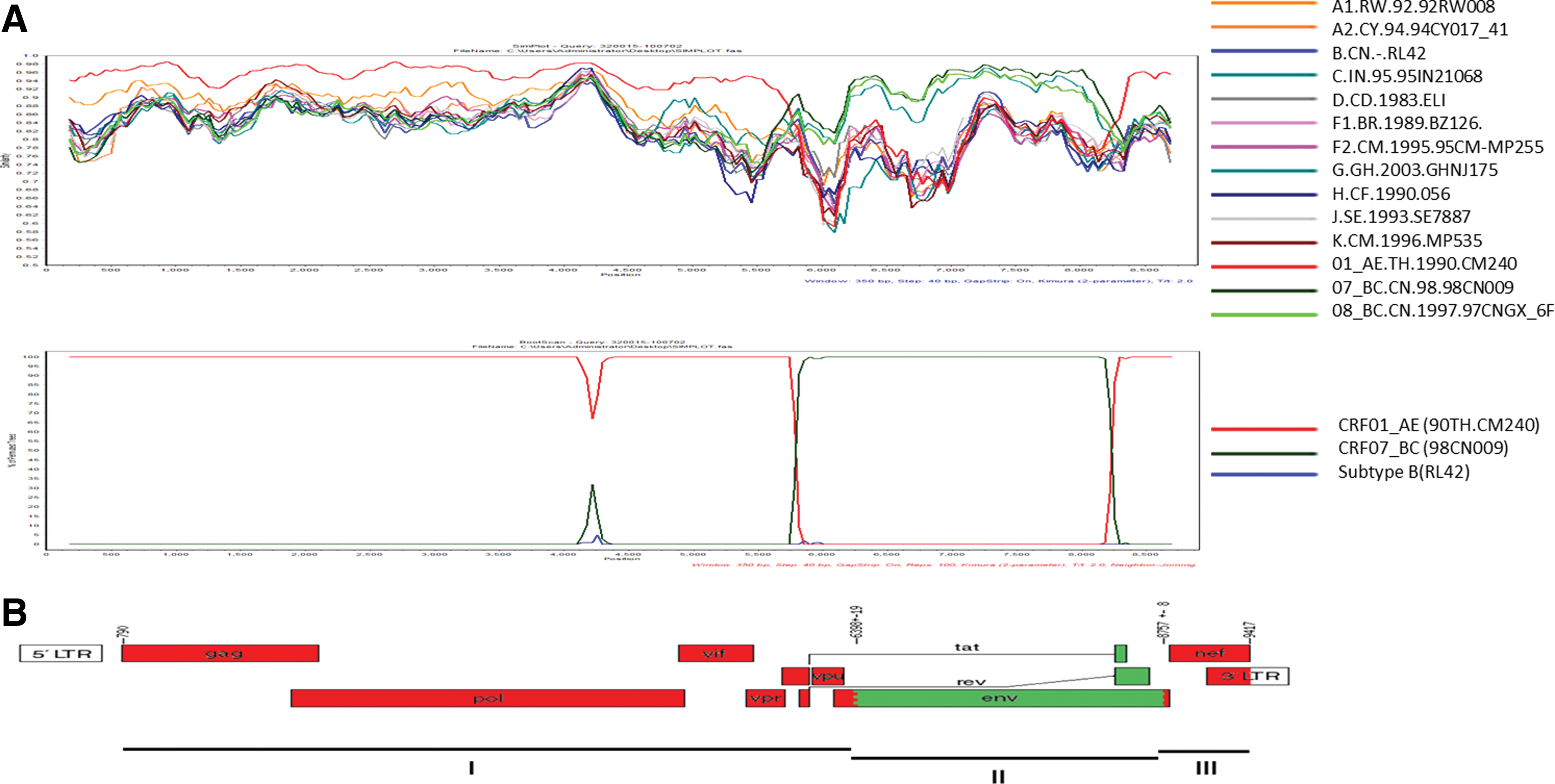
The NFLG sequence of subject 10LAN015 is 8,631 nt in size (HXB2: 790–9,417), spanning the gag, pol, vif, vpr, tat, vpu, env, nef and a part of 3′ long terminal repeat. From the neighbor-joining phylogenetic tree, the NFLG sequence of 10LNA015 was most closely related to the CRF01_AE references with high confidence (bootstrap value is 100), but also was independent of the CRF01_AE references (Fig. 1). The similarity analysis using the simplot software revealed that the genome of subject 10LNA015 was restructured by CRF01_AE and CRF07_BC with one CRF07 fragment inserted into a CRF01_AE backbone in Figure 2A (upper panel). The bootscanning analysis revealed that the genome of subject 10LNA015 consisted exclusively of CRF01_AE and CRF07_BC with two recombinant breakpoints (Fig. 2A, lower panel), corresponding to HXB2 nucleotide positions 6,398 ± 19 and 8,757 ± 8, both located in env gene region, subfragmented into three subregions: region I (HXB2: 790–6,379 nt), region II (6,417–8,749 nt), and region III (8,865–9,417 nt) (Fig. 2B). Based on the schematic structure of all reported recombinant forms of CR01_AE and CRF07_BC, the profile of the recombinant structure of subject 10LNA015 was distinct from the other six recombinant forms, 7 –11 suggesting that known CRF01_AE/07_BC recombinant forms have not yet been circulating nationwide, and they were only confined to some certain high-risk populations in HIV-1-specific active region.

Phylogenetic tree analysis of near full-length nucleotide sequence of subject 10LNA015. Neighbor-joining tree analysis of subject 10LNA015 (8,628 nt, HXB2: 790–9,417 nt) with the reference sequences of HIV-1 group M subtypes and CRFs relevant to this study was constructed with 1,000 bootstrap replicates, where the solid circle marks 10LNA015. Only the bootstrap values above 80 are shown and the scale bar represents 5% genetic distance.
Regions I and III of CRF01_AE were phylogenetically analyzed with the sequences from 1 to 7 CRF01_AE clusters reported in 2013 14 and the subregion tree showed that the CRF01_AE regions of subtype 10LNA015 were clustered together with the CRF01_AE lineage 5 (bootscan values ≥90), which widely spread among the MSM population and less heterosexual population in northern China 14 (Fig. 3), demonstrating that the parental origin of CRF01_AE fragments in subject 10LNA015 was from the northern sexual population. Region II of CRF07_BC was phylogenetically analyzed with the sequences from the Chinese MSM cluster 5 and other high-risk populations. This CRF07_BC region differed from the Chinese MSM CRF07_BC cluster and was mixed in other separated CRF07_BC reference sequences, indicating that subject 10LNA015 was unrelated to the MSM population, and the HIV infection was likely to occur in the heterosexual contact or drug injection. Furthermore, according to his self-report that the heterosexual behavior was his only high-risk factor, the occurrence of this recombinant incident may be due to heterosexual contact in his resident city.
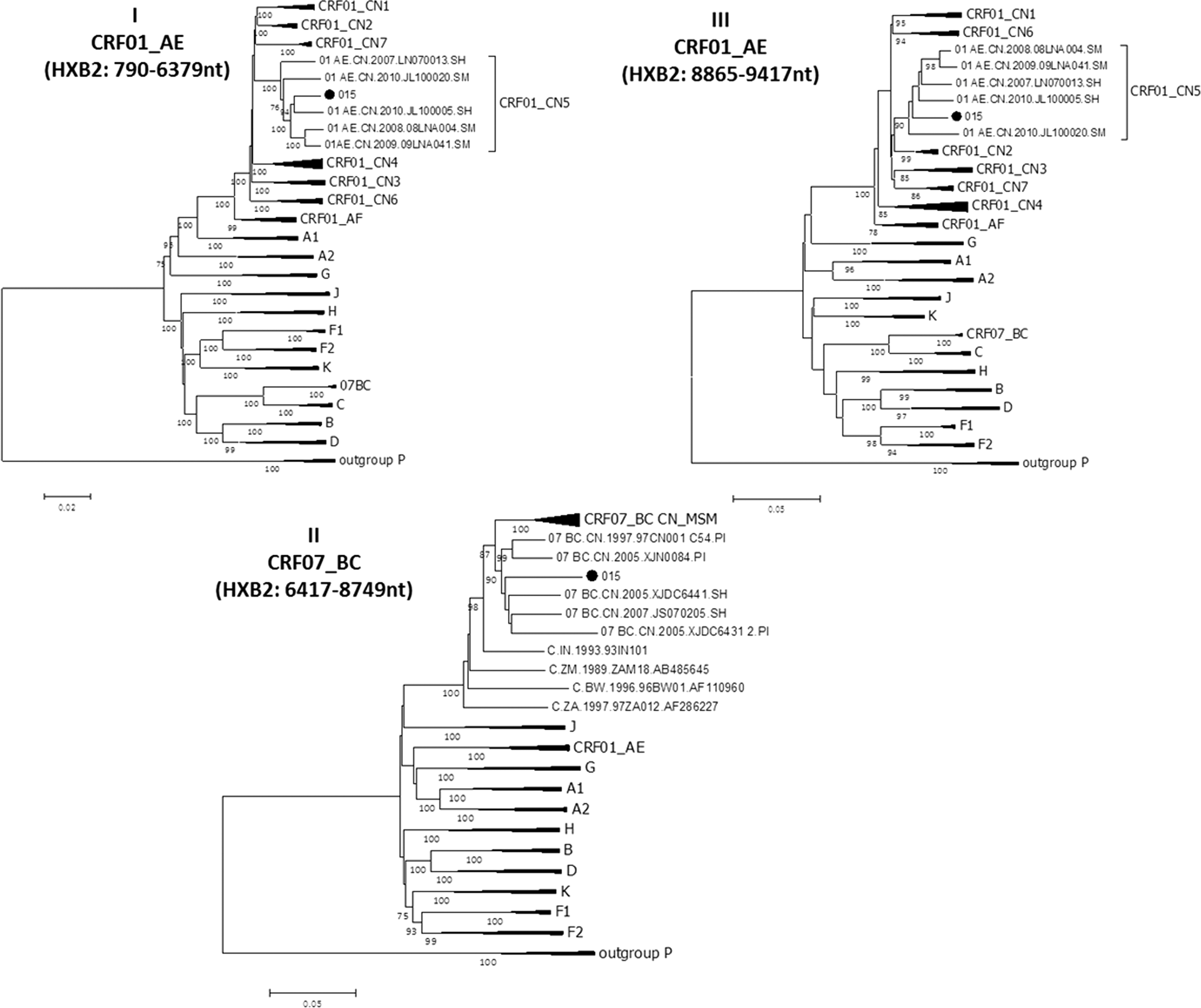
Subregion trees of two CRF01_AE segments and one CRF07_BC segment of 10LNA015 were constructed with all known HIV-1 group M subtypes/subsubtypes and two HIV-1 CRFs (CRF01_AE and CRF07_BC). The reference sequences also consist of seven previously reported CRF01_AE clusters in China 14 and one CRF07_BC cluster in the Chinese MSM population. 5
Here, we reported the first second-generation recombinant form between CRF01_AE and CRF07_BC in the Nei Monggoi Autonomous Region and identified that the infection may occur in a local heterosexual population and found that the present CRF01/07 URFs mostly originated from the local heterosexual population. Noteworthily, although the Nei Monggoi Autonomous Region is one of the lowest HIV prevalence regions, 15 the case of the second-generation recombinant form has also emerged. Increasing second-generation recombinant forms suggest us that it is necessary to focus the HIV surveillance among the high-risk population nationwide, especially in low-epidemic areas.
Sequence Data
The nucleotide sequence of 10LNA015 has been submitted to GenBank with the accession number KU051564.
Footnotes
Acknowledgments
This work was supported by National Major Projects for Infectious Diseases Control and Prevention (2012ZX10001006), National Natural Science Foundation of China (81401655), and Development Programme of the innovative group by Ministry of Education.
Author Disclosure Statement
No competing financial interests exist.