




Abstract
We found cluster 1 and cluster 2 that were identified as two potential circulating recombinant forms (CRFs) by analyzing the recombinant breakpoints and phylogenetic tree. Three sequences composed of CRF01_AE, subtype C, and potential subtype B (N/A) in cluster 1 had nearly identical recombinant breakpoints, and four sequences composed of CRF01_AE and subtype B in cluster 2 possessed identical breakpoints. Demographic characteristics indicated that there were no epidemiological linkages among three subjects in cluster 1 and four subjects in cluster 2, respectively. Likewise, two unique recombinant forms (URFs) were found in this study: one URF was composed of subtype C and subtype B, and subtype B was inserted into a backbone of subtype C; another URF was composed of subtype C, subtype B, CRF01_AE, and subtype A2. It was inferred that the potential novel CRFs and URFs have spread into general populations, suggesting that the series research of novel recombinant strains will be a priority for our researches in the future.
T
Hebei, a northern province of China, shares a border with Henan in the south where substantial HIV/AIDS individuals infected through blood transmission were found, surrounding Tianjin and Beijing. Hebei province, with an area of 190,000 km2, included 11 prefectures, 172 counties, and 2,228 townships. The first HIV/AIDS epidemic in this area was initiated by migrant workers of Shijiazhuang prefecture returning from Africa in 1989, 3 but their genotypes were not detected because of limited experimental conditions at that time. A HIV-1 outbreak occurred through the blood in Xingtai and Langfang between 1993 and 1995, and their genotypes were identified as subtype B. 4,5
In recent years, HIV-1 subtypes, prevalent in Hebei, have changed from CRF07_BC, subtype C, and subtype B in 20026 to CRF07_BC, subtype C, CRF01_AE, CRF08_BC, and subtype B in 2008, 7 and there were different HIV-1 subtypes in the different populations. 8 Currently, subtype B, CRF01_AE, and CRF07_BC are three main genotypes circulating in Hebei, 9,10 which provides conveniences for the genetic recombination of different HIV-1 genotypes. HIV-1 genetic diversity and the complexity of high-risk behaviors constitute major challenges for HIV control and prevention of Hebei. Consequently, it is urgent for us to monitor HIV-1 recombinant strains prevalent in Hebei, China. In this work, the genomic schematics of nine HIV-1 recombinant strains identified among newly diagnosed HIV-1 individuals were analyzed based on HIV-1 full length gag-partial pol gene sequences.
Blood samples were collected from five prefectures of Hebei (Fig. 1), that is, Shijiazhuang (SJ13230, SJ13226, SJ13323), Tangshan (TS130523, TS130808), Qinhuangdao (QHD13AD009, QHD13AD025), Handan (13HD065), and Hengshui (HS2013822). These nine subjects (eight males and one female) were newly diagnosed for HIV-1 infection in 2013 and did not undergo antiretroviral therapy. Their demographic characteristics were collected through face-to-face questionnaire survey after blood collection. Written informed consents were obtained from all patients before blood collection. This study was approved by the local Ethics Committee at Hebei Provincial Center for Disease Control and Prevention (Document number: IRB-2012004). In this study, HIV-1 full length gag and partial pol (1.3 kb) genes were amplified and sequenced.
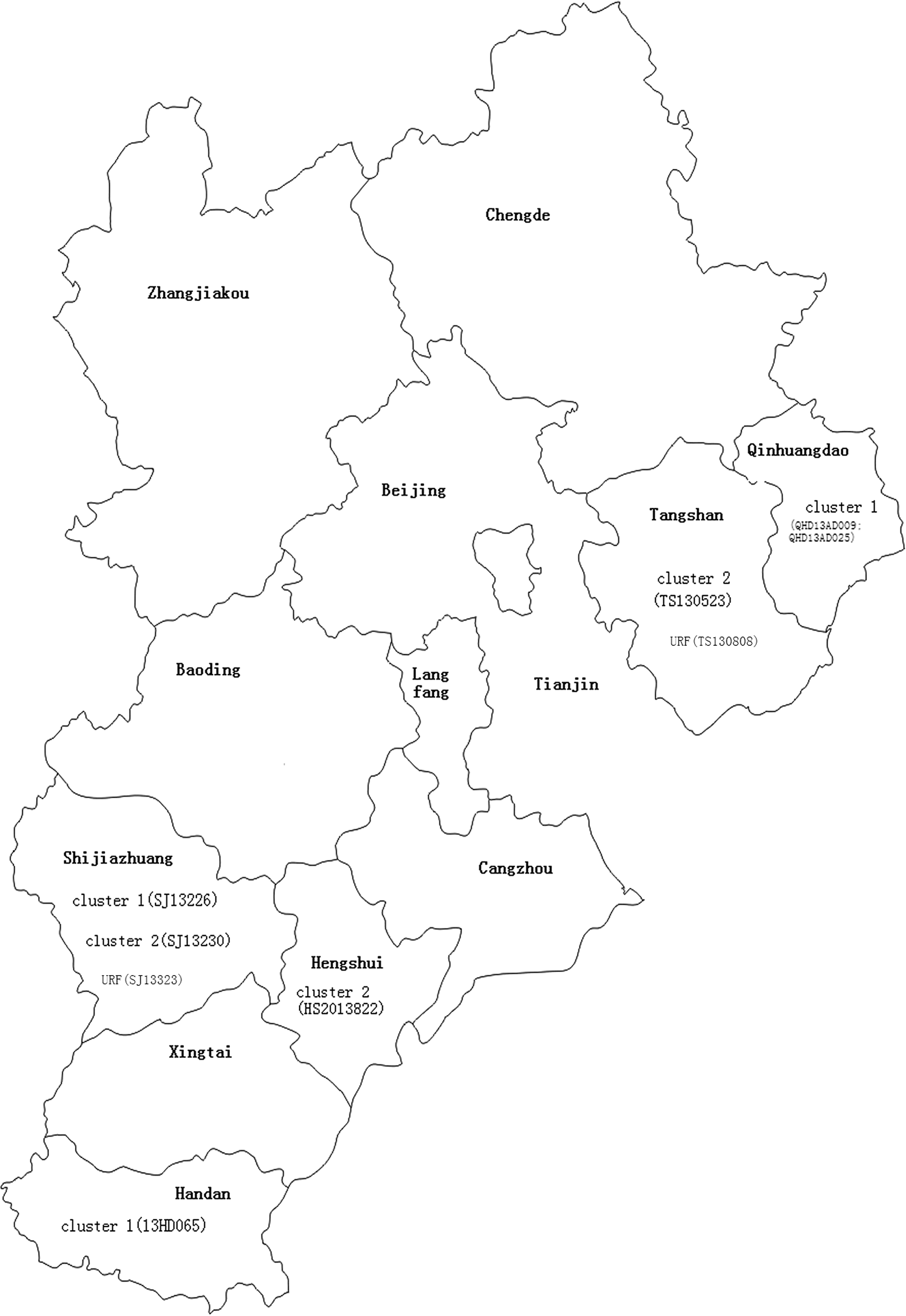
Geographic distribution of nine novel recombinant strains in Hebei. Sample IDs in brackets behind words “cluster” and “URF” represent novel recombinant strains belonging to clusters and URFs, respectively. URFs, unique recombinant forms.
As shown in Table 1, the face-to-face questionnaire survey indicated that seven subjects were of Han ethnicity and two subjects were of Yi nationality. Of these subjects, the mean values of age and first CD4 counts were 39.3 years and 214 cells/μl, respectively. All nine subjects were infected with HIV-1 through sexual contact, including homosexual contact (77.8%, 7/9) and heterosexual contact (22.2%, 2/9).
URFs, unique recombinant forms.
All of the sequenced original fragments were edited and assembled as reported previously.
11
To implement the phylogenetic tree analysis, full length gag and partial pol gene sequences derived from the same recombinant strain were assembled together and aligned with reference sequences (A–D, F–H, J, K, CRF01_AE, all CRFs associated with BC recombination and 01B recombination), which were obtained from HIV database (
By neighbor-joining phylogenetic tree analysis of full length gag-partial pol gene sequences (Fig. 2), we found two clusters from our sequences, including cluster 1 (HS2013822, SJ13230, and TS130523) and cluster 2 (QHD13AD009, QHD13AD025, SJ13226, and 13HD065), distantly related to all known HIV-1 subtypes/CRFs obtained from HIV database. Cluster 1 and cluster 2 were supported by bootstrap values of 100%, respectively. SJ13323 and TS130808 were monophyletic branches, respectively, not belonging to any cluster as shown in Figure 2.
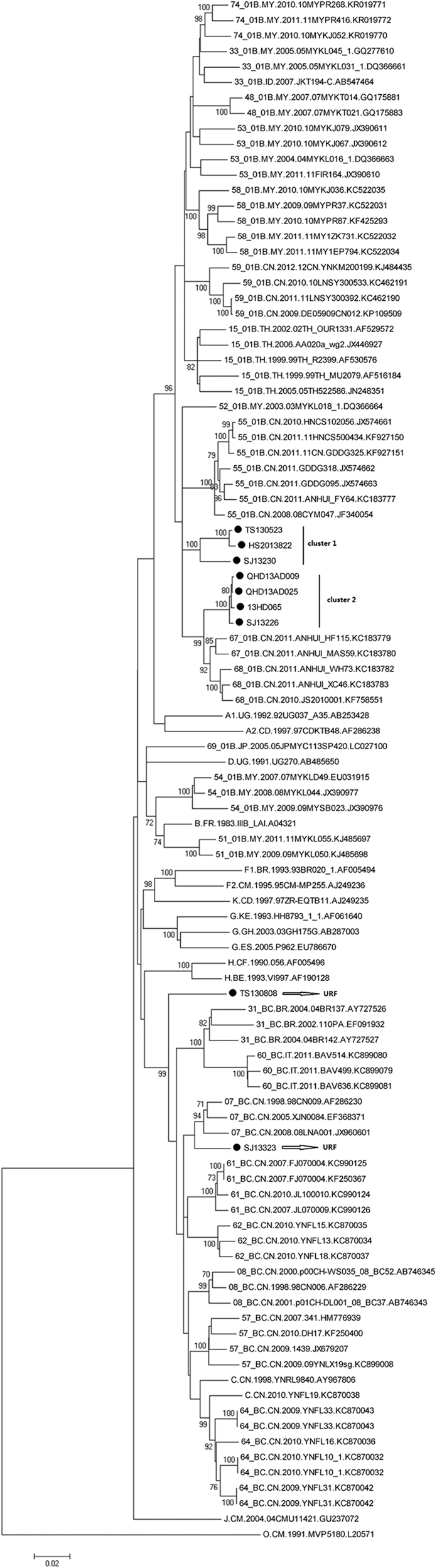
Neighbor-joining phylogenetic tree analysis of HIV-1 full length gag-partial pol gene sequences from nine novel recombinant strains (●) in Hebei. All the reference strains were obtained from HIV database. Values on the branches represent the percentage of 1,000 bootstrap replicates, and bootstrap values lower than 70% are hidden in the tree. The scale length indicates 2% nucleotide sequence divergence.
As indicated in Figure 3, HIV-1 recombinant breakpoints were analyzed using online jpHMM and RIP 3.0. In cluster 1, three recombinant strains have nearly identical genomic schematic structures, which were composed of CRF01_AE, subtype C, and N/A. RIP revealed that N/A should be a potential subtype B. TS130523 and HS2013822 shared the same recombinant breakpoints corresponding to HXB2 nucleotide position 2574 approximately. SJ13230 has recombinant breakpoint at position 2495 approximately. N/A gene fragments were inserted into backbones of these three recombinant strains at position 3090 approximately. Moreover, TS130523, HS2013822, and SJ13230 were from Tangshan, Hengshui, and Shijiazhuang, respectively, with no apparent epidemiological linkage. In cluster 2, QHD13AD009, QHD13AD025, SJ13226, and 13HD065 were from Qinhuangdao, Shijiazhuang, and Handan, respectively, and these four recombinant strains shared an identical recombinant pattern, composed of CRF01_AE and subtype B. Their recombinant breakpoints corresponded to HXB2 nucleotide position 2799 approximately.
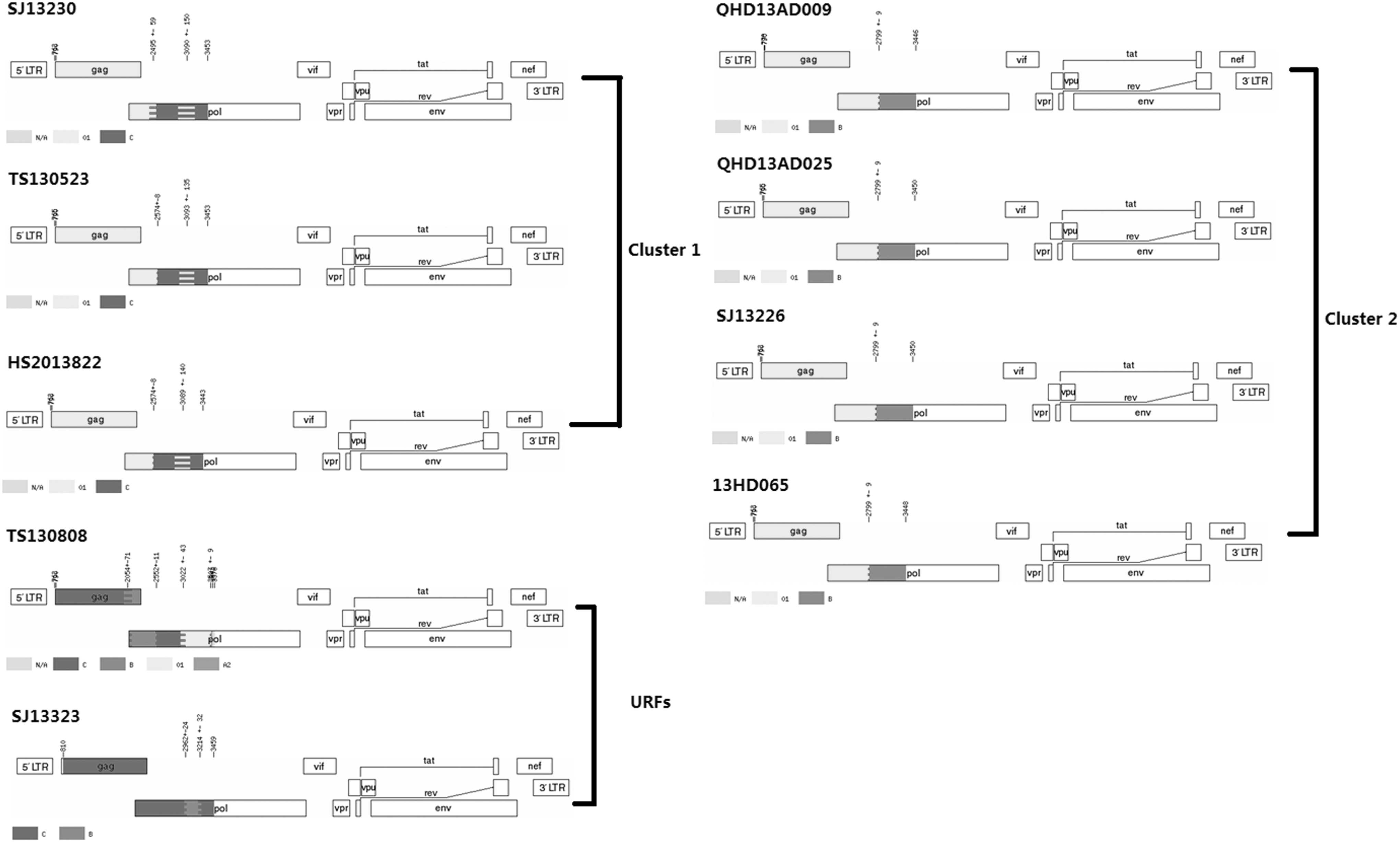
Genomic maps of nine novel recombinant strains. The mosaic maps based on HXB2 numbering were generated using jpHMM Program (
Consequently, in terms of the criteria for identification of a CRF, 12 we inferred that cluster 1 and cluster 2 might be two CRFs. SJ13323 and TS130808 were URFs with two different recombinant patterns. The breakpoints analysis revealed that HIV-1 full length gag-partial pol of SJ13323 was composed of subtype C and subtype B, and subtype B was inserted into a backbone of subtype C. The breakpoints based on HXB2 nucleotide were positions 2962 and 3214 approximately. Genome of TS130808 was complicated, including subtype C, subtype B, CRF01_AE, and subtype A2. The recombinant gene map of TS130808 was as follows: subtype C (790–2070 nt), subtype B (2071–2546 nt), subtype C (2547–3050 nt), CRF01_AE (3051–3151 nt), and subtype A2 (3516–3542 nt).
As the first recombinant strain identified in Hebei, CRF07_BC was initiated by one injection drug user coming from Guangxi in 2002, 6 followed by the second recombinant strain (CRF08_BC) in 2008. 7 Currently, CRF07_BC and CRF08_BC have become two main circulating recombinant forms in Hebei, consistent with HIV-1 epidemic in China. 13 With the development of HIV-1 genetic diversity, new recombinant strains in Hebei occurred. 10 In this work, nine novel recombinant strains were identified, and their gene fragments were closely associated with three main genotypes (subtype B, CRF01_AE, and CRF07_BC) circulating in Hebei. Compared with our previous reports, 6 –10 this study was based on long gene fragments (full length gag and partial pol genes), which more precisely identify the recombinant patterns of novel recombinant strains.
All of nine novel recombinant strains were infected through sexual exposure, of which two were heterosexual and seven were homosexual. Furthermore, their mean age was only 39.3 years, being in sexually active, when HIV-1 infection should be preferential. In addition, in this study, there were two people of Yi nationality who have casual sex, concurrent sexual partnerships, and inject drugs. 14,15 It was inferred that the novel CRFs and URFs have spread into general populations, which has become the key barrier of HIV prevention and control.
In conclusion, we found cluster 1 and cluster 2 that were identified as two potential CRFs by analyzing the recombinant breakpoints of recombinant strains and phylogenetic tree. Three sequences composed of CRF01_AE, subtype C, and potential subtype B (N/A) in cluster 1, from three no linkage prefectures, have nearly identical recombinant breakpoints, and four sequences composed of CRF01_AE and subtype B in cluster 2, without obvious epidemiologic linkage, possessed identical breakpoints. Likewise, two URFs were found in this study: one URF was composed of subtype C and subtype B, and subtype B was inserted into a backbone of subtype C; another URF was composed of subtype C, subtype B, CRF01_AE, and subtype A2. In the future, the series research of novel recombinant strains will be our priority and provide critical data for early prevention and control of HIV-1.
Footnotes
Acknowledgment
We thank the Academy of Military Medical Sciences for technical assistance in this study.
Authors' Contributions
This study was conceived and designed by X.L. and Y.L. X.L. and Y.L. performed this study, analyzed results, and drafted the article. Z.C., S.C., and H.Z. contributed to acquiring of data and revising data critically. Y.Z. carried out the epidemiological investigation. C.Z. participated in the detection of CD4 cell counts. Z.C. and J.L. provided financial and technical assistance.
Sequence Data
All nucleotide sequences of the study isolates have been submitted to GenBank with the accession numbers KU378038–KU378046.
Author Disclosure Statement
No competing financial interests exist.