




Abstract
In this study, blood samples from newly HIV-1 infected men who have sex with men (MSM) were collected, and HIV-1 genotypes were identified based on gag p17-p24 and nef gene regions. We found that participants aged from 20 to 40 years old were the major infection group in Harbin. CRF01_AE was the predominant genotype, contributing to 84.7% of HIV-1 infections, followed by subtype B (4.7%), CRF07_BC (3.5%), and subtype B′ (Thai B, 1.2%). Moreover, five unique recombinant forms (5.9%) were also identified, including genotypes 01B, 01C, and 01/02. The recombinant CRF01_AE/CRF02_AG was first reported in China. These results suggested that current HIV-1 genotype epidemic among MSM in Harbin is more complicated and that intersubtype recombinants have emerged. Therefore, timely regional epidemiological surveillance of HIV-1 genotype and development of prevention measures for new HIV-1 infections among MSM are quite important.
A
Considering the current complexity of nationwide HIV-1 molecular epidemiology in China, we aimed to monitor the HIV-1 epidemic among MSM in Harbin. Thus, in the present study, we collected seropositive blood samples from newly infected MSM and identified HIV-1 genotypes based on gag and nef gene regions. This study was approved by the Institutional Review Board of Fourth Affiliated Hospital of Harbin Medical University ([2015]KT003). A written informed consent was obtained from each participant.
A total of 87 antiviral treatment-naive HIV-1 infected MSM individuals who were first diagnosed as HIV-1 seropositive between March 2013 and December 2014 at the Fourth Affiliated Hospital of Harbin Medical University were enrolled in this study. The median age of these participants was 33.8 years, and 71.3% (62/87) of the participants concentrated in the age group from 20 to 40 years. In addition, 43.7% (38/87) of these participants had CD4 cell counts <200 cells/μL (Table 1), indicating the progression of disease.
CRF01_AE strains included one sample with only nef gene region successfully obtained.
Subtype B′ strains included one sample with only nef gene region successfully obtained.
CRF, circulating recombinant form; MSM, men who have sex with men; URFs, unique recombinant forms.
Genomic DNA was extracted from peripheral blood mononuclear cells and then subjected to polymerase chain reaction (PCR) amplification. A partial gag p17-p24, corresponding to HXB2 nucleotide (nt) positions 847 to 1,455, was amplified by nested PCR with outer primers Gag-OF (5′-ATATGGGTGCGAGAGCGTCAGTATT-3′) and Gag-OR (5′-TCCAACAGCCCTTTTTCCTAGG-3′) and followed by inner primers Gag-IF (5′-TAGTTCCTGCTATGTCACTTCC-3′) and Gag-IR (5′-GGGAAAAAATTCGGTTAAGGCC-3′). The first and second rounds of PCR were run under the same condition consisting of an initial denaturation step at 94°C for 10 min, followed by 35 cycles of 94°C for 30 s, 55°C for 30 s, 72°C for 1 min, and a final extension step at 72°C for 10 min. A full-length nef (HXB2: nt8797-9415) was amplified with primers as previously described. 5 The purified PCR products were subjected to direct sequencing.
The nef and gag p17-p24 genes were aligned separately using the Clustal X. A phylogenic tree was constructed by the neighbor-joining method based on maximum composite likelihood model using Mega 5.0 software with the HIV-1 gag and nef reference sequences obtained from the Los Alamos National Laboratory (LANL) HIV sequence database. The genotype of HIV-1 samples was determined by the subtype or circulating recombinant form (CRF) lineage distribution of gag and nef genes. As shown in Figures 1 and 2, a total of 85 partial gag p17-p24 and 87 full-length nef genes were obtained. Among the 85 samples having both gag and nef sequences, HIV-1 genotypes were distributed as follows: CRF01_AE (72/85, 84.7%), subtype B (4/85, 4.7%), CRF07_BC (3/85, 3.5%), subtype B′ (1/85, 1.2%), and unique recombinant forms (URFs, 5/85, 5.9%). Most CRF01_AE sequences (65/72, 90.3%) identified here mainly subclustered with CRF01-4 and CRF01-5 lineages, both of which are commonly present among MSM in northern China. 6 Five gag and two nef sequences subclustered with the CRF01-1 lineage, which is commonly found among heterosexuals and injecting drug users (IDUs) (Figs. 1A and 2A). 6 The remaining two CRF01_AE nef sequences (HLJ001 and HLJ033) seemed no distinct from CRF01 cluster orientation (Fig. 2A). In addition, the two samples having nef but lacking gag sequences were identified as a subtype B′ (HLJ017) and a CRF01_AE (HLJ026) gene in their nef regions, respectively (Fig. 2).
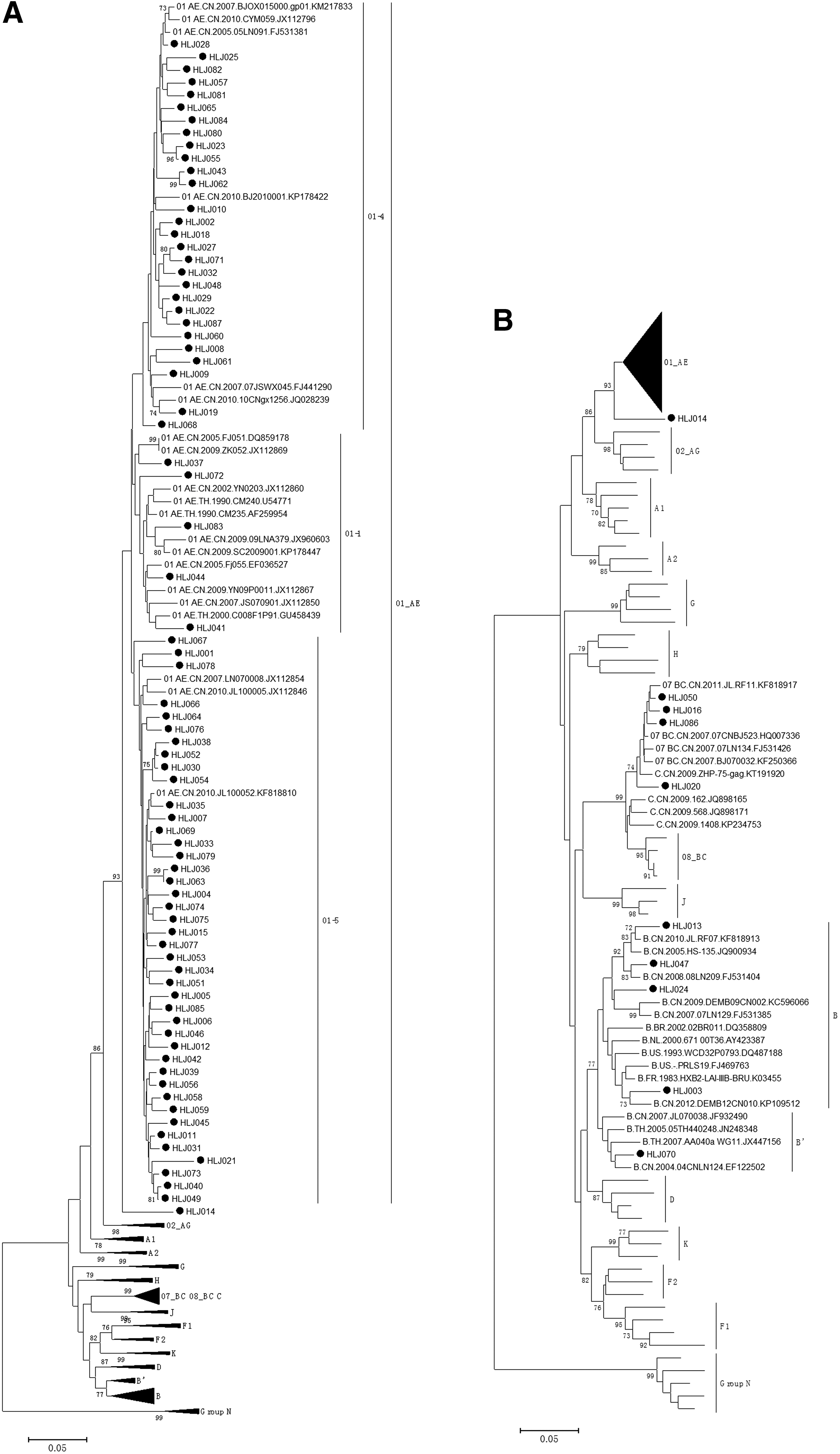
Phylogenic analysis of gag p17-p24 gene sequences from MSM in Harbin. Neighbor-joining tree was constructed for 85 gag sequences and subtype references.
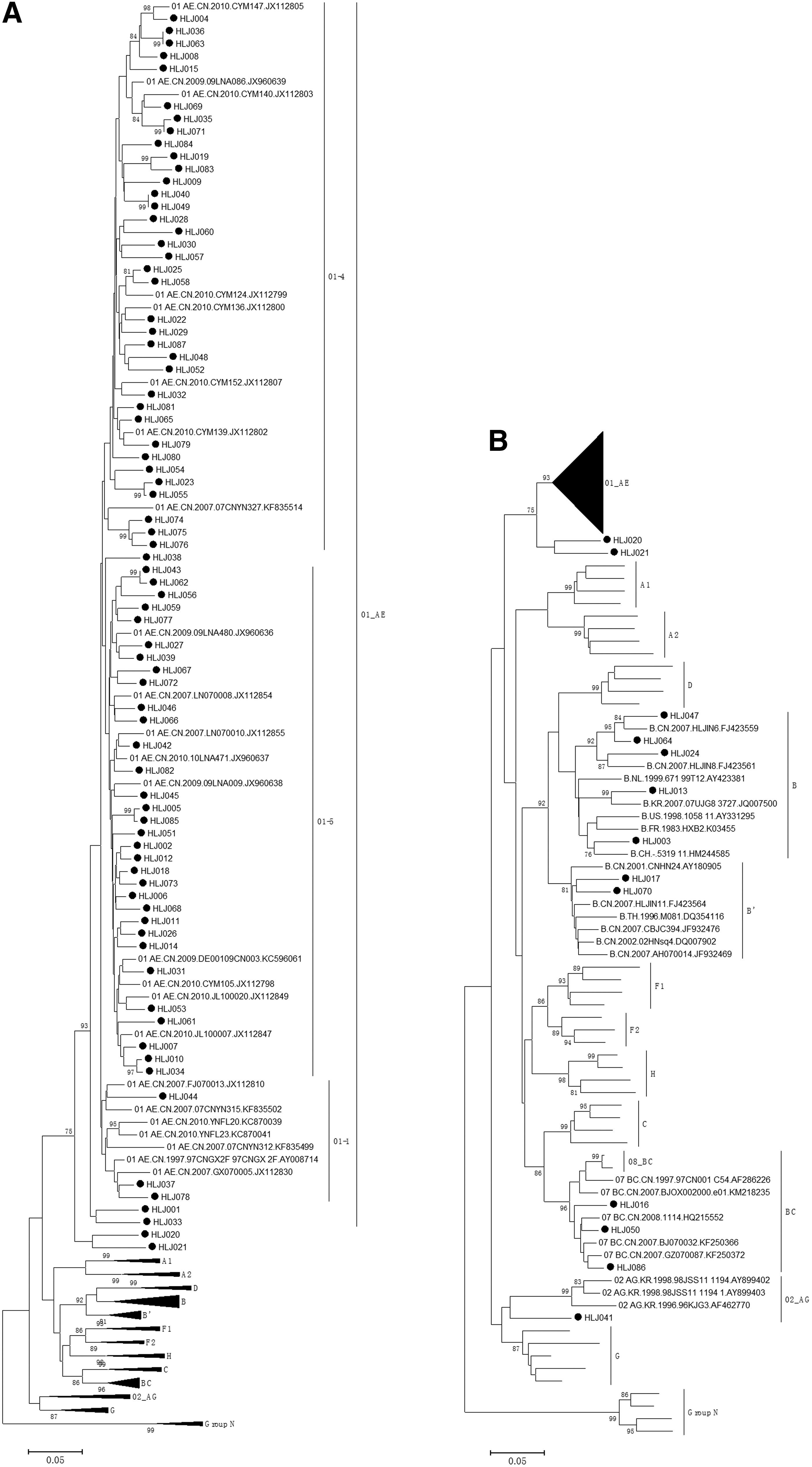
Phylogenic analysis of nef gene sequences from MSM in Harbin. Neighbor-joining tree was constructed for 87 nef sequences and subtype references.
Furthermore, discordant gene regions or outlier positions in the trees were observed in five samples, and then a further analysis using the jumping profile Hidden Markov Model (jpHMM) program (
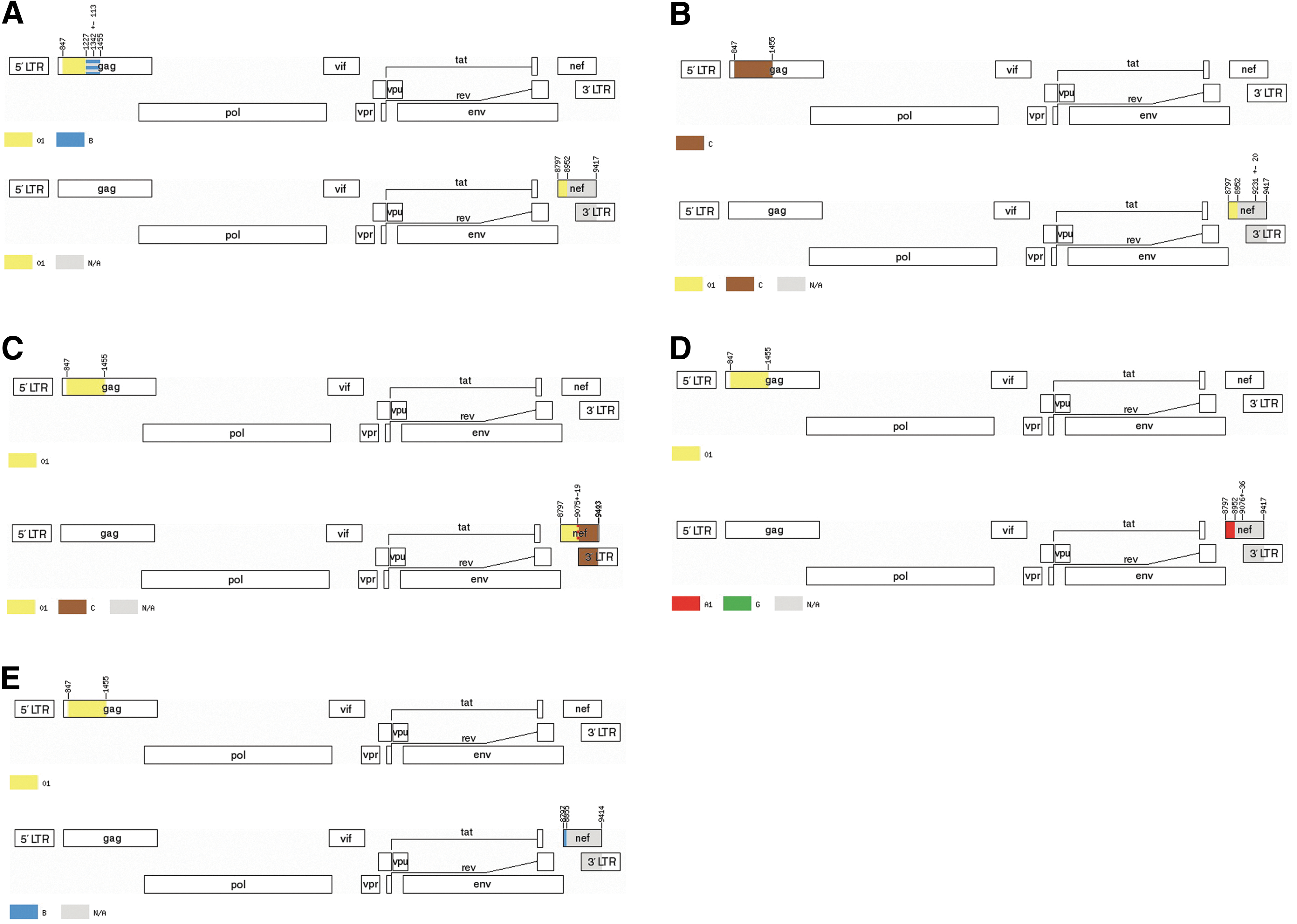
Recombinant analysis of the gag and nef genes of URFs by jpHMM program.
The CRF02_AG nef gene from HLJ041 was further aligned with available CRF02_AG nef references worldwide (285 sequences). The phylogenic analysis showed that this CRF02_AG nef gene was clustered with references from HIV-1 infected patients in South Korea (Fig. 2B and Supplementary Fig. S1; Supplementary Data are available online at
Since the first case reported in 1993, HIV-1 infection in Harbin continues to increase. HIV-1 transmission route has transformed from blood transmission to heterosexual contact and then to homosexual contact. According to the province's case report, by the end of 2014 (
In the present study, we found that HIV-1 genotypes among MSM were complicated. CRF01_AE genotype was responsible for 84.7% of infections compared to 77.8% during 2011–2013 and 65.4% in 2010, 7,8 indicating that CRF01_AE had kept increasing and still dominated HIV-1 epidemic among MSM in this area. In recent years, CRF01_AE strains emerged and rapidly spread nationwide and have become the predominant strain in HIV-1 infections through sexual contact. To understand the origin, timescale, spatial spread, and risk group structure, CRF01_AE strains nationwide have been divided into seven distinct phylogenic clusters. Clusters 1–3 were primarily found in heterosexuals and IDUs in southeast and southwest cities. Clusters 4 and 5 were prevalent among MSM in northern cities. Clusters 6 and 7 were only found in southeast and southwest cities, Yunnan and Fujian. 6 In our present study, CRF01_AE sequences formed two main lineages, gathering with clusters 4 (CRF01-4) and 5 (CRF01-5), consistent with the previous findings in northern cities. 7,9 In addition, few sequences gathered with CRF01-1 lineage, indicating the complexity of CRF01_AE strains epidemic in Harbin.
In China, cocirculation of CRF01_AE with other genotypes, such as subtype B and CRF07_BC, among MSM provides high possibility of generating intersubtype recombination and even URFs, leading to genetic diversity and complexity of HIV-1 strains. 7,10 –12 In the present study, we reported five URFs in MSM in Harbin. All these URFs contained one gene portion of CRF01_AE viruses, which can be explained by the fact that CRF01_AE has dominated HIV-1 epidemic among MSM in this city. These URFs identified in the present study supported our previous finding that MSM have become the main source for generation of complex recombinant forms in Harbin. 7
Of special significance, we identified one CRF01_AE/CRF02_AG recombinant in this study and the CRF02_AG nef gene portion of this URF clustered with references from South Korea. To our knowledge, it was the first report of this URF in China. Recently, CRF02_AG, which is predominant in West and Central Africa, 10 has been increasingly spreading in China, 9,11 and cocirculation of CRF01_AE and CRF02_AG has been found in the Jilin province, 9 which is adjacent to South Korea and Harbin, Heilongjiang province. However, due to the lack of nef gene information of samples from Jilin and other regions of China, whether the CRF02_AG nef gene identified here was introduced from Jilin or other regions is still unknown. It is worth noting that the CRF02_AG strains were commonly spreading among heterosexuals. 9,10 Furthermore, the CRF01_AE portion in recombinant CRF01_AE/CRF02_AG was subclustered with the China CRF01-1 lineage, which is commonly found in heterosexuals and IDUs in China. 6 Therefore, we speculate that this CRF02_AG nef gene might be introduced into MSM population in Harbin by bisexuals. In China, it was reported that the prevalence of bisexual behavior among MSM is 31.2%. 12 The bisexuals will bring the CRF02_AG genotype into MSM population and promote creation of new recombinants such as CRF01_AE/CRF02_AG. Therefore, the surveillance of HIV-1 infections among bisexual population in China will be of great importance in future.
In this study, other frequently used and highly variable structural genes such env and pol genes were not involved. Therefore, some recombinants will not be determined, and subsequently, the recombinant ratio will be underestimated. In the future, other HIV-1 genes will be analyzed together, and the full-length or near full-length genomic sequences of the URFs, especially the recombinant CRF01_AE/CRF02_AG, will be obtained for evaluation of the recombinant characteristics and phylogenic origins of these URFs.
Footnotes
Acknowledgments
This work was funded by grants from the Natural Science Foundation of Heilongjiang Province, China (D200602), the Health and Family Planning Commission of Heilongjiang Province (2013140), and the Innovative and Entrepreneurial Training Plan for College Students of Heilongjiang Province (201510226017). The nucleotide sequences analyzed in this study were submitted to GenBank with accession numbers of KT717407-KT717491 for the HIV-1 partial gag p17-p24 gene region and KT717492- KT717578 for full-length nef gene region.
Author Disclosure Statement
No competing financial interests exist.
References
Supplementary Material
Please find the following supplemental material available below.
For Open Access articles published under a Creative Commons License, all supplemental material carries the same license as the article it is associated with.
For non-Open Access articles published, all supplemental material carries a non-exclusive license, and permission requests for re-use of supplemental material or any part of supplemental material shall be sent directly to the copyright owner as specified in the copyright notice associated with the article.
