




Abstract
The HIV-1 epidemic in Brazil is driven by subtypes B, F1, and C and recombinants forms among those subtypes. The distribution of HIV-1 subtypes, however, may vary across different Brazilian regions and the molecular epidemiologic profile in Northern Brazil remains poorly explored. HIV-1 pol sequences were obtained from 305 patients failing antiretroviral therapy followed at outpatient clinics from five Northern Brazilian states. The most prevalent HIV-1 clade observed in the Northern Brazilian region was subtype B (81%), followed by BF1 recombinants (10%), subtype F1 (4%), subtype C (3%), BC recombinants (2%), and BU recombinants (1%). Although HIV-1 subtype B was the predominant HIV-1 clade in Northern Brazil, its prevalence greatly varies among different states, ranging from 63% in Rondônia to 92% in Acre. Among the 37 HIV-1 recombinant sequences detected in the Northern Brazilian region, nine (24%) displayed a unique recombinant form structure, five (14%) a CRF28/29_BF-like structure, and four (11%) a CRF31_BC-like structure. Two other BF1 recombinant patterns were identified in 16 (43%) and three (8%) samples that may correspond to two potentially new CRFs_BF characteristic of the Northern region. This study reveals that despite the low spatial connectivity with other Brazilian regions, the genetic complexity of the HIV-1 epidemic in Northern Brazil is very high and that the molecular epidemiologic pattern may vary across different northern states, reflecting a complex epidemic with multiple independent viral introductions into this Brazilian region.
Introduction
S
The Northern Brazilian region comprises the states of Acre (AC), Amapá (AP), Amazonas (AM), Pará (PA), Rondônia (RO), Roraima (RR), and Tocantins (TO). It is the largest Brazilian region, corresponding to 45% of the national territory, bordered by Brazilian Central-Western and Northeastern regions to the south and east, Bolivia and Peru to the west, and Colombia, Venezuela, Guyana, Suriname, and French Guiana to the north. Mostly covered by the Amazon rain forest, it is also the most isolated and least densely populated Brazilian region, with about 15 million inhabitants (3.8 inhabitants per km2). About 45,000 AIDS cases were reported in the Northern Brazilian region since detection of the first AIDS case in 1986 until June 2015. 1 The incidence of newly reported AIDS cases experienced a sharp increase in the Northern region over the last years, rising from 14.3 cases per 100.000 inhabitants in 2005 to 25.7 cases per 100.000 inhabitants in 2014, well above the national mean (20.5 cases per 100.000 inhabitants). 1 Among the 10 Brazilian state's capitals with the highest incidence of newly reported AIDS cases in 2014, four were located in the Northern region: Manaus (AM), Porto Velho (RO), Belem (PA), and Boa Vista (RR), supporting the dynamic nature of the AIDS epidemic in this Brazilian region.
The Brazilian AIDS epidemic is mostly driven by HIV-1 subtypes B, F1, and C and recombinants forms among those subtypes, although the relative prevalence of different HIV-1 subtypes and recombinants could greatly vary across different Brazilian regions. 2 –5 Previous studies support a high prevalence of subtype B (≥75%) in Northern Brazil, followed by subtype F1 (2%–14%), BF1 recombinants (3%–10%), and subtype C (0%–6%). 6 –13 These estimates, however, should be interpreted with caution because no molecular data are available from some Northern Brazilian states (AC, RO, and RR) and a relative low number of HIV-1 sequences have been subtyped from most other states (n < 100), with the only exception of PA (n = 558).
The objective of this study was to obtain a clearer picture of the HIV-1 molecular diversity in different states from Northern Brazil. To this end, we subtyped a total of 305 HIV-1 pol gene sequences sampled at five different states from the North region (AC, AM, PA, RO, and RR).
Materials and Methods
Study patients
A total of 305 HIV-1 pol sequences were recovered from patients failing antiretroviral therapy followed at outpatient clinics from the Public Health System distributed throughout five states (AC, AM, PA, RO, and RR) of the Northern Brazilian region. Whole blood samples from HIV-1-infected patients were sent for genotyping analysis at the Fundação de Medicina Tropical Dr Heitor Vieira Dourado (Manaus) and the Fundação Oswaldo Cruz (Rio de Janeiro), between 2010 and 2011, in the context of the Brazilian Network for HIV Genotyping (RENAGENO). A fragment of around 1,250 pb encompassing the whole protease (PR) and part of the reverse transcriptase (RT) regions of pol gene was amplified and sequenced using the TruGene HIV Genotyping Kit (Siemens, Munich, Germany), under conditions recommended by the manufacturers. The study was approved by the Ethics Committee of “Fundação de Medicina Tropical Dr Heitor Vieira Dourado” (Number CAAE: 09121512.8.0000.0005).
HIV-1 subtyping
HIV-1 subtypes were initially determined with the REGA HIV-1 Subtyping Tool 3.0 software
14
and later confirmed by phylogenetic and bootscanning analyses with HIV-1 reference sequences of subtypes A–D, F–H, J, and K and of Brazilian circulating recombinant forms (CRFs), retrieved from the Los Alamos HIV database (
Bootstrap values supporting branching with HIV-1 reference sequences were determined in NJ trees constructed using the K2-parameter substitution model, based on 100 resamplings, with a 250 nt sliding window moving in steps of 10 bases. Initially, only HIV-1 reference sequences of “pure” subtypes were used for bootscanning analysis. If the recombination pattern found was similar to a particular CRF, then the bootscanning analysis was repeated adding the reference sequences of the putative CRF and removing the sequences of the parental subtypes. Finally, each fragment assigned to a particular subtype was subject to ML phylogenetic analysis to further confirm the genetic structure of recombinant viruses. Sequence fragments that did not cluster with any known HIV-1 group M subtype or CRF with aLRT support of ≥0.70 were defined as U.
Results
Three hundred five HIV-1 pol sequences from patients living in five different states from Northern Brazil (AC, AM, PA, RO, and RR) were analyzed in the present study. This sample represents about 1% of the total number of people diagnosed with HIV/AIDS in those Brazilian states in the last 10 years.
1
Most patients were from AM (34%) and PA (33%), followed by RO (17%), RR (12%), and AC (4%). That distribution roughly matches the overall contribution of each state to the total number of AIDS cases diagnosed in the Northern Brazilian region: AM (31%), PA (43%), RO (10%), RR (4%), and AC (2%).
1
The most prevalent HIV-1 clade in our sample was subtype B (n = 248, 81%), followed by BF1 recombinants (n = 30, 10%), subtype F1 (n = 12, 4%), subtype C (n = 8, 3%), BC recombinants (n = 5, 2%), and BU recombinants (n = 2, 1%) (Fig. 1 and Supplementary Fig. S1; Supplementary Data are available online at
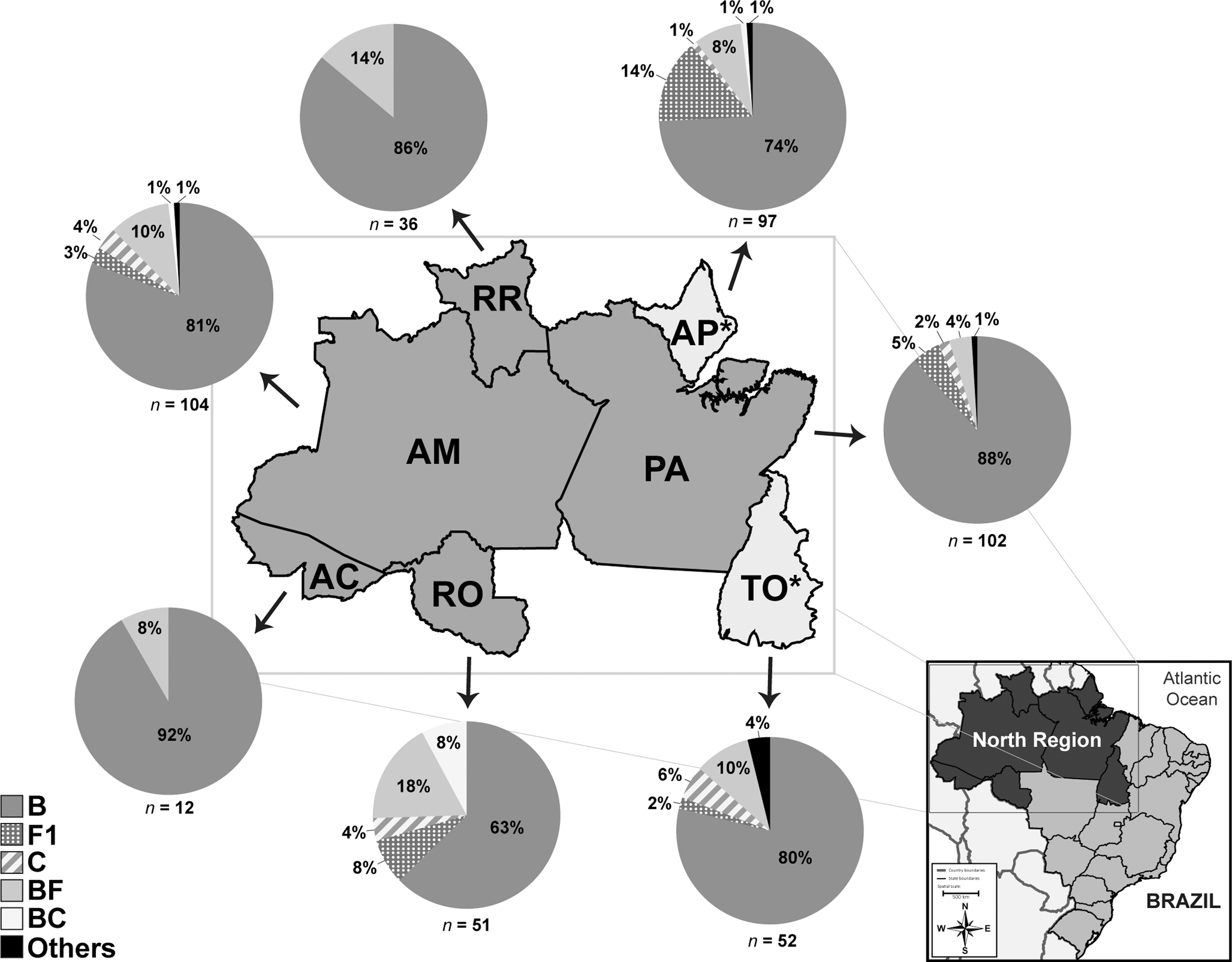
Map of Brazilian Northern region depicting the estimated prevalence of HIV-1 subtypes and intersubtype recombinants among HIV-infected individuals from different states. The total number of HIV-1 sequences analyzed in each locality is indicated below each graph. The HIV-1 subtype prevalence in the states of Amapá and Tocantins (marked with an asterisk) was estimated in previous studies. 8,13 AC, Acre; AM, Amazonas; AP, Amapá; PA, Pará; RO, Rondônia; RR, Roraima; TO, Tocantins.
A closer inspection of recombinant sequences revealed that the 30 BF1 recombinants detected were distributed in nine independent lineages (Fig. 2 and Supplementary Fig. S2). One BF1 lineage comprises sequences sampled at AM, PA, and RR (n = 5) that displayed the same mosaic structure at pol gene (Fig. 2) and branched with high support (Supplementary Fig. S2) with the CRFs 28_BF and 29_BF reference sequences and was thus classified as CRF28/29_BF-like recombinants. Two other BF1 lineages comprise more than two sequences with the same mosaic structure: BF-I (n = 16) and BF-II (n = 3) (Fig. 2). The lineages BF-I (that comprises sequences from AC, AM, RO, and RR) and BF-II (that only comprises sequences from RO) do not branch with any CRF_BF previously described in Brazil (Supplementary Fig. S2) or in South America (data not shown), and probably represent new CRFs_BF characteristic of the Northern Brazilian region. The remaining BF1 lineages detected in Northern Brazil comprise only one sequence each and were classified as unique recombinant forms (URFs_BF). All BC recombinants detected in RO displayed the same mosaic structure at pol gene (Fig. 2) and branched with high support (Supplementary Fig. S2) with the CRF31_BC reference strains and were classified as CRF31_BC-like recombinants, whereas the other BC strain from AM was classified as a URF_BC. Finally, the two BU recombinants identified displayed unique mosaic structures (Fig. 2).
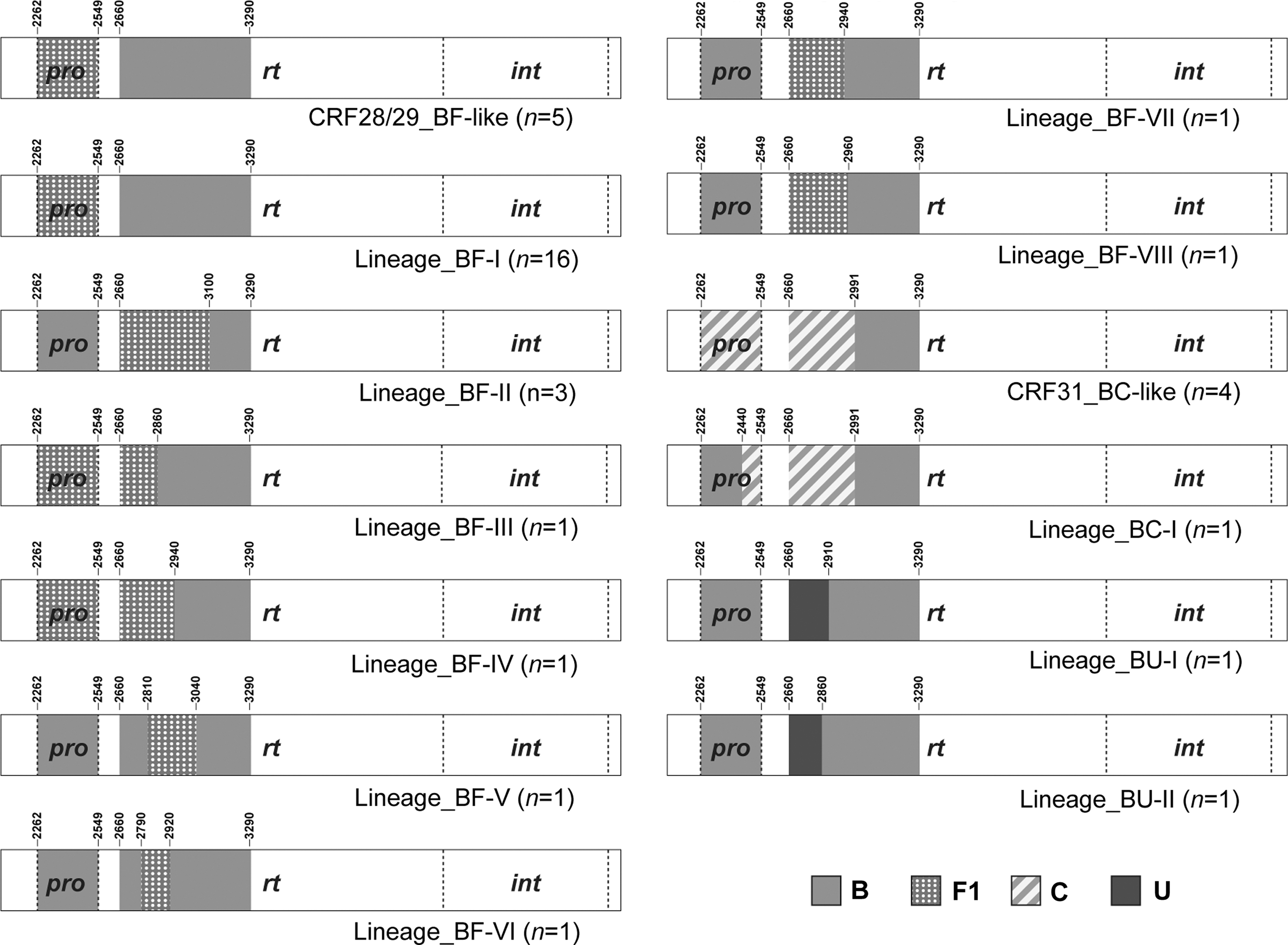
Schematic representation of the different mosaic patterns of intersubtype recombinant HIV-1 pol sequences from Northern Brazil. Segments are colored according to the subtype assignment as described in the legend. Fragments not analyzed were represented in white. Dotted lines delimitate the protease (pro), reverse transcriptase (rt), and integrase (int) regions.
Discussion
The AIDS epidemic in the Northern Brazilian region continues to expand, but the genetic characteristics of the HIV-1 strains circulating in this vast and relatively isolated region are largely unknown. The results from this study among patients from five different Northern Brazilian states indicate that the genetic complexity of the HIV-1 epidemic in the North is very high.
Despite the low spatial connectivity and population density, the HIV-1 epidemic in Northern Brazil resulted from multiple independent viral introductions and is dominated by subtype B, followed by F1 and BF1 recombinants, compared to that found in the Southeastern, Northeastern, and Central-Western Brazilian regions. 2 –5 HIV-1 subtype C and BC recombinants were also detected in the Northern region, consistent with previous studies. 7 –9,11,13 Although the overall prevalence of HIV-1 subtype C in Northern Brazil was low (<5%), this viral strain was detected in all northern states with a relative high sampling size (n > 40 sequences) (Fig. 1). This supports the notion that HIV-1 subtype C has experienced a slow (but steady) northward expansion from the epicenter in the southernmost states 18 and now reaches nearly all Brazilian states.
Recombinant strains comprise 13% of all HIV-1 pol sequences from Northern Brazil analyzed in this study. Some of the BF1 and BC recombinant sequences detected in the Northern region displayed a CRF28/29_BF-like and a CRF31_BC-like recombinant pattern. Although the CRF28/29_BF and CRF31_BC have been mostly associated to the Brazilian states of Sao Paulo (Southeastern region) 19 –21 and Rio Grande do Sul (Southern region), 22 –26 respectively, BC and BF1 pol sequences with a CRF-like mosaic structure have been described in some states from the Central-Western, 27 –29 Northeastern, 30,31 and Northern 13 Brazilian regions, supporting a wider dissemination of these Brazilian CRFs than originally described. The highest prevalence of CRF28/29_BF-like sequences was detected in the states of AM and RR (3%) and of CRF31_BC-like recombinants in RO (8%).
In this work, we also detected for the first time the circulation of two potentially new CRFs_BF, in this study, called lineage I and lineage II. The BF1 lineage I was particularly remarkable because it seems to reach a relative high prevalence in northern states located on the west: RO (10%), RR (8%), AC (8%), and AM (7%) and may represent an epidemiologically relevant regional CRF_BF. The BF1 lineage II, by contrast, was only detected in RO at a relative high prevalence (6%). The detection of these putative CRFs supports that HIV-1 epidemic in Northern Brazil has been also shaped by both viral dissemination through local (state-specific) transmission networks and viral exchanges among individuals from different Northern Brazilian states. Subsequent full-length genome analyses should be performed to determine whether those recombinants represent new CRFs_BF.
Although HIV-1 subtype B was the predominant HIV-1 clade in Northern Brazil, its prevalence greatly varied among different states, ranging from 63% in RO to 92% in AC. The states of AP and TO displayed the highest prevalence of subtype F1 (14%) and subtype C (6%), respectively, as described previously. 8,13 Notably, despite the low size of the HIV epidemic in RO with only 4,723 AIDS cases described up to June 2015, 1 this state displayed a quite complex molecular epidemiologic profile and the highest prevalence of BF1 (18%) and BC (8%) strains among northern states. It is also interesting to note that despite the high prevalence of BF1 and BC variants detected in RO, most recombinant viruses branched within only three clades (BF1 lineage I, BF1 lineage II, and CRF31_BC-like) and only one sequence from this state was classified as a URF.
In summary, the results from this study support a complex HIV-1 molecular epidemiologic profile in the Northern Brazilian region characterized by the cocirculation of subtypes B, F1, and C and diverse recombinant forms among those subtypes. HIV-1 subtype B was the predominant clade in Northern Brazil, but its prevalence greatly varies among different states. Our results also supports that the overall genetic complexity of the HIV-1 epidemic in the Northern region has been mostly shaped by: (1) multiple introductions of viral strains from other Brazilian regions (country-specific lineages), (2) viral exchanges among Northern Brazilian states (regional-specific lineages), and (3) local expansion of some viral strains (state-specific lineages). This study represents an important contribution to understand the molecular epidemiological characteristics of the HIV-1 epidemic in the Amazon Brazilian region.
Footnotes
Acknowledgment
E.D. is funded by a fellowship from “Programa Nacional de Pós-Doutorado (CAPES-Brazil).”
Sequence Data
Sequences were deposited in GenBank under accession numbers KU762018-KU762322.
Author Disclosure Statement
No competing financial interests exist.
References
Supplementary Material
Please find the following supplemental material available below.
For Open Access articles published under a Creative Commons License, all supplemental material carries the same license as the article it is associated with.
For non-Open Access articles published, all supplemental material carries a non-exclusive license, and permission requests for re-use of supplemental material or any part of supplemental material shall be sent directly to the copyright owner as specified in the copyright notice associated with the article.
