




Abstract
The Interleukin-10 (IL-10) gene polymorphism influences the pathogenesis and evolution of HIV-1 disease. Many studies in this regard have evaluated the association between this polymorphism and HIV-1 susceptibility, yet, the exact relationship between them remains ambiguous and contradictory. A systematic literature search was conducted and the found case–control studies assessing the association between IL-10-1082G/A, −592C/A, −819C/T gene polymorphism and HIV-1 susceptibility were analyzed. The pooled odds ratios (ORs) and 95% confidence interval (CI) were calculated by a fixed effect model. In general, no significant relationship was found between IL-10-1082G/A gene polymorphism and susceptibility to HIV-1 infection (A vs. G genotype model: OR = 0.97, 95% CI = 0.81–1.23, p = .775; GG vs. AA+AG model: OR = 0.98, 95% CI = 0.76–1.27, p = .867; GG+AG vs. AA model: OR = 0.97, 95% CI = 0.70–1.35, p = .852; GG vs. AA model: OR = 0.88, 95% CI = 0.67–1.15, p = .348; AG vs. AA model: OR = 0.96, 95% CI = 0.67–1.37, p = .811; GG+AA vs. AG model: OR = 1.03, 95% CI = 0.74–1.43, p = .886). IL-10-529C/A gene polymorphism might lead to a decreased risk of HIV-1 infection (A vs. G genotype model: OR = 0.88, 95% CI = 0.73–1.06, p = .166; GG vs. AA+AG model: OR = 0.94, 95% CI = 0.80–1.11, p = .447; GG+AG vs. AA model: OR = 0.75, 95% CI = 0.61–0.92, p = .005; GG vs. AA model: OR = 0.73, 95% CI = 0.57–0.93, p = .012; AG vs. AA model: OR = 0.74, 95% CI = 0.60–0.92, p = .0.007; GG+AA vs. AG model: OR = 1.11, 95% CI = 0.72–1.71, p = .641). IL-10-819C/T gene polymorphism might lead to an increased risk of HIV-1 infection (A vs. G genotype model: OR = 1.25, 95% CI = 1.04–1.50, p = .019; GG vs. AA+AG model: OR = 1.29, 95% CI = 0.81–2.01, p = .278; GG+AG vs. AA model: OR = 1.42, 95% CI = 1.05–1.93, p = .023; GG vs. AA model: OR = 1.63, 95% CI = 1.11–2.38, p = .012; AG vs. AA model: OR = 1.32, 95% CI = 0.95–1.84, p = .094; GG+AA vs. AG model: OR = 0.92, 95% CI = 0.72–1.19, p = .537). In general, the meta-analysis found no marked association between the IL-10-1082G/A gene polymorphism and HIV-1 susceptibility, IL-10-529C/A gene polymorphism might lead to a decreased risk of HIV-1 infection, and IL-10-819C/T gene polymorphism might lead to an increased risk of HIV-1 infection.
Introduction
I
Many reports have documented that HIV infection is characterized by generalized immune activation with high levels of circulating cytokines, such as tumor necrosis factor (TNF)-α, interleukin (IL)-6, and IL-10. 6 –9 Polymorphisms associated with decreased IL-10 production have been associated with increased likelihood of HIV-1 acquisition and accelerated rate of CD4+ T cell decline particularly in late stage disease, 10 suggesting that high IL-10 production may reduce susceptibility to HIV-1 infection and protect against disease progression. 11 Meanwhile, several reported studies suggest that IL-10 is associated in the pathogenesis of HIV-1 infection. 12 However, although many population studies on the relationship between susceptibility to HIV infection and IL-10-1082G/A, −592C/A, −819C/T gene polymorphism have been conducted, the results are inconsistent and inconclusive due to limited sample sizes and different study populations. 13,14 Hence, for this reason, a meta-analysis was carried out to explore whether there is any relationship between IL-10-1082G/A, −592C/A, −819C/T gene polymorphism and susceptibility to HIV-1 in the population.
Strategy for literature search
An extensive search of the available literature on the association between susceptibility to HIV-1 and IL-10 gene polymorphism (−1082G/A, −592C/A, −819C/T) was conducted by searching PubMed, Web of Knowledge, Embase, Chinese Web of Knowledge, Wanfang, and Chongqing VIP database. The database was searched up to January 2016 and included English and/or Chinese studies with the keywords “Human Immunodeficiency Virus” or “HIV” or “AIDS” or “Acquired Immune Deficiency Syndrome,” polymorphism or variant or mutation, “interleukin” or “IL” or “cytokine.”
Criteria for inclusion and exclusion
A strict criteria for inclusion and exclusion was used in this meta-analysis and all selected studies met the following inclusion criteria: (1) the aim of the study must be to assess the association between the IL-10-1082G/A, −592C/A, −819C/T gene polymorphism and HIV-1 susceptibility (2) must be a relevant case–control study (3) must have selected published and printed data for estimating the odds ratio (OR) with 95% confidence interval (CI).
On the other hand, the following studies were excluded: (1) animal studies (2) repeated study (3) studies where genotype frequencies were not reported.
Data extraction
Data was extracted by two investigators using a standardized data extraction method form from all elected studies individually, and in case of disagreement between the two researchers, discussion would ensue to reach consensus. The following information was extracted from each study: name of the first author, publication year, country, background, sample size, selection criteria of controls, genotype and allele/number of patients and controls.
Quality assessment
The Newcastle-Ottawa Scale for assessing quality of observational and nonrandomized studies was adopted for quality assessment.
Statistical analysis
The association between IL-10-1082G/A, −592C/A, −819C/T gene polymorphism and the susceptibility of HIV-1 was anticipated by OR with the corresponding 95% confidence interval (CI) under an allele model (G vs. A), a dominant model (GG vs. AA+AG), a recessive model (GG+AG vs. AA), and a co-dominant model (GG vs. AA) and an over-dominant model (GG+AA vs. AG). The implication of the pooled OR was determined by Z test. The fixed-effects model or random-effects model was utilized depending on whether heterogeneity existed among studies or not. Heterogeneity among studies was analyzed with Cochran's Q statistic and the I2 statistic. p < .10 in Q-test indicated no heterogeneity among studies. p < .1 rather than 0.05 was considered noteworthy heterogeneity for the χ 2-based Q testing and a value of 0% for I2 indicated no heterogeneity and increasing percentage implied increased heterogeneity. That is, I2 will be utilized to guess total variation across studies that are due to heterogeneity rather than chance (<25% is considered low heterogeneity, 25%–50% moderate, and >50% as high-level heterogeneity). 15,16 The numerical significance of OR was estimated using Z test, and p < .05 was measured as statistically important. To assess the stability of results sensitivity analysis was done by eliminating one single study each time. 17 Similarly, Hardy–Weinberg equilibrium was estimated by the χ 2 test in the controls. 18 To find publication bias Begg's funnel plot and Egger's test were examined. 19,20 Also, Egger's linear regression test was conducted to estimate funnel plot asymmetry (p < .05 was estimated significant publication bias), and other similar study analyses were done by using STATA version 12.0 software (Stata Corporation, College Station, TX). It was analyzed that all tests were two-sided and the significance levels were found to be 0.05.
Results
Search results and characteristics of the included studies
A database was used to shortlist 190 potentially relevant articles, from which a total of 146 articles were identified for further evaluation. Afterward, a more exhaustive reading and analysis helped to remove 97 potentially relevant articles, which were rejected because of their obvious irrelevance to the purpose of this study. Ultimately, six studies including 1147 cases and 1637 controls for IL-10-1082G/A, seven studies including 1279 cases and 1696 controls for IL-10-592C/A, and two studies including 440 cases and 565 controls for IL-10-819C/T gene polymorphism were incorporated in our meta-analysis. The flow chart of the search method is shown in Figure 1, while the individuality and characteristics of these articles are listed in Table 1. All nine studies provide the numbers of alleles in both cases and controls. To test all the polymorphism in the control group, the Hardy–Weinberg equilibrium model was used (Tables 2 –4).

Flow diagram of included/excluded studies.
HWE, Hardy–Weinberg equilibrium.
Risk of bias assessment
The quality of the studies included in the meta-analysis was assessed with the Newcastle-Ottawa Scale, and higher scores reflect better quality of the study methodology. The average score of all studies was above six (these results are not shown).
Pooled analyses
Association between the IL-10-1082G/A gene polymorphism and HIV-1 susceptibility
Fixed-effects model was used in the recessive model and the co-dominant model, and random-effects model was used in the other models. In general, no significant relationship was found between the IL-10-1082G/A gene polymorphism and susceptibility to HIV-1 infection (A vs. G genotype model: OR = 0.97, 95% CI = 0.81–1.23, p = .775; GG vs. AA+AG model: OR = 0.98, 95% CI = 0.76–1.27, p = .867; GG+AG vs. AA model: OR = 0.97, 95% CI = 0.70–1.35, p = .852; GG vs. AA model: OR = 0.88, 95% CI = 0.67–1.15, p = .348; AG vs. AA model: OR = 0.96, 95% CI = 0.67–1.37, p = .811; GG+AA vs. AG model: OR = 1.03, 95% CI = 0.74–1.43, p = .886) (Table 5 and Fig. 2).
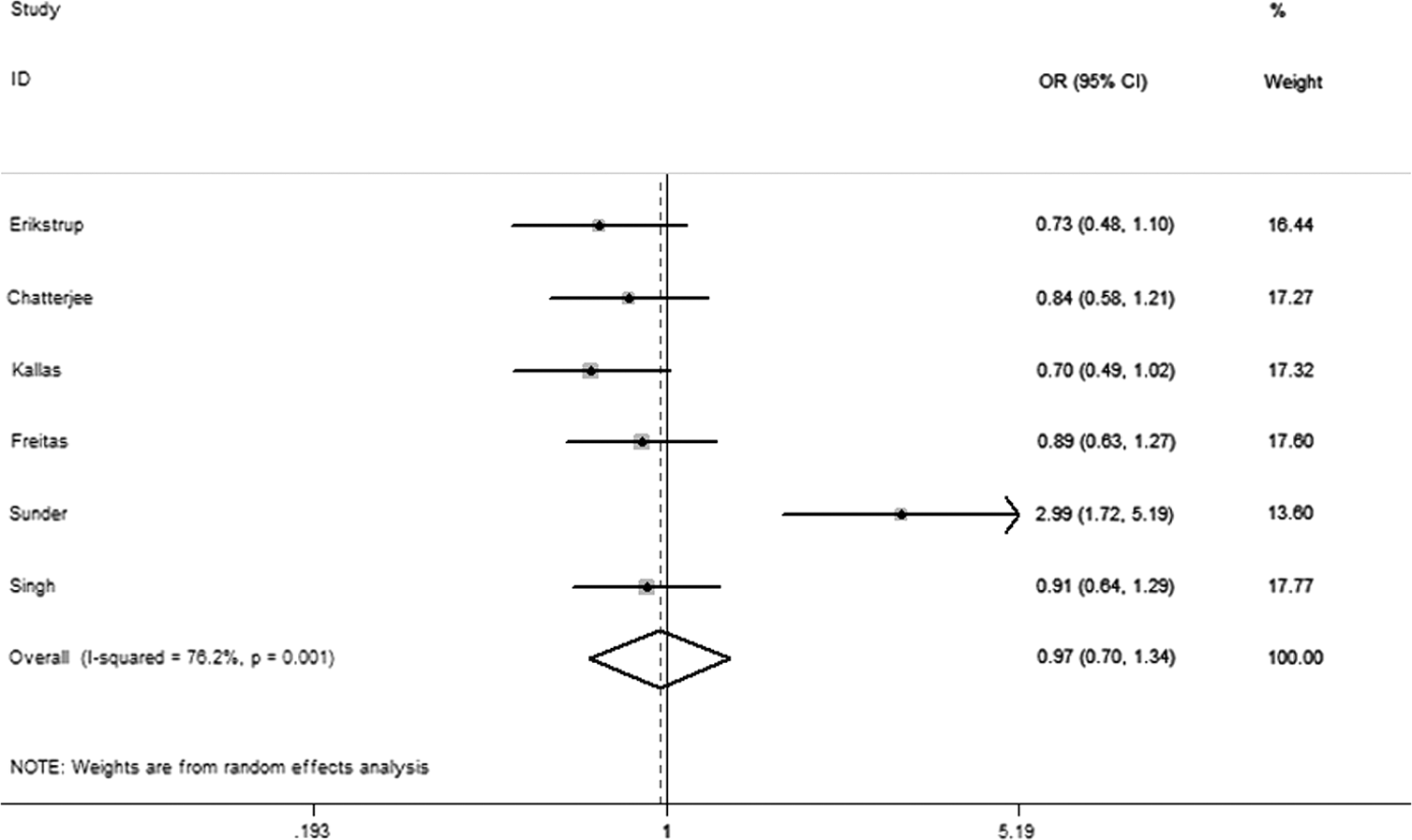
Forest plot of the susceptibility of HIV-1 associated with IL-10-1082G/A (AA vs. GG/AG).
*Phe t = p value for heterogeneity.
Association between IL-10-592C/A gene polymorphism and HIV-1 susceptibility
Random-effects model was used in the allele contrast model and over-dominant model, and fixed-effects model was used in the other models. In general, IL-10-592C/A gene polymorphism might lead to a decreased risk of HIV-1 infection (A vs. C genotype model: OR = 0.88, 95% CI = 0.73–1.06, p = .166; CC vs. AA+AC model: OR = 0.94, 95% CI = 0.80–1.11, p = .447; CC+AC vs. AA model: OR = 0.75, 95% CI = 0.61–0.92, p = .005; CC vs. AA model: OR = 0.73, 95% CI = 0.57–0.93, p = .012; AC vs. AA model: OR = 0.74, 95% CI = 0.60–0.92, p = .007; CC+AA vs. AC model: OR = 1.11, 95% CI = 0.72–1.71, p = .641) (Table 5 and Fig. 3).

Forest plot of the susceptibility of HIV-1 associated with IL-10-592C/A (CC vs. AA).
Association between the IL-10-819C/T gene polymorphism and HIV-1 susceptibility
Random-effects model was used in the recessive model, and random-effects model was used in the other models. In general, IL-10-819C/T gene polymorphism might lead to an increased risk of HIV-1 infection (C vs. T genotype model: OR = 1.25, 95% CI = 1.04–1.50, p = .019; TT vs. CC+CT model: OR = 1.29, 95% CI = 0.81–2.01, p = .278; TT+CT vs. CC model: OR = 1.42, 95% CI = 1.05–1.93, p = .023; TT vs. CC model: OR = 1.63, 95% CI = 1.11–2.38, p = .012; CT vs. CC model: OR = 1.32, 95% CI = 0.95–1.84, p = .094; TT+CC vs. CT model: OR = 0.92, 95% CI = 0.72–1.19, p = .537) (Table 5 and Fig. 4).
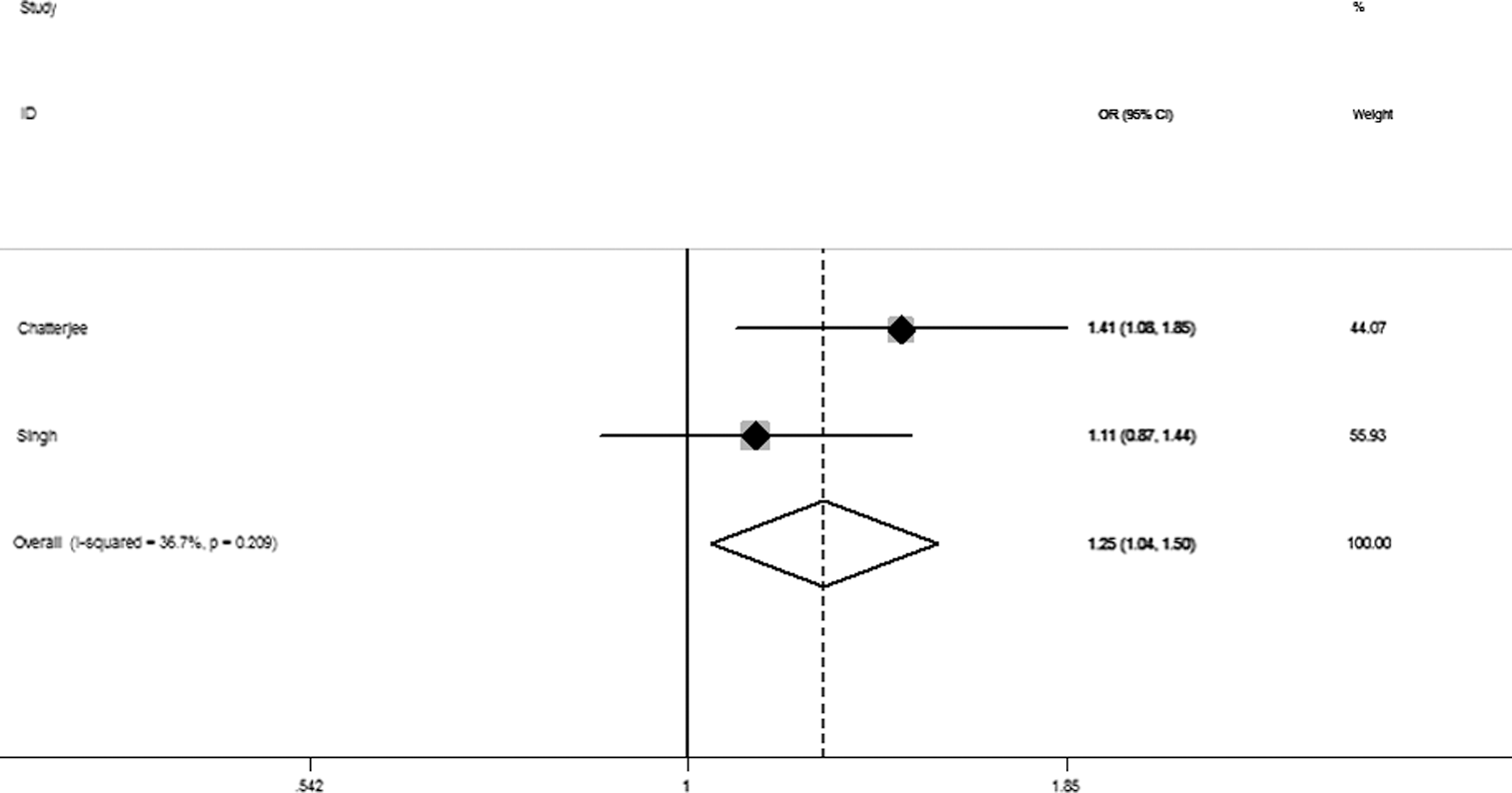
Forest plot of the susceptibility of HIV-1 associated with IL-10-819C/T (C vs. T).
Discussion
The present meta-analysis is evocative of the absence of a relationship between the IL-10-1082G/A gene polymorphism and susceptibility to HIV-1. Thus, the results of this meta-analysis indicate that the IL-10-1082G/A gene polymorphism are not involved in susceptibility to HIV-1. As for association between IL-10-592C/A, −819C/T and HIV-1 susceptibility, IL-10-592C/A gene polymorphism might lead to a decreased risk of HIV-1 infection, and IL-10-819C/T gene polymorphism might lead to an increased risk of HIV-1 infection.
HIV/AIDS has been increasing with the passage of time since it was found by the U.S. Center for Disease Control and Prevention (CDC) in 1981. 21 HIV-infections remain the deadliest epidemic in human history. Despite the reasonable progress made in the HIV/AIDS diagnosis, prevention and treatment of HIV/AIDS are still among the most important public health issues globally. 22 Cytokines play a vital role in regulating the homoeostasis of the immune system and alterations in their relative levels play critical roles in the immune response against HIV-1 infection and the progression of HIV-1 infection to clinical AIDS. 23 Many reports have documented that HIV infection is characterized by generalized immune activation with high levels of circulating cytokines, such as TNF-α, IL-6, and IL-10. 6 –9,24 Numerous population based studies have been conducted to authenticate the hypothesis that IL-10 gene polymorphisms may boost the susceptibility to HIV-1. 2,9,10 Nevertheless, at present, the available published data on the relationship between the IL-10-1082G/A, −592C/A, −819C/T gene polymorphism and HIV-1 susceptibility have only provided conflicting results. 13,14 Accordingly, to address this issue this study was undertaken.
IL10 is a TH-2 cell cytokine that inhibits macrophage growth and T cell cytokine secretion. 25 Interleukin 10 is a major regulator of innate immunity and prevents the development of immunopathological lesions that result from exacerbated protective immune response to acute and chronic infections. 26 HIV-1-infected individuals with a particular IL-10 promoter haplotype have recently been reported to progress to AIDS more rapidly, but with a late effect manifested primarily about 5 years post-HIV-1 seroconversion. 27 Indeed, IL-10 may promote viral persistence by inactivation of effect or immune mechanisms. 28,29 In addition, increasing evidence has suggested that IL-10 acts as a general inhibitor of proliferative and cytokine responses of both T-helper-Th1 and Th2 cells in vitro and in vivo. 30 IL-10 limits viral replication in vivo by inducing secretion of inflammatory cytokines and limiting replication of T cells. Polymorphisms in IL-10 were also shown to influence susceptibility to HIV infection and rate of progression to AIDS. 31
This study presents a detailed analysis of the association between the IL-10-1082G/A, −592C/A, −819C/T gene polymorphism and HIV-1 susceptibility. The results revealed no statistically significant relationship between the overall effects of the IL-10-1082G/A gene polymorphisms and HIV-1 susceptibility in any of the genetic models. The validity of the failure to detect any significant effect of this polymorphism on HIV-1 infection was endorsed by many critical factors. First, other IL gene polymorphisms such as IL-10-592C/A, −597C/A, −819T/C can affect the ability of produce IL-10 and afterward affect the susceptibility to HIV-1. 32 –35 In the meantime the low AA genotype frequency can be an important element. 36 Additionally, it could be due to the antagonistic relation of the opposite effect that can be seen between IL and other genes. 37 Consequently, the effect must be analyzed with vigilance, and further investigations with additional extensive number of case–control studies are necessary to authenticate these result. As for association between IL-10-592C/A, −819C/T and HIV-1 susceptibility, IL-10-529C/A gene polymorphism might lead to a decreased risk of HIV-1 infection, and IL-10-819C/T gene polymorphism might lead to an increased risk of HIV-1 infection.
Several limitations need to be addressed, and they could influence the result. First, this meta-analysis was based on a relatively small number of studies. Second, we confined our studies to published studies in English and Chinese, and thus did not include the unpublished researches, as a result related articles published in other language or unpublished studies were left out and this method could lead to the oversight of some related studies concerning the relationship between the IL-10-1082G/A gene polymorphism and HIV-1 susceptibility. Third, we could not test for the gene and environment interactions due to the lack of sufficient studies. Fourth, the detailed genetic data in different age and gender were insufficient in the studies of this meta-analysis, so there is no analysis about different age and gender. In the future, we will continue to collect the detailed genetic data in different age and gender for further analysis. Additionally, we should all be aware of the heterogeneity that was revealed by our analyses. The heterogeneity is a potential problem.
To the best of our knowledge, this is the first meta-analysis that has been performed to examine the relationship between the IL-10-1082G/A, −592C/A, −819C/T gene polymorphism with HIV-1. Additionally, the relationship between the IL-10-1082G/A, −592C/A, −819C/T gene polymorphism and HIV-1 susceptibility is statistically more persuasive than any single study. But this issue must be further investigated to ascertain the relationship between other related variables with the susceptibility to HIV-1.
Conclusion
This study evaluated the association between IL-10-1082G/A, −592C/A, −819C/T gene polymorphism and HIV-1 susceptibility. IL-10-1082G/A gene polymorphism are not involved in susceptibility to HIV-1, IL-10-592C/A gene polymorphism might lead to a decreased risk of HIV-1 infection, and IL-10-819C/T gene polymorphism might lead to an increased risk of HIV-1 infection.
Footnotes
Acknowledgment
We thank all our colleagues working in the Department of Epidemiology and Health Statistics, School of Public Health of Central South University.
Author Contributions
Designed the experiments: L.C. and C.J. Performed the experiments: C.J., Z.L., and S.J.L. Analyzed the data: C.J., S.X.L., and P.C. Contributed reagents/materials/analysis tools: L.C., C.J., and Z.L. Wrote the article: C.J. and L.C.
Author Disclosure Statement
No competing financial interests exist.