




Abstract
Polymorphisms of the hepatitis C virus (HCV) core protein and NS3 have been described to be associated with liver cirrhosis (LC) and/or hepatocellular carcinoma in patients with chronic hepatitis C genotype 1b (HCV 1b). Here, we determine whether there is an association between LC and polymorphisms of viral core protein and NS3 in patients in Hubei province, China. A total of 42 patients with chronic HCV 1b (21 patients with LC and 21 with chronic hepatitis [CH]) were enrolled, amino acid sequence of the core protein and N-terminus of NS3 were obtained by direct sequencing and compared with the prototype strain HCV-J. No significant difference of amino acid polymorphisms was observed between isolates from LC and CH patients in the core protein. However, in the N-terminus of NS3, amino acid polymorphisms at positions A1072T (Ala 1072 chronic Thr 1072 cirrhosis), I1074V (Ile 1074 chronic Val 1074 cirrhosis), and T1098N/I (Thr 1098 chronic Asn or Ile 1098 cirrhosis) correlated significantly with LC. These findings indicate that the polymorphisms of HCV at these sites may be the risk factors for the development of LC in patients with chronic HCV 1b.
L
About 15%–20% of chronically infected individuals eventually develop cirrhosis within a decade; however, other patients may show persistently normal alanine aminotransferase levels during this period, and the mechanisms of these clinical differences remain poorly understood. 4,5 Therefore, it is necessary to understand the heterogeneity of disease progression in chronically infected individuals.
Both host and viral factors may be involved in the heterogeneity of HCV disease progression, the host factors including age of infection, gender, alcohol intake, as well as genetic related. 1 With regard to viral factors, several studies have indicated that HCV core protein mutations at positions 70 (Gln70) and/or 91 (Met 91) were associated with LC and HCC. 5 –9 In addition, mutations at N-terminus of NS3 also described to be related to HCC. 5 The studies already described, however, were carried out based on the patients in Japan and the United States; the aim of this study was to explore the association between LC and polymorphisms of the core protein and N-terminus of NS3 in patients in Hubei province, China.
Forty-two patients (21 patients with LC and 21 with chronic hepatitis [CH]) persistently infected with HCV genotype 1b were enrolled between July and August 2014 from Zhongnan hospital of Wuhan University, Centers for Disease Control and Prevention of Wuxue and Health Centre of Dougang Town. The patients all accorded with the following criteria: (i) they were former paid blood donors in rural areas of Hubei Province; (ii) they were free of coinfection with HBV and/or HIV; and (iii) they had no alcoholic liver disease, primary biliary cirrhosis, autoimmune liver disease, or other forms of hepatitis. LC was diagnosed based on a combination of clinical, biochemical (AST/Platelet Ratio Index>2), and ultrasound imaging findings. The study protocol was approved by the Ethic Committees of Zhongnan hospital of Wuhan University and conformed to the ethical guidelines of the Declaration of Helsinki. The objectives and methods of this study were clearly explained to the patients. Informed written consent from guardians was obtained before collection of data and taking blood samples.
Quantitative HCV RNA detection was performed with the diagnostic kit for quantification of HCV RNA (Shanghai Huake Bio-engineering Co., LTD.) according to the manufacturer's protocol with a detection limit of 250 IU/ml. To perform sequence analysis, HCV RNA was extracted from 200 μl plasma sample using the Trizol LS reagent following the manufacturer's protocol and cDNA was synthesized in a 20 μl reaction volume containing 200 U M-MLV reverse transcriptase (Promega) at 42°C for 60 min. The core and N-terminus of NS3 regions of the HCV genome were amplified as described elsewhere. 10,11 Direct sequencing was used to determine the sequences of the amplified fragments.
HCV genetypes were determined by phylogenetic tree analysis of the core region. Six HCV nucleotide sequences with known genetype (genetypes 1a, 1b, 2a, 3a, 4a, 5a, and 6b) were collected from the HCV sequence database (
Chi-square or Fisher's exact probability tests were used for categorical variables. For measurement data, Student's t-test was used. SPSS17.0 software package was used and a p < .05 was considered significant.
Sequences of core protein were obtained from all patients' plasma. As shown in Figure 1, the hepatitis C genotype 1b was the sole genotype of all the viral isolates from 42 patients. The clinical characteristics of LC and CH groups are shown in Table 1. The LC group had significantly higher titers of AST, TBIL, and the value of APRI, but lower platelet counts and albumin titers than those of the CH group. There was no significant difference in HCV RNA titers between the two groups (Table 1).
Mean ± SD.
ALT, alanine aminotransferase; APRI, AST/platelet ratio index; AST, aspartate transaminase; CH, chronic hepatitis; HCV, hepatitis C virus; LC, liver cirrhosis; TBIL, total bilirubin.
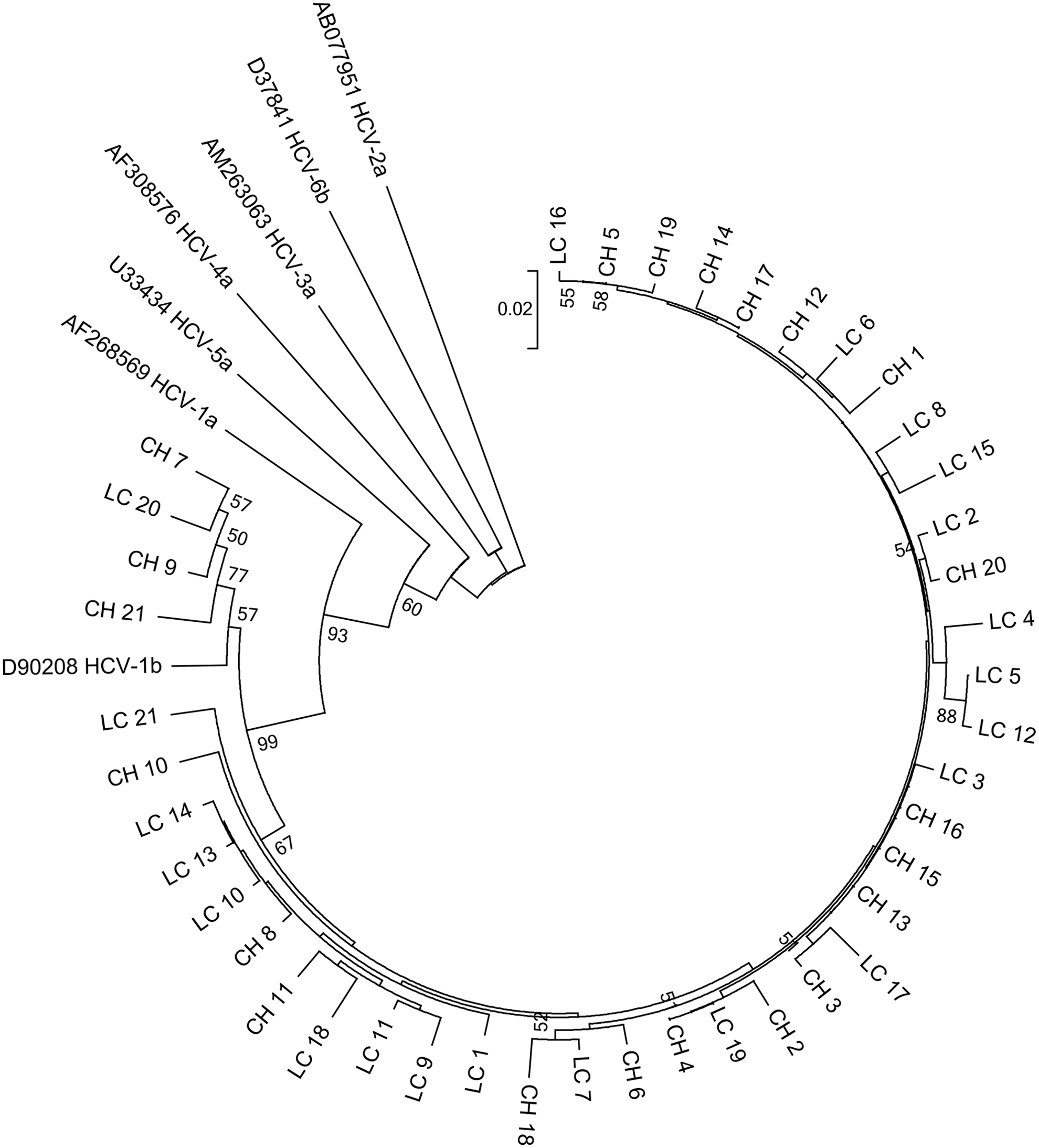
Phylogenetic tree of core sequences from patients with LC and CH (21 with LC and 21 with CH). Branch lengths are drawn to scale. The scale bar represents 2% of nucleotide sequence divergence. Sequences of the six HCV subtypes (subtypes 1a, 1b, 2a, 3a, 4a, 5a, and 6b) have been included in the tree. CH, chronic hepatitis; LC, liver cirrhosis; HCV, hepatitis C virus.
No significant difference in amino acid polymorphisms of the core protein was observed between isolates from LC and CH patients. The mutation rates of aa70 in the LC group and CH group were 14% (3/21) and 10% (2/21), respectively. The mutation rates of aa 91 in the LC group and CH group were 24% (5/21) and 33% (7/21), respectively (Table 2).
Sequences of NS3 were obtained from 95% (20/21) and 90% (19/21) of LC and CH isolates, respectively; Arg70, arginine at position 70 of the core protein; Leu91, leucine at position 91 of the core protein; Thr1072, threonine at position 1072 of NS3; Ala1072, alanine at position 1072 of NS3; Ile1074, isoleucine at position 1074 of NS3; Val1074, valine at position 1074 of NS3; Asn1098, asparagine at position 1074 of NS3; Ile1098, isoleucine at position 1098 of NS3; Thr1098, threonine at position 1098 of NS3.
Sequences of NS3 were obtained from 95% (20/21) and 90% (19/21) of LC and CH isolates, respectively. We found that 17 of 20 LC isolates (85%) had Thr at position 1072, whereas only 6 of 19 CH isolates (32%) did; at position 1074, 10 of 20 LC isolates (50%) had Val, whereas only 2 of 19 CH isolates (11%) did; at position 1098, 10 of 20 LC isolates were (50%) Asn or Ile (N/I), whereas the rate was 11% (2/19) in the CH isolates. Significant differences were observed between the LC group and CH group at the amino acid polymorphisms in positions 1072, 1074, and 1098 (p = .001, p = .014, p = .014, respectively, Table 2 and Fig. 2).
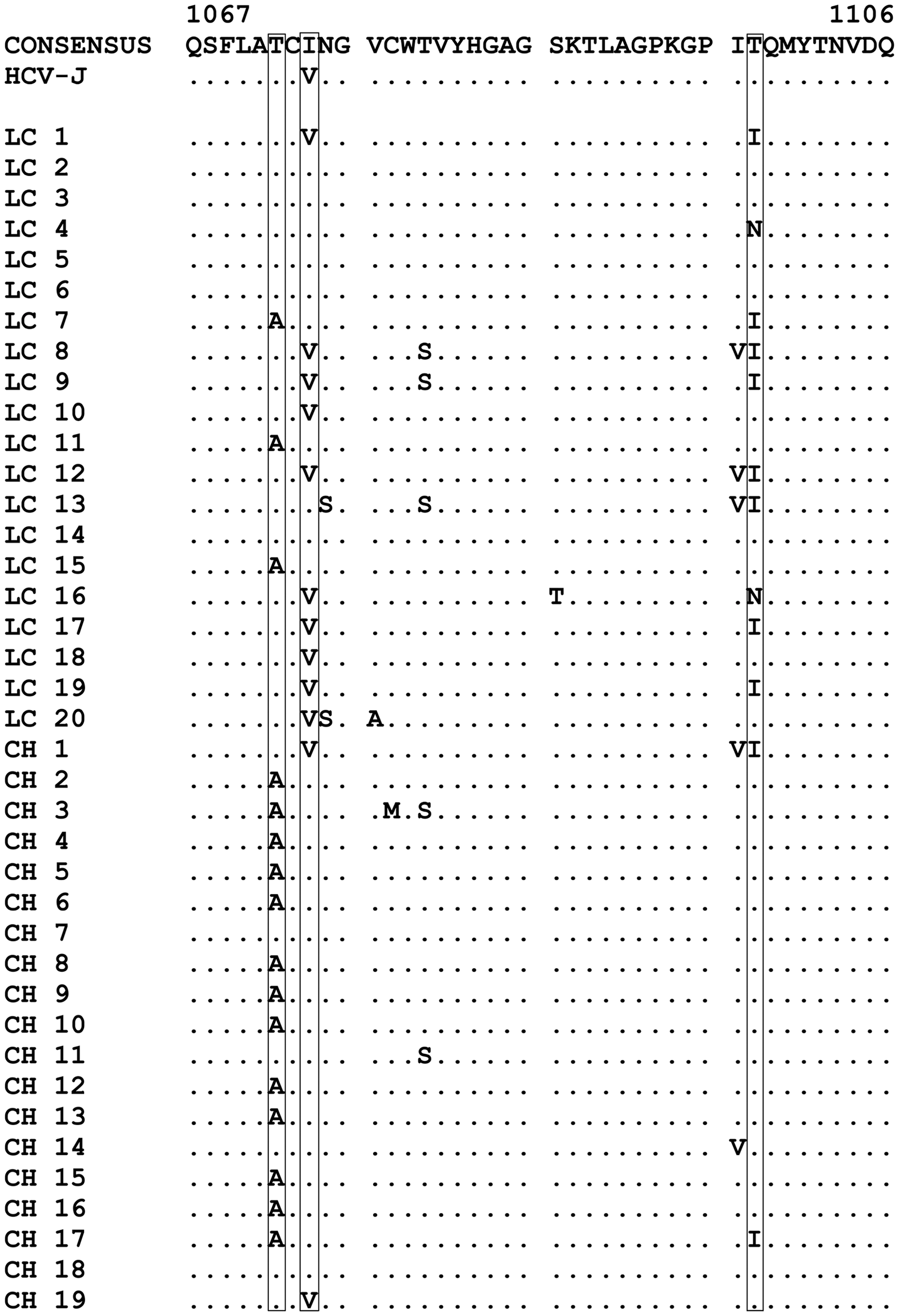
Alignment of deduced aa sequences 1067–1106 in the NS3 from patients with LC and CH. Amino acid residues are indicated with standard single-letter code, and dots indicate residues identical to those in the consensus sequence derived from all sequenced isolates, the numbers along the sequence indicate the aa positions. Sequence of prototype HCV-J is shown for comparison. The aa1072, aa1074, and aa1098 are shown in boxes from left to right in the figure, respectively.
LC is one of the most common long-term complications of chronic HCV infection. In this study, we demonstrated that HCV isolates with NS3-A1072T, NS3- I1074V, and NS3-T1098N/I were closely associated with LC development. Although the core-Gln70 was described to be associated with LC in Japanese patients, this association was not observed in our study. The difference may be because of geographical differences of HCV isolates in different countries. To our knowledge, this is the first report about the correlation between NS3-A1072T/I1074V/T1098N/I and LC. Future studies are necessary to understand the mechanism of the association between HCV NS3 polymorphisms and the development of LC.
Footnotes
Acknowledgments
This research was supported by grants from the Nature Science Foundation of Hubei Province, grant number 2013CFB254. We thank Prof. W.-Z.H. for proofreading the article. The GenBank accession numbers are KT948818–KT948898.
Author Disclosure Statement
No competing financial interests exist.