




Abstract
A novel HIV-1 unique recombinant virus (XC2014EU20) was identified. It was isolated from an HIV-positive man who was infected through heterosexual sex in Sichuan, China. The near full-length genome analyses showed that the novel recombinant was composed of three subtype B regions in a subtype C backbone. Different from the other circulating recombinant forms and unique recombinant forms, six recombinant breakpoints of XC2014EU20 with seven fragments were observed in the pol, vpu, and nef genes, respectively. The emergence of B/C recombinant strain indicated the increasing complexity of the HIV-1 epidemic in Sichuan, China.
H
In this study, we separated a recombinant strain of HIV-1 (XC2014EU20) from a 41-year-old male, who was infected through heterosexual sex in Sichuan, China, and presented with CD4+ T-cell count 405 cells/μl and viral load 8,550 copies/ml on May 15, 2014. Informed consent was signed before the sample collection. This study was reviewed by the Institutional Research Ethics Community of the Chinese Center for Disease Control and Preventive (No. 201334).
Viral RNA was extracted from the virus isolated from the peripheral blood mononuclear cells using QIAamp® Viral RNA Mini Kit, and then transcribed into cDNA. Through gradient dilution of cDNA, the near full-length genome (NFLG) was amplified by nested polymerase chain reactions (nest-PCRs). 4 The following PCR conditions for both of the two rounds were used, including an initial denaturation of 94°C for 2 min followed by 35 cycles of 94°C for 30 s, 62°C for 30 s, and 68°C for 4 min, followed by a final extension at 68°C for 10 min. The positive PCR products were purified and sequenced. The sequences were spliced and assembled by Sequencher v4.9.
The NFLG sequences were first aligned with the HXB2 as standard reference strain by using Clustal W, and then adjusted manually by using BioEdit.
8
The standard subtype reference alignment file was obtained from the Los Alamos National Laboratory HIV Database (
As shown in Figure 1, the NFLG sequence of the novel virus (XC2014EU20) was clustered with CRF07_BC with 0.838 bootstrap values, but formed a monophyletic branch distinct from them. The recombinant pattern analyses conducted by Simplot identified that the genome NFLG sequences of XC2014EU20 were probably composed of three subtype B regions (regions II, IV, and VI) in a subtype C backbone (regions I, III, V, and VII). The breakpoint positions refer to the HXB2 coordinates, and were located by the HIV Sequence Locator (
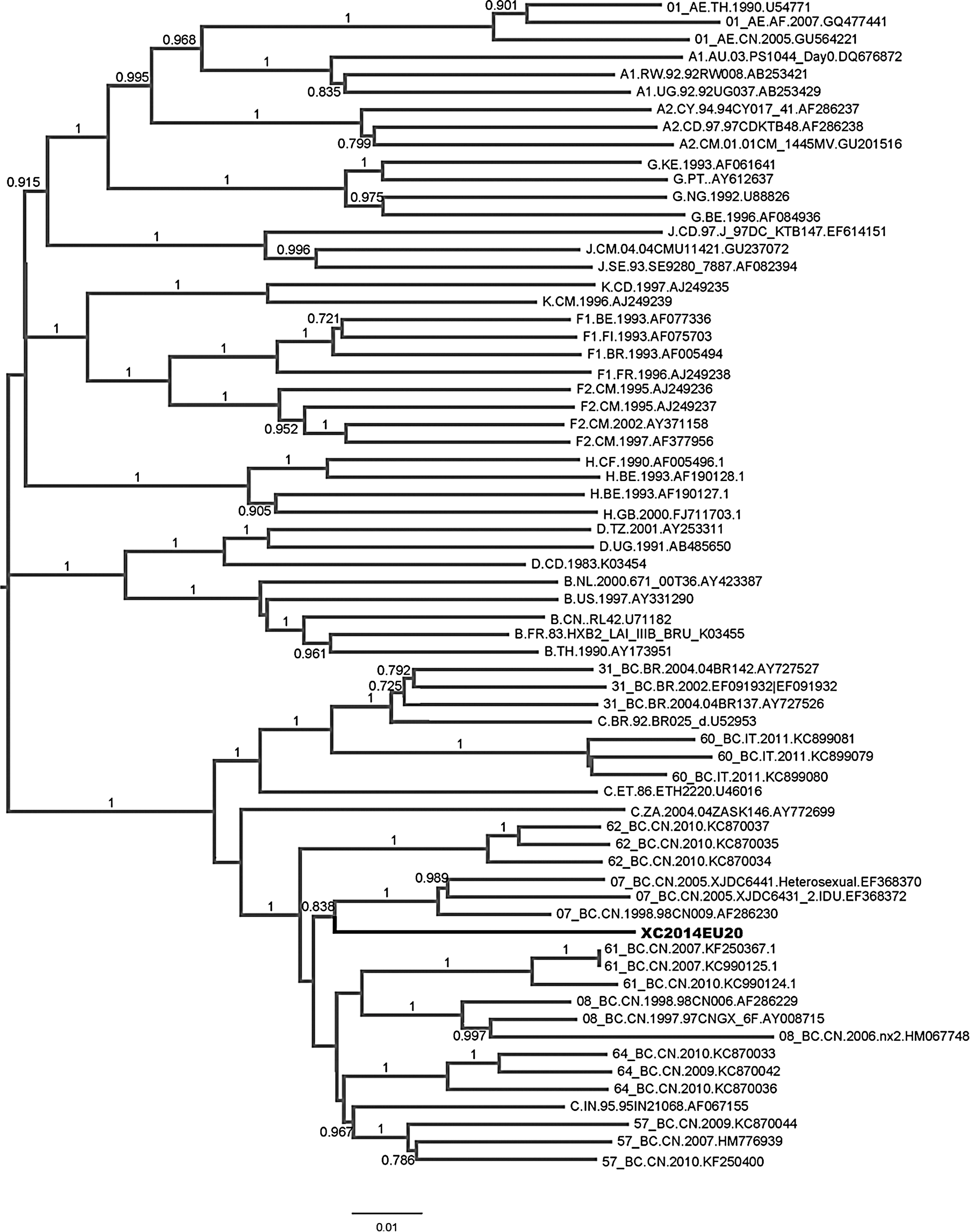
Phylogenetic tree analyses of the NFLG sequence of XC2014EU20. It was constructed by the neighbor-joining method. XC2014EU20 clustered with the CRF07_BC reference sequences, but formed a distinct monophyletic branch distantly related to the CRF07_BC reference sequences. Bootstrap values (>0.7) are shown at the corresponding nodes. NFLG, near full-length genome.

Recombinant analysis for XC2014EU20.
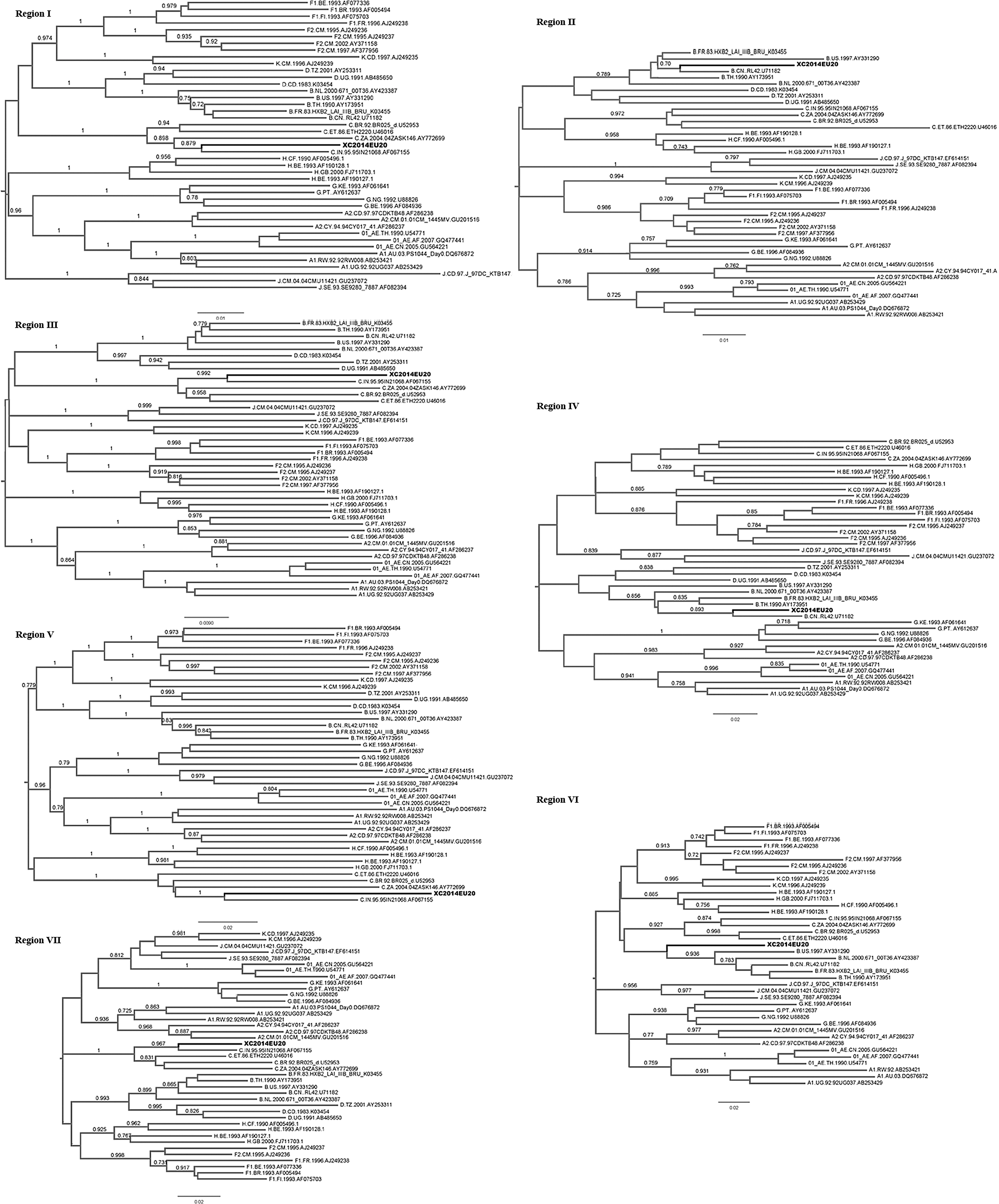
Phylogenetic trees for seven genome fragments of the newly identified XC2014EU20. Black label marks each fragment of XC2014EU20, which was displayed as a bold line in each phylogenetic tree. The subtypes and names of all sequences are pointed in the right side of the trees. The scale bars are shown at the bottom of each tree. Bootstrap values (>0.7) are shown at the corresponding nodes.
The NFLG of XC2014EU20 kept the subtype C parental backbone with three small subtype B fragments inserted into pol, vpu, and nef genes, respectively. There were five B fragments inserted into the subtype C parental backbone in CRF07_BC. 2 In addition to the three subtype B fragments inserted into pol, vpu, and nef genes, respectively, the other two B fragments were inserted into gag and gag-pol genes. The recombinant form XC2014EU20 was similar to CRF08_BC, both of which were three subtype B fragments inserted into the subtype C parental backbone. 3 Two subtype B fragments were inserted into pol and nef genes. The other B fragment of CRF08_BC was inserted into p24 of gag gene, whereas the other B fragment of XC2014EU20 was inserted into vpu gene. 3 The recombinant forms of CRF57_BC and CRF62_BC were different from XC2014EU20. 4,6 Only one subtype B fragment was found in gag gene of subtype C parental backbone in CRF57_BC. 4 And two subtype B fragments were inserted into pol and vpu-env genes of subtype C parental backbone in CRF62_BC. 6 Different from the recombinant form of XC2014EU20, CRF61_BC composed of two established CRFs (CRF07_BC and CRF08_BC). 5 Compared with XC2014EU20, the recombinant form of CRF64_BC identified that there were five subtype B fragments inserted into gag, pol, and nef genes of subtype C parental backbone, respectively. 7 The recombinant structure of XC2014EU20 was distinct from any known CRFs and URFs to date. To further understand the pattern of viral recombination and recombinant site, it was necessary to discover more recombinant forms.
The novel B/C recombinant identified in this study suggested the continued generation of new recombinant strains in Sichuan. This obviously increases the complexity of the HIV epidemic and may complicate the development of an HIV vaccine. Understanding the molecular epidemiologic properties of these newly emerging inter subtype recombinants will provide critical information for designing effective prevention measures against HIV transmission in the region.
Sequence Data
The NFLG sequence of XC2014EU20 has been submitted to GenBank with the accession number KU886698.
Footnotes
Acknowledgments
This work was supported by the National Natural Science Foundation of China (grant numbers 81261120384, 81172733, and 81561128006), the Key Project of the State Key Laboratory of Infectious Diseases Prevention and Control (grant number 2011SKLID102), and the European Research Infrastructures for Poverty-Related Diseases (grant number 312661).
Author Disclosure Statement
No competing financial interests exist.