




Abstract
Recombinant forms contribute substantially to the genetic diversity of human immunodeficiency virus type 1 (HIV-1). Here we report a novel HIV-1 recombinant detected from a comprehensive HIV-1 molecular epidemiologic study among cross-border populations in China. Near full-length genome (NFLG) phylogenetic analysis showed that the novel HIV-1 recombinant ZJCIQ15005, which was isolated from a Malaysian immigrant worker in Zhejiang, China, clustered with CRF55_01B reference sequences but set up a distinct branch. Recombinant analysis showed that the NFLG of ZJCIQ15005 composed of CRF55_01B (as the backbone) and CRF07_BC, with 12 recombinant break points observed in the pol, vif, vpr, tat, rev, env, nef, and 3′LTR regions. This is the first detection of a novel HIV-1 recombinant (CRF55_01B/CRF07_BC) in immigrant workers in China. The emergence of this recombinant may increase the complexity of the HIV-1 epidemic in China and suggests the importance of continuous surveillance of the dynamic changes of HIV-1.
H
As China is continuously open to the world, people from all around the world can come to China freely for business, travel, study, etc. This can facilitate diverse social and cultural exchange on one hand, but on another hand, it may potentially increase the transmission and spread of various diseases, including HIV-1/AIDS. Therefore, it is important and necessary to monitor HIV-1 infection status and viral dynamics among cross-border populations.
In the present study, plasma was collected from an HIV-1-positive patient (ZJCIQ15005) in March 2015 with informed consent. Epidemiological survey data showed that the patient was a 35-year-old male and a Malaysian citizen who came to Zhejiang, China, as an immigrant worker. Unfortunately, he refused to disclose background information related to infection time, route, and high-risk behaviors involved. The near full-length genome (NFLG) of ZJCIQ15005 (8974 bp) was amplified using primer sets and parameters described previously. 8,9 Polymerase chain reaction products were purified and sequenced by an ABI 3730XL sequencer using BigDye terminators (Applied Biosystems, Foster City, CA). A BLAST search was performed to exclude the possibility of cross-contamination.
NFLG sequence of ZJCIQ15005 was aligned together with reference sequences obtained from the HIV databases (
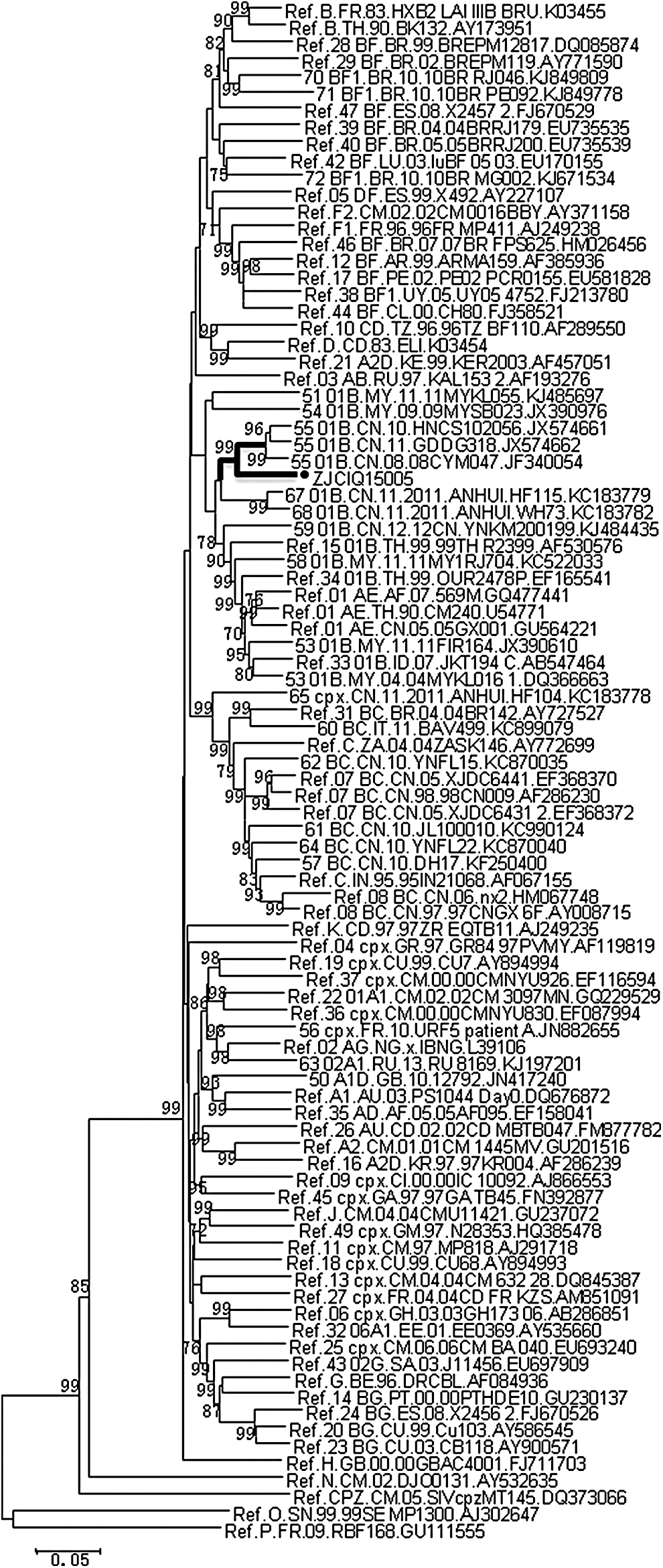
Phylogenetic analysis of the NFLG nucleotide sequence of the ZJCIQ15005 isolate. The neighbor-joining phylogenetic tree was constructed based on the NFLG nucleotide sequences of HIV-1 isolates using the MEGA 6 software package. All the reference strains were retrieved from the Los Alamos National Laboratory HIV Sequence Database. The ZJCIQ15005 isolate was labeled with a black solid circle in the highlighted branch. Bootstrap analysis was performed with 1,000 replications, and only bootstrap values >70% are shown. The scale bar represents 5% genetic distance. HIV-1, human immunodeficiency virus type 1; NFLG, near full-length genome.
To analyze the recombination form of ZJCIQ15005, the sequence was submitted to RIP (

RIP analysis for ZJCIQ15005. Similarity distance analysis was performed using RIP from the Los Alamos National Laboratory HIV Database with default setting except for the window size of 300. RIP, Recombinant Identification Program.
Bootscan analysis was subsequently carried out using SimPlot (version 3.5.1) to position the recombination break points. The query sequence ZJCIQ15005 was bootscanned with reference sequences (CRF55_01B and CRF07_BC as parents, subtype G as outgroup) using all default settings. Bootscan results showed that ZJCIQ15005 was composed of 12 interlaced mosaic segments corresponding to CRF55_01B (I, III, V, VII, IX, and XI) and CRF07_BC (II, IV, VI, VIII, X, and XII), respectively (Fig. 3). All CRF55_01B segments were well confirmed by phylogenetic trees with bootstrap values between 88 and 100 (Supplementary Fig. S1; Supplementary Data are available online at
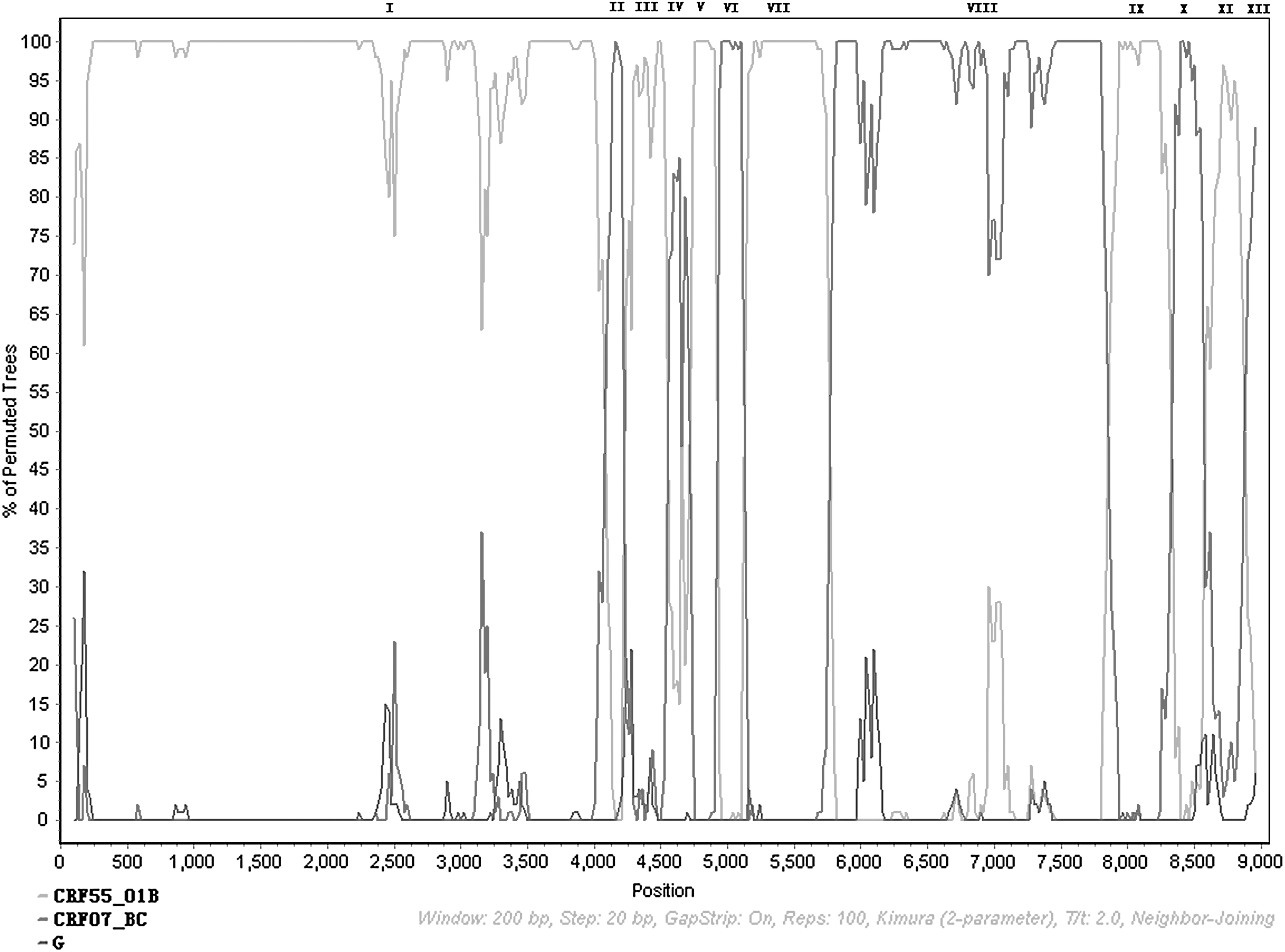
Bootscan plots of ZJCIQ15005 using CRF55_01B, CRF07_BC, and subtype G as subtype references.
The break point positions were referred to the HXB2 coordinates and located by the HIV Sequence Locator (

Genomic map of ZJCIQ15005. The break point positions referred to HXB2 coordinates located by the HIV Sequence Locator (
The recombinant ZJCIQ15005 was discovered from a comprehensive HIV-1 molecular epidemiologic study among cross-border populations in Zhejiang province of China. Besides this CRF55_01B/CRF07_BC recombinant, we also detected CRF02_AG, CRF01_AE/07_BC, CRF55_01B, CRF03_AB, CRF13_cpx, CRF64_BC, and CRF65_cpx recombinant viruses, all of which were relatively new and rare for the Chinese populations (data not shown). Therefore, a continuing HIV-1 molecular epidemiologic investigation that focuses on cross-border populations is necessary to characterize their potential recombination and transmission, which may help to understand the dynamics of the HIV-1 epidemic.
In summary, we characterized an NFLG sequence from an immigrant worker and identified a novel HIV-1 recombinant, consisting of different recombinant break points between CRF55_01B and CRF07_BC strains. Understanding the properties of these newly emerging inter-CRF recombinants may provide a better comprehensive understanding to incorporate in the design of vaccines and other effective prevention measures to control and limit the HIV/AIDS epidemic in China.
Sequence Data
The NFLG sequences of ZJCIQ15005 have been deposited in GenBank with the accession number KX010453.
Footnotes
Acknowledgments
The authors thank Samantha Chen for proofreading. This study was supported by the Science and Technology Program of Guangdong, China (grant no. 2015A020211004), the Chinese National Science and Technology Major Projects for Infectious Diseases Control and Prevention (grant no. 2012ZX1001-002), and the Open Research Fund of the State Key Laboratory (grant no. 2015SKLD308).
Author Disclosure Statement
No competing financial interests exist.
References
Supplementary Material
Please find the following supplemental material available below.
For Open Access articles published under a Creative Commons License, all supplemental material carries the same license as the article it is associated with.
For non-Open Access articles published, all supplemental material carries a non-exclusive license, and permission requests for re-use of supplemental material or any part of supplemental material shall be sent directly to the copyright owner as specified in the copyright notice associated with the article.
