




Abstract

E
The first patient was a 62-year Brazilian Caucasian male with HAM/TSP diagnosis according to WHO criteria. He reported to be bisexual with promiscuous sexual behavior. His spouse (patient 2) was a 54-year Caucasian female with HAM/TSP who developed a concomitant aggressive non-Hodgkin's lymphoma that evolved around 6 months to death. She reported that the husband was the single sexual partner during her life. DNA from peripheral blood mononuclear cells (PBMCs) was extracted. HTLV-1 proviral load was determined by TaqMan Real Time PCR. Patients 1 and 2 presented 20.6 and 94.01 copies tax/100 PBMCs, respectively. The long terminal repeat (LTR) and ORF-I regions were amplified and sequenced. Both individuals presented the G29S mutation and a viral similarity of 100% in both regions. To determine if the G29S mutation occurred prior to or after transmission, we elucidated the genetic relationship between p12 and LTR sequences of HTLV-1 from our patients and sequences available in GenBank. All samples with G29S belonged to a particular cluster in the phylogenetic tree (Fig. 1), demonstrating that those samples shared a recent common ancestor and that are likely to reflect that there was recent or ongoing transmission. Here, we characterized this polymorphism associated with a particular HTLV-1aA lineage. This lineage is circulating in Brazil.
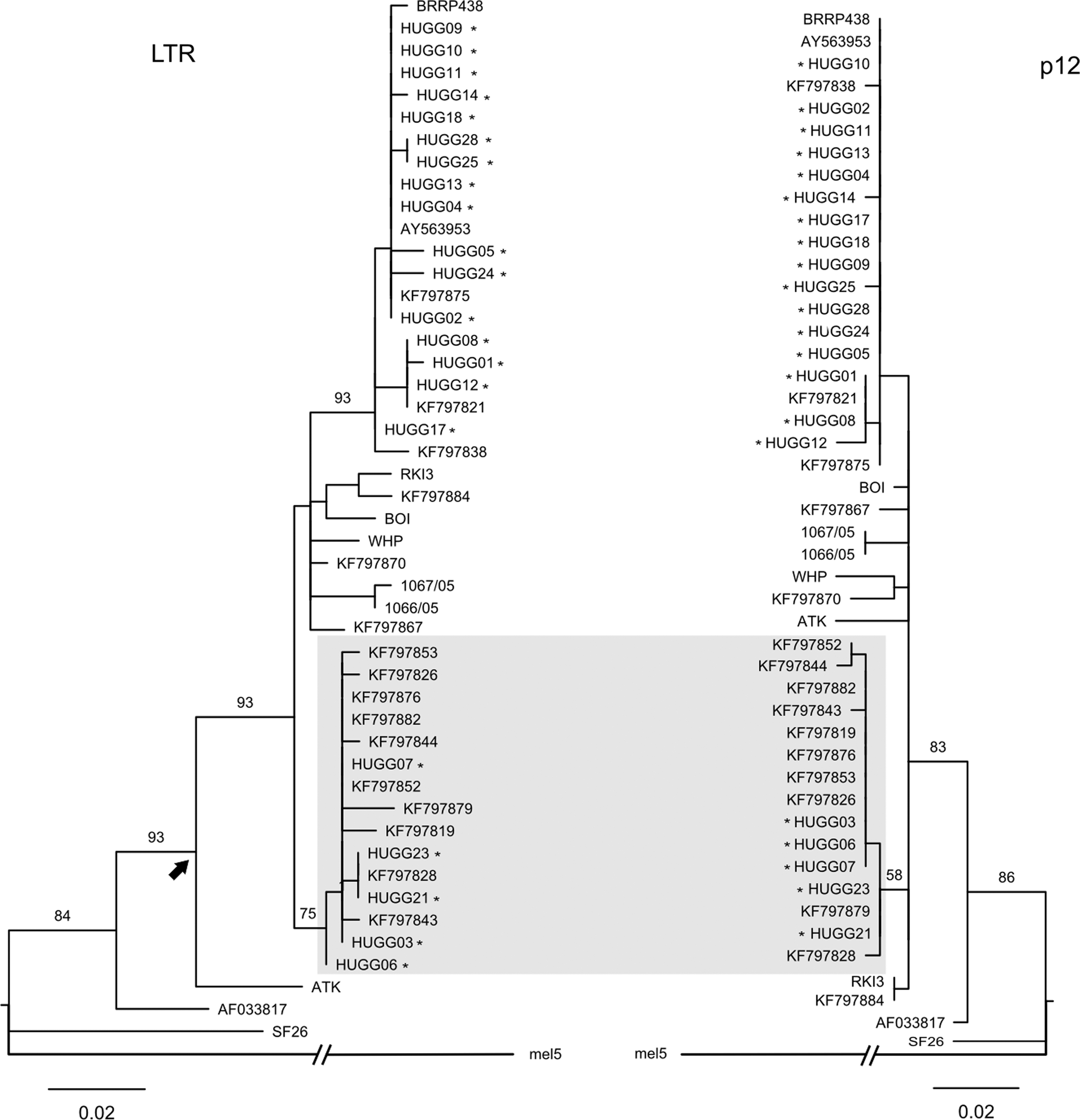
Phylogenetic trees showing the relationships between HTLV-1 LTR and p12 from genomes presenting the p12 canonical proteolytic site G29 and G29S. These maximum likelihood trees were based on LTR (634 bp) and p12 (300 bp). The clusters containing HTLV-1 lineage with G29S polymorphism are highlighted. The arrow indicates the split between HTLV-1aA and HTLV-1aB subgroups. (* label) sequences from Rio de Janeiro. The sequences p Bootstrap values >55% are indicated. The scale bars represent substitutions per site. Different HTLV-1 subtypes are presented in the figure: Mel5 (HTLV-1c), SF26 (HTLV-1b), AF033817 (HTLV-1aC), ATK (HTLV-1aB), all other sequences belong to HTLV-1aA subtype. HTLV-1, human T cell lymphotropic virus type 1; LTR, long terminal repeat.
Pessôa et al. analyzed the complete HTLV-1 coding regions of 81 patients and observed the presence of a monophyletic cluster containing 10 HTLV-1aA sequences from 10 individuals from São Paulo. 5 Here, we show that all sequences within this monophyletic cluster carry the G29S polymorphism. Interestingly, our patients with G29S were spouses (HUGG21–HUGG23), which likely represents a horizontal transmission event for HTLV-1aA with G29S. We hypothesized that the contamination occurred during their marital life, reinforced not only by the genetic similarity observed between the patients' samples but also by the history reported by patient 2. She reported no risk behavior for sexually transmitted diseases, considering that her husband was her single partner during her life. Although the G29S virus was not infectious in monkeys, 2 our data indicate that a lineage carrying this polymorphism can be transmitted, and is, therefore, infectious among humans. The strain G29S used in the recent study conducted by Pise-Masison et al. was generated by engineering the HTLV-1 molecular clone pAB by substituting glycine 29 with serine. 2 However, in G29S strains infecting humans, there are other nucleotide substitutions. Those mutations in different viral genes may be influencing the HTLV-1 infectivity and may be compensating the lack of infection observed in the molecular clone pAB-G29S. Therefore, G29S polymorphism seems to be part of a global polymorphism that determines the infective capacity of this viral strain.
Footnotes
Acknowledgments
The PDTIS/FIOCRUZ sequencing platform. This work was supported by Fundação de Amparo a Pesquisa do Estado do Rio de Janeiro (FAPERJ) and by Post-Graduation on Infectious and Parasitic Diseases (UFRJ), a PhD fellowship to C.R. from Coordenação de Aperfeiçoamento de Pessoal de Nível Superior (CAPES), and a PhD fellowship to M.J.C.C. and L.Z. from Conselho Nacional de Desenvolvimento Científico e Tecnológico (CNPq).
Author Disclosure Statement
No competing financial interests exist.