




Abstract

S
Twenty women who had regular menses for the past 3 months comprised the premenopausal group and 20 women who did not have menses for at least 1 year comprised the postmenopausal group. The age range for premenopausal women was 23–48 years (mean 35). For postmenopausal women, age range was 45–81 years, (mean 55). Each premenopausal woman provided three samples coinciding with proliferative (days 5–9), ovulatory (days 12–16), and secretory (days 19–23) stages of their menstrual cycle (with day 0 signifying start of menses). Each postmenopausal woman provided one sample. Both groups had similar percentage of bacterial vaginosis (BV) (nine visits for premenopausal versus eight visits for postmenopausal). However, three visits of Trichomonas vaginalis (TV) were all in premenopausal group with two of those with both BV and TV. Cohort characteristics and sample collection procedures are described in Ref. 1
Cervical vaginal lavage (CVL) was assayed for cathepsins B, D, and G by ELISA (R&D Systems, Minneapolis, MN; ABCAM, Cambridge, MA; Abnova, Taipei City, Taiwan, respectively). NE concentrations were determined using a multiplex bead immunoassay system (MILLIPLEX Human Sepsis Magnetic Bead Panel 3; EMD Millipore, Billerica, MA). Protease bioactivity for cathepsins B and D was measured using fluorescence-based assays (ABCAM).
Values less than lower limit of detection were assigned the value of “1” and all values were log transformed. As premenopausal women have repeated mediator measures, all comparisons were based on generalized estimating equations models.
We observed significantly lower levels of cathepsin D in postmenopausal women than in premenopausal women (median, premenopausal 4.2 vs. postmenopausal 0 log pg/ml, p ≤ 0.0001) (Fig. 1A). Although no significant changes across menstrual cycle were observed, there was a trend toward higher levels during the proliferative phase, which has also been observed by other studies. 4 Cathepsin D bioactivity was also significantly reduced in postmenopausal women (median, premenopausal 3 fluorescence units (FU) vs. postmenopausal 2 FU, p = .004) (Fig. 1B) without any significant changes across menstrual cycle. In contrast, although we detected high levels and bioactivity of cathepsin B, no significant differences were observed by menopausal or menstrual status (not shown). Cathepsin G was undetectable in all samples. High levels of NE were detected and a trend toward lower values during the ovulatory stage was observed, as previously described by Tawara et al. 5 However, no significant changes were observed by menstrual or menopausal status (not shown). Furthermore, there were no correlations between levels or activities of proteases and BV or TV status (not shown).
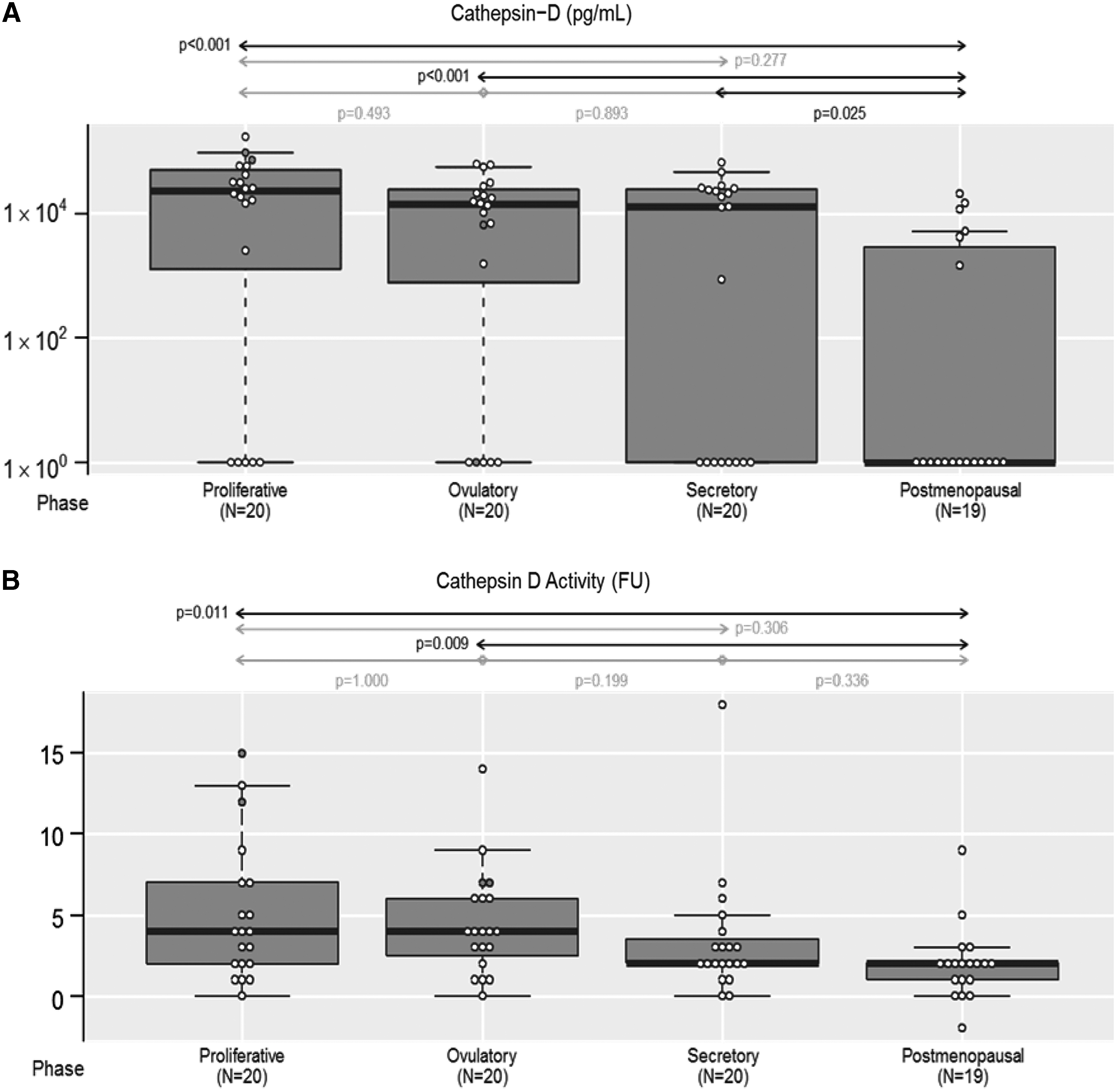
Reduced levels and bioactivity of cathepsin D in CVL from postmenopausal women. CVL from premenopausal (n = 60) and postmenopausal (n = 19) women was tested for cathepsin D by ELISA.
Cathepsin D has been shown to be associated with enhanced HIV infection/replication in vaginal secretions. 6 However, our study found significantly reduced levels and activity of cathepsin D in postmenopausal CVL. This matches with our recently published data from the same cohort showing reduced levels of other genital immune mediators in postmenopausal women. 1 Further studies are needed to understand mechanisms of HIV acquisition/transmission in postmenopausal women.
Footnotes
Acknowledgments
Funding for this study was provided by R03 A1102837-01(M.G.), GWU Start-up funds (M.G.). We would like to thank Dr. Phalguni Gupta and Deena Ratner at the University of Pittsburgh for providing HIV-1 virus stocks; Kim Rapozoa and Jaclyn Kurpewski at Miriam Hospital Research Center, Brown University, for participant recruitment and sample processing; Dr. Charles Wira and his group at Geisel School of Medicine at Dartmouth for advice on data analysis and article writing. We thank the District of Columbia (AI117970) and the Lifespan/Tufts/Brown (P30AI042853) Center for AIDS research for mentorship and support.
Author Disclosure Statement
No competing financial interests exist.