




Abstract
HLA-B*57:01 is strongly associated with severe adverse drug reaction induced by the anti-HIV drug abacavir (ABC) and antibiotic flucloxacillin. This study was dedicated to establishing a new method for HLA-B*57:01 genotyping and investigating the HLA-B*57:01 distribution pattern in four Chinese populations. A single-tube duplex real-time polymerase chain reaction (PCR) system was established by combining the amplification refractory mutation system and TaqMan probe. The reliability of this assay was validated by comparing the genotyping results with those by sequence-based typing. With this assay, the distribution of HLA-B*57:01 in 354 blood samples from four ethnic groups, namely, Han, Tibetan, Uighur, and Buyei, was determined. A 100% concordance was observed between the results of real-time PCR and sequence-based typing in 50 Uighur samples. As low as 0.016 ng DNA that carried HLA-B*57:01 could be detected with this assay. HLA-B*57:01 carriers identified in 100 Northern Han Chinese, 104 Buyeis, 100 Tibetans, and 50 Uighurs were 0, 1 (0.96%), 3 (3%), and 6 (12%), respectively. The carrier rate of HLA-B*57:01 in Uighur was significantly higher than those in Northern Han (p = .001) and Buyei (p = .005). The newly established real-time PCR assay provides a rapid and reliable tool for HLA-B*57:01 allele screening before the prescription of ABC and flucloxacillin in clinical practice.
Introduction
A
A nucleoside analog, ABC is commonly used against HIV-1, with potent antiviral activity as a nucleoside reverse transcriptase inhibitor. 5 Although ABC is safe and effective for the treatment of HIV, ∼5%–8% of the patients treated with ABC developed HSRs. 6 Rechallenge with ABC after an HSR typically results in an increased risk of death. 7 The association of ABC-induced HSRs with HLA-B*57:01 was first reported by Mallal et al. 8 In Caucasian and Hispanic ethnic populations, HLA-B*57:01 was present in 78% (14/18) of the patients with ABC-induced HSRs compared with 2% (4/167) of the ABC-tolerant controls (p < .0001, hazard ratio = 39), with a positive predictive value of 100% and a negative predictive value of 97%. Subsequently, several independent studies corroborated the association between a diagnosis of ABC HSRs and the carriage of the allele HLA-B*57:01. 9 –11 Flucloxacillin, an effective antimicrobial, is used for soft tissue infections caused by Staphylococcus aureus. 12 In British populations, the incidence of flucloxacillin-induced liver injury has been estimated at 8.5 per 100,000 new users in days 1–45 after first treatment. 13 A recent genome-wide association study demonstrated that the presence of the HLA-B*57:01 was significantly associated with the high risk of flucloxacillin-induced liver injury. 4 Carriers of HLA-B*57:01 have an 80-fold increased risk of developing liver disease on flucloxacillin treatment (p = 2.7 × 10⁻¹⁶). In view of the important role of HLA-B*57:01 in the susceptibility of individuals to drug-induced HSRs, several authority institutions, including Clinic Pharmacogenetics Implementation Consortium, US Food and Drug Administration, and European AIDS Clinical Society, strongly recommend screening for HLA-B*57:01 before prescribing ABC to minimize the risk of HSR. 14,15
The HLA system plays an important role in the ability of immune regulation and antigen presenting in organism. This system is highly polymorphic, and more than 4,000 HLA-B alleles have been identified. 1 Highly homologous sequences among different HLA genes and multiple polymorphic loci are involved in the designation of certain alleles. This condition raises more challenges and difficulties for HLA genotyping. At present, several methods are used to detect individual HLA genotypes, including polymerase chain reaction (PCR) sequence-based typing (PCR-SBT), PCR sequence-specific primers (PCR-SSP), sequence-specific oligonucleotide probes (PCR-SSOP), and next-generation sequencing (NGS). 16 PCR-SBT is the gold standard for HLA genotyping but is relatively expensive and laborious. Moreover, it may yield ambiguous results because of the overlapping peaks of particular target gene sequences. 17 The PCR-SSP and PCR-SSOP methods can cause secondary pollution easily because the products are performed in agarose gel electrophoresis for detection and analysis. 18 NGS has become more popular because of its high throughput, but it is time-consuming and expensive. 19 Therefore, the above methods are not adapted to the concept of promptness and convenience of modern molecular detection. Considering the demerits of these molecular techniques, real-time PCR has been used to detect HLA alleles and has proven to be highly discriminatory, convenient, and time-saving. 20,21 In the case of HLA-B*57:01, a specific method for HLA-B*57:01 detection using SYBR Green real-time PCR with two sets of primers was reported previously. 22,23
In this study, a more rapid and convenient real-time PCR assay for HLA-B*57:01 detection was established and validated using one pair of allele-specific primers and one TaqMan probe. The distribution of HLA-B*57:01 in four Chinese ethnicities were investigated with this reliable and fast method. The results can guide the HLA-B*57:01 genotyping-based ABC or flucloxacillin prescription in different populations.
Materials and Methods
Samples
A total of 354 unrelated healthy samples were randomly collected from a multiethnic cohort in China, including 100 Hans from Shaanxi province, 104 Buyeis from Guizhou province, 100 Tibetans from Tibet, and 50 Uighurs from Xinjiang. Informed consent was obtained from each donor, and this study was approved by the Ethics Committee of the Northwest University.
Genomic DNA extraction
Genomic DNA was extracted from these peripheral blood samples with a QIAamp DNA Extraction Kit (Qiagen). The purity and concentration of the DNA samples were measured by a Nanodrop spectrophotometer (Thermo Fisher Scientific). A positive standard DNA sample with heterozygous HLA-B*57:01 was provided by Dr. Wei Zhang (Institute of Clinical Pharmacology, Central South University, Changsha, China).
Primer and probe design
The HLA-B*57:01 sequence was obtained from the dbMHC database. 2 HLA-B*07:02:01 is the reference sequence of HLA-B members. Specific primers and the probe set for HLA-B*57:01 were designed based on the highly variable sequences. The primers and probe of the reference gene β-globin were adapted as described previously. 24 The details of these primers and probes are presented in Table 1. Next, the specificity of all primers and probes were analyzed using Primer-BLAST in NCBI. 3 DINAMelt server website 4 and uMelt batch 2.0 5 were also used to further analyze the melting temperature. All primers and probes were synthesized by Sangon Biotech. Co. Ltd. (Sangon).
Fp, forward primer; Rp, reverse primer; FAM, 6-carboxyfluorescein; HEX, 6-carboxy-hexachlorofluorescein; BHQ2, Black Hole Quencher-2; HLA, human leukocyte antigen.
HLA-B*57:01 typing by duplex real-time PCR assay
Allele-specific PCR assays were performed in 20 μl reaction volume with 10 μl 2 × Premix Ex Taq™ II (TaKaRa), 250 nM each of the target-specific primers and 100 nM target probe, 125 nM each of the reference primers and 50 nM reference probe, and ∼10 ng of genomic DNA. All the real-time PCR reactions were carried out using a ViiA™7 real-time PCR instrument (Applied Biosystems). Thermal cycling was initiated at 95°C for 30 s, followed by 40 cycles at 95°C for 5 s, and 64°C for 34 s. The control groups were also set separately with negative and positive HLA-B*57:01 standard samples. For each template, cycle threshold values were recorded. Reactions were replicated at least three times per experiment to verify the results.
Reliability evaluation of the duplex real-time PCR assay
To evaluate the accuracy of the duplex real-time TaqMan PCR assay, DNA samples from 50 Uighurs were regenotyped for HLA-B*57:01 by the SBT method using the Excellerator® HLA-B kit (GenDx). The concordance of the negative and positive results between these two methods was evaluated. The detection limit of the real-time PCR assay was deduced from the HLA-B*57:01 standard DNA samples, which were serially diluted to varying concentrations of 10, 2, 0.4, 0.08, and 0.016 ng. Negative control groups containing HLA-B*57:01-negative sample and no DNA template were also set.
Statistical analysis
Statistical analysis was carried out with the SPSS 20.0 software (IBM). The frequency comparison of HLA-B*57:01 among the four population groups was explored using Fisher's exact test. The value of statistical significance was set at p < .05 (two-sided).
Results
Primer and probe design
Based on the sequence comparisons, the sequence of HLA-B*58:01 mostly resembled that of HLA-B*57:01, and the highest variability sequences of HLA-B*57:01 was found in exon2 and intron2 (Fig. 1). In exon2, a C to G mutation at position 384 could distinguish HLA-B*57 from all other HLA-B alleles, except for HLA-B*58. Therefore, the terminal base of the forward primer was designed in this specific location, and a mismatch was introduced in the second base at the 3′-end of the specific forward primer to improve the specificity of the ARMS reaction. In intron2, two single-base mutations, G to A in 560 and T to C in 563, were the most crucial bases to discriminate HLA-B*58:01 from HLA-B*57:01. Thus, a reverse TaqMan probe was designed in this region to further discriminate HLA-B*57:01 from HLA-B*58:01. In addition, a universal reverse primer was designed in intron2. Thus, combining a pair of ARMS primers with a specific-locus TaqMan probe could ensure the specific amplification of HLA-B*57:01. Other pairs of primers and one TaqMan probe amplifying the reference gene (β-globin) were also used to monitor this detection assay. The 3′-end of probes were all labeled with Black Hole Quencher-2, while the 5′-end of probe for HLA-B*57:01 and the probe for β-globin were labeled with 6-carboxy-hexachlorofluorescein (HEX) and 6-carboxyfluorescein (FAM), respectively.
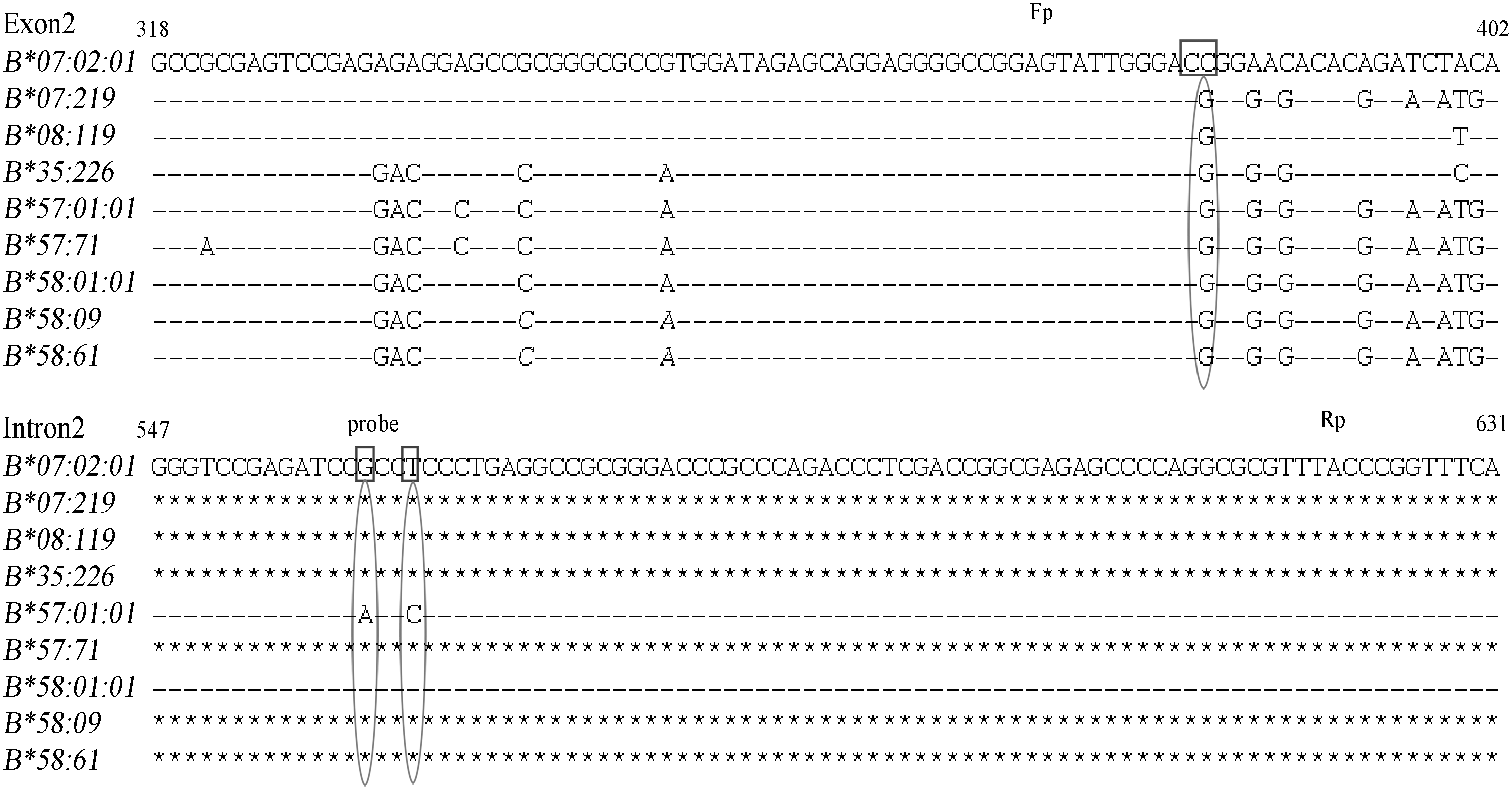
Location of sequence-specific primers and TaqMan probe in HLA-B*57:01. HLA-B*07:02:01 is the official reference sequence. The special bases among the representative sequences are emphasized. The boxes show the specific-locus in the official HLA-B reference sequence, when aiming at detecting HLA-B*57:01 allele. The ovals show the corresponding location, representing the specific bases or variation in this position for HLA-B*57:01 and some other HLA-B alleles. HLA, human leukocyte antigen.
Performance of the real-time PCR assay
A novel duplex real-time PCR method with one pair of ARMS primers and one TaqMan probe was established for HLA-B*57:01 detection. The amplification of the reference gene suggested successful DNA extraction and PCR reactions. In this assay, a qualified DNA sample should generate FAM (blue) fluorescence amplification curves. Samples that simultaneously generated FAM (blue) and HEX (red) “S”-type fluorescence amplification curves were considered as HLA-B*57:01-positive samples, while the absence of a signal for HLA-B*57:01 probe indicated the absence of HLA-B*57:01 allele in the samples (Fig. 2). With this method, the amplification results of the HLA-B*57:01 standard sample were consistent with the expected result. The detection sensitivity experiment showed that the lowest detection limit was 0.016 ng. The fluorescence amplification curve of HLA-B*57:01 was undetectable when the DNA template was reduced to 0.008 ng (Fig. 3).
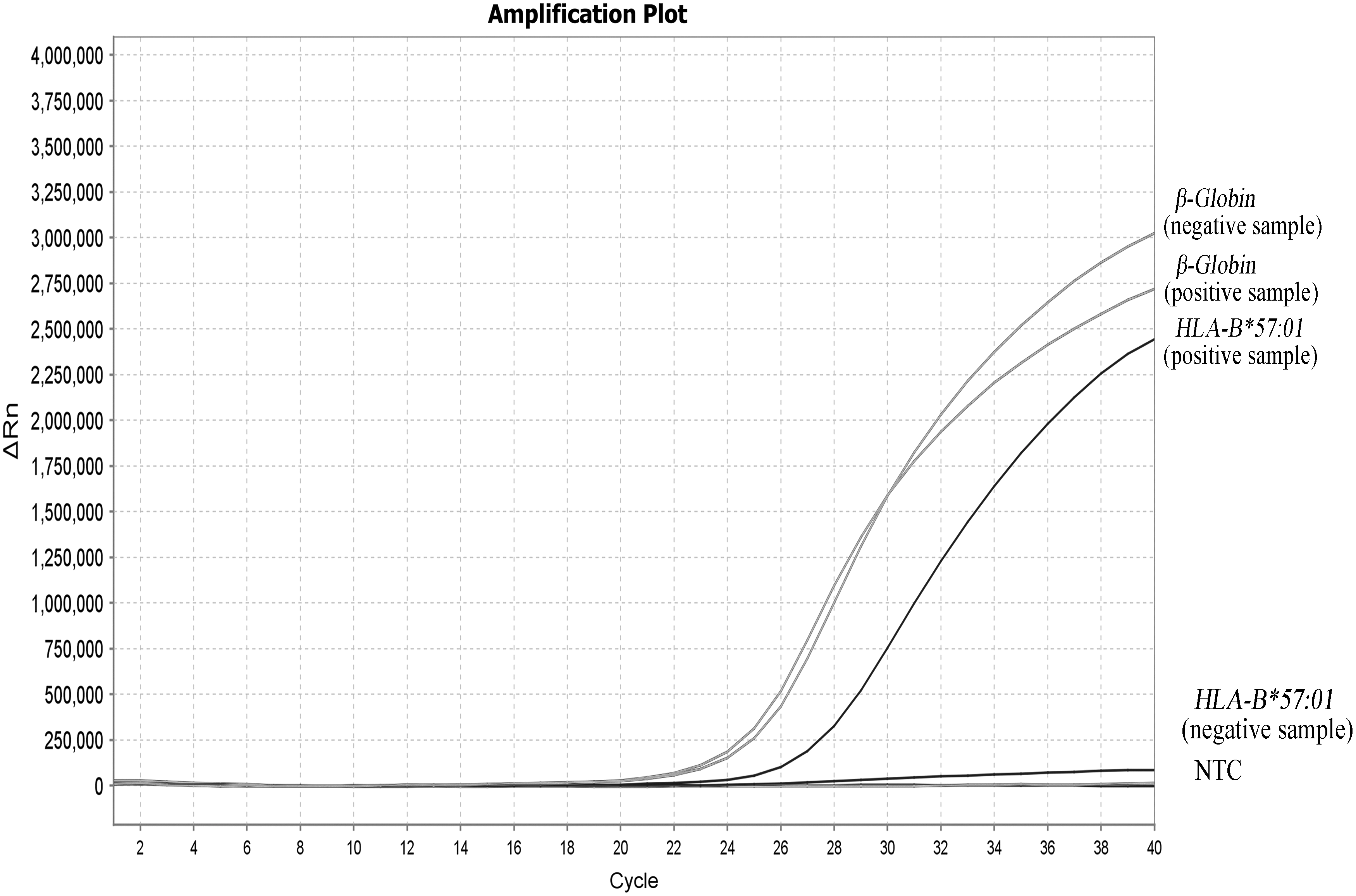
Amplification curve of the HLA-B*57:01 standard samples by the established duplex real-time PCR. NTC, nontemplate control; PCR, polymerase chain reaction.
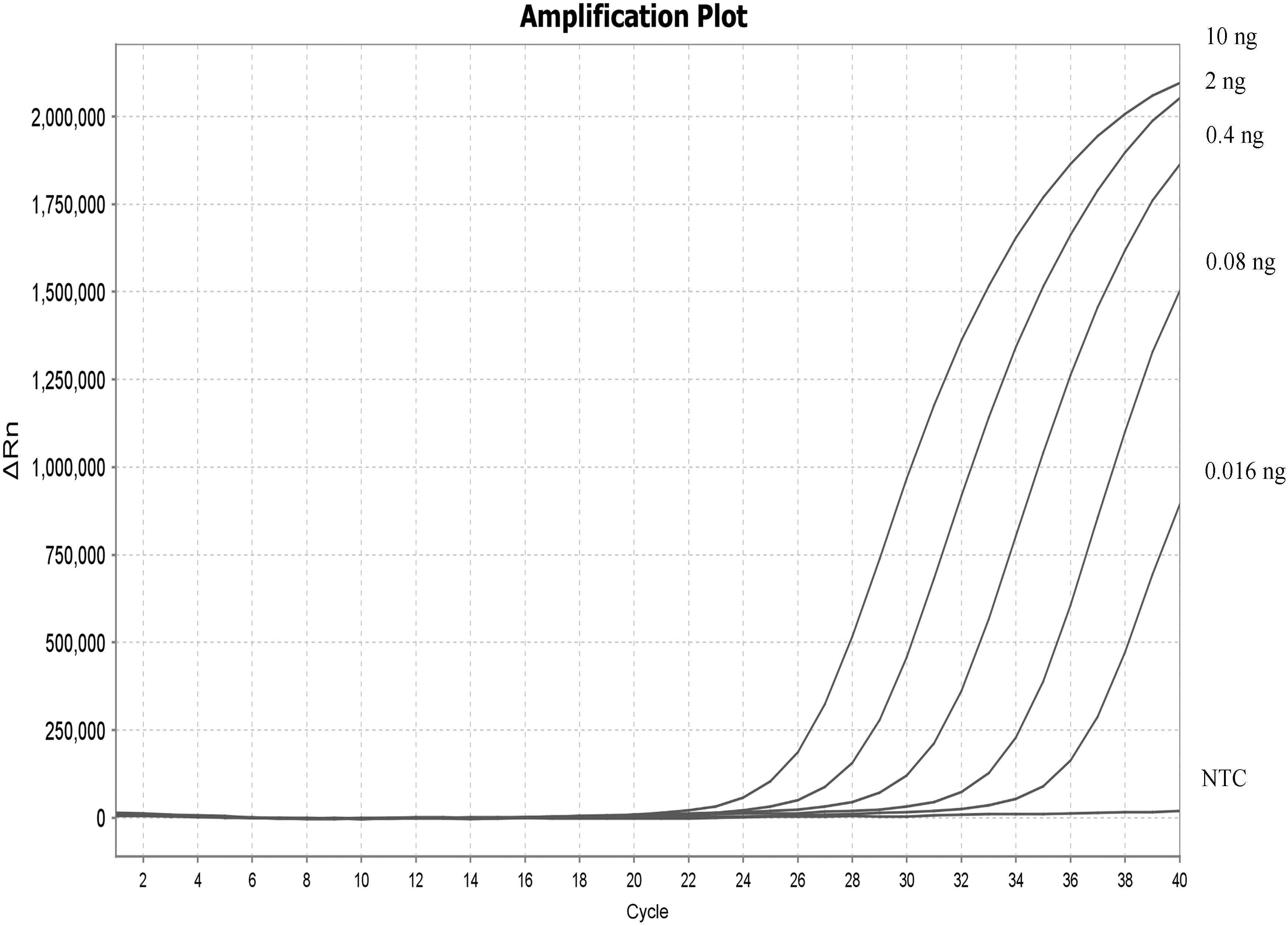
Detection limit of the real-time PCR assay was detected by serial dilutions of HLA-B*57:01 standard DNA.
Accuracy of the real-time PCR assay
The genotyping results of the HLA-B*57:01 allele in 50 Uighur samples were compared with those by SBT to assess the accuracy of the new method. A total of six HLA-B*57:01-positive and 44 negative samples were identified by both methods. No false-positive and false-negative samples were observed. A 100% agreement was obtained between the results from real-time PCR and SBT. Therefore, compared with SBT results, the analytical sensitivity and specificity, as well as the positive predictive value and the negative predictive value of the established assay, were all very good (100%). In addition, the six HLA-B*57:01-positive samples identified by the SBT were all heterozygotes.
Distribution of HLA-B*57:01 allele in four Chinese populations
This new method was used to investigate the frequency of the HLA-B*57:01 in four Chinese populations. Positive HLA-B*57:01 carriers were not found in 100 Han Chinese, while one, three, and six carriers were identified in 104 Buyeis, 100 Tibetans, and 50 Uighurs, with positive rates of 0.96%, 3%, and 12%, respectively (Table 2). The number of positive carriers of HLA-B*57:01 in the Uighur population was also significantly higher than those in the Northern Han (p = .001 < .05) and Buyei (p = .005 < .05) populations (Fig. 4). Furthermore, all the identified positive samples in Buyeis and Tibetans were validated by the SBT method as heterozygotes.
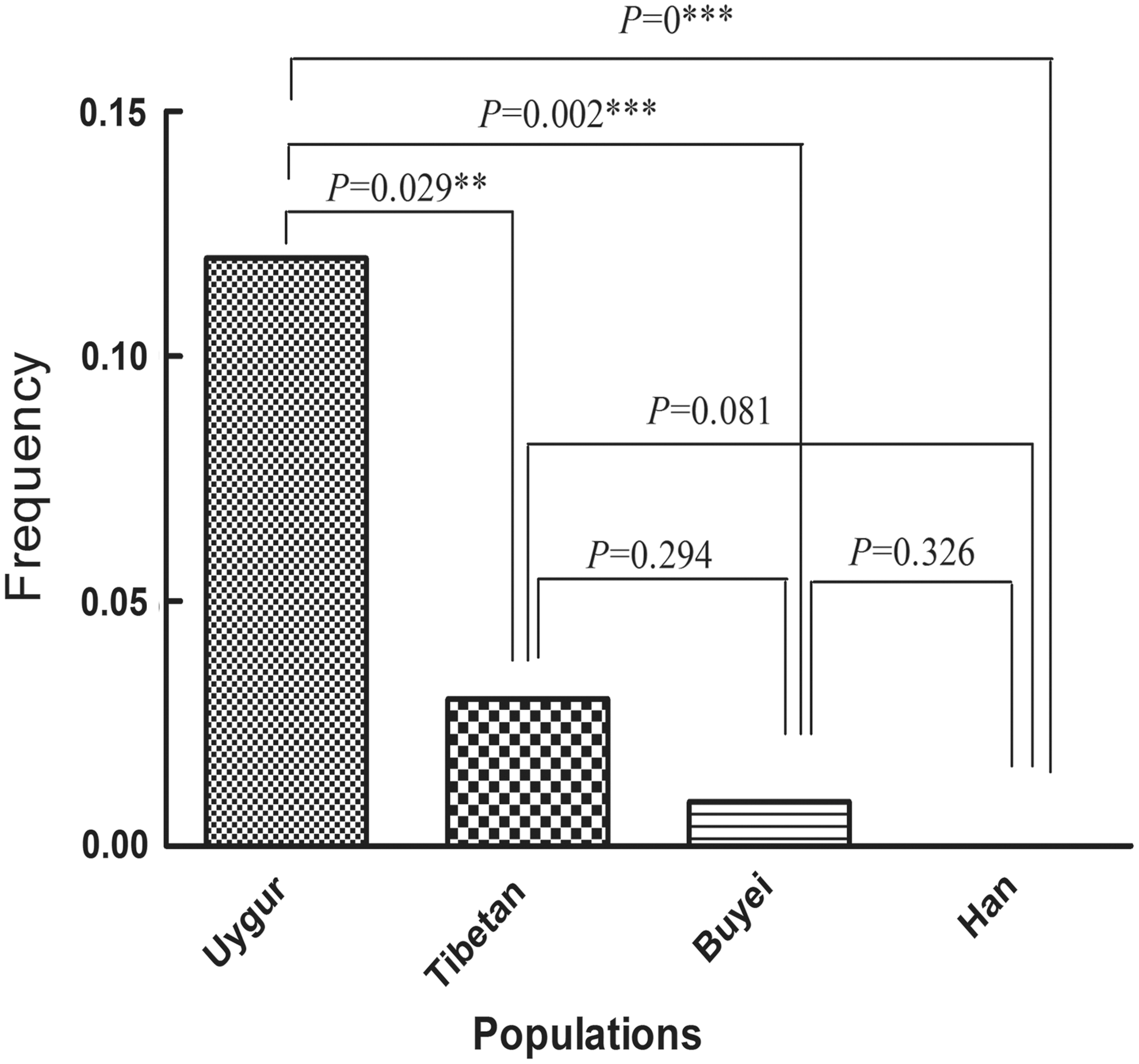
Comparison of positive rates of HLA-B*57:01 among four ethnic groups in China.
Discussion
The presence of the HLA-B*57:01 was significantly associated with the severe adverse reactions induced by ABC 8,25 and flucloxacillin. 4 The prospective screening for HLA-B*57:01 before ABC administration can significantly reduce the incidence rate of ABC HSR. 3 Therefore, a rapid and accurate detection method for HLA-B*57:01 screening is necessary for pharmacogenetic studies and routine clinical settings. In the current study, a reliable and sensitive duplex real-time PCR assay, combined with ARMS primers and a sequence-specific TaqMan probe, was developed and validated.
With properties such as rapidity, sensitivity, and flexibility of use, the TaqMan probe-based real-time PCR was found to be more methodologically advantageous than traditional PCR assays and is more efficient in molecular detection. ARMS is based on the principle that amplification is efficient when the 3′ terminal base of the primer matches the template, but inefficient or even nonexistent when a mismatch occurs. 26 The combination of ARMS primers and TaqMan real-time PCR allows high-throughput and sensitive detection with an improved interpretation of PCR results. 27,28 Currently, this combination method is being applied to HLA genotyping. For example, with the combination of specific primers and TaqMan probes, a real-time PCR assay for HLA-B*27 detection was developed in a previous study, and the results indicated that the assay is reliable and sensitive for HLA genotyping. 29
For HLA-B*57:01 detection, a SYBR Green-based real-time PCR assay has been reported by two studies. 22,23 In the current study, a novel TaqMan probe-based real-time PCR assay appropriate for HLA-B*57:01 typing was also developed. Although similarities exist, our method is an update of the previously reported assay. The previous studies used two pairs of SSP and SYBR Green for the amplification and identification of HLA-B*57:01. Only the fluorescence signals of the two separate reactions are detected and a positive result could be obtained. SYBR Green has also been replaced gradually by TaqMan probes in recent years because of the difficulties in distinguishing specific from nonspecific amplification products and primer dimers. 29,30 In the present study, one pair of ARMS primers and one sequence-specific TaqMan probe were used instead for HLA-B*57:01 identification. This combination could ensure the discrimination of HLA-B*57:01 from most of the HLA-B alleles, even for the most homologous allele HLA-B*5801. The complete accordance between the results by the established assay and those by SBT validated the specificity and sensitivity of this novel assay. Another distinct feature of this method is the use of duplex fluorescence channel to amplify simultaneously the target gene HLA-B*57:01 and the reference gene in a single tube. This feature makes the system more time-saving and cost-effective, reducing the process duration to only 1 h for 96 samples. In addition, this assay was able to detect the genomic DNA at concentrations as low as 0.016 ng. Compared with conventional methods, these characteristics make the novel method suitable for routine HLA-B*57:01 genotyping in clinical and molecular identifications.
The prevalence of HLA-B*57:01 is varied in populations worldwide. 14 The allele frequency of HLA-B*57:01 was reported in 4%–8% of European populations. 31,32 However, HLA-B*57:01 exists at a very low rate in Korean populations and is absent in Japanese populations. 33,34 Similarly, the association between HLA-B*57:01 and ABC HSRs varies among different populations. Strong associations (∼50%–100% ABC HSRs carry the HLA-B*57:01 allele) were reported in Caucasians, while weak associations were observed in Korean and Japanese populations. 8,11,25,35 Therefore, the diversity of HLA-B*57:01 allele distribution frequencies may be the reason for the large regional and ethnic differences in the associations between HLA-B*57:01 and ABC HSRs. Considering the significant diversity in the nationalities and genetic backgrounds in China, the investigation into the prevalence of HLA-B*57:01 and its association with drug-induced HSR in different Chinese populations is of great value. In this study, the polymorphic distribution of HLA-B*57:01 in four main ethnicities in China using the developed real-time PCR method was investigated. The result showed that the prevalence of HLA-B*57:01 is highest in the Uighur minority, with a positive rate of 12%, while it is relatively low and even rare in Northern Han Chinese, Tibetans, and Buyeis. These findings demonstrate that the prevalence and polymorphic distributions of HLA-B*57:01 are highly variable in different ethnic groups in China. These data will expand the worldwide pharmacogenomic data of HLA-B*57:01 and will be valuable to the implementation of genotype-based personalized medicine in different Chinese populations.
In conclusion, a novel single-tube duplex TaqMan-based real-time PCR assay was developed in this study. The method proved to be rapid, reliable, and sensitive, and it would have a high potential in routine HLA-B*57:01 screening before ABC or flucloxacillin treatment to reduce the occurrence of HSR in the clinical setting. Moreover, the observed ethnic diversity of HLA-B*57:01 distribution in Chinese populations is crucial to the comprehensive understanding on the potential relevance of HLA-B*57:01 with drug-induced HSR.
Footnotes
Acknowledgments
This study was supported by the State Project for Essential Drug Research and Development (2012ZX09506001-007) and China's Postdoctoral Science Fund (2015M582695).
Author Disclosure Statement
No competing financial interests exist.