




Abstract

T
The enigmatic features of these innate cell interactions with env are mediated primarily by the pattern recognition receptors of membrane-bound c-type lectin receptor (CLRs) family such as Langerin, DC immunoreceptor, DC-specific ICAM-3 grabbing nonintegrin (DC-SIGN), mannose receptor, blood DC antigen 2, and Sialic acid-binding immunoglobulin-type lectins (SIGLEC-1), the most important CLRs that recognize exclusively the glycans on the surface of HIV-1 env. 1 The innate cells and the CLRs they express are spatially and temporally distributed along the sexual transmission pathway to generally form the first line of defense and perform differential functions leading finally to viral internalization and endosomal degradation for efficient antigen presentation, and also modulate toll like receptor (TLR)-induced cytokine expression to enhance the infection of HIV.
The fate of virus being taken up by these cells, whether shuttled to the endocytic pathway leading to degradation and presentation or transmission pathway by trafficking to a tetraspanin (CD81)-enriched protective environment, is not known. 2,3 The env glycans serve as pathogen-associated molecular pattern and it is the sole target of CLRs. The role of env glycans in the determination of fate of virus within DCs has been determined by altering the glycan composition of the virus envelope into more homogeneous glycans by producing viruses under different glycosylation inhibitory conditions using glycosylation pathway inhibitors, swainsonine (Golgi mannosidase II inhibitor), kifunensine (ER mannosidase I inhibitor), and GnTI−/− (GlcNAc transferase I) mutant cell line (293S). Using this strategy, it has been shown that viral glycan heterogeneity affects the binding of virus to DC-SIGN receptor. 4 Viruses with more homogeneous glycans and higher oligomannose content especially GlcNAc2Man9 bound more tightly to DC-SIGN followed by viruses with higher content of GlcNAc2Man5 than viruses with heterogeneous glycans. The glycan composition was further shown to affect the transfer of virus to T cells and was found that viruses with more homogeneous glycans and higher oligomannose content were transmitted less efficiently than viruses with heterogeneous glycans. The viruses with more homogeneous glycans and higher oligomannose content colocalized more within endocytic compartment, whereas the virus with heterogeneous glycans colocalized within CD81 compartments. Determination of the relative degradation of the glycan-altered viruses, it was found that viruses with more oligomannose content degrade faster than those with heterogeneous glycans. 4 We also found similar results using tier 1 SF162.LS, tier 2 chronic (JRFL.JB) and acute (REJO4541.67), and tier 3 (PVO.4) viruses using RAJI cell line as well as monocyte-derived DCs. Together, these findings are consistent with the previous study 4 and confirm that glycan composition regulates the fate of virus, either to antigen presentation or to transmission pathway. The different modes of DC-SIGN-mediated effector functions toward HIV are summarized in Figure 1, with special emphases on glycan composition, which regulates the pathway taken within DCs by HIV-1 through DC-SIGN.
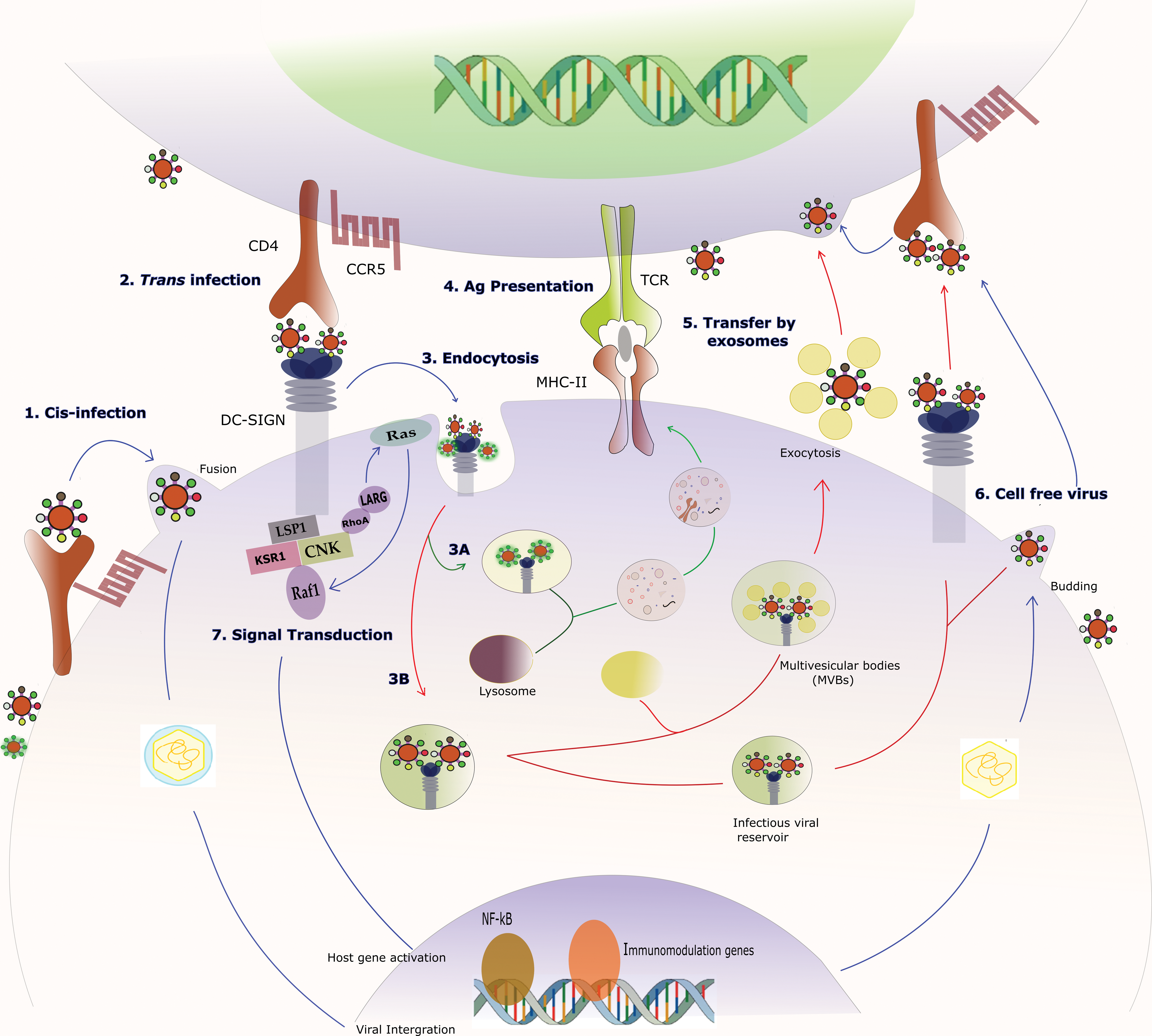
Recognition of HIV-1 by the innate immune system through CLRs expressed by different subtypes of DCs and macrophages lining the sexual route of HIV-1 transmission, and their role in viral dissemination. These cells commonly work as professional APCs and express both primary receptors of HIV-1 infection, CD4, and coreceptors CCR5/CXCR4, as well as innate PRRs such as CLRs. The viruses may enter DCs through primary receptors and cause infection, called cis-infection
Footnotes
Author Disclosure Statement
No competing financial interests exist.