




Abstract
HTLV-1-associated myelopathy/tropical spastic paraparesis (HAM/TSP) is a chronic demyelinating and disabling syndrome caused by human T lymphotropic virus 1 (HTLV-1). Although the pathogenic mechanisms that lead to HAM/TSP outcome have not been elucidated, genetic and immunological factors may be involved in the myelopathy occurrence. This study aimed to compare cytokines, chemokines, and nitric oxide (NO) levels in asymptomatic and HAM/TSP HTLV-1-infected patients. The study group consisted of 21 HAM/TSP and 48 asymptomatic HTLV-1 patients. Chemokines (CCL5, CCL2, CXCL8, CXCL9, and CXCL10) and cytokines [IL-2, interferon gamma (IFN-γ), tumor necrosis factor alpha (TNF-α), IL-4, IL-6, and IL-10] were measured using cytometric bead array, whereas NO production was measured after reaction of supernatants with nitrate reduction solution. CXCL9 and CXCL10 chemokines levels were found to be higher in the HAM/TSP group. CXCL9 was also strongly correlated with CXCL10 and both CXCL9 and CXCL10 were moderately correlated with CCL2 and CCL5 levels, in both HAM/TSP and asymptomatic groups. There was no significant difference related to NO, IL-4, IL-6, and IL-10 levels between the clinical groups but TNF-α and IFN-γ levels were increased in HAM/TSP patients. Thus, factors such as CXCL9, CXCL10, TNF-α, and IFN-γ could be good prognostic biomarker candidates, and further studies may help to clarify their association with HAM/TSP immunopathogenesis.
Introduction
H
Th1 profile predominates in the immune response to HTLV-1 infection, with production of cytokines such as interferon gamma (IFN-γ) and tumor necrosis factor alpha (TNF-α), as well as IL-6 and chemokines such as CCL3 and CCL4. 3
Although HAM/TSP immunopathogenesis has not been elucidated, immunological factors, host genetic variants, and viral factors may be involved in myelopathy occurrence. 4,5 Some studies have also shown that Tax viral protein, an important transactivating nuclear phosphoprotein in the mechanism of regulation of transcription and that can induce the immortalization of T cells, is able to activate the transcription of many genes, resulting in the expression of cytokines, chemokines, and other cell products in the cellular microenvironment. 6 –8
Furthermore, it is known that cytokines and chemokines can activate the expression of inducible nitric oxide synthase, which produces nitric oxide (NO), an important cellular signaling molecule involved in several pathologies, inducing nitrosative stress, mitochondrial damage, cytostasis, apoptosis, and cytolysis. 9,10
However, it is not known why only a small percentage of individuals develop HAM/TSP. Several studies have been conducted to identify prognostic biomarkers such as proviral load and serum soluble IL-2 receptor (sIL-2R). 11,12 In fact, immune system molecules are good potential candidates in predicting the clinical outcome in HTLV-1-infected patients.
Therefore, this study aimed to compare cytokines, chemokines, and NO levels in asymptomatic and HAM/TSP HTLV-1-infected patients.
Materials and Methods
The study group consisted of 21 HAM/TSP and 48 asymptomatic HTLV-1 patients who attended at Oswaldo Cruz University Hospital (HUOC), Pernambuco, Brazil. HAM/TSP diagnosis was made according to the criteria recommended by the World Health Organization for diseases associated with HTLV-1. To minimize the possibility of including patients who still might develop the disease, we included as asymptomatic only the patients with >3 years of medical follow-up, since it was suggested that the establishment of HAM/TSP occurs on average 3.3 years after infection. 13,14 Clinical data for patients selection and characterization were obtained through medical chart reviews. These data were used to recruit patients who met the criteria for the groups investigated in this study.
Chemokines (CCL5, CCL2, CXCL8, CXCL9, and CXCL10) were quantified in the plasma of 69 (48 asymptomatic and 21 HAM/TSP) infected individuals, whereas the cytokines (IL-2, IFN-γ, TNF-α, IL-4, IL-6, and IL-10) and NO were measured in the serum and plasma, respectively, of 43 (27 asymptomatic and 16 HAM/TSP) infected individuals.
A cytometric bead array (BD Biosciences, San Jose) was used for cytokines and chemokines quantitative measurement, as recommended by the manufacturer. NO plasma levels were measured after reaction of supernatants with nitrate reduction solution (5 mg/ml NADPH, 0.5 M KH2PO4, 1 U/100 μl nitrate reductase enzyme) (Sigma-Aldrich, St. Louis) for 18 h at 37°C. Then, Griess reagent was added (Promega, Madison) and the nitrite concentration was obtained through comparison with a sodium nitrate standard curve, provided in the kit.
Comparisons of cytokines, chemokines, and NO levels between asymptomatic subjects and HAM/TSP patients were evaluated by Mann–Whitney test. Spearman correlation test was also used to observe any correlation of chemokine and cytokine levels within groups. Differences were considered significant at p < .05, and statistical tests were performed in GraphPad Prism 5.0 software.
Results
Chemokine levels were studied in 48 asymptomatic HTLV-1-infected subjects and 21 HAM/TSP patients, whereas cytokine levels and NO production were measured in 43 HTLV-1-infected individuals (27 asymptomatic and 16 HAM/TSP). The main characteristics of the study population are given in Table 1.
Chi-square.
t-Test.
HAM/TSP, HTLV-1-associated myelopathy/tropical spastic paraparesis; NO, nitric oxide; HTLV-1, human T lymphotropic virus 1.
CXCL10 and CXCL9 chemokine levels were higher in the HAM/TSP group (Fig. 1). Other chemokine levels were not different between the groups.
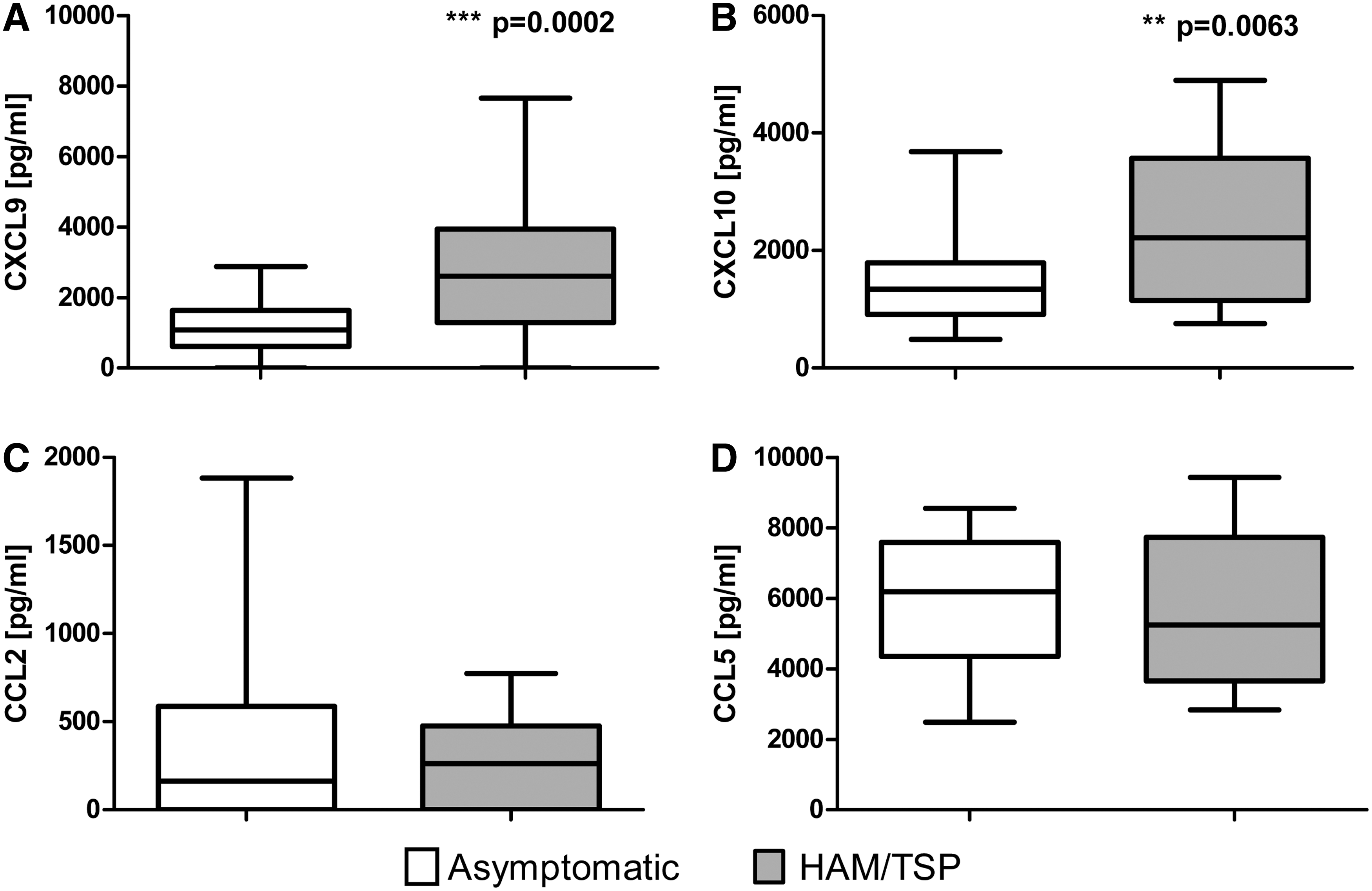
CXCL9 and CXCL10
However, correlation of chemokines found that CXCL9 was strongly correlated with CXCL10 and moderately correlated with CCL5 in both groups (Table 2). Furthermore, CXCL10 was also correlated moderately with CCL5 in both the asymptomatic and HAM/TSP groups. CXCL8 was undetectable in most samples.
Spearman correlation test.
Th2 cytokines (IL-4, IL-6, and IL-10) and IL-2 levels were not different between the groups (Fig. 2). In contrast, analysis of TNF-α and IFN-γ, related to a Th1 profile, revealed that these cytokine levels were significantly higher in the HAM/TSP patients than in asymptomatic individuals (Fig. 2B, C). NO levels also showed no significant differences between the groups (Fig. 3).
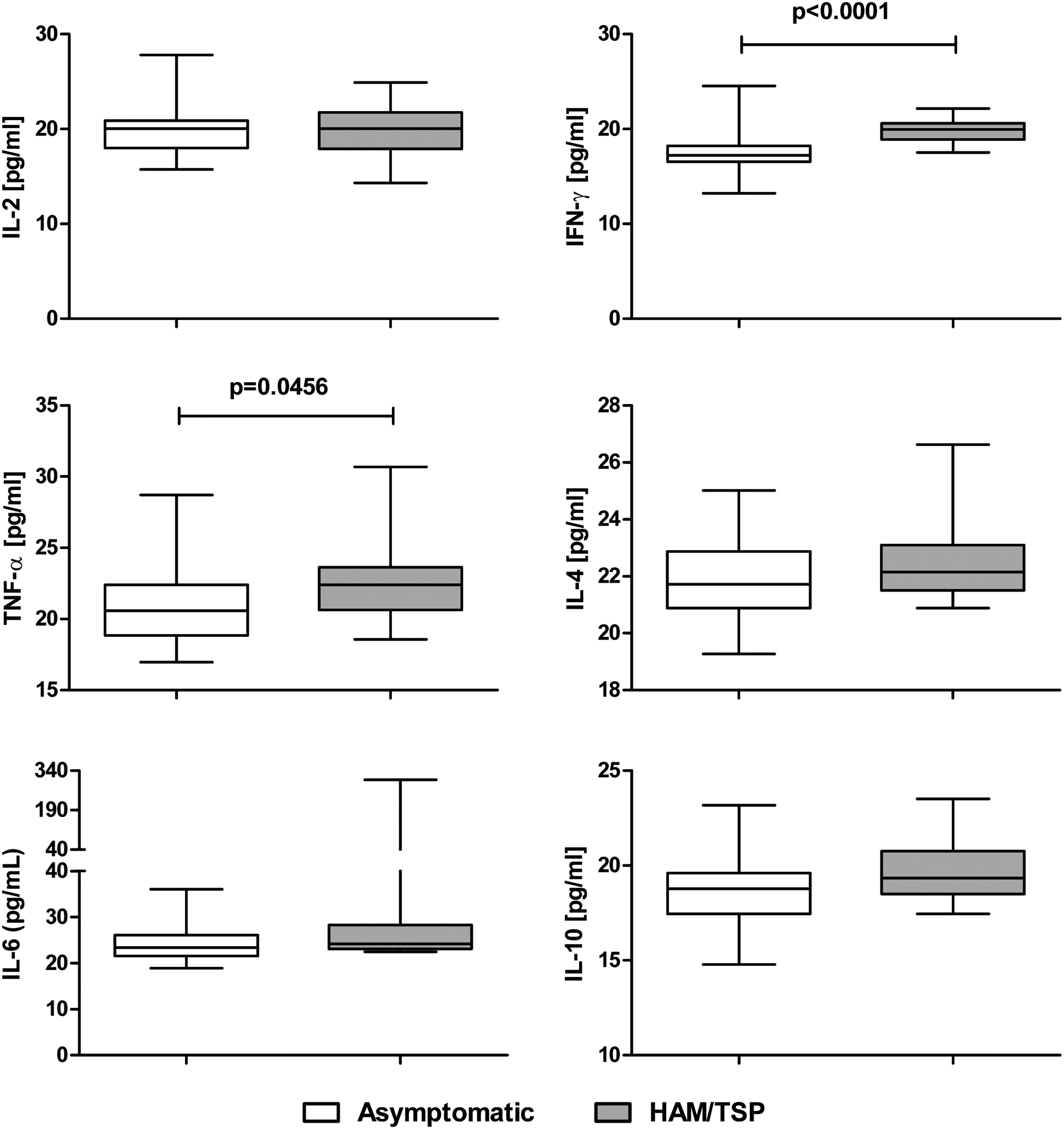
TNF-α and IFN-γ were significantly higher in the HAM/TSP patients than in asymptomatic individuals. IFN-γ, interferon gamma; TNF-α, tumor necrosis factor alpha.
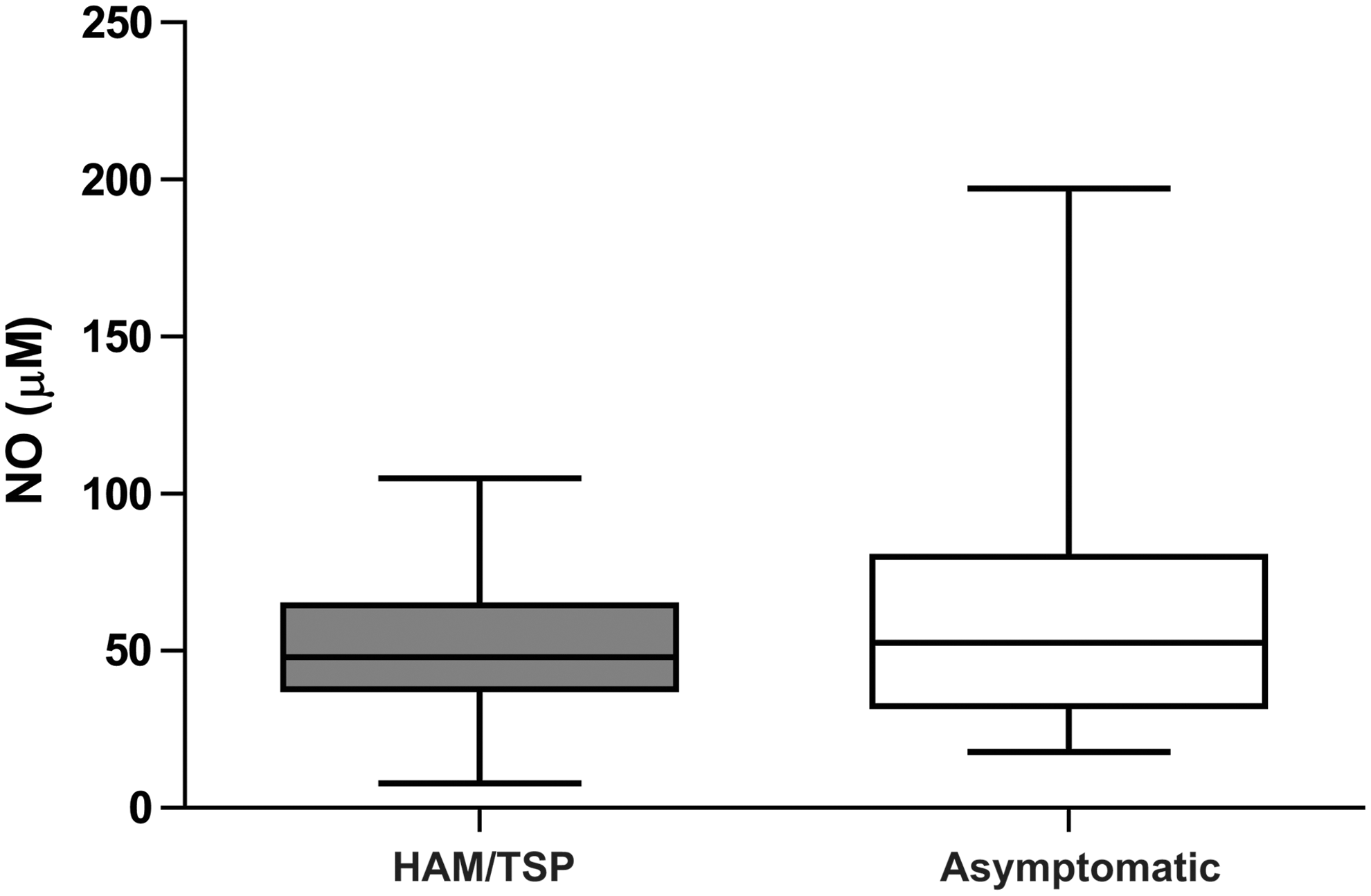
NO levels were similar between the groups. NO, nitric oxide.
In addition, positive correlations between IL-4 and IL-10 (p = .025; r 2 = 0.5562) as well as between IFN-γ and IL-6 (p = .035; r 2 = 0.5269) levels were observed in HAM/TSP patients (Table 3). Asymptomatic patients presented positive correlation between IL-4 and IFN-γ (p = .029; r 2 = 0.421), between IL-6 and IL-10 (p = .024; r 2 = 0.432), between IL-10 and IL-2 (p = .041; r 2 = 0.395), and between IL-10 and IL-4 (p = .004; r 2 = 0.3917).
Spearman correlation test.
Discussion
It is well known that in HAM/TSP patients, Th1 profile cytokines, such as TNF-α and IFN-γ, are prominent, in contrast to the reduction in Th2 cytokines, such as IL-4 and IL-10. 15 –18 The IFN-γ and TNF-α gene expression is also higher in symptomatic patients. 19 In fact, the production of TNF-α in HAM/TSP patients has been shown in several studies. This cytokine stimulates the secretion of other cytokines and chemokines, producing endothelial adhesion molecules and suppressing the activity of regulatory T cells. 20 Recent studies have shown whether anti-TNF agents would be effective in treating diseases related to HTLV-1 (arthropathy associated with HTLV-1 and other rheumatic conditions associated with the virus). 21 –23 One of these studies showed that the response rate to anti-TNF treatment was lower in HTLV-1 carriers and suggested that HTLV-1 patients with rheumatoid arthritis had greater inflammation and higher resistance to anti-TNF therapy than healthy controls. 24
The inflammatory response triggered by increased production of IFN-γ, TNF-α, IL-2, mainly by the CD4+ T cell response, is what maintains the chronic inflammatory process in HAM/TSP patients. 25,26 IFN-γ is a polypeptide with immunomodulatory, antiparasitic, and antiviral activities. In addition, it is able to inhibit proliferation of cells producing IL-4, IL-5, IL-6, IL-10, and IL-13. 27 A recent study showed high expression of IFN-γ in HTLV-1 patients, which was even higher in HAM/TSP patients. Furthermore, the authors observed a significant correlation between IFN-γ gene expression and the degree of walking aid, since IFN-γ expression was higher in wheelchair than in nonwheelchair HAM/TSP patients, evidencing the correlation between levels of IFN-γ and progression of HAM/TSP. 28
Levels of Th2 cytokines, such as IL-4 and IL-10, are generally lower in HAM/TSP patients, although some studies have reported that IL-10 can act on virus infection through its immunomodulatory function. 15 –17,29,30
Our data showed no statistical significant differences regarding IL-6 levels between asymptomatic and HAM/TSP groups, although several studies have demonstrated that the increase of IFN-γ, TNF-α, and IL-6 in peripheral blood is an important HAM/TSP mediator. 16,31 –33
As in this study, chemokines such as CXCL9 and CXCL10 have been found in higher levels in the blood and cerebrospinal fluid (CSF) of HAM/TSP patients than asymptomatic carriers or patients with other neurological diseases, including multiple sclerosis. 34 –38 Sato et al. argue that the levels of CXCL9 and CXCL10, strongly correlated in their study, represent viable candidates for HAM/TSP prognostic biomarkers.
Although this study did not find increased NO in symptomatic patients, it is known that NO is an important cellular signaling molecule involved in some pathological and physiological processes. 39
In addition, Baydoun et al. have shown that HTLV-1 expressing Tax-infected T cells have high intracellular levels of NO, and the authors suggested that HTLV-1 Tax may induce NO synthesis and this, in turn, generates double-strand DNA breaks, the most serious kind of damage to the DNA.
Overall, HAM/TSP group appears to present a more inflammatory environment than the asymptomatic group. In addition to inflammatory mediators at high levels, positive correlations between chemokines observed in HAM/TSP patients show that proinflammatory mediators go together, as well as anti-inflammatory mediators.
Different from this study, Montanheiro et al. found an increased CCL5 concentration in HAM/TSP patients, suggesting that the increased production of these and other chemokines could lead to the recruitment of proinflammatory factors that contribute to the myelin damage. 40 Likewise, although CCL2 may not have been increased in the HAM/TSP group in this study, their functions have been related to various neuroinflammatory diseases, including multiple sclerosis. Therefore, the cytokine production may have a role in the mild neurological damage observed in HAM/TSP. 15
In conclusion, a disbalance toward proinflammatory factors was found to be correlated with HAM/TSP disease. Further studies may be able to validate these factors as prognostic biomarkers and help to clarify the immunopathogenesis of HAM/TSP, leading to new studies using these mediators as possible targets.
Footnotes
Acknowledgments
The authors are grateful to Fiocruz for financial support to this research and also to the individuals infected with HTLV-1 for agreeing to participate in this study.
Author Disclosure Statement
No competing financial interests exist.