




Abstract
Benefits of switching to a single-tablet regimen (STR) of emtricitabine/rilpivirine/tenofovir (FTC/RPV/TDF) in virologically suppressed antiretroviral treatment (ART) experienced HIV-positive women include pregnancy category B rating and lack of clinically significant drug interactions between RPV and oral contraceptives. Unfortunately, studies involving switching to FTC/RPV/TDF enrolled fewer than 25% women. We undertook this 48-week study to assess the ability of virologically suppressed HIV-positive women switching to RPV STR to remain virologically suppressed and comply with the caloric intake requirement. HIV-positive women on ART with viral load <50 c/mL for 6 months before study entry and no known resistance to FTC, TDF, or RPV were enrolled and switched to STR RPV/FTC/TDF. Caloric intake (≥400 kcal) compliance and concurrency with oral STR RPV/FTC/TDF were evaluated with a 3-day food diary, which was validated by obtaining participant's caloric consumption through phone calls on randomly chosen dates. For each 3-day food diary, the daily median caloric intake and median value for each macronutrient consumed concurrent with FTC/RPV/TDF were computed. Medication adherence was measured using a visual analog scale. We enrolled 33 women, 73% of whom were African American. At week 48, virologic suppression (HIV RNA <40 c/mL) was maintained in 96% of women, including those (n = 4) who reported imperfect ART adherence. The daily median caloric intake concurrent with FTC/RPV/TDF was 820 kcal by food diary and 677 kcal by random phone call. Median kcal intake (food diary) did not change significantly from baseline (684 kcal) to week 48 (820 kcal); median change 102 kcal, p = .15. Women who reported noncompliance with a ≥400 kcal meal did not experience virologic failure. Significant concordance between caloric adherence and virologic suppression was not detected. Our study demonstrated that HIV-positive women who switched to STR FTC/RPV/TDF continued to experience virologic suppression and were readily able to comply with the recommended caloric intake requirement.
Introduction
I
Considerations for ART regimen switching in the setting of sustained virologic suppression include the following: regimen simplification, adverse events associated with the current regimen, or an enhanced safety profile of the new regimen. Switching to an RPV-based regimen might prove beneficial for the following reasons: improved lipid profile, 1,2 fewer neuropsychiatric side effects, no clinically significant drug interactions for patients on methadone therapy, and small pill size. FTC/RPV/TDF has a pregnancy category B rating and the lack of clinically significant drug interactions between RPV and oral contraceptives is a key consideration when considering switch regimens for women of child-bearing potential (Edurant™ [rilpivirine] tablets; Tibotec Pharmaceuticals, Raritan, NJ). 5 Unfortunately, the SPIRIT study enrolled 14% women, Mills et al. (switching from efavirenz to RPV) enrolled 8.2% women, and Monczor et al. enrolled 25% women. 1 –3 Thus, among women who are likely to achieve notable benefit, there is limited data on the efficacy of switching to FTC/RPV/TDF.
While switching to FTC/RPV/TDF appears to be an attractive choice for women, this must be balanced with the recommended caloric requirement. The complex and multifunctional roles women must play at work and in the home influence their ability to put self first. Women are frequently the primary caregivers and issues related to childcare or eldercare may limit their ability to focus on their own health needs, and may influence adherence to specific medication dosing requirements. Regular administration of RPV-based regimens with food is important, as the absorption of RPV is optimal when taken with either a normal-fat or high-fat diet. Lower absorption would likely decrease the effectiveness of RPV in suppressing HIV replication and could lead to virologic failure. Therefore, we undertook this 48-week study to assess the ability of virologically suppressed HIV-positive women switching to FTC/RPV/TDF to remain virologically suppressed and comply with the caloric intake requirement, and to study the agreement between caloric intake and virologic suppression. Secondary aims were to assess antiretroviral (ARV) treatment adherence and changes in fasting lipid profile.
Methods
Between April 2012 and April 2014, HIV-positive women on stable combination ART with viral load <50 copies/mL for 6 months before study entry and no known resistance to FTC, TDF, or RPV were enrolled and switched to FTC/RPV/TDF. All enrolled women received healthcare at the University of North Carolina Infectious Diseases Clinic (UNC ID Clinic). Resistance was defined as the presence of the nucleoside reverse transcriptase mutations K65R and M184 V/I and the nonnucleoside reverse transcriptase mutations K101E/P, E138G/K/Q/R, Y181C/I/V, and H221Y. Viral suppression was defined as HIV RNA <50 copies/mL and caloric adherence was defined as ≥400 kcal at the meal consumed concurrent with FTC/RPV/TDF intake. ARV medication adherence was measured using a visual analog scale (VAS).
A food diary and phone dietary assessment were used to measure compliance with caloric intake. All participants were asked to keep a 3-day food recall diary to collect information on the following: (1) meal time when FTC/RPV/TDF was taken, (2) food items consumed at this meal, and (3) beverages consumed at this meal. To avoid response fatigue, participants were asked to keep the diary for 2 weeks (weeks 1 and 3 of each month) in months 1–6 and 1 week per month for months 7–12. The validity of the food diary was assessed by obtaining participant's caloric consumption through phone calls on randomly chosen dates (one per month). During these calls, participants were asked to recall the (1) meal time when STR FTC/RPV/TDF was taken, (2) food items consumed at this meal, and (3) beverages consumed at this meal. As carbohydrates from sugar-sweetened beverages (SSB) increase gastric transit time, we compared consumption of all calories versus all calories minus SSB. 6 A 7-day run-in period from screening to baseline (week 0) was used to familiarize study participants with use of the food diary. During the run-in period, participants did not make any adjustment to dietary intake and remained on their old ART regimen. Each 3-day food diary was summarized using the median caloric intake. Nutrition variables measured included the total caloric intake, macronutrients (proteins, carbohydrates, and fats), foods without sugar-sweetened beverages, and foods without any beverage. Except where stated otherwise, caloric intake analysis includes all foods and beverages consumed.
Analysis week windows were defined as postentry to <8 weeks for “week 4”; 8 to <36 weeks for “week 24”; and 36 weeks onward for “week 48”. Concurrence between caloric intake and virologic suppression was obtained by using the 3-day food diary measurement closest to the scheduled HIV RNA measurement. A kappa coefficient and exact test were used to evaluate concordance between caloric compliance (≥400 kcal) and antiretroviral adherence. Changes in caloric intake, body weight, and fasting lipids, each from baseline to week 48, were assessed using a Wilcoxon signed-rank test. Complete case analyses were used (i.e., missing data were excluded). Nutrition information was summarized using Food Processor 10.13.1 software. Statistical analyses were conducted in SAS 9.3 (SAS Institute, Cary, NC).
Results
Of 33 women enrolled in the study, 27 women had an evaluable HIV-1 RNA measurement, 26 had a random call caloric measurement, and 21 had a food diary caloric measurement at week 48. One participant who was unable to attend the week 48 visit was missing HIV-1 RNA, but had caloric measurements from food diary and random call available in the week 48 window. Of the six women who discontinued the study early, only one discontinued due to ARV failure; other reasons included loss to follow-up (n = 2), allergic reaction (n = 1), and patient preference (n = 2).
Most participants were African American (73%), median age was 46 years, and median time since HIV diagnosis was 13 years (Table 1). At baseline, 88% of participants were overweight/obese (body mass index ≥25 kg/m2).
ART, antiretroviral treatment; BMI, body mass index; NNRTI, non-nucleoside reverse transcriptase inhibitor; PI, protease inhibitor.
Virologic suppression
Virologic suppression was maintained in 100% (n = 31) of participants at week 4; 97% (29/30) of participants at week 24; and 96% (26/27) of participants at week 48. The one participant with ARV treatment failure at week 48 was noncompliant with caloric requirement due to religious fasting and had an HIV RNA of 870 c/mL; confirmatory HIV RNA repeated 3 weeks later was 137 c/mL and genotype testing could not be obtained. Using the VAS, perfect medication adherence over 7 days was reported for 96% (27/28) and 85% (23/27) of women at weeks 24 and 48, respectively. All 4 women who reported imperfect ARV adherence at week 48 were virologically suppressed.
Compliance with caloric intake
At week 48, median caloric intake by food diary was 820 kcal (n = 21) and by random phone assessment was 677 kcal (n = 26) (Table 2). Median kcal intake (by food diary) did not change significantly from baseline (684 kcal, Q1, Q3: 541, 916) to week 48 (820 kcal; Q1, Q3: 635, 950); median change 102 kcal, p = .15. Compliance with a ≥400 kcal meal at week 48 was 81% (21 of 26 women) by random phone assessment and 86% (18 of 21 women) by food diary. Compliance with food diary maintenance was high (86% at weeks 24 and 48). Body weight remained stable from baseline to week 48 (baseline and week 48 median weight 84 kg; median change from baseline 0.0 kg, p = .56). Median intake of macronutrients was numerically similar at baseline and week 48, and SSB comprised 11% and 14% of median total kcal consumed at baseline and week 48, respectively (Table 2). Consumption of SSB contributed to approximately one-third of the median carbohydrate content of the participant's diet at week 48.
Association between virologic suppression and caloric intake
Women who reported noncompliance with a ≥400 kcal meal did not experience virologic failure. At week 48, among women who had both viral load and calorie intake measurement, noncompliance with a ≥400 kcal meal was reported by 10% (2 of 20) and 20% (5 of 25) of women by food diary and random phone assessment, respectively; all of these women had HIV RNA levels <50 c/mL. Significant concordance between caloric compliance and viral suppression was not detected (Food diary kappa: 0, p > .99; Random phone assessment kappa: −0.07, p > .99).
Lipid profile
Fasting lipid profiles at baseline and week 48 are shown in Table 3 and Figures 1 –3. Women experienced a significant decline in total cholesterol (median change −16 mg/dL, p = .011), triglycerides (median change −21 mg/dL, p = .019), and high-density lipoprotein (HDL) cholesterol (median change −8.5 mg/dL, p = .003). Low-density lipoprotein (LDL) cholesterol remained almost unchanged between baseline and week 48 (median 1 mg/dL, p = .61). There was also no significant change in the ratio of total cholesterol to HDL (median 0.23, p = .11).

Total cholesterol at baseline and week 48.
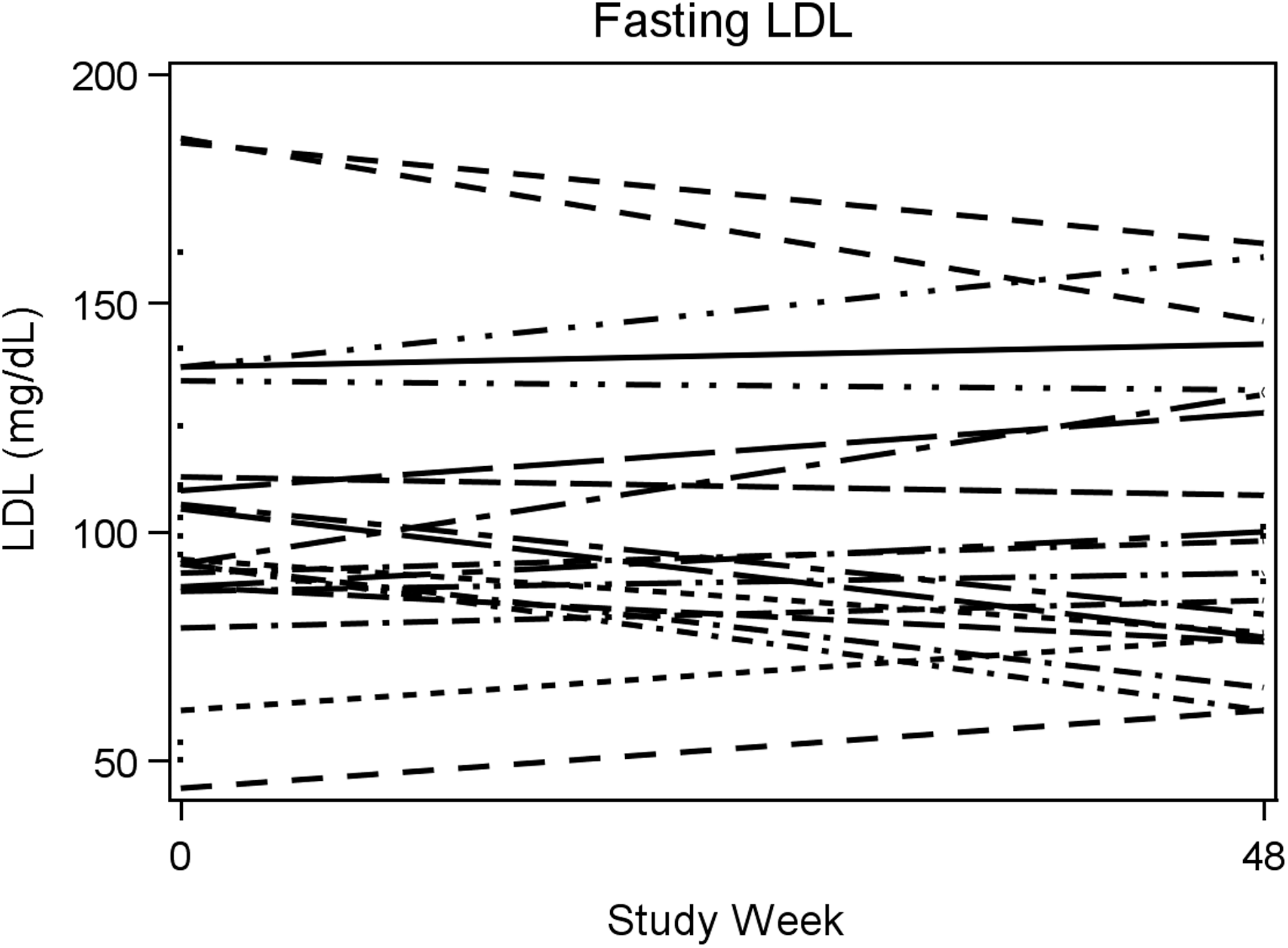
Low-density lipoprotein (LDL) cholesterol at baseline and week 48.
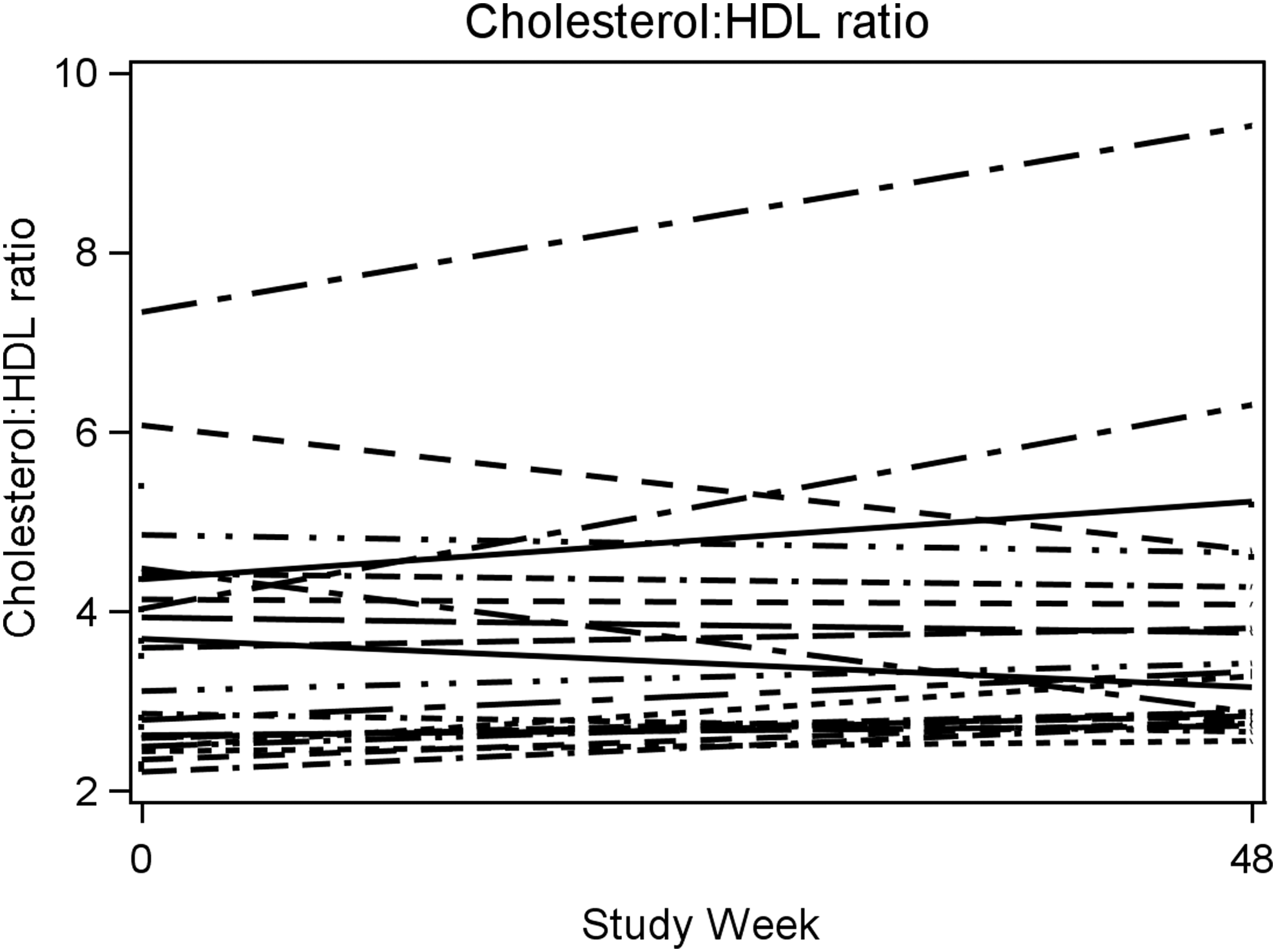
Total cholesterol to high-density lipoprotein (HDL) cholesterol ratio at baseline and week 48.
HDL, high-density lipoprotein; LDL, low-density lipoprotein.
Discussion
To our knowledge, this is the first FTC/RPV/TDF switch study conducted exclusively in HIV-positive women to (1) describe maintenance of virologic suppression, (2) understand the ability of HIV-positive women to comply with the dietary requirements of an RPV-containing STR, and (3) investigate the concordance between medication and caloric intake and virologic suppression. We demonstrated maintenance of virologic suppression similar to other FTC/RPV/TDF switch studies with high rates of suppression at weeks 24 and 48 (97% and 96%, respectively) in a population of women who were predominantly African American. 1,2
We found that most (86% by food diary) women were able to comply with the recommended caloric intake of ≥400 kcal. We believe that the caloric data obtained in our study is particularly robust as we (1) employed random phone call assessment to validate the reported caloric intake obtained through food diaries and (2) facilitated high compliance with food diary maintenance through avoidance of diary fatigue. This is supported by the fact that few women did not return the food diaries. Notably, women were able to comply with a 400 kcal meal requirement without changing calorie intake. This likely contributed to the stability of the women's weight throughout the duration of the study. As 88% of the women were overweight or obese at baseline, the lack of weight gain despite the caloric requirement is a particularly favorable finding for this ART regimen.
We found no concordance between caloric intake and virologic suppression. Few women (five through random calls and two through food diary) reported noncompliance with the ≥400 kcal requirement. Reassuringly all of the women who were noncompliant with the recommended calorie intake remained virologically suppressed (HIV RNA <50 c/mL). While these results are reassuring, it should be noted that a 3-day food diary may have underestimated the number of times RPV was taken with less than 400 calories. The 3-day recall was a median and participants may have been more adherent to calorie intake when maintaining their diary. That there was good agreement between random calls and food diary suggests that women were not more adherent during recording period.
We noted improvements in some of the fasting lipid components after switching to FTC/RPV/TDF. In keeping with other FTC/RPV/TDF switch studies, women had significant decreases in total cholesterol (median decrease 16 mg/dL), HDL cholesterol (median decrease 8.5 mg/dL), and triglycerides (median decrease 21 mg/dL). However, we differ from other studies, in that women in our study did not experience any change in LDL cholesterol (median increase 1 mg/dL). 1,2 This study population had a high proportion (88%) of overweight/obese participants with the concomitant comorbid risks of diabetes, cardiovascular disease, and stroke. Therefore, any therapy that confers potentially beneficial lipid changes is worthy of consideration.
A significant strength of our study might also contribute to a limitation as we only enrolled women, and in doing so limited the generalizability of the study results. However, we specifically chose a women-only study population due to the potential benefits that this regimen could confer on women, namely pregnancy category and lack of interaction with oral contraceptives, and the fact that there were limited data from clinical trials in this population. Other considerations that might limit the generalizability of study results are (1) small sample size, which can once again be attributed to the goal of enrolling only women, and (2) the women were enrolled from a single clinic population. The open-label design of this study might have contributed to bias, both from the clinical trial team and the patient.
Reasons for ART regimen switching in patients who are virologically suppressed are multifactorial. The current Department of Health and Human Services guidelines suggest that among the strategies for switching, there is good supporting evidence for within-class switches from EFV to RPV and from a PI-based regiment to RPV. 7 Our study results are in agreement with these earlier studies. We demonstrated that compliance with the food requirement that some might consider a hindrance was easily achievable in this population. Additional reasons that favor using FTC/RPV/TDF are the improvements in fasting lipid profile and the lack of weight gain in our participants. We believe that once-daily FTC/RPV/TDF represents a convenient and effective option for women and the calorie intake required is readily achievable.
Footnotes
Acknowledgments
The authors would specially like to thank the study participants, investigators, and study staff. This study was supported, in part, by the University of North Carolina at Chapel Hill, Center for AIDS Research, National Institutes of Health-funded program P30 AI50410, and Gilead Sciences, Inc. (Foster City, CA). The funders have had no influence on the study design, data collection, data analysis, interpretation and reporting of results, and article preparation.
Author Disclosure Statement
No competing financial interests exist.