




Abstract

E
The IVAP, stimulated or not with either pokeweed mitogen or Epstein–Barr virus, was primarily applied for diagnostic purpose in adult patients. And its usage was soon promising for performing children follow-up. 1 In Brazil, by employing the same concept that an enhancement could induce the synthesis of specific antibodies from HIV-primed B cells, using the mitogens and/or antigens, we decided to test the use of the disrupted whole HIV-1 as stimulant accessory for producing the specific antibody. Therefore, we cultured the PBMCs from HIV/AIDS-suspected patients for several days in HIV-1-antigen-coated microwells of a commercial ELISA kit, and using the same plates for detecting the produced antibodies following the regular manufacturer's recommendation (Fig. 1). This method termed as “in vitro-induced antibody production” (IVIAP) was applied for diagnosing the HIV infection in adults and children of >3 months of age. And it showed high sensitivity and specificity, with the advantage of low cost and antibody secretion in 24 h of culture. 1,2 The IVIAP technique was able to discriminate the anti-HIV-1 antibodies produced by B cells from children from the maternal antibodies that crossed placenta during pregnancy. This finding induced us to use it for diagnosing HIV-1 vertical transmission in suspected children, at the time, in which the polymerase chain reaction (PCR) for HIV-1 RNA/DNA detection was not available in poor-resource countries, such as Brazil. 1,2 Subsequently, we used the IVIAP for diagnosing one patient with an atypical HIV primary infection, before seroconversion. 3
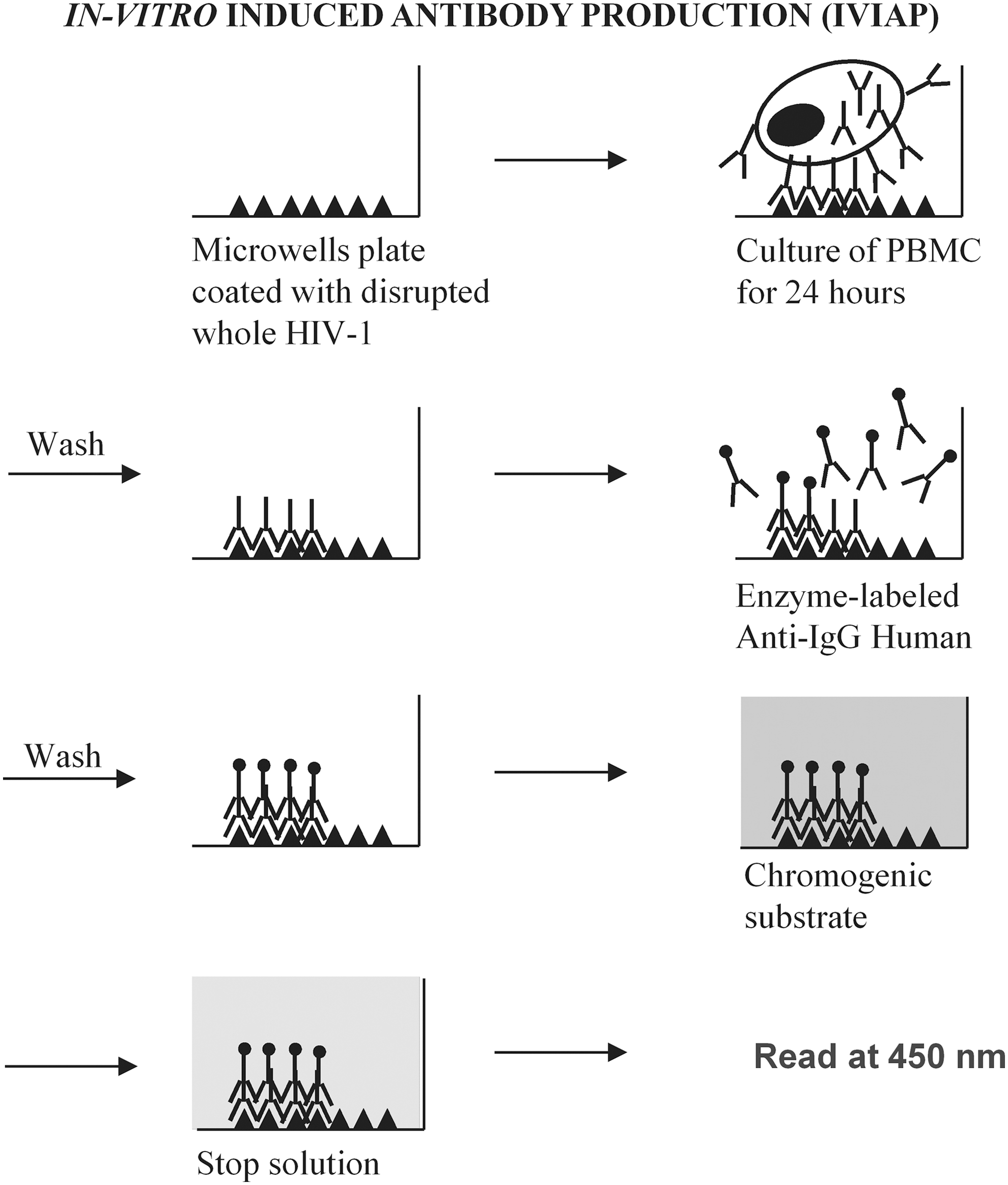
Schematic representation of the in vitro-induced antibody production (IVIAP) technique using a commercial ELISA kit for culture, and for detecting the produced anti-HIV-1 antibodies. PBMCs, peripheral blood mononuclear cells.
Now, reading the article recently published by Feldblum et al., concerning the use of the SMARTube to detect acute HIV infection before seroconversion, 4 we decided to comment on our previous experience with IVIAP, which agrees with the concept of SMARTube. Although we do not know the nature of stimulant that is present in such a tube (mitogen and/or antigens), this innovative technology called “Stimmunology” is able to accelerate the production of HIV-specific antibodies in primed B cells, corroborating our previous works. In accordance with the authors, this innovative technology could be used in developing country sites as an alternative to technically challenging and costly enzyme immunoassays and PCR tests to detect the acute HIV infection. In turn, SMARTube offers the opportunity to prevent HIV transmission and rapid therapeutic interventions.
Footnotes
Acknowledgment
Caterino-de-Araujo received a fellowship from CNPq PD no. 302661/2015-8.
Author Disclosure Statement
No competing financial interests exist.