HIV-1 transmission in intravenous drug users (IDUs) has been characterized by high genetic multiplicity and suggests a greater challenge for HIV-1 infection blocking. We investigated a total of 749 sequences of full-length gp160 gene obtained by single genome sequencing (SGS) from 22 HIV-1 early infected IDUs in Xinjiang province, northwest China, and generated a transmitted and founder virus (T/F virus) consensus sequence (IDU.CON). The T/F virus was classified as subtype CRF07_BC and predicted to be CCR5-tropic virus. The variable region (V1, V2, and V4 loop) of IDU.CON showed length variation compared with the heterosexual T/F virus consensus sequence (HSX.CON) and homosexual T/F virus consensus sequence (MSM.CON). A total of 26 N-linked glycosylation sites were discovered in the IDU.CON sequence, which is less than that of MSM.CON and HSX.CON. Characterization of T/F virus from IDUs highlights the genetic make-up and complexity of virus near the moment of transmission or in early infection preceding systemic dissemination and is important toward the development of an effective HIV-1 preventive methods, including vaccines.
Introduction
HIV-1 is transmitted by sexual contact across mucosal surface, by maternal–infant exposure, and by percutaneous inoculation. Eighty percent of heterosexual sexual transmission infection (HSX) and 75% of men who have sex with men (MSM) infection arise from a single virus, highlighting the extreme bottleneck and inherent inefficiency in virus transmission, but only 65% of intravenous drug users (IDUs) acquired single variants that led to productive infection.1 The higher multiplicity of HIV-1 infection observed in IDU is associated with a higher epidemiological risk of virus acquisition and suggests a greater challenge for HIV-1 vaccines.2 In the acute phase of infection, HIV-1 replicates exponentially and diversifies randomly, allowing for an unambiguous molecular identification of transmitted/founder virus (T/F virus) genomes and a precise characterization of the population bottleneck to virus transmission.3,4 Sequence analysis has shown that transmitted variants tend to contain envelope with shorter more compact variable loop structures and fewer glycosylation sites compared with variants in chronic infected patient.2 CCR5-tropic viruses (R5 viruses) are preferentially transmitted by all routes.5 A recent research reported signature sites identified between MSM and HSX Founder viruses in envelope.1 A greater understanding of T/F virus of IDUs may help identify envelope protein vulnerabilities that can be targeted by vaccines designed to block the virus or virally infected cells at or near the moment of transmission or in the early period preceding the establishment of viral latency and productive disseminated infection.
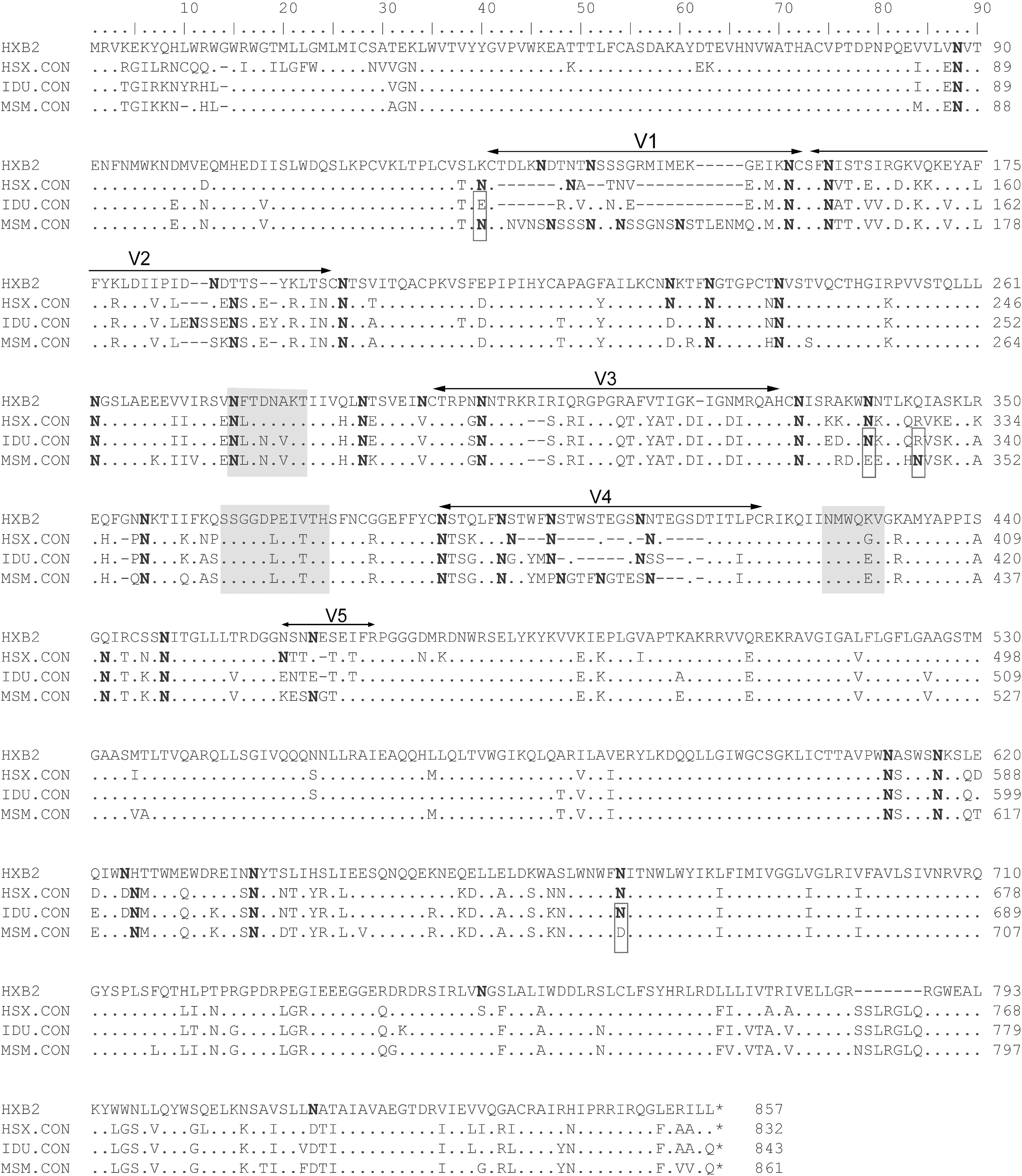
Here, we obtained a total of 749 gp160 sequences using single genome sequencing (SGS) method from 22 early HIV-1-infected IDUs in Xinjiang province, northwest China. Sequences were aligned using an online tool HIVAlign (www.hiv.lanl.gov). Phylogenetic analysis was performed by MEGA 6.0. A phylogenetic tree was constructed by the neighbor-joining method by taking 1,000 bootstrap replicates. Predicted co-receptor usage was determined using the web-based tools Web PSSM and Geno2pheno based on the sequence of the variable region (V3 region). The number of potential N-linked glycosylation sites (PNGS) was determined using N-glycosite available from the Los Alamos database (http://hiv.lanl.gov). Consensus sequence was generated using Consensus Maker (http://hiv.lanl.gov). Overall, all 749 sequences were classified as subtype CRF07_BC, with pure subtype C backbone in gp160.6 The SGS sequences of each subject make a consensus sequence of the subject. And then, T/F virus consensus sequence (IDU.CON) was calculated from 22 consensus sequences. The CRF07_BC homosexual T/F virus consensus sequence (MSM.CON) were also generated from sequences download in GenBank (accession no.: KM217738–KM218259). The amino acid of subtype C heterosexual T/F virus consensus sequence (HSX.CON; KM066116), MSM.CON, and IDU.CON were aligned and are presented in Figure 1. The residue frequency of genetic signature site of IDU and MSM is listed in Table 1. IDU.CON was discovered with longer variable region (V1, V2, and V4 loop) and less net charge compared with HSX.CON; the longer V1, V2, V4 loop results in loose variable loop structures (Table 2). A total of 26 PNGS were discovered in IDU.CON compared with 29 in HSX.CON and 31 in MSM.CON (Fig. 1). During transmission, it is widely accepted that there is strong selection for CCR5-tropic viruses. As expected, the IDU.CON V3 loop was predicted to use the CCR5 for cell entry, using both the C-PSSMsinsi (http://indra.mullins.microbiol.washington.edu/webpssm) and geno2pheno (coreceptor) (http://coreceptor.bioinf.mpiinf.mpg.de) algorithms. The GPGQ crown motif was significantly conserved (Table 3).7 It is believed that blocking the molecular events underlying the earliest virus–host interactions in HIV-1 infections is of paramount importance. Our results illustrate the characteristics of virus near the moment of transmission or in early infection preceding systemic dissemination and will be helpful in developing preventive methods, including vaccines.
The amino acid alignment of HXB2, HSX.CON, MSM.CON, and IDU.CON. PNGS is shown in bold. The estimated genetic signature residues is indicated by the hollow box, and the CD4 binding site is indicated by shaded box. PNGS, potential N-linked glycosylation sites.
The NFLGs are available in GenBank under the accession no. KY345421–KY346492.
Footnotes
Acknowledgments
This work was supported by the National Natural Science Foundation of China (81361120407), the State Key Laboratory for Infectious Disease Prevention and Control China, and the Ministry of Public Health Ethical Review Committee for Research in Human Subjects.
Author Disclosure Statement
No competing financial interests exist.
References
1.
TullyDC, OgilvieCB, BatorskyRE, et al.: Differences in the selection bottleneck between modes of sexual transmission influence the genetic composition of the HIV-1 founder virus. PLoS Pathog, 2016; 12:e1005619.
2.
KillickM, CapovillaA, PapathanasopoulosMA: Generation and characterization of an HIV-1 subtype C transmitted and early founder virus consensus sequence. AIDS Res Hum Retroviruses, 2014; 30:1001–1005.
3.
KeeleBF, GiorgiEE, Salazar-GonzalezJF, et al.: Identification and characterization of transmitted and early founder virus envelopes in primary HIV-1 infection. Proc Natl Acad Sci U S A, 2008; 105:7552–7557.
4.
Salazar-GonzalezJF, BailesE, PhamKT, et al.: Deciphering human immunodeficiency virus type 1 transmission and early envelope diversification by single-genome amplification and sequencing. J Virol, 2008; 82:3952–3970.
5.
ShawGM, HunterE: HIV transmission. Cold Spring Harbor Perspect Med, 2012; 2.
6.
QiuZ, XingH, WeiM, et al.: Characterization of five nearly full-length genomes of early HIV type 1 strains in Ruili city: Implications for the genesis of CRF07_BC and CRF08_BC circulating in China. AIDS Res Hum Retroviruses, 2005; 21:1051–1056.
7.
CormierEG, DragicT: The crown and stem of the V3 loop play distinct roles in human immunodeficiency virus type 1 envelope glycoprotein interactions with the CCR5 coreceptor. J Virol, 2002; 76:8953–8957.