




Abstract
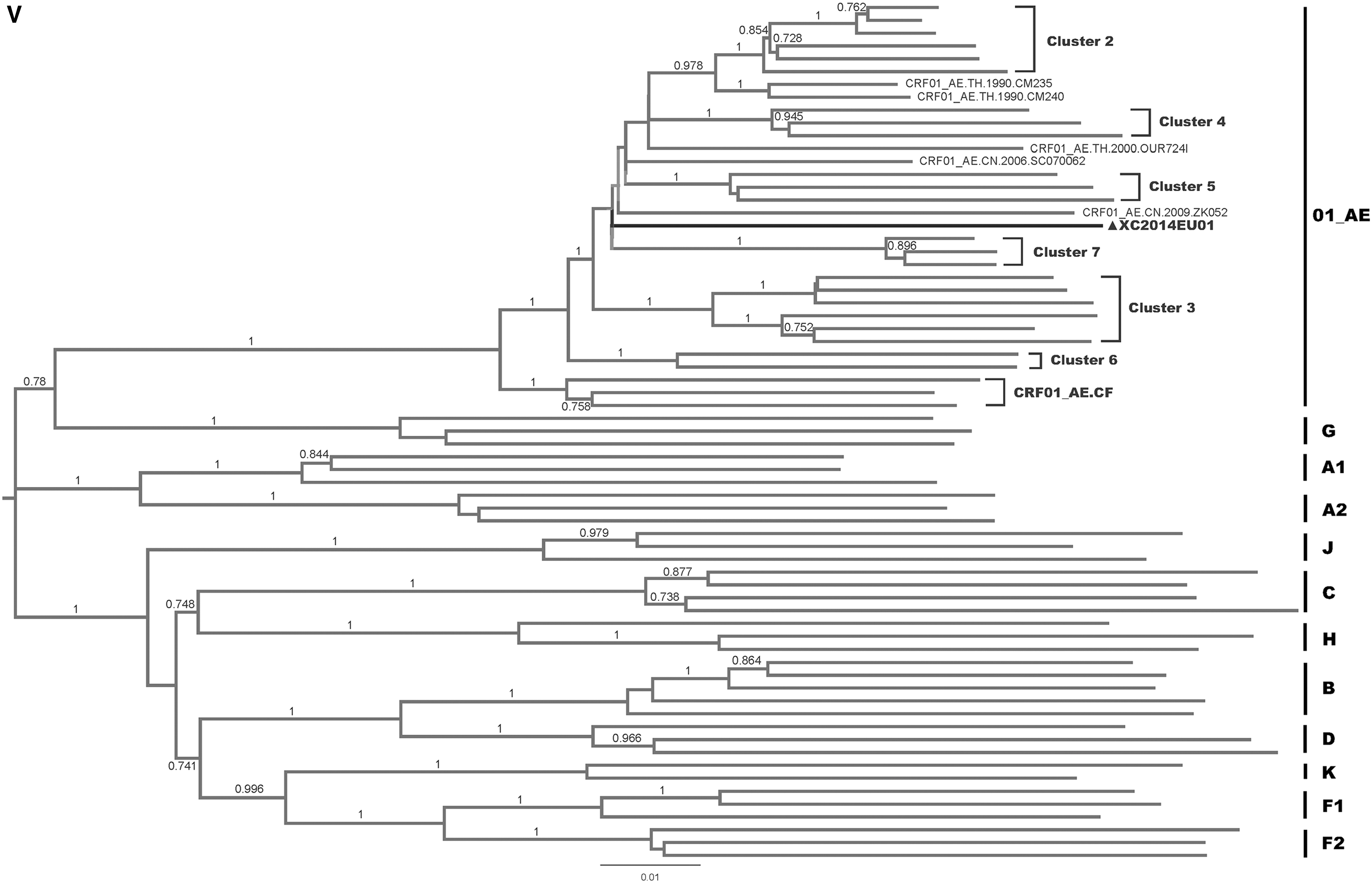
We report in this study a novel HIV-1 unique recombinant virus (XC2014EU01) isolated from an HIV-positive man who infected through heterosexual sex in Sichuan, China. The near full-length genome analyses showed that XC2014EU01 harbored one subtype B segment in pol region and two subtype C segments in gag-pol region in a CRF01_AE backbone. The unique mosaic structure was distinctly different from the other CRF01_AE/B′/C recombinant forms reported. Phylogenetic tree analyses revealed that the subtype B region originated from a Thailand subtype B′ lineage, the subtype C regions were from an India C lineage, and the backbone was from CRF01_AE. XC2014EU01 was still identified as CCR5-tropic, and plasma of XC2014EU01 infected person had the media neutralizing activity. The emergence of XC2014EU01 may increase the complexity of the HIV-1 epidemic among high-risk populations and the difficulty of vaccine research and development.
R
In this study, we separated a recombinant strain of HIV-1 (XC2014EU01) from a 52-year-old male, who was infected through heterosexual sex in Sichuan, China, and presented with CD4+ T cell count 366 cells/μl and viral load 93,500 copies/ml on March 13, 2014. The informed consent was signed before the sample collection. This study was reviewed by the Institutional Research Ethics Community of the Chinese Center for Disease Control and Preventive (No. 201334).
The viral RNA was extracted from the virus isolated from the peripheral blood mononuclear cells using QIAamp® Viral RNA Mini Kit (QIAGEN) and then transcribed into cDNA. Through gradient dilution of cDNA, the near full-length genome (NFLG) was amplified by nested polymerase chain reactions (nest-PCRs). 6 The following PCR conditions for both of the two rounds were used, including an initial denaturation 94°C for 2 min, followed by 35 cycles of 94°C for 30 s, 62°C for 30 s, and 68°C for 4 min, followed by a final extension at 68°C for 10 min. The positive PCR products were purified and sequenced. The sequences were spliced and assembled by Sequencher v4.9.
The NFLG sequence of XC2014EU01 was aligned against all known HIV-1 group M reference sequences representing subtypes/sub-subtypes and CRF relative to our study in China, obtained from the Los Alamos HIV Sequence Database (
The NFLG sequence of XC2014EU01 was obtained with the length of 8,891 bp (relative to the HXB2 nucleotide numbering system: positions 635 to 9613). Phylogenetic analyses revealed that the NFLG sequence of XC2014EU01 clustered with CRF01_AE and CRF78_cpx with 0.94 bootstrap values, but formed a monophyletic branch distinct from them (Fig. 1). Recombination analyses show that XC2014EU01 was composed of CRF01_AE, C, and B′, with two C segments and one B′ segment inserted in CRF01_AE backbone (Fig. 2A). The breakpoints relative to HXB2 nucleotide positions were defined by HIV Sequence Locator (
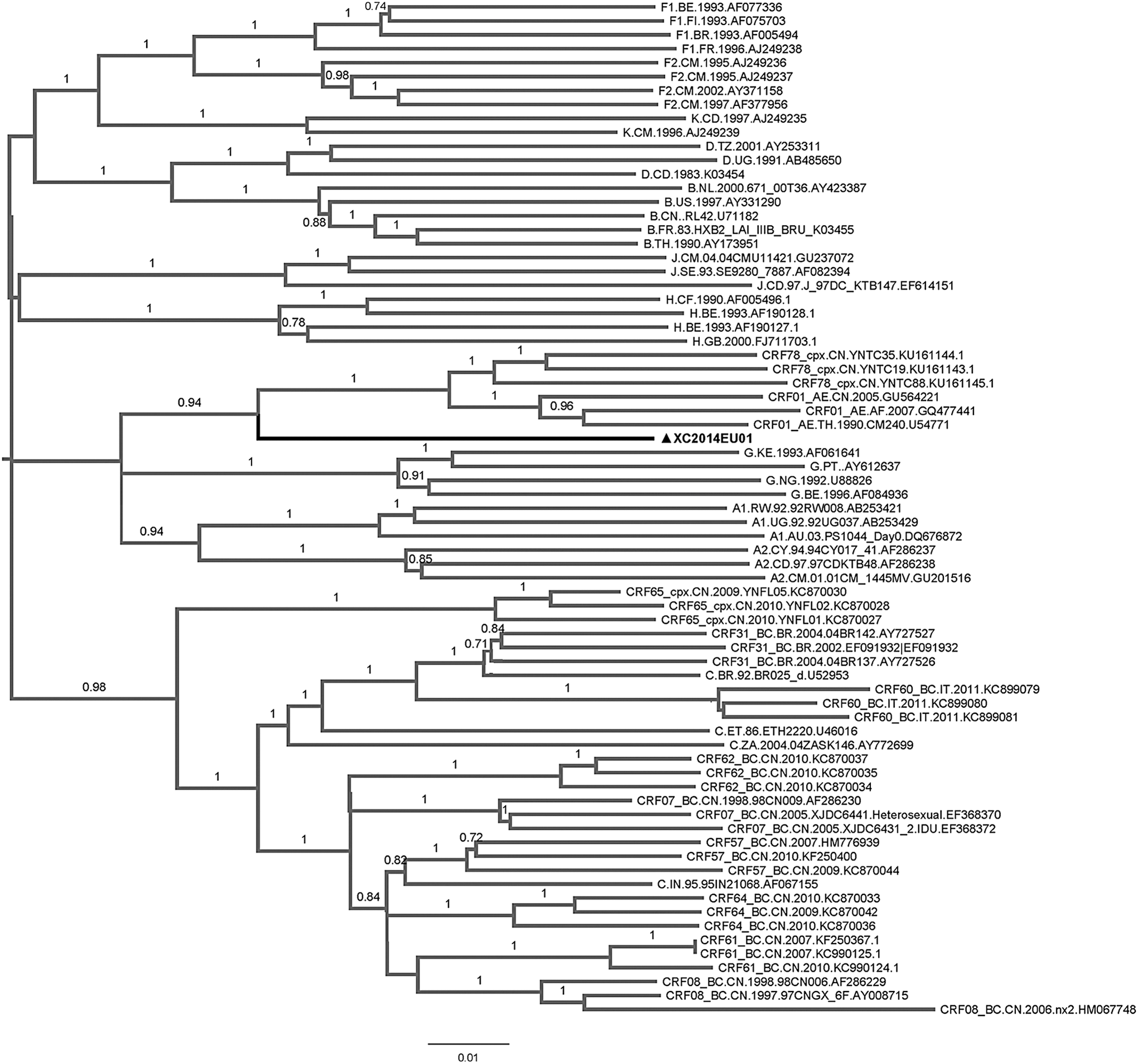
Phylogenetic tree analyses of the NFLG sequence of XC2014EU01. It was constructed with MEGA 5.0 using the neighbor-joining method with the Kimura two-parameter model and 1,000 bootstrap replication test. XC2014EU01 clustered with the CRF01_AE and CRF78_cpx reference sequences, but formed a distinct monophyletic branch distantly related to the reference sequences. A solid triangle (▲) marks XC2014EU01, which was also displayed as a bold line throughout the article. Bootstrap values (>0.7) were showed at the corresponding nodes. NFLG, near full-length genome.
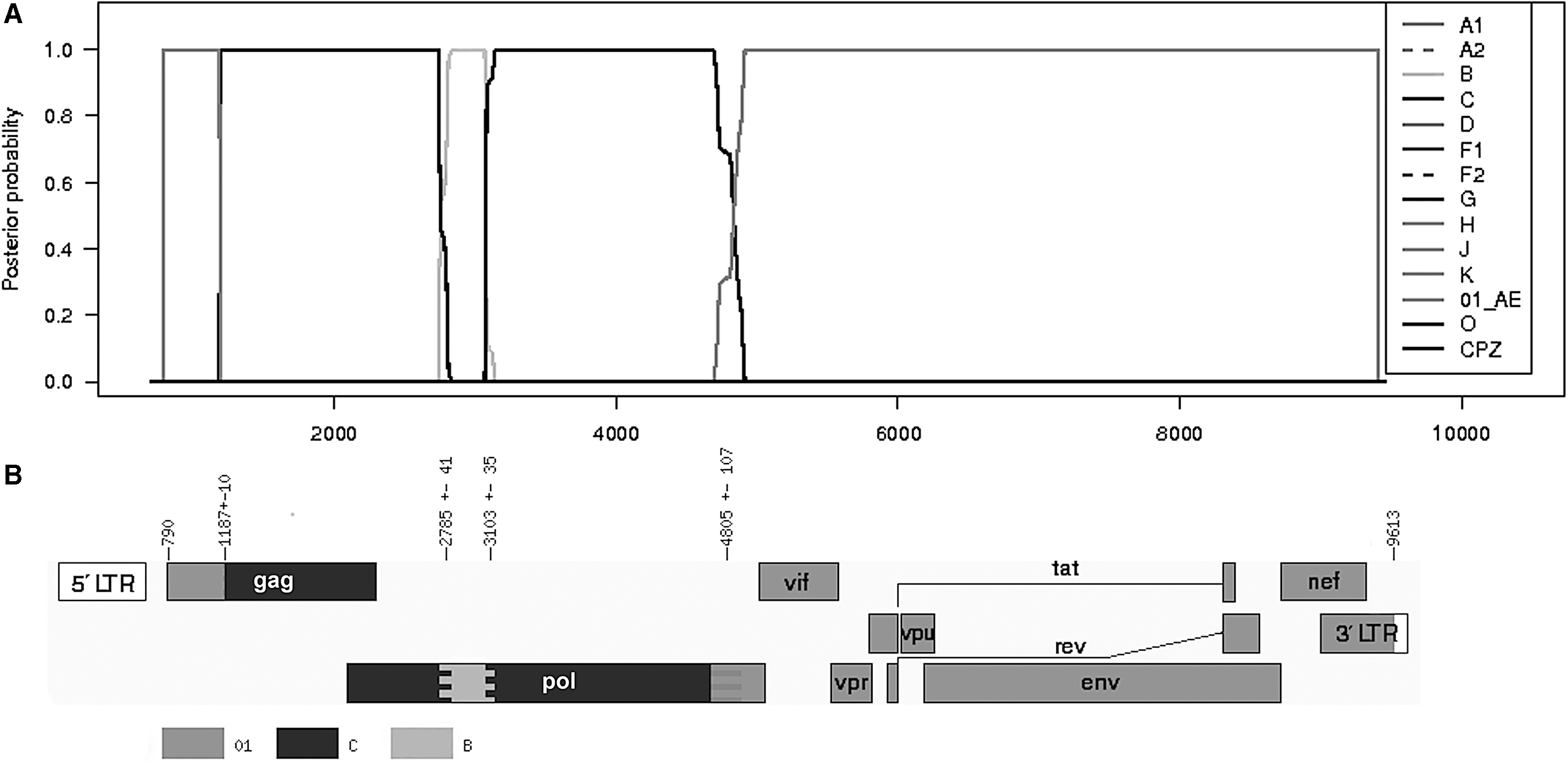
Recombinant analysis of XC2014EU01.
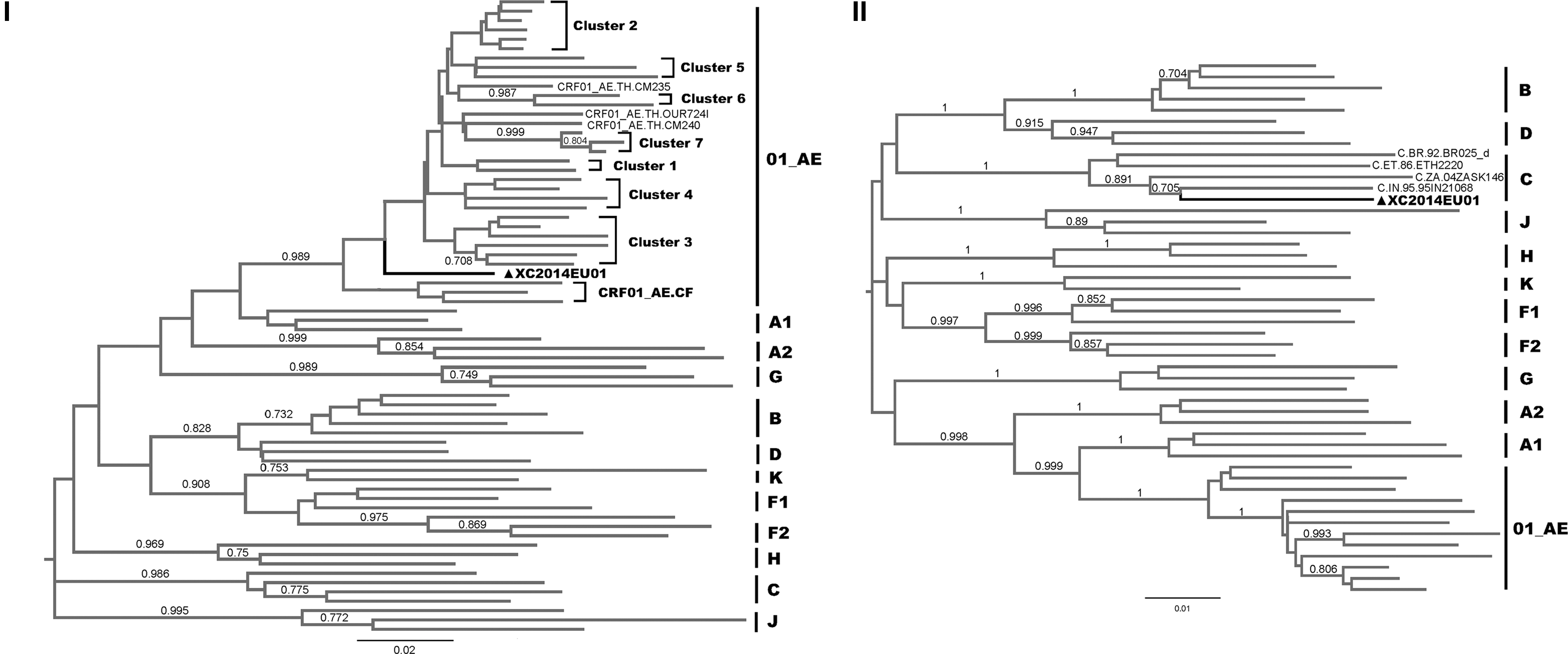
Subregion tree analysis of the novel identified XC2014EU01. Phylogenetic trees for five segments

The viral NFLG of XC2014EU01 kept the CRF01_AE parental backbone with three subtype B′ and C segments inserted into gag and pol genes, respectively. Compared with XC2014EU01, the recombinant form of JL.RF01 identified that there were six subtype B′ and C segments inserted into gag and pol genes of CRF01_AE parental backbone. 3 The recombinant form of XC2014EU01 was also different from CRF65_cpx and CRF78_cpx. 4,5 The mosaic structure of CRF65_cpx recombinant genome was composed of fourteen subtype C, B′, and CRF01_AE segments. 4 The recombinant form XC2014EU01 was similar to CRF78_cpx, both of which were three subtype C and B segments inserted in the CRF01_AE parental backbone. 5 The majority of gag and pol genes of XC2014EU01 were subtype C segments with a small subtype B′ segment (322 bp) inserted in p51gene, whereas there were three small subtype C and B segments inserted in gag and pol gene of the CRF01_AE parental backbone in CRF78_cpx. 5
In this study, XC2014EU01 was identified as CCR5-tropic on Ghost cells consistent with partly CRF01_AE found in China. It was largely due to whole env sequence of XC2014EU01 belonged to CRF01_AE. 11 Moreover, the neutralizing activity depended critically on HIV-1 envelope protein. 12 So the plasma of XC2014EU01 infected person was detected for neutralizing activities against 15 HIV pseudotyped viruses in TZM-bl cells (not shown). These pseudoviruses include 12 pseudovirus of global Panel, 2 Tier 1 pseudoviruses of MW965 and SF162, and 1 murine retrovirus of SVA-MLV (murine retrovirus Env-pseudovirus) as unrelated negative control. The 50% inhibitory dose (ID50) to pseudovirus infection was calculated in times of dilution, and ID50 < 20 was counted as negative. VRC01 at 200 μg/ml was detected as the control.
For SVA-MLV control pseudovirus, VRC01 and the plasma of the patient (XC2014EU01) showed negative neutralizing results (<20). These results verified patient free of antiretrovirus drug therapy. For the other 14 pseudoviruses detected, VRC01 showed broad neutralizing activity, which neutralized 13 to 14 of the 14 pseudoviruses (neutralizing breadth >90%), consistent with other report. 13 The plasma of XC2014EU01 showed media neutralizing activity, which neutralized 10 to 12 of the 14 pseudoviruses (neutralizing breadth 70%–90%). The neutralizing potency of the plasma (XC2014EU01) was 69.78 lower than 195.59 of VRC01, without producing the broad-neutralizing antibodies.
The emergence of the novel CRF01_AE/B′/C recombinant suggested the continued generation of new recombinant strains in high-risk populations in Sichuan. XC2014EU01 was still identified as CCR5-tropic, and the plasma of XC2014EU01 infected person did not have the broad neutralizing activity. The emergence of XC2014EU01 may indicate the increasing complexity of the HIV-1 epidemic among high-risk populations in Sichuan. And whether the recombination may confer selective advantages forming circulating clusters over parental viruses remains to be investigated.
Sequence Data
The NFLG sequence of XC2014EU01 has been submitted to GenBank with the accession number KX353919.
Footnotes
Acknowledgments
This work was supported by the National Natural Science Foundation of China (grant 81261120384, 81172733, and 81561128006); the Key Project of the State Key Laboratory of Infectious Diseases Prevention and Control (grant 2011SKLID102); and the European Research Infrastructures for Poverty Related Diseases (grant 312661).
Author Disclosure Statement
All the authors have no conflict of interest.