




Abstract

L
Treatments with MTIs/NAM revealed a common feature in autologous/allogeneic system: a blunted HIV recovery with rapid decline toward extinction, in contrast to those three samples where viral cultures were positive post-PHA treatment, in which viral growth was normal in autologous system with an even better viral yield in allogenic system. This anomalous behavior of virus suggested massive presence of defective HIV particles. To confirm this, we visually inspected the viral ultrastructure by electron microscopy (EM) as described. 3
Three samples of supernatant from viremic individuals where virus was reactivated by PHA only were concentrated by ultracentrifuge and vortexed to resuspend the pellet, and 12 unconcentrated samples treated with MTIs/NAM were analyzed. There were seen many broken viruses in the samples that underwent ultracentrifuge/vortex suggesting that this procedure can damage virus (Fig. 1A–C), while the samples treated with MTIs/NAM (Fig. 1D–I) revealed exclusively aberrant HIV strains, showing abnormally small size, with diffused/unclear matrix and in almost all cases the absence of double membrane.
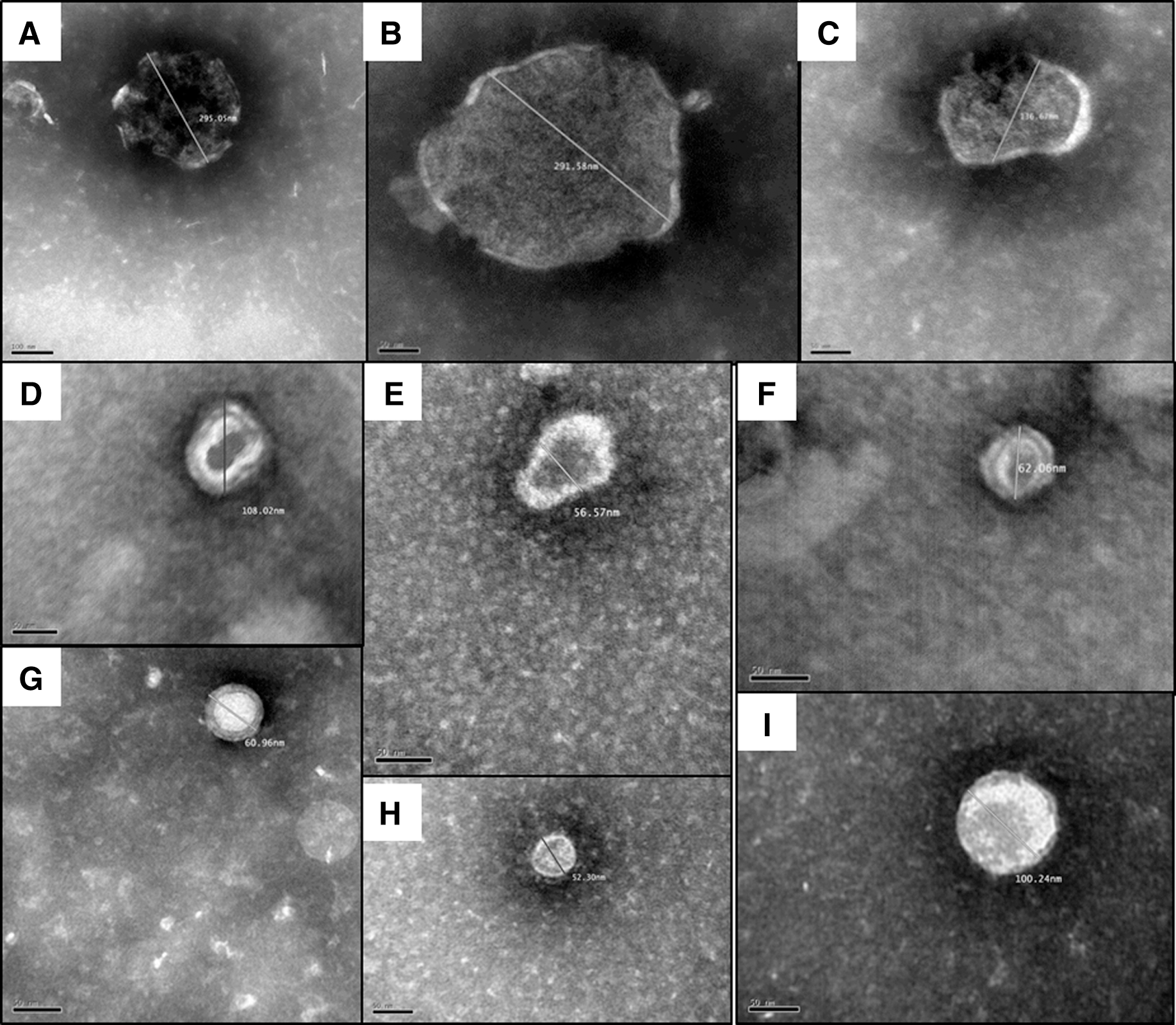
Electron microscopy images of HIV-1 particles purged by different pathways.
It has been demonstrated that defective HIV obtained from individuals under long-term ART may present defective HIV with genomes as short as 2 kb. 4 These results suggest that beside long-term ART that may decrease the pool of replication-competent viruses and proportionally increase defective proviral pool, designing new strategies targeting this defective proviral pool may be desirable to obtain sterilizing cure of HIV-infection. Opening of the chromatin via deacetylase/methyltranfersase inhibitors forcibly pushes out infectious as well as defective particles, but defective particles dominate in the culture probably due to complementation and thus consume maximum multiplicity of infection and finally extinct in allogenic system.
We recognize that it can be difficult to differentiate these alleged abnormal virions from membrane debris released by cells, such as microvesicles or exosomes. 5 Nonetheless, strategies aimed at viral purging that coordinate with the natural balance of chromatin might play a prime important role in reactivation of the virus that can enable/help the immune system to clear infected cells and can thus avoid rendering the cell dysfunctional.
Footnotes
Acknowledgments
This study was supported by FAPESP and CNPq, 2013/11323-5 and 454700/2014-8, respectively. We are thankful to EM sector for its assistance.
Author Disclosure Statement
No competing financial interests exist.