




Abstract
The envelope glycoprotein (Env) gp120 of human immunodeficiency virus type 1 (HIV-1) plays a critical role in viral entry into host cells. The broadly neutralizing human monoclonal antibody VRC01, which recognizes the CD4 binding site on gp120, neutralizes more than 90% of HIV-1 isolates. However, some of the CRF01_AE viruses prevalent in Southeast Asia are resistant to VRC01-mediated neutralization. We previously reported that 3 amino acid residues at positions 185, 186, and 197 of gp120 played an important role in the VRC01 resistance of CRF01_AE Env (AE-Env) clones isolated from HIV-infected Thai individuals. However, the VRC01 susceptibility of AE-Env clones was not fully explained by mutations at these 3 residues. In the present study, we examined other factors involved in the acquisition of viral VRC01 resistance. Neutralization tests using lentiviral vectors expressing a series of mutant AE-Env clones revealed that the deletion of 2–4 amino acid residues on the loop structure in the V5 region of gp120 conferred VRC01 resistance to several AE-Env clones. Our results provide novel insights into the mechanisms underlying viral VRC01 resistance.
Introduction
H
Combination ART (cART) using multiple types of antiretroviral drugs is the standard treatment regimen for individuals living with HIV-1. 7 Several antiretroviral drugs have been developed, and HIV-1-related mortality is decreasing. However, cART cannot completely eradicate existing virus reservoirs. Therefore, HIV-1-infected individuals must continue cART throughout their lifetime to maintain the suppression of virus replication. The virus may also acquire resistance to antiretroviral drugs if the treatment is not properly conducted, such as inappropriate adherence. 8 Therefore, the development of preventive and therapeutic HIV vaccines is urgently required.
Although vaccines against HIV-1 have not yet been developed, potent anti-HIV-1-neutralizing antibodies are produced in some HIV-1-infected individuals and have the potential to inhibit infection by the broad subtypes and CRFs of HIV-1. 9 Therefore, broadly neutralizing antibodies (bNAbs) generated from infected individuals are now being examined to accumulate information for the development of HIV-1 vaccines. 10 VRC01 is one of the recently established bNAbs generated from a patient who was infected with HIV-1 subtype B virus. 11 VRC01 neutralizes more than 90% of circulating HIV-1 isolates. It also protects humanized mice from HIV-1 infection. 12,13 bNAbs generally initiate neutralization by targeting spike-like structures on viral envelopes (Env) composed of highly glycosylated envelope glycoprotein 120 (gp120), which binds to CD4 receptors and CXCR4/CCR5 coreceptors, and the transmembrane protein, gp41, causing membrane fusion. The main part of the epitope of VRC01 is located on the CD4 binding site (CD4bs) of gp120. 11,14 Therefore, VRC01 masks CD4bs to inhibit viral entry.
Approximately 10% of CRF01_AE isolates are resistant to VRC01-mediated neutralization, 11 and the mechanisms by which viruses acquire resistance to VRC01 currently remain unclear. Recently, we generated a series of CRF01_AE Env (AE-Env) clones derived from chronically HIV-1-infected Thai individuals and established 35 infectious AE-Env-recombinant viruses. 15 Genotypic and phenotypic studies of these functional AE-Env clones were then carried out. 15,16 As a part of immunological characterization of these AE-Env clones, their neutralization susceptibilities to antiserum and bNAbs, including IgG1 b12 (b12), 2G12, 2F5, 4E10, and VRC01, were studied. 16 –18 Judging from their neutralization susceptibilities to bNAbs, these AE-Env clones were considered to be Tier 2 Env clones. 16 –18 Our previous studies revealed that two potential N-linked glycosylation (PNLG) sites at amino acid positions 186 (N186) and 197 (N197) and an amino acid residue: glutamic acid, glycine, or asparagine at position 185 in CRF01_AE Env (AE-Env) gp120 were responsible for the acquisition of viral resistance to two CD4bs antibodies, b12 and VRC01. 17,18 However, the susceptibility of some AE-Env clones to VRC01 was not affected by these PNLG sites or the amino acid residue at position 185. 18 These findings suggest that other factor(s) contribute to the acquisition of resistance. To identify other amino acid residue(s) influencing the resistance of viral strains to VRC01, we introduced additional mutations into AE-Env clones and evaluated their susceptibilities to VRC01 using lentiviral vectors expressing a series of mutant AE-Env.
Materials and Methods
Cells
Lenti-X 293T cells (Takara, Shiga, Japan) were cultured in Dulbecco's modified Eagle's medium supplemented with 10% fetal bovine serum (DMEM-10% FBS). U87.CD4.CXCR4 and U87.CD4.CCR5 cells were cultured in DMEM-10% FBS with 1 μg/ml of puromycin and 300 μg/ml of G418. Lenti-X 293T cells and U87 cell lines were maintained at 37°C with 5% CO2.
CD4bs antibodies
To prepare VRC01, the expression vectors of the heavy and light chains, CMVR VRC01 H and CMVR VRC01 L, respectively, 11 were transfected into FreeStyle 293-F cells using 293fectin Transfection Reagent (Life Technologies, Oslo, Norway). Five days after transfection, the supernatant containing VRC01 was collected and purified using the MAbTrap Kit (GE Healthcare, Buckinghamshire, United Kingdom). The concentration of purified VRC01 was calculated by absorbance at 280 nm. The antibody solution was aliquoted and stored at −30°C. CMVR VRC01 H and CMVR VRC01 L were provided by Dr. John Mascola through the NIH AIDS Research and Reference Reagent Program (ARRRP), Division of AIDS, NIAID, NIH. In addition, b12 was purchased from Polymun Scientific (Vienna, Austria).
Preparation of mutant AE-Env expression vectors
The expression vectors for the AE-Env clones, 52PB3, 52PL4, 52PL7, 47PL1, 47CC11, 60PL2, 98CC2, 102CC2, and 105PL3, 15,16 were previously generated by the cloning of env genes derived from HIV-1-infected Thai individuals into the mammalian expression vector, pCI-neo Mammalian Expression Vector (Promega, Madison, WI). The first two digits in the identification (ID) of Env clone were derived from patient ID. 15 Therefore, three AE-Env clones, 52PB3, 52PL4, and 52PL7, were derived from patient 52, while two AE-Env clones 47PL1 and 47CC11 were derived from patient 47. Mutations at positions 185, 186, and 197 were introduced into each clone as described previously. 17,18 The gene sequences of the VRC01-resistant AE-Env clones, 52PL7-E185D/N186Q/N197Q, 47PL1, 47PL1-N197Q, 47CC11, 47CC11-N197Q, and 47CC11-G185D/N197Q, as well as the VRC01-susceptible clones, 52PB3-E185D/N197Q, 52PL4-E185D/N197Q, 60PL2-N197Q, 98CC2, 98CC2-G185D/N197Q, 102CC2-E185D/N197Q, 105PL3, 105PL3-N197Q, and 105PL3-D185G/N197Q, were aligned using GENETYX version 10 software (GENETYX, Tokyo, Japan). Mutations at amino acid positions 50, 152, 183, 186, 412, 459, and 750 were introduced by site-directed mutagenesis using PfuUltra II Fusion HS DNA Polymerase (Agilent Technologies, Santa Clara, CA) for 52PL7-E185D/N186Q/N197Q, 52PB3-E185D/N197Q, and 52PL4-E185D/N197Q or the KOD Plus Mutagenesis Kit (TOYOBO, Kyoto, Japan) for 47PL1, 47PL1-N197Q, 47CC11, 47CC11-N197Q, 47CC11-G185D/N197Q, 60PL2-N197Q, 98CC2, 98CC2-G185D/N197Q, 102CC2-E185D/N197Q, 105PL3, 105PL3-N197Q, and 105PL3-D185G/N197Q.
Generation of lentiviral vectors expressing AE-Env
The second-generation lentiviral packaging plasmid, psPAX2, and luciferase-expressing lentiviral vector plasmid, pLenti CMV Puro LUC (w168-1), 19 were cotransfected with an AE-Env expression vector into Lenti-X 293T cells using FuGENE HD transfection reagent (Promega) or polyethylenimine (Polysciences, Warrington, PA). Forty-eight hours after transfection, the supernatant was cleared by centrifugation for 5 min at 3,000 rpm and stored at −80°C. The HIV-1 Gag p24 antigen in the viral supernatant was measured using an enzyme-linked immunosorbent assay (Rimco, Okinawa, Japan). The infectivities of the generated lentiviral vectors were evaluated using the following steps. U87.CD4.CXCR4 or U87.CD4.CCR5 cells, which were seeded on 24-well plates (6 × 10⁴ cells/500 μl/well) 24 h before infection, were infected with the lentiviral vector (10 ng of p24). Forty-eight hours after infection, the supernatant was aspirated. Cells were then lysed in 100 μl of Glo Lysis Buffer (Promega). Luciferase activity in infected cells was measured using a Steady-Glo Luciferase Assay Kit (Promega) and LB 962 Microplate Luminometer (Berthold Technologies, Bad Wildbad, Germany). Viral infectivity was estimated by the level of relative light units (RLUs) and compared between lentiviral vectors expressing AE-Env clones with and without mutations. U87.CD4.CXCR4 and U87.CD4.CCR5 cells were provided by Dr. HongKui Deng and Dan R. Littman through ARRRP.
Neutralization assay
To examine the VRC01 and b12 susceptibilities of lentiviral vectors expressing AE-Env, a neutralization assay was performed essentially as described previously. 17 Lentiviral vectors expressing AE-Env, but not AE-Env-recombinant viruses, were used in all neutralization assays in the present study. Briefly, U87.CD4.CXCR4 or U87.CD4.CCR5 cells were seeded on 96-well plates (5 × 10³ cells/100 μl/well) and incubated for 24 h. A lentiviral vector expressing AE-Env (10 or 30 ng) was incubated for 1 h with twofold serially diluted VRC01 or b12. Cells were incubated with a mixture of the virus and the antibody. Forty-eight hours after infection, RLU was measured as described above. Percent neutralization was calculated by comparisons between luciferase activities in the presence and absence of the antibody. IC50 values were then calculated using a standard function of GraphPad Prism 5 software (GraphPad Software, San Diego, CA).
Results
Single or multiple amino acid substitution(s) at positions 50, 152, 183, 412, and 750 of gp120 did not affect susceptibilities of AE-Env clones to VRC01
We previously reported that two PNLG sites, N186 and N197, and an amino acid residue: glutamic acid, glycine, or asparagine, at position 185 of Env gp120 played an important role in the acquisition of viral resistance to bNAbs, IgG1 b12, and VRC01. 18 However, some AE-Env clones were not conferred with VRC01 susceptibility by the amino acid substitutions at these residues. Two AE-Env clones, 52PB3 and 52PL4, became susceptible to VRC01 when N197 was removed and glutamic acid was substituted to aspartic acid at position 185 (52PB3-E185D/N197Q and 52PL4-E185D/N197Q, respectively), while the VRC01 susceptibility of 52PL7 was not altered by amino acid substitutions at positions 185, 186, and 197 (52PL7-E185D/N186Q/N197Q). 18
To identify other factors involved in viral VRC01 resistance, the amino acid sequences of Env gp120 and gp41 among 52PB3, 52PL4, and 52PL7 were compared (Fig. 1). The results obtained revealed differences in 4 amino acid residues on gp120 and in a residue on gp41 between 52PL7 and both of 52PB3 and 52PL4 (Fig. 1). The insertion of 2–4 more amino acid residues at two positions on gp120 of both 52PB3 and 52PL4 was noted from that in 52PL7 (Fig. 1). This result prompted us to construct a series of 52PB3 point mutants by replacing an amino acid residue at position 50, 152, 183, 412, or 750 of 52PB3 to that of 52PL7 (T50I, E152D, P183Q, G412D, or S750T, respectively). A neutralization assay using a series of lentiviral vectors expressing 52PB3 mutants was then performed to evaluate the VRC01 susceptibilities of these 52PB3 mutants. The results obtained showed that infection by lentiviral vectors expressing 52PB3 mutants was inhibited by VRC01 in a dose-dependent manner (Fig. 2A), suggesting that the susceptibilities of 52PB3 mutants to VRC01 were not altered by the introduction of a single amino acid mutation. To clarify whether neutralizing susceptibility is regulated by multiple amino acid residues, multiple amino acid substitutions were introduced into 52PB3. 52PB3-E185D/N197Q-T50I/E152D, 52PB3-E185D/N197Q-T50I/E152D/P183Q, 52PB3-E185D/N197Q-T50I/E152D/P183Q/G412D, and 52PB3-E185D/N197Q-T50I/E152D/P183Q/G412D/S750T were constructed, and their VRC01 susceptibilities were evaluated. The results obtained showed that 52PB3-E185D/N197Q-T50I/E152D and 52PB3-E185D/N197Q-T50I/E152D/P183Q were still susceptible to VRC01 (data not shown). In addition, 52PB3-E185D/N197Q-T50I/E152D/P183Q/G412D and 52PB3-E185D/N197Q-T50I/E152D/P183Q/G412D/S750T lost their infectivities (data not shown). These results suggest that amino acid residues at positions 50, 152, 183, 412, and 750 did not affect the VRC01 susceptibility of the AE-Env clone, 52PB3.
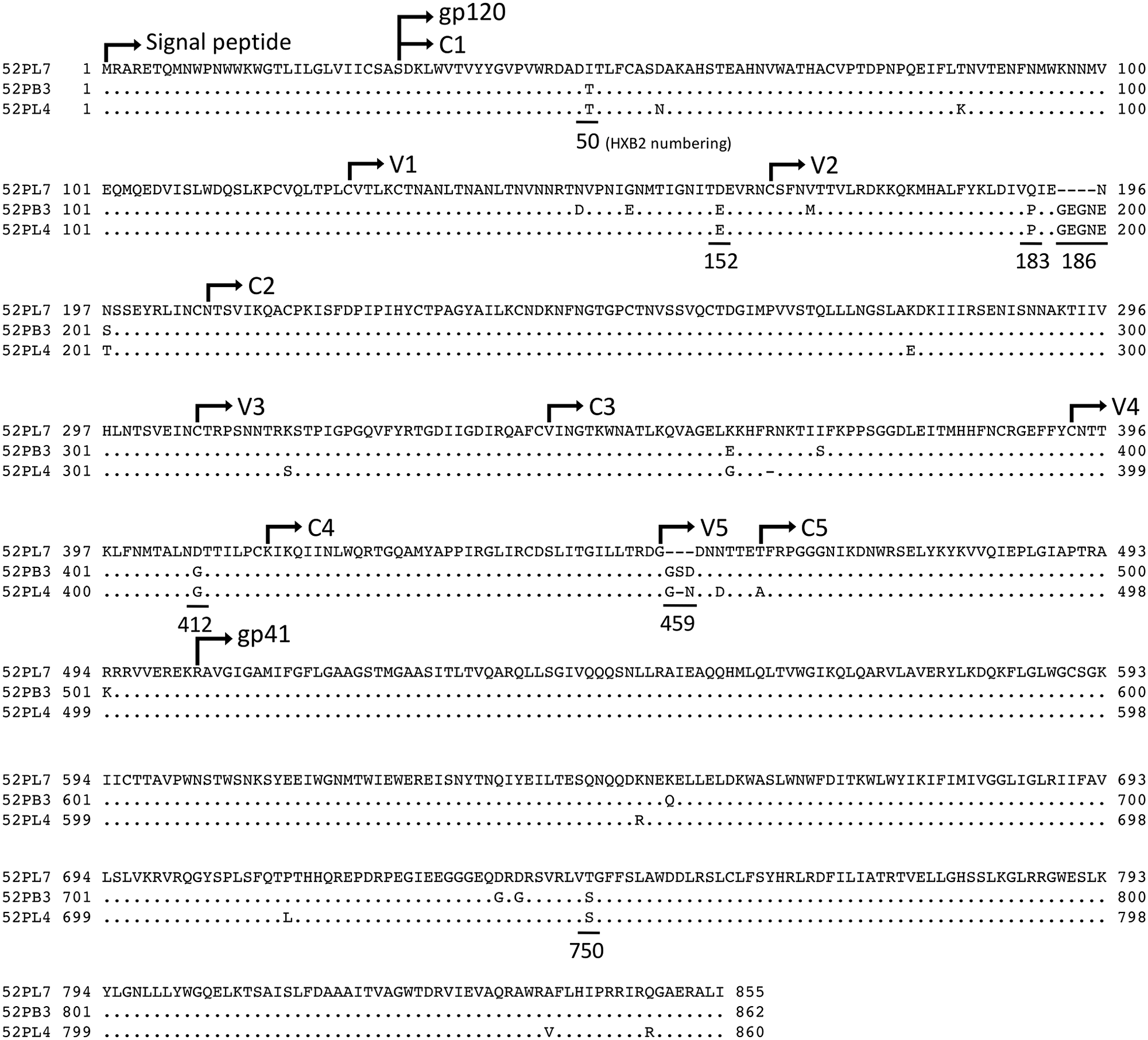
Comparison of gp120 and gp41 amino acid sequences among 52PL7, 52PB3, and 52PL4. The amino acid sequences of Env gp120 and gp41 were compared among the AE-Env clones, 52PL7, 52PB3, and 52PL4. Amino acid sequences were aligned using GENETYX version 10 software. Dots denote amino acid identities, while dashes represent a gap introduced to optimize alignment. The positions of the gp120 variable (V) and conserved (C) regions are shown in the figure. Amino acid differences are indicated by underscores with the numbering of amino acid residues based on HXB2 Env. gp120, glycoprotein 120.

Influence of amino acid mutations at positions 50, 152, 183, 186, 412, 459, and 750 of gp120 on VRC01 susceptibilities of AE-Env clones, 52PB3 and 52PL4. An amino acid substitution was introduced into the AE-Env clone, 52PB3, at amino acid positions 50 (T50I), 152 (E152D), 183 (P183Q), 412 (G412D), and 750 (S750T) of gp120
A group of amino acid residues in the V5 region of gp120 influenced VRC01 susceptibilities of AE-Env clones, 52PB3, 52PL4, and 52PL7
We examined the influence of a group of amino acid residues around amino acid position 186 in the V2 region and position 459 in the V5 region of gp120 on the VRC01 susceptibilities of the AE-Env clones, 52PB3, 52PL4, and 52PL7. In position 186, 4 amino acid residues, glycine, glutamic acid, glycine, and asparagine (Fig. 1), were removed (186d) from 52PB3-E185D/N197Q to construct the deletion mutant, 52PB3-E185D/N197Q-186d. In position 459, 3 amino acid residues, glycine, serine, and aspartic acid (Fig. 1), were removed (459d) from 52PB3-E185D/N197Q to construct 52PB3-E185D/N197Q-459d. The VRC01 susceptibilities of the AE-Env mutants, 52PB3-E185D/N197Q-186d and 52PB3-E185D/N197Q-459d, were then assessed. Neutralization tests revealed that the deletion of 4 amino acid residues at position 186 did not affect the VRC01 susceptibility of 52PB3-E185D/N197Q (Fig. 2B, 52PB3-E185D/N197Q-186d). In contrast, the deletion of 3 amino acid residues at position 459 of gp120 conferred VRC01 resistance to 52PB3-E185D/N197Q (Fig. 2B, 52PB3-E185D/N197Q-459d). We also constructed a 52PL4-E185D/N197Q mutant with an amino acid deletion at position 459 (52PL4-E185D/N197Q-459d) to examine whether the group of amino acid residues at position 459 affects the VRC01 susceptibilities of other VRC01-susceptible AE-Env clones. Neutralization tests revealed that the deletion of 2 amino acid residues at position 459 conferred VRC01 resistance to 52PL4-E185D/N197Q (Fig. 2C, 52PL4-E185D/N197Q-459d).
We then investigated the influence of 3 amino acid residues, glycine, glutamic acid, and asparagine, at amino acid position 459 in the VRC-resistant AE-Env clone, 52PB3-E185D/N197Q on the VRC01 susceptibility of 52PL7-E185D/N186Q/N197Q. Three amino acid residues were inserted into position 459 (459i) of 52PL7-E185D/N186Q/N197Q to generate 52PL7-E185D/N186Q/N197Q-459i, and VRC01 susceptibility was evaluated. Neutralization tests revealed that amino acid insertion conferred VRC01 susceptibility to the AE-Env clone, 52PL7-E185D/N186Q/N197Q (Fig. 3, 52PL7-E185D/N186Q/N197Q-459i). These results suggest that the group of amino acid residues at position 459 in the V5 region of gp120 regulates the VRC01 susceptibilities of the AE-Env clones, 52PB3, 52PL4, and 52PL7. Therefore, the lack of the 2–3 amino acid residues in the V5 region played an important role in conferring VRC01 resistance to these AE-Env clones. In addition, we compared the relative infectivities of lentiviral vectors expressing AE-Env with and without mutations at position 459. Among the deletion mutants, the infectivity of 52PB3-E185D/N197Q-459d was 28% lower, while that of 52PL4-E185D/N197Q-459d was 5% higher compared with the corresponding virus without the amino acid deletion (Table 2). In the insertion mutant, 52PL7-E185D/N186Q/N197Q-459i, the amino acid insertion improved infectivity by approximately fivefold from that of the virus without the amino acid insertion (Table 3). These results suggest the absence of a correlation between viral infectivity and VRC01 susceptibility.
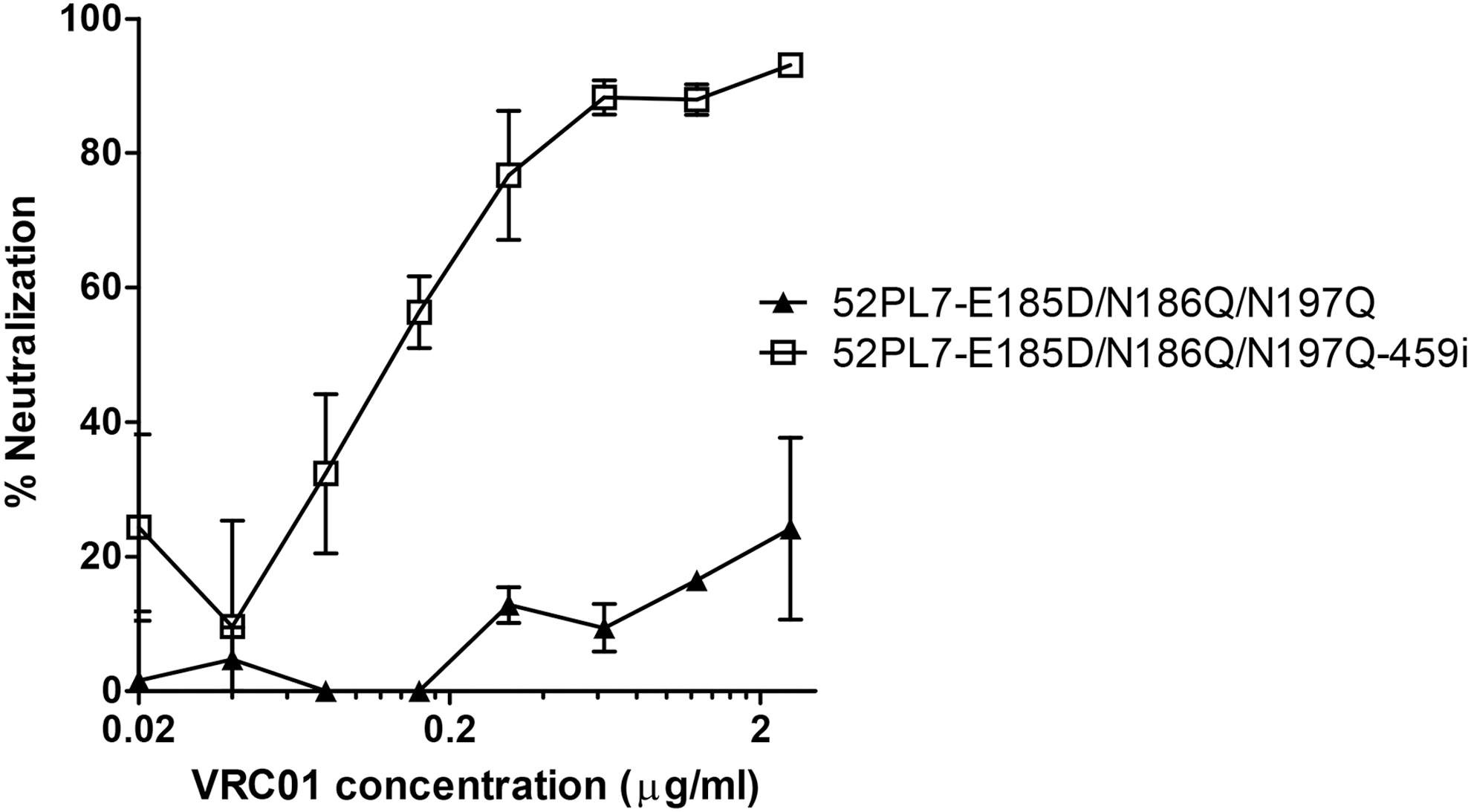
Influence of an amino acid insertion at position 459 in the V5 region of gp120 on the VRC01 susceptibility of the AE-Env clone, 52PL7-E185D/N186Q/N197Q. An amino acid insertion was introduced into position 459 of gp120 in the AE-Env clone, 52PL7-E185D/N186Q/N197Q. The VRC01 susceptibilities of lentiviral vectors expressing AE-Env were then evaluated by neutralization tests, as described in the Materials and Methods section. The results obtained are expressed as percent neutralization, which was calculated by the reduction rate of viral infectivity in the presence of VRC01 from that in the control experiment in the absence of VRC01. Data points are the means and standard errors (error bars) of at least two independent experiments.
VRC01 resistance was conferred on several VRC01-susceptible AE-Env clones by the removal of 2–4 amino acid residues in the V5 region of gp120
As described above, a correlation was observed between the lack of 2–3 amino acid residues at position 459 in the V5 region of gp120 and the acquisition of VRC01 resistance by the AE-Env clones, 52PB3, 52PL4, and 52PL7. The Env genes of 52PB3, 52PL4, and 52PL7 showed a very close phylogenic relationship because these three AE-Env clones were isolated from a HIV-1-infected individual. To examine whether the amino acid residues at position 459 play a role in the VRC01 susceptibilities of other AE-Env clones, we constructed mutant AE-Env clones derived from 60PL2, 98CC2, 102CC2, and 105PL3. The VRC01 susceptibilities of these AE-Env clones with and without mutations at amino acid positions 185, 186, and 197 are shown in Table 1. These AE-Env clones had an additional 2–4 amino acid residues at position 459 in the V5 region of gp120 (Fig. 4), similar to 52PB3 and 52PL4. Four amino acid residues were removed from 60PL2- and 98CC2-derived AE-Env clones, and 2 or 3 amino acid residues were removed from 102CC2- or 105PL3-derived clones, respectively. Neutralization tests were performed using lentiviral vectors expressing these AE-Env mutants. The results obtained showed that most of the AE-Env clones tested were conferred with VRC01 resistance after a 2–4-amino acid deletion was introduced at position 459, regardless of their phylogenic features (Table 2). We then examined the relative infectivities of the lentiviral vectors expressing AE-Env clones with and without the amino acid deletion. Most lentiviral vectors maintained their infectivities, and no correlation was present between the infectivities and VRC01 susceptibilities of the AE-Env clones (data not shown). However, 98CC2- and 105PL3-derived clones lost their infectivities (data not shown). Therefore, it was not possible to assess the VRC01 susceptibilities of 98CC2- and 105PL3-derived clones.

Comparison of amino acid sequences in C4, V5, and C5 regions of gp120 among 52PL7, 60PL2, 98CC2, 102CC2, 105PL3, 47PL1, and 47CC11. The amino acid sequences of the Env gp120 C4, V5, and C5 regions were compared among the AE-Env clones, 52PL7, 60PL2, 98CC2, 102CC2, 105PL3, 47PL1, and 47CC11. Amino acid sequences were aligned using GENETYX version 10 software. Dots denote amino acid identities, while dashes represent a gap introduced to optimize alignment. The numbering of amino acid residues was based on HXB2 Env.
The IC50 values of VRC01 for suppressing viral entry were cited from a previous study. 18
IC50 is >2 μg/ml.
The IC50 of VRC01 for suppressing viral entry was calculated using GraphPad Prism 5 software. Data are shown as the means of at least two independent experiments.
Single or multiple amino acid mutations were introduced into AE-Env clones. Amino acid numbering is based on HXB2 Env gp120.
IC50 is >2 μg/ml.
Data between brackets were cited from a previous study 18 .
Relative infectivity (shown in parentheses) of the lentiviral vector expressing AE-Env with deletion mutation at position 459 (459d) was calculated by comparing it with the luciferase activity of the corresponding lentiviral vector expressing AE-Env without 459d, which was defined as 100%.
The generated lentiviral vector expressing mutant AE-Env lost its infectivity (non-infectious, N.I.); therefore, it was not possible to evaluate neutralization susceptibility to VRC01.
IC50 is <0.02 μg/ml.
gp120, Glycoprotein 120.
VRC01 susceptibility was not conferred to two VRC01-resistant AE-Env clones, 47PL1 and 47CC11, by the insertion of 3 amino acid residues at position 459 in the V5 region of gp120
Since the deletion of 2–4 amino acid residues at position 459 in the V5 region of gp120 conferred VRC01 resistance to several AE-Env clones (Table 2), we examined the influence of amino acid insertions on the VRC01 susceptibilities of other AE-Env clones. 47PL1 and 47CC11 were resistant to VRC01-mediated neutralization regardless of mutations at positions 185, 186, and 197 (Table 1). Neither had additional amino acid residues at position 459 in the V5 region of gp120 (Fig. 4), similar to 52PL7. We then inserted 3 amino acid residues, glycine, serine, and aspartic acid, found in 52PB3 (Fig. 1) into position 459 of 47PL1 and 47CC11. Neutralization tests revealed that the insertion of 3 amino acid residues did not confer VRC01 susceptibility to 47PL1- or 47CC11-derived AE-Env mutants (Table 3). The infectivities of lentiviral vectors expressing AE-Env clones were significantly decreased by the insertion of the amino acid residues, while no correlation was found between the infectivities and VRC01 susceptibilities of the AE-Env clones (Table 3).
The IC50 of VRC01 for suppressing viral entry was calculated using GraphPad Prism 5 software. Data are shown as the means of at least two independent experiments.
Single or multiple amino acid mutations were introduced into AE-Env clones. Amino acid numbering is based on HXB2 Env gp120.
IC50 is >2 μg/ml.
Data between brackets were cited from a previous study. 18
Relative infectivity (shown in parentheses) of the lentiviral vector expressing AE-Env with insertion mutation at position 459 (459i) was calculated by comparing it with the luciferase activity of the corresponding lentiviral vector expressing AE-Env without 459i, which was defined as 100%.
RLUs, relative light units.
The impact of amino acid deletions and insertions in the V5 region of gp120 on b12-susceptibility of AE-Env clones
We next examined the influence of amino acid deletions and insertions at position 459 on the susceptibilities of AE-Env clones to other CD4bs antibody, b12. Neutralization test revealed that the b12 susceptibilities of AE-Env clones, 52PB3-E185D/N197Q, 52PL4-E185D/N197Q, and 102CC2-E185D/N197Q, were significantly reduced after a 2–4-amino acid deletion was introduced at position 459 of these AE-Env clones (Table 4, 52PB3-E185D/N197Q-459d, 52PL4-E185D/N197Q-459d, and 102CC2-E185D/N197Q-459d). Since all 60PL2- and 105PL3-derived AE-Env mutants were not susceptible to b12-mediated neutralization, we could not examine the role of a 2–4-amino acid deletion at position 459 on the b12 susceptibility of these AE-Env clones (Table 4). In addition, the b12 susceptibility of 52PL7-E185D/N186Q/N197Q, 47PL1-N197Q, and 47CC11-G185D/N197Q was also reduced after a 3-amino acid insertion was introduced at position 459 of these AE-Env clones (Table 5, 52PL7-E185D/N186Q/N197Q-459i, 47PL1-N197Q-459i, and 47CC11-G185D/N197Q-459i).
The IC50 of IgG1 b12 for suppressing viral entry was calculated using GraphPad Prism 5 software. Data are shown as the means of at least two independent experiments.
Single or multiple amino acid mutations were introduced into AE-Env clones. Amino acid numbering is based on HXB2 Env gp120.
IC50 is >10 μg/ml.
Data between brackets were from a previous study related to Utachee et al. 18
The IC50 of IgG1 b12 for suppressing viral entry was calculated using GraphPad Prism 5 software. Data are shown as the means of at least two independent experiments.
Single or multiple amino acid mutations were introduced into AE-Env clones. Amino acid numbering is based on HXB2 Env gp120.
IC50 is >10 μg/ml.
Data between brackets were from a previous study related to Utachee et al. 18
Amino acid deletions were detected in the V5 region of gp120 among major subtypes and CRFs of HIV-1
We investigated amino acid deletions in the V5 region of Env gp120 among viruses of the major subtypes and CRFs.
3
The gp120 amino acid sequences of 100 of the most recently registered subtype A, B, C, D, and G viruses, as well as CRF01_AE and CRF02_AG viruses, were retrieved from the HIV sequence database (
One hundred env gene sequences of the most recently registered subtype A, B, C, D, or G viruses, as well as CRF01_AE or CRF02_AG viruses, were retrieved from the HIV sequence database (
The frequency of Env gp120 with the deletion of amino acid residue(s) at position 459 in the V5 region was estimated.
gp120 Amino acid sequences were aligned and compared with that of 52PB3, and the number of missing amino acid residue(s) at position 459 was manually counted. Zero (0) represents no missing amino acid residues, while −1, −2, and −3 represent 1, 2, and 3 missing amino acid residues, respectively.
Others include samples that were not examined due to inaccurate alignment.
HIV, human immunodeficiency virus.
Discussion
HIV-1 Env gp120 plays an important role in viral entry into host cells expressing the primary receptor, CD4, and coreceptor, CXCR4/CCR5. Env gp120 forms a trimer on viral lipid membranes with the gp41 transmembrane protein. Env gp120 exhibits high intersubtype and intrasubtype divergence 20 ; however, CD4bs, which is nonconsecutively located on gp120 and plays a role in contact with CD4, is functionally conserved. 14,21,22 Neutralizing antibodies or bNAbs targeting CD4bs such as VRC01 are generated in HIV-1-infected individuals during the infection. Thus, CD4bs may be a potent vaccine antigen against HIV-1. However, the virus may become resistant to these antibodies upon acquiring amino acid mutations in gp120. VRC01 interacts with the V5 region of gp120 in considerably different manner from that of CD4. 14 Previous studies using subtype B viruses revealed that amino acid mutations in the V5 region of gp120, as well as in the loop D and CD4 binding loop of gp120, conferred a high level of viral resistance to VRC01. 23,24 In addition, a single PNLG site in the V5 region of gp120 25 or the combination of two PNLG sites in the V5 region and at amino acid position 197 of gp120 26 was reported to be associated with the VRC01 resistance of CRF07_BC and CRF08_BC viruses. It is well documented that the changes in amino acid residues in the V5 regions of gp120 cause steric clashes with the CDR H2 or CDR L3 of VRC01-class antibodies, but not of another CD4bs antibody, N6. 27 Our study revealed that amino acid mutations in the V5 region of gp120 were also associated with the VRC01 resistance of CRF01_AE viruses.
In the present study, we found another factor at amino acid position 459 in the V5 region of gp120 by comparing amino acid sequences between VRC01-resistant and -susceptible AE-Env clones. The results obtained demonstrated that the deletion of 2–4 amino acid residues conferred VRC01 resistance to several AE-Env clones, regardless of mutation(s) at positions 185, 186, and 197 (Table 2). In addition, a comparison of gp120 amino acid sequences among viruses in major HIV-1 subtypes and CRFs revealed that a notable proportion of Env gp120 derived from viruses in major subtypes and CRFs had at least one amino acid deletion at position 459 (Table 6). These results suggest that the amino acid deletion at position 459 in the V5 region of gp120 potentially influences the VRC01 susceptibilities of these viruses. In contrast, the insertion of amino acid residues did not alter viral VRC01 susceptibility, except for that of 52PL7-E185D/N186Q/N197Q (Table 3). This result suggests that the trimeric conformation of Env gp120 was significantly changed by the amino acid deletion, but not by the insertion. Another possibility is that the amino acid insertion did not influence viral susceptibility to VRC01 specifically for these two AE-Env clones, 47PL1 and 47CC11, which were isolated from plasma and cultured cells, respectively, from the same individual. Since 47PL1 and 47CC11 were resistant to VRC01-mediated neutralization, regardless of whether with or without modifying amino acid residues around position 459 (Table 3), other possibility is that VRC01 epitope on these AE-Env clones might not be intact. In addition, no correlation was found between the VRC01 susceptibility and the number of missing amino acid residue(s) at position 459 of 528 Env clones retrieved from CATNAP database (data not shown). Therefore, we consider that several factors, including amino acid deletions at position 459, are involved in the regulation of viral neutralizing susceptibility to VRC01. The impact of amino acid deletions and insertions at position 459 in the V5 region of gp120 on viral b12 susceptibility was also studied. We observed similar tendency that b12 susceptibility of 52PB3-, 52PL4-, and 102CC2-derived AE-Env mutants was reduced after a 2–4-amino acid deletion was introduced at position 459 of these AE-Env clones (Table 4). However, the b12 susceptibility of 52PL7-derived AE-Env mutant was also reduced after a 3-amino acid insertion was introduced at position 459 of the AE-Env clone (Table 5), suggesting that the role of amino acid mutations at position 459 in the V5 region of gp120 on viral neutralization susceptibility was somewhat different between VRC01- and b12-mediated neutralization.
Variable regions in gp120, including the V5 region, form a loop structure that plays an important role in maintaining the functional structure of gp120, as well as viral infectivity. 28 In the present study, the wild-type AE-Env clone, 105PL3, lost its infectivity after the amino acid deletion was introduced into position 459, while 105PL3 mutants maintained their infectivity after a combination of mutations at positions 185, 197, and 459 was introduced (Table 2). This result suggests that the combination of mutations at positions 185, 197, and 459 plays a role in maintaining a functional Env gp120 structure. However, the mechanisms by which amino acid deletions in position 459 interact with mutations at positions 185 and/or 197 remain unclear. Therefore, molecular interactions among these amino acid residues need to be examined in a future study.
The results of the present study also revealed that the lack of 2–4 amino acid residues at position 459 in the V5 region of gp120 plays an important role in the acquisition of viral VRC01 resistance. However, a virus that spontaneously loses additional residues at position 459 is not always resistant to VRC01, based on our previous findings. 15,18 Therefore, an amino acid deletion at position 459 may be a critical factor conferring VRC01 resistance to a limited number of AE-Env clones. A phenotypic study using a large number of Env clones is needed to reveal the importance of the group of amino acid residues at position 459 for viral VRC01 resistance. In addition, further studies, such as an analysis of the crystal structure of VRC01-bound gp120 and binding efficacy of gp120 to the antibody with and without a mutation, are required to reveal conformational changes in gp120 in more detail. Nevertheless, we consider the results of the present study to provide important information for elucidating the mechanisms underlying VRC01 resistance and developing HIV-1 vaccines.
Footnotes
Acknowledgments
This work was supported, in part, by Grants-in-Aid for Scientific Research (KAKENHI) from the Japan Society for the Promotion of Science (JSPS), the program of the Japan Initiative for Global Research Network on Infectious Diseases (J-GRID) from the Ministry of Education, Culture, Sport, Science and Technology in Japan, and the Japan Agency for Medical Research and Development (AMED). The expression vectors of the VRC01 heavy and light chains, CMVR VRC01 H and CMVR VRC01 L, and HIV-1 permissive cell lines, U87.CD4.CXCR4 and U87.CD4.CCR5 cells, were obtained through the NIH ARRRP, Division of AIDS, NIAID, NIH. This article was proofread by Medical English Service (Kyoto, Japan).
Author Disclosure Statement
No competing financial interests exist.