




Abstract
The latent HIV-1 reservoir of memory CD4+ T cells that persists during combination antiviral therapy prevents a cure of infection. Insight into mechanisms of latency and viral reactivation are essential for the rational design of strategies to reduce the latent reservoir. In this study, we quantified the levels of >2,600 proteins in the CCL19 primary CD4+ T cell model of HIV-1 latency. We profiled proteins under conditions that promote latent infection and after cells were treated with phorbol 12-myristate 13-acetate (PMA) + ionomycin, which is known to efficiently induce reactivation of latent HIV-1. In an analysis of cells from two healthy blood donors, we identified 61 proteins that were upregulated ≥2-fold, and 36 proteins that were downregulated ≥2-fold under conditions in which latent viruses were reactivated. These differentially expressed proteins are, therefore, candidates for cellular factors that regulate latency or viral reactivation. Two unexpected findings were obtained from the proteomic data: (1) the interactions among the majority of upregulated proteins are largely undetermined in published protein–protein interaction networks and (2) downregulated proteins are strongly associated with Gene Ontology terms related to mitochondrial protein synthesis. This proteomic data set provides a useful resource for future mechanistic studies of HIV-1 latency.
Introduction
A
The best described latent reservoir consists of long-lived memory CD4+ T cells that contain replication-competent proviruses that are transcriptionally silent. 2 Development of the “shock” component of a cure strategy is greatly facilitated by the availability of primary CD4+ T cell models of HIV-1 latency. Although these models do not recapitulate all of the features of latently infected cells obtained from patients ex vivo, 3 they can be used to investigate mechanisms involved in the establishment and maintenance of latent infection (e.g., Refs. 4,5 ). In addition, primary CD4+ T cell models allow evaluation of small molecules as latency reactivation agents (LRAs).
A convenient primary CD4+ T cells model has been developed by Lewin and colleagues. 6,7 In this model, resting CD4+ T cells are treated with the chemokine CCL19, resulting in conditions in which the cells support high levels of latent infection that can be efficiently reactivated by T cell activation. The CCL19 model has been used to evaluate the ability of histone deacetylase inhibitors (HDACis) and other small molecules to reactivate latent HIV-1. 3,8,9 We used this model recently to evaluate the ability of HDACis to upregulate an RNA polymerase II (RNAP II) elongation factor termed P-TEFb that is a cofactor for the viral Tat protein. 10 P-TEFb is downregulated in resting CD4+ T cells that harbor latent HIV-1 and its upregulation is required for viral reactivation. 4,5
Proteins that are either upregulated or downregulated when latent viruses are reactivated are candidates for important regulatory factors of latency or viral reactivation. Transcriptional profiling of mRNA levels in primary CD4+ T cell models of latency can provide clues to the identities of such important proteins. However, the correspondence between the levels of mRNAs and their encoded proteins is generally poor and has been shown to have only a 40% explanatory power. 11,12 Studies of mechanisms involved in HIV-1 latency will, therefore, benefit from identification of differences in the proteome between cells harboring latent virus and cells with reactivated virus.
In this study, we conducted a proteomic profile of the CCL9 model of latency. We quantified the levels of >2,600 proteins in CCL19-treated CD4+ T cells from two blood donors under conditions that promote latent infection and after cells were treated with phorbol 12-myristate 13-acetate (PMA) + ionomycin, which is known to induce reactivation of latent HIV-1. We identified 61 proteins that are upregulated ≥2-fold, and 36 proteins that are downregulated ≥2-fold, when latent viruses are activated. Two upregulated and two downregulated proteins were analyzed in immunoblots to validate the proteomic data. This data set provides a useful resource for future mechanistic studies.
Materials and Methods
Resting CD4+ T cells were isolated from two healthy blood donors by negative selection from peripheral blood of healthy donors by the Rosettesep CD4+ cells isolation kit (STEMCELL Technologies, Inc.). Cells were cultured for 3 days in the presence of CCL19 (10 nM; PeproTech, NJ) in RPMI-1640 supplemented with 10% fetal bovine serum and 10 U/ml IL-2; cells were then infected with an HIV-1 NL4.3-Luciferase reporter virus (NL4-3.Luc.R-E-; from NIH AIDS Reagent Program; virus also deleted for Nef; catalog no. 3418) and incubated for 2 days and then treated with and without 10 ng/ml PMA +1 μM ionomycin for 16 h at which time cell extracts were prepared for proteomic profiling. A portion of cells was assayed for Luciferase expression to verify successful reactivation of latent HIV-1.
Proteomic analysis pipeline
Proteomic profiling of whole cell extracts was performed by the Baylor College of Medicine Mass Spectrometry Proteomics Core Laboratory as described previously.
13,14
After several quality control steps, a total of 2,617 proteins were quantified. Proteomic data are presented in Supplementary File S1 (Supplementary Data are available online at
Immunoblots
Antisera used in immunoblots were NCOA2 from BD Biosciences (mouse, catalog no. 610984, used at dilution of 1:2,000); SULT1BI from R&D Systems (sheep, catalog no. AF5959, used at dilution of 1:1,000); KDM6B from Abcam (rabbit, catalog no. Aba169197, used at dilution of 1:2,000); Calumenin from Santa Cruz Biotechnology (mouse, catalog no. SC-271357, used at a dilution of 1:1,000); and β-actin from Abcam (mouse, catalog no. AB3280, used at a dilution of 1:5,000).
Results
Resting CD4+ T cells were isolated from two healthy blood donors and cultured with CCL19 for 3 days to establish conditions that promote latent HIV-1 infection. Cultures were infected with an HIV-1 NL4.3-Luciferase reporter virus and incubated for an additional 2 days as described in Materials and Methods section. Cultures were then stimulated with and without PMA + ionomycin for 16 h at which time total cell extracts were prepared for proteomic profiling. PMA + ionomycin were chosen as the activation method as it has been used as a standard to which the potencies of LRAs have been compared. 21 Portions of cell extracts were assayed for Luciferase expression to verify successful reactivation of latent HIV-1 (not shown). Proteomic profiles of cell extracts were determined as described in Materials and Methods section. Proteomic data are presented in Supplementary Files S1 and S2. It should be noted that only a fraction of cells in cultures were infected with the HIV-1 reporter virus. Therefore, the proteomic profiles reflect changes in the bulk cultures of unstimulated CC19-treated versus CCL19-treated and activated CD4+ T cells.
Upregulated proteins
Proteins that were either upregulated or downregulated ≥2-fold in both donors after activation of CCL19-treated cells are listed in Tables 1 and 2, respectively. The magnitudes of upregulated or downregulated proteins are shown in Figures 1 and 2, respectively. Upregulated proteins include 10 proteins that likely function as RNAP II transcription factors: AHR, EGR2, ZFX, TFCP2L1, TBX21, CXXC1, MEAF6, UNK, TAF8, and TAF1L. These proteins are candidates for cellular factors that regulate viral latency, either through direct or indirect effects on RNAP II transcription of the integrated provirus. KDM6B (JMJD3) is a notable upregulated protein; KDM6B is a lysine-specific demethylase with activity for dimethylated or trimethylated lysine 27 of histone H3 (H3K27me2 or H3K27me3). As these H3 methylations are repressive chromatin marks, KDM6B may play a role in reactivation of latent HIV-1 through its H3K27 demethylase activity.

Upregulated proteins. The positive fold change is shown for the indicated 61 proteins in CD4+ T cells from two donors after PMA + ionomycin stimulation of CCL-19-treated cells. The individual donors are indicated by gray and black bars. PMA, phorbol 12-myristate 13-acetate.
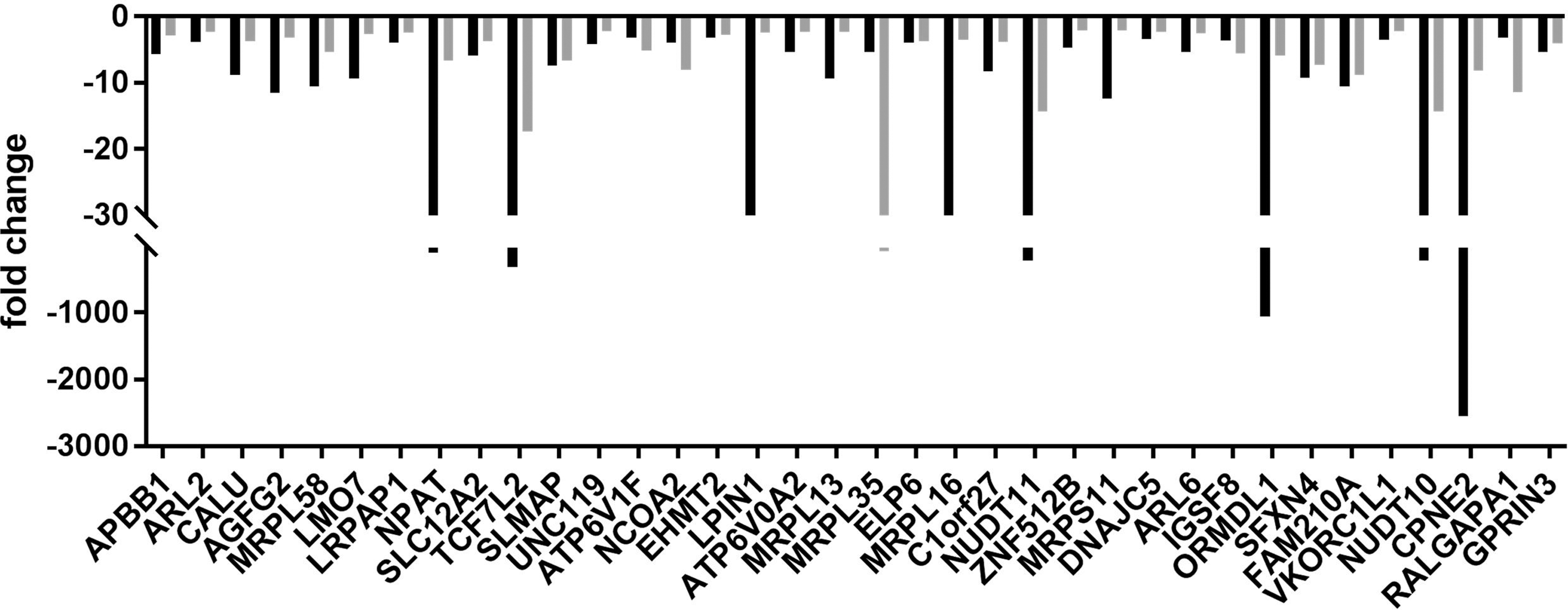
Downregulated proteins. The negative fold change is shown for the indicated proteins in CD4+ T cells from two donors after PMA + ionomycin stimulation of CCL-19-treated cells. The individual donors are indicated by gray and black bars.
A recent publication used an ultracomplex shRNA screen to identify genes that have roles in HIV-1 latency or reactivation in a Jurkat CD4+ T cell model. 22 It should be noted that the properties of HIV-1 latency in Jurkat cell lines can differ from latency in primary CD4+ T cells. Jurkat cells are transformed and grow exponentially, whereas primary CD4+ T cells are quiescent and display only low levels of metabolic processes, including RNAP II transcription and protein synthesis. Nevertheless, it is notable that four of the upregulated proteins shown in Table 1 were found in the shRNA screen to repress latency (promote reactivation) in Jurkat cells: GNAI1, SDCBP, ZFX, and KDM6B. Therefore, induction of these four proteins in CCL19-treated cells may contribute to viral reactivation. Interestingly, BACH2 was identified as an upregulated protein in CCL19-treated cells, and this is of interest as HIV-1 integration into the BACH2 gene has been observed in clonally expanded CD4+ T cells that harbor latent virus in infected individuals treated with cART. 23
Downregulated proteins
A notable feature of the set of 36 downregulated proteins (Table 2) is that 5 are involved in mitochondrial protein synthesis: MRPL58, MRPL13, MRPL35, MRLP16, and MRPS11 (Table 2). Although the significance of these differentially expressed proteins to HIV-1 latency and reactivation is unclear, shRNA depletion of MRPL35 was observed to promote latency in Jurkat CD4+ T cells. 22 Because the recent ultracomplex shRNA screen found that NPAT and ATP6VOA2 promote HIV-1 latency in Jurkat cells, these two proteins in our downregulated data set are strong candidates as factors that promote latency.
Validation of proteomic data
We performed an immunoblot analysis to determine whether the proteomic data are reliable. Resting CD4+ T cells were isolated from two additional healthy blood donors and cultured with CCL19 as described in Materials and Methods section. Cells were then cultured for an additional 2 days, stimulated with and without PMA + ionomycin for 16 h, and cell extracts were prepared for immunoblots. We examined two proteins identified to be upregulated in the proteomic data—SULT1B1 and KDM6B—and two proteins identified to be downregulated in the proteomic data—NCOA2 and Calumenin. As shown in Figure 3, the immunoblot analysis verified that after activation of CCL19-treated cells, SULT1B1 and KDM6B were upregulated and NCOA2 and Calumenin were downregulated. The immunoblot data indicate that the proteomic profile data are reliable.

Immunoblot validation of proteomic data. Resting CD4+ T cells were isolated from two healthy blood donors. Cells were cultured in the presence of CCL19 and subsequently activated with PMA + ionomycin as described for cells processed for proteomic profiling. After activation for 16 h, cell extracts were prepared and immunoblots performed to quantify the levels of indicated proteins.
KEGG pathways
An analysis of differentially expressed proteins in PMA + ionomycin-stimulated CCL19-treated cells identified activation of several KEGG pathways of significance to HIV-1 reactivation (Table 3 and Supplementary File S3). Activated signaling pathways include NF-κB, MAPK, T cell receptor, TNF, and JAK-STAT. Activation of these pathways likely leads to downstream events that are critical for reactivation of latent virus, such as phosphorylation of the T-loop of CDK9 (catalytic core of P-TEFb) and nuclear translocation of NF-κB and NFAT. 24 –27
GO enrichment
The differentially expressed proteins in PMA + ionomycin-treated cells were analyzed for enrichment of GO Biological Processes (Table 4 and Supplementary Files S4 and S5). A number of processes relevant to RNAP II transcription of the integrated HIV-1 provirus were enriched: histone modification, chromatin modification, nucleic acid metabolic process, and RNA metabolic process. Interestingly, processes involved in symbiont interactions with the host were also enriched, suggesting that differentially expressed proteins involved in viral–host interactions were affected by PMA + ionomycin stimulation. Finally, the mitochondrial translation process GO term was highly enriched, reflecting the downregulation of certain proteins involved in mitochondrial protein synthesis (Table 2).
PPI network
The network associated with the upregulated proteins in PMA + ionomycin-stimulated cells was extracted from the human PPI network (Fig. 4). To generate the PPI network, several databases (BIND, HPRD, DIP, and MINT) that contain experimentally observed PPIs were searched. As shown in Figure 4, edges were drawn to connect two proteins if any previously reported interactions were found in a database for these two proteins. The edge width was calculated based upon the number of shortest paths that a node lies on, which reflects the node's importance in controlling information in a network. The remarkable feature of this network is the unknown PPIs for the great majority of upregulated proteins. As it is believed that most proteins exist in multiprotein complexes in cells, 28 this absence of documented PPIs for these upregulated proteins was unexpected. The lack of established PPIs with these upregulated proteins suggests that this set of proteins has been relatively understudied.

PPI network. The PPI network for upregulated proteins in PMA + ionomycin-stimulated CCL19-treated cells is indicated. PPI, protein–protein interaction.
Discussion
In this study, we have documented changes in the proteome under conditions in which latent HIV-1 is reactivated in the CCL19 primary CD4+ T cell model of latency. Identification of differentially expressed proteins is generally more informative than identification of differentially regulated mRNAs, as there is not a strong correspondence in mammalian cells between levels of mRNAs and levels of the encoded proteins. 11,12 We identified 61 proteins that are upregulated and 36 proteins that are downregulated when CCL19-treated cells are stimulated with PMA + ionomycin, a condition that potently reactivates HIV-1. Our criteria for identification of differentially expressed proteins were a ≥2-fold change in two donors. Our data set, therefore, lacks proteins whose quantitation for one or both donors was below a twofold difference. If we set our threshold for ≥1.5-fold change in both donors, we can identify 79 upregulated proteins and 52 downregulated proteins.
We note that although CCL9-treated cultures were infected with an HIV-1 reporter virus in this study to verify successful reaction of latent viruses, only a fraction of cells in cultures were infected with the reporter virus. The proteomic profiles, therefore, reflect changes in the bulk cultures of CD4+ T cells. It is possible that the subset of cells that were infected possess unique proteomic features not found in uninfected cells. Regardless of this potential limitation of our study, the set of differentially regulated proteins reported here provides a useful resource for future mechanistic studies.
A major mechanism of HIV-1 latency is transcriptional repression of the integrated provirus, and this is largely the consequence of epigenetic repression and limiting levels of essential transcription factors. It is notable that we identified KDM6B (JMJD3) as an upregulated protein. This lysine demethylase has activity for dimethylated or trimethylated lysine 27 of histone H3 (H3K27me2 or H3K27me3). Because H3K27 methylation is repressive, removal of this histone mark by upregulated KDM6B may be critical for viral reactivation. We identified 10 upregulated proteins that are thought to function as transcription factors (Table 1). The induction of these proteins may contribute to viral reactivation, either directly through effects on RNAP II transcription of the integrated provirus or indirectly through transcriptional induction of cellular genes whose protein products contribute to reactivation.
We note that our study did not evaluate changes in protein post-translational modifications (PTMs) after stimulation of CCL19-treated cells. PTMs that occur after T cell stimulation can be essential for reactivation of latent HIV-1. For example, the T-loop of CDK9 requires phosphorylation for active P-TEFb and the viral Tat protein's transcriptional elongation function. This phosphorylation is low in quiescent CD4+ T cells that harbor latent HIV-1 and T cell stimulation that induces T-loop phosphorylation correlates with reactivation of latent HIV-1. 10,25,29 Future studies that characterize changes in PTMs after reactivation of latent HIV-1 in a primary CD4+ T cell model will provide an additional valuable data set for studies of HIV-1 latency.
Our proteomic analysis made two unexpected observations—downregulation of proteins involved in mitochondrial protein synthesis (Table 2) and absence in PPI networks for the majority of upregulated proteins (Fig. 4). Because T cell activation induces an elevation in mitochondrial metabolism, 30,31 it is puzzling why PMA + ionomycin stimulation of CCL19-treated cells would lead to downregulation of mitochondrial protein synthesis. In addition, the significance of absence of PPI networks for upregulated proteins is unclear and may be the consequence of limited previous study of this set of proteins. Future studies with these upregulated proteins will likely place them in PPI networks.
In summary, our proteomic analysis has identified 61 upregulated proteins and 36 downregulated proteins. These proteins can be analyzed in mechanistic studies of HIV-1 latency and reactivation. The upregulated proteins are candidates for important regulatory factors for viral reactivation, whereas the downregulated proteins are candidates for regulatory factors for the maintenance of latency.
Footnotes
Acknowledgments
This work was supported by the National Institutes of Health grant AI116173 (to A.P.R.) and National Science Foundation grant 1620957 (to H.M.). We thank Dr. Anna Malovannaya for helpful discussion.
Author Disclosure Statement
No competing financial interests exist.
References
Supplementary Material
Please find the following supplemental material available below.
For Open Access articles published under a Creative Commons License, all supplemental material carries the same license as the article it is associated with.
For non-Open Access articles published, all supplemental material carries a non-exclusive license, and permission requests for re-use of supplemental material or any part of supplemental material shall be sent directly to the copyright owner as specified in the copyright notice associated with the article.
