




Abstract
Cocirculation of multiple subtypes in the same population contributes significantly to the emergence of recombinant viruses. BJ2015EU19, a novel CCR5-tropic human immunodeficiency virus (HIV)-1, second-generation recombinant virus, was isolated from a man who has sex with men in Beijing, China. Phylogenetic analysis of the near full-length genome showed that BJ2015EU19 consisted of seven fragments from CRF01_AE and CRF07_BC. There were six recombinant breakpoints in the pol, vpu, env, and nef genes of BJ2015EU19, which were different from the other circulating recombinant forms and unique recombinant forms (URFs). The new emergence of the URF increases the complexity of the HIV epidemic in the Chinese homosexual group, and the ongoing generation of recombinant viruses may provide an important basis for future analysis of the recombination mechanism of HIV-1.
H
It was identified in this study that BJ2015EU19, an URF, consisted of seven segments from CRF_01AE and CRF07_BC. The virus was isolated from a 35-year-old HIV-1-positive patient infected by homosexual contact in Beijing, China. The patient was diagnosed as HIV-1 positive in 2012 and presented with CD4+ T cell count 311 cells/μl and viral load 7,790 copies/ml on June 26, 2015. Informed consent was signed before sample collection. This study was reviewed by the Institution Research Ethics Community of Chinese Center for Disease Control and Prevention (No. 201334).
The viral genome was extracted from the replicable virus using QIAamp Viral RNA Mini Kit and then transcribed into cDNA. The near full-length genome (NFLG) was amplified using the nested polymerase chain reactions (nest-PCRs) with the gradient diluted cDNA template and TaKaRa LA Taq DNA polymerase (TaKaRa, Dalian, China). The PCR conditions of both rounds involved 2 min of initial denaturation at 94°C, then followed by 35 cycles of 15 s at 94°C, 30 s at 62°C, and 5 min at 68°C. The reaction was terminated with a final extension step at 68°C for 15 min. 9 After purification, the positive PCR products were sequenced. And then the sequences were spliced and assembled by Sequencher V4.10.1.
The NFLG sequences of HIV-1 references that included various subtypes (A–D, F–H, J, and K) and Chinese CRFs were downloaded from the Los Alamos National Laboratory HIV Database (

Phylogenetic tree analysis of the NFLG sequence of BJ2015EU19. All HIV-1 group M reference sequences were used to construct the neighbor-joining phylogenetic tree with the Kimura two-parameter model and 1,000 bootstrap replications test. The tree branch of BJ2015EU19 is displayed as a bold line. Bootstrap values (>0.7) are shown at the corresponding nodes. The scale bar is shown at the bottom of the tree. HIV, human immunodeficiency virus; NFLG, near full-length genome.
To determine the recombination form of BJ2015EU19, the sequence was analyzed using RIP and Simplot. The result showed that it consisted of seven segments from CRF01_AE and CRF07_BC. Bootscan analysis was subsequently carried out to position the combination breakpoints with a window size of 200 bp, a step size of 20 bp, and 50% consensus.
BJ2015EU19 genome has six recombinant breakpoints with seven fragments in the pol, vpu, env, and nef genes by using HXB2 as calibrator: ICRF07_BC (635–4,021 nt), IICRF01_AE (4,022–4,226 nt), IIICRF07_BC (4,227–6,207 nt), IVCRF01_AE (6,208–8,293 nt), VCRF07_BC (8,294–8,779 nt), VICRF01_AE (8,780–9,040 nt), and VIICRF07_BC (9,041–9,614 nt) (Fig. 2A, B). To confirm the subtypes of mosaic fragments, phylogenetic analysis for seven genetic segments was carried out following the method already mentioned. It was found that two CRF01_AE fragments (IICRF01_AE 4,022–4,226 nt and IVCRF01_AE 6,208–8,293 nt) could be well clustered into a specific cluster (Cluster 5, Fig. 3, II and IV) reported by Feng et al., which were found primarily among MSM in major northern China. 11 However, these segments may be too short, we could not find the cluster origin of VI, and the bootstrap values at the corresponding nodes of II and VI were lower (Fig. 3, II and VI). The CRF07_BC regions in BJ2015EU19 (Fig. 3, I, III, V, and VII) clustered with CRF07_BC reference sequences. Phylogenetic analysis suggested that the recombination breakpoints in BJ2015EU19 were different from those in the other CRFs and URFs.
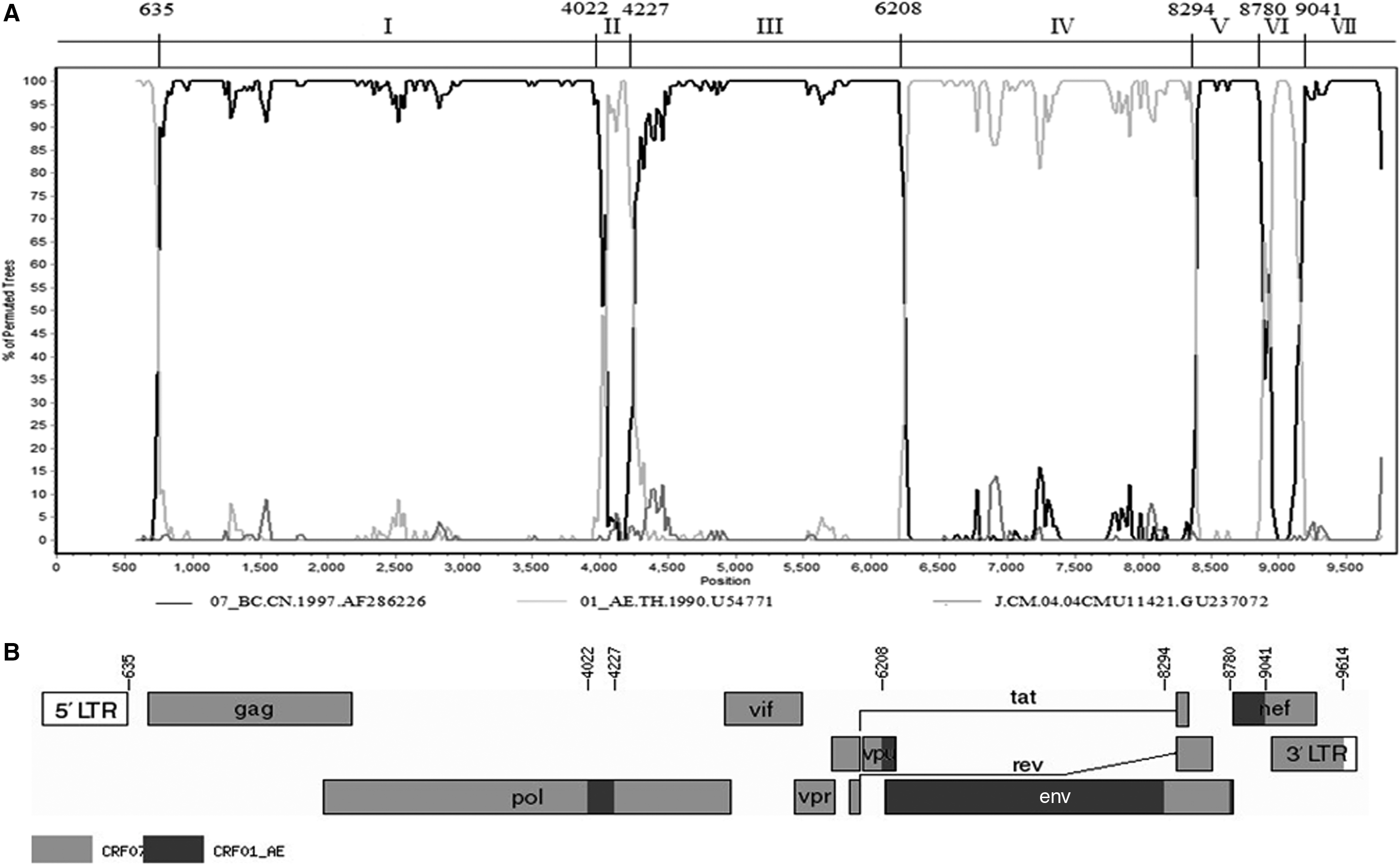
Recombinant analysis of the novel identified BJ2015EU19.
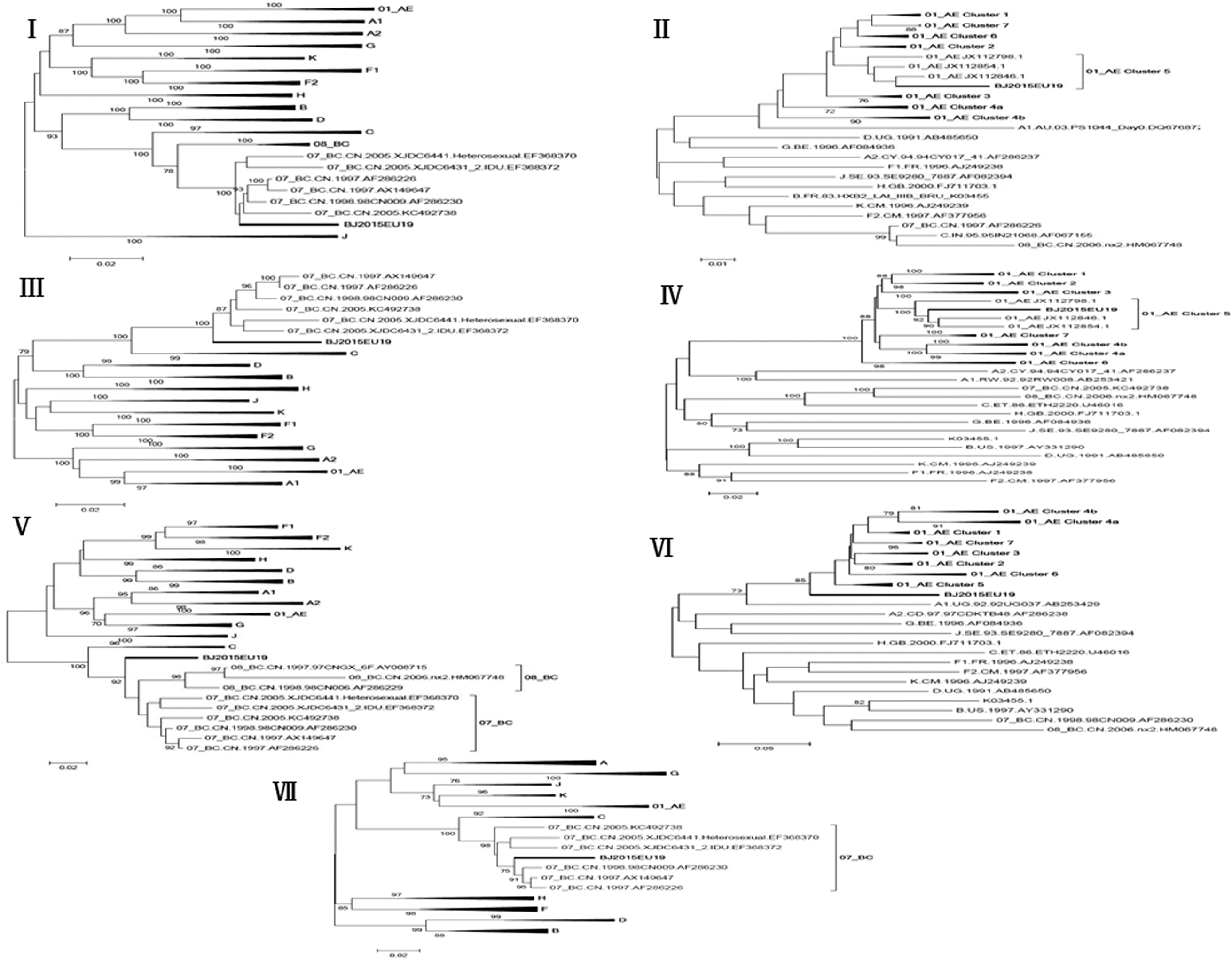
Subregion tree analysis of the novel identified BJ2015EU19. The phylogenetic trees of the seven mosaic segments defined by bootscanning plot analysis were constructed with MEGA 5.0 using the neighbor-joining method. The stability of the nodes was assessed by bootstrap analysis with 1,000 replications. The tree branch of mosaic fragments is displayed as a bold line. Bootstrap values (>0.7) are shown at the corresponding nodes. Scale bars are shown at the bottom of each tree.
In this study, BJ2015EU19 was identified as CCR-5 tropic on GHOST cells. In brief, GHOST-CCR5, GHOST-CXCR4, and parental GHOST cells (2 × 10⁴/well) were exposed to 200 TCID50 HIV-1BJ2015EU19 in 24-well plates for 4–8 h followed by culturing for a night at 37°C. Then the infected GHOST cells were cultured at 37°C with fresh medium. Positive control viruses for each coreceptor were included in the assay. After 4 to 7 days of infection, green fluorescent protein (GFP) expression was observed by fluorescence microscopy to determine the tropic of BJ2015EU19.
The viral replication curve of BJ2015EU19 showed that the virus grew on the 3rd day and reached the highest level on the 17th day. In brief, PBMCs isolated from the patient were cocultured with PBMCs from a healthy donor for 28 days. The supernatants were harvested every 3–4 days intervals, and p24 was measured using a commercial enzyme-linked immunosorbent assay kit (Hebei medical university, China).
In conclusion, BJ2015EU19, isolated from one HIV-1-positive subject, was identified as a unique CRF01_AE/CRF07_BC recombinant form based on NFLG sequencing. The emergence of BJ2015EU19 may reflect the continual generation of various forms of intersubtype recombinants, which indicates the importance of continuous surveillance of the dynamic change of HIV-1 subtypes and recombinants among the MSM population in Beijing, China.
Sequence Data
The nucleotide sequence of the isolate BJ2015EU19 has been submitted to GenBank with the accession number KY950610.
Footnotes
Acknowledgments
This work was supported by the National Natural Science Foundation of China (grant nos. 81261120384, 81172733, and 81561128006); the European Research Infrastructures for Poverty Related Diseases (grant no. 312661); and the National Major Project of the State Key Laboratory of Infectious Diseases Prevention and Control (grant no. 2011SKLID102).
Author Disclosure Statement
No competing financial interests exist.