




Abstract
HIV-1 genetic diversity has recently been more and more complicated in Hebei province. To know about the transmission pattern of HIV-1 in Hebei, the phylogenetic analysis of non-CRF01_AE strains was performed using the maximum-likelihood (ML) method. Four clusters and two clusters were observed in the CRF07_BC and subtype B ML tree, respectively. Of these clusters, men who have sex with men (MSM) sequences were the most frequent, and no pure heterosexual cluster was found in this study. Our findings highlighted the close transmission relationship between the main HIV-1 non-CRF01_AE strains and the sexual exposure especially among MSM between neighboring provinces, such as Beijing and Liaoning, and Hebei. This provides new evidence that the main strains of HIV-1 were introduced into Hebei through sexual exposure especially among MSM from neighboring provinces, suggesting that it is urgent for us to take measures together with neighboring provinces to cut off HIV-1 dissemination chain through MSM.
A
More recently, CRF01_AE has gradually replaced subtype B as the most common genotype, followed by CRF07_BC, subtype B, and other genotypes. 5 The recent study 5,6 identified that all 10 genotypes found in Hebei have spread out of their initial risk groups into the general population through sexual contact, especially through MSM. Furthermore, the distribution of HIV-1 genotypes between MSM and heterosexuals showed the significant difference. In 2013, eight CRF01_AE transmission clusters were observed through the maximum-likelihood (ML) tree analysis, and proved the close relationship between HIV-1 CRF01_AE transmission in neighboring provinces (Beijing, Liaoning, Tianjin, Shandong, etc.) and Hebei. 5
In this work, we have analyzed the transmission pattern of HIV-1 non-CRF01_AE strains among different high-risk groups and areas based on full length gag-partial pol (1.3 kb) gene sequences obtained from all newly diagnosed HIV-1 non-CRF01_AE individuals in 2013.
As reported 5 previously by Lu et al., a total of 284 newly diagnosed individuals infected with HIV-1 non-CRF01_AE were identified in 2013, including CRF07_BC (143 cases), subtype B (97 cases), URFs (30 cases), CRF08_BC (6 cases), subtype C (3 cases), CRF55_01B (3 cases), subtype A1 (1 case), and CRF65_cpx (1 case), and did not receive antiretroviral therapy. Of them, 30 URFs have been analyzed in detail in our previous report. 5,7 In this study, the remaining 254 non-CRF01_AE strains are discussed. The epidemiological information of the study subjects was obtained by face-to-face interviews during collecting of blood samples. Written informed consent was obtained from all study subjects. Our present work was authorized by the local Ethics Committee at Hebei Provincial Center for Disease Control and Prevention.
As described previously,
8,9
HIV-1 RNA was extracted from 254 study subjects, HIV-1 full length gag (HXB2:763-2400) and partial pol gene (HXB2:2147-3462) were amplified, sequenced, edited, and assembled, and HIV-1 genotype was confirmed using methods reported previously by our study team.
5
In this study, the ML tree was constructed using MEGA 6.0 with 1,000 bootstrap replicates. The reference sequences (A–D, F–H, J, K, O, and CRFs) were obtained from the HIV database (
As shown in Figure 1, our subtype B closely clustered with the reference Thailand B and was far from Europe and America B. In the ML tree, two transmission clusters designated clusters 1 and 2 were observed among subtype B sequences. Clusters 1 and 2 contained 44 study sequences, respectively. Cluster 1 contained 17 heterosexual sequences, 2 blood infection sequences, and 25 MSM sequences, and these sequences clustered with the reference sequences from 10 provinces (Shandong, Henan, Shanxi, Guangdong, Jilin, Anhui, Ningxia, Yunnan, Hubei and Jiangsu.) of China. In Shandong, Henan, and Shanxi, the blood contaminated by HIV ever resulted in the increase of HIV epidemic here.

The ML tree analysis based on HIV-1 full length gag-partial pol gene sequences from HIV-1 subtype B strains. The ML tree was constructed using MEGA 6.0 with 1,000 bootstrap replicates. The reference sequences (A–D, F–H, J, K, O, CRFs) were obtained from the HIV database (
A total of 29 MSM sequences and 15 heterosexual sequences were included in cluster 2, together with the reference sequences from Beijing, which indicated that the close transmission relationship was identified among the sexual contact population between Beijing and Hebei. Particularly, clusters 1 and 2 were two big MSM transmission clusters in which MSM sequences were predominant. Therefore, we infer that HIV-1 subtype B might be introduced into Hebei through high-risk behaviors from Beijing, and then the virus spreads predominantly among two groups of MSM in Hebei. We should take intervention measures, such as public health education, together with Beijing to cut off the HIV-1 dissemination chain through sexual contact. Because the chance of HIV-1 infected individuals with an undetectable viral load transmitting their virus was very low and quite possibly zero, 10 antiretroviral treatment suppressing virus replication is also an effective measure, which can reduce HIV-1 transmissions between Beijing and Hebei.
In the CRF07_BC ML tree (Fig. 2), four transmission clusters were observed. Cluster 1 was a very large cluster, containing 88 study sequences (72 MSM sequences and 16 heterosexual sequences). In cluster 1, the study sequences closely clustered with the reference sequences obtained from Beijing and Liaoning. Moreover, seven subclusters identified that HIV-1 CRF07_BC strains were circulating among the MSM population in different prefectures of Hebei, China: for example, among MSM between Shijiazhuang and Cangzhou (subclusters 1, 2, and 4); between Shijiazhuang, Tangshan, and Langfang (subcluster 5); between Baoding, Shijiazhuang, and Cangzhou (subcluster 6); and between Shijiazhuang, Chengde, and Handan (subcluster 7). Seven subclusters indicate that Shijiazhuang has become the provincial epicenter of the spread of HIV-1 CRF07_BC strain through MSM.
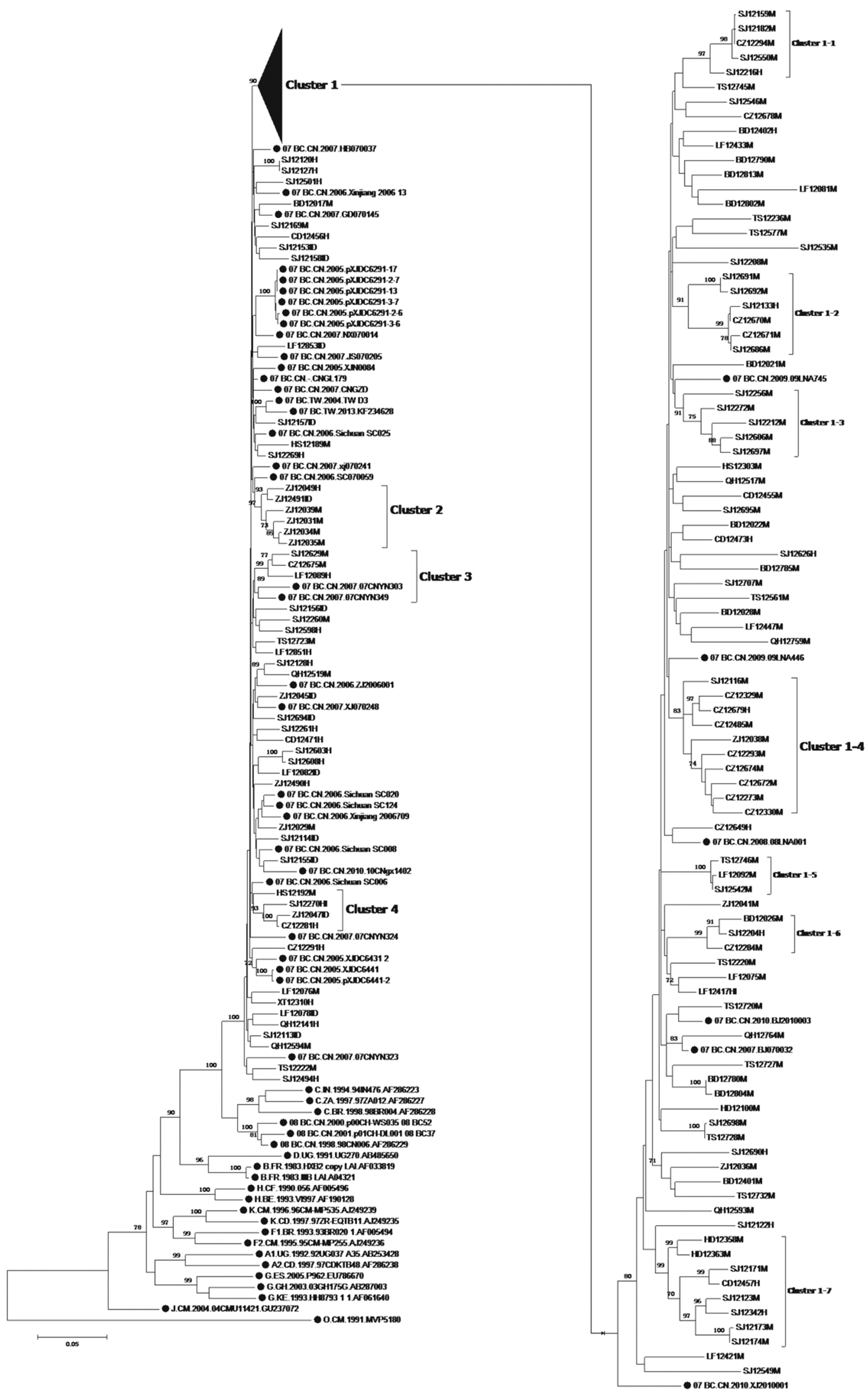
The ML tree analysis based on HIV-1 full length gag-partial pol gene sequences from HIV-1 CRF07_BC strains. The ML tree was constructed using MEGA 6.0 with 1,000 bootstrap replicates. The reference sequences (A–D, F–H, J, K, O, CRFs) were obtained from the HIV database (
Clusters 2 and 4 were two transmission clusters closely related to Sichuan, containing six sequences (four MSM sequences, one heterosexual sequence, and one intravenous drug user (IDU) sequence) and four sequences (one MSM sequence, one IDU sequence, one heterosexual sequence, and one IDU/heterosexual sequence), respectively. In cluster 3, three study sequences (two MSM and one heterosexual) clustered with the sequences from Yunnan. The mentioned fact suggests that CRF07_BC strains circulating in Beijing, Liaoning, Sichuan, and Yunnan have the close genetic relationship. In addition, cluster 2 was distantly related to cluster 4, suggesting that there have been two transmission events of HIV-1 CRF07_BC strains at different times through MSM, IDU, or heterosexuals between Sichuan and Hebei.
Figure 3 indicates that one CRF65_cpx strain found in this study clustered with the reference CRF65_cpx from Anhui, which was supported by a 100% bootstrap value. CRF65_cpx was identified and circulating in southern China; however, our study is the first to observe the occurrence of this CRF in a northern province of China. The ML tree analysis also indicated that the homosexual contact might be the main factor behind CRF65_cpx being introduced into Hebei. Moreover, it is also possible that it was brought north by IDUs or heterosexuals and then entered with MSM after arrival. Likewise, three CRF55_01B sequences were closely associated with the reference sequences from Guangdong and Hunan. Compared with CRF55_01B confirmed among MSM in southern China, CRF55_01B was observed among not only MSM but also among heterosexuals in Hebei, suggesting that HIV-1 CRF55_01B strain is spreading out of its original population through sexual contact.

The ML tree analysis associated with other non-CRF01_AE strains. The ML tree was constructed using MEGA 6.0 with 1,000 bootstrap replicates. The reference sequences (A–D, F–H, J, K, O, CRFs) were obtained from the HIV database (
As reported
1,11
previously, the prevalence of subtype A is poor in China, and mainly distributed among heterosexuals in northeast and eastern China. In this study, we BLAST the 12429 sequence against all other HIV-1 sequences obtained from HIV database (
Subtype C was distantly related to the reference sequences from Yunnan; however, it clustered with the sequences from India, Brazil, South Africa, and Zambia, with apparent genetic relationship. In Hebei, all study subjects with CRF08_BC were infected through their sexual exposure, including two MSM and four heterosexuals. These CRF08_BC sequences were closely associated with the sequences from Yunnan, Guangxi, and Guangdong. The previous report indicated that CRF08_BC mainly distributed in IDUs in southwest China, 1 where the minority nationalities are the main inhabitants. Their attitudes toward sex are liberated, and the multiple high-risk behaviors are prominent. 12,13 This infers that HIV-1 is spreading out of these provinces into other areas through sexual contact with the changing of HIV-1 transmission routes in these areas. Currently, many of the illiterate female marriage immigrants who come from Yunnan, Guangxi, Sichuan, and so on dwell in Hebei. So the illiterate female marriage immigrants infected with CRF08_BC have become one of the factors of this strain spread in Hebei. However, CRF08_BC has a low prevalence.
In conclusion, four clusters and two clusters were observed in the CRF07_BC and subtype B ML tree, respectively. In these transmission clusters, MSM sequences were the most frequent, and no pure heterosexual cluster was found in this study. Our findings indicated that the main HIV-1 non-CRF01_AE from Hebei clustered with the reference sequences from southwestern China (Yunnan, Guangxi, and Sichuan), southern China (Guangdong and Hunan), and neighboring provinces (Beijing, Liaoning, and Shandong), respectively. Particularly, the close transmission relationship between the main HIV-1 non-CRF01_AE strains was identified through the sexual exposure especially among MSM between neighboring provinces and Hebei. This provides new evidence that the main strains of HIV-1 were introduced into Hebei through sexual exposure especially by MSM from neighboring provinces, suggesting that it is urgent for us to take measures together with neighboring provinces to cut off the HIV-1 dissemination chain through MSM.
Sequence Data
The sequences reported in this study have been submitted to GenBank with accession numbers MF684019 to MF684335.
Footnotes
Acknowledgments
The authors thank the staff of local Centers for Disease Control and Prevention in Hebei Province for their assistance, especially with the fieldwork. This study was implemented with the support of the Natural Science Fund of Hebei Province (H2016303006).
Authors' Contributions
X.L. conceived and designed this study. X.L., Y.L., Y.W., N.A., and C.Z. implemented the whole study. X.L. analyzed experimental data and drafted the article. S.C. revised the article. Y.L., Y.W., and S.C. contributed to the investigation of the epidemiological information. All authors read and approved the final article.
Author Disclosure Statement
No competing financial interests exist.