




Abstract
The study of natural products in biomedical research is not a modern concept. Many of the most successful medical therapeutics are derived from natural products, including those studied in the field of HIV/AIDS. Biomedical research has a rich history of discovery based on screens of medicinal herbs and traditional medicine practices. Compounds derived from natural products, which repress HIV and those that activate latent HIV, have been reported. It is important to remember the tradition in medical research to derive therapies based on these natural products and to overcome the negative perception of natural products as an “alternative medicine.”
Natural Products and Medical Discoveries
T
Many of these products are present as protective defense mechanisms for the plant. The caustic nature of these products is used to deter predators from ingesting the plant, and the medicinal properties are derived from the natural inflammatory and protective properties of these products. 7 The origin of many of these drugs is based in traditional medicine practices and the use of the raw unpurified products in these practices was often effective without additional isolation, purification, synthesis, and patenting.
The 2015 Nobel Prize for medicine was shared for the discovery of two of these natural product-based therapeutics, artemisinin and ivermectin. 8 Artemisinin was discovered in the late 1960's in a screen of antimalarial Chinese traditional medicinal herbs. 9 A crude extract of the leaves of Artemisia annua, known in Traditional Chinese Medicine (TCM) as qinghaosu, was able to fully inhibit the rodent malarial parasite Plasmodium berghei and was later equally effective when given as a crude extract to humans. The isolation and large-scale synthesis of the active compound artemisinin followed in 1972. Avermectin was discovered in the early 1970's through a screen of soil-derived products which had medicinal potential. 10 The fermentation product of Streptomyces avermitilis, a soil bacteria, avermectin was highly efficient at killing parasitic larvae. Avermectin was then further modified to create ivermectin, which had additional potency and was safe to use in humans and animals. In 1987 ivermectin was synthesized into an effective drug against river blindness. Altogether, these examples highlight the history of screening natural products for their medicinal properties, and the diverse targets which have benefited from such research.
Current HIV Therapy
While HIV treatments have progressed significantly in the past 20 years, current treatment strategies are far from perfect and most importantly none of the current treatment options results in HIV cure. 11 With current antiretroviral therapy (ART), viral titers are maintained below the level of detection in most individuals. However, side effects and lifetime daily administration of these drugs, while the individual feels relatively normal, can result in nonadherence to treatment and treatment interruption. Even a brief interruption in ART results in a rapid rebound of viral titers, which increase the potential for ART escape mutants that require adjustments in maintenance of drug regimen. 12 –14
In spite of effective suppression of viral replication with suppressive ART, latently infected cells prevent complete clearance by the virus. 15 Latently infected cells are not actively replicating or producing viral proteins, which are the targets for ART. 16 Therefore, it is crucial to continue research to improve on this imperfect system by finding more effective suppressive agents and discovering a means to safely reactivate latent HIV, as a means to target and eliminate latently infected cells.
Natural Products and HIV
HIV suppression
The bulk of HIV research using natural product-based compounds is based on suppression of the virus. Several effective plant-based compounds were studied early in the history of HIV research and continue to be studied today. These novel inhibitory compounds may lead to new ART, which have increased suppressive function, are available in the case of escaped mutants, and are possibly more cost effective treatment options (Fig. 1).
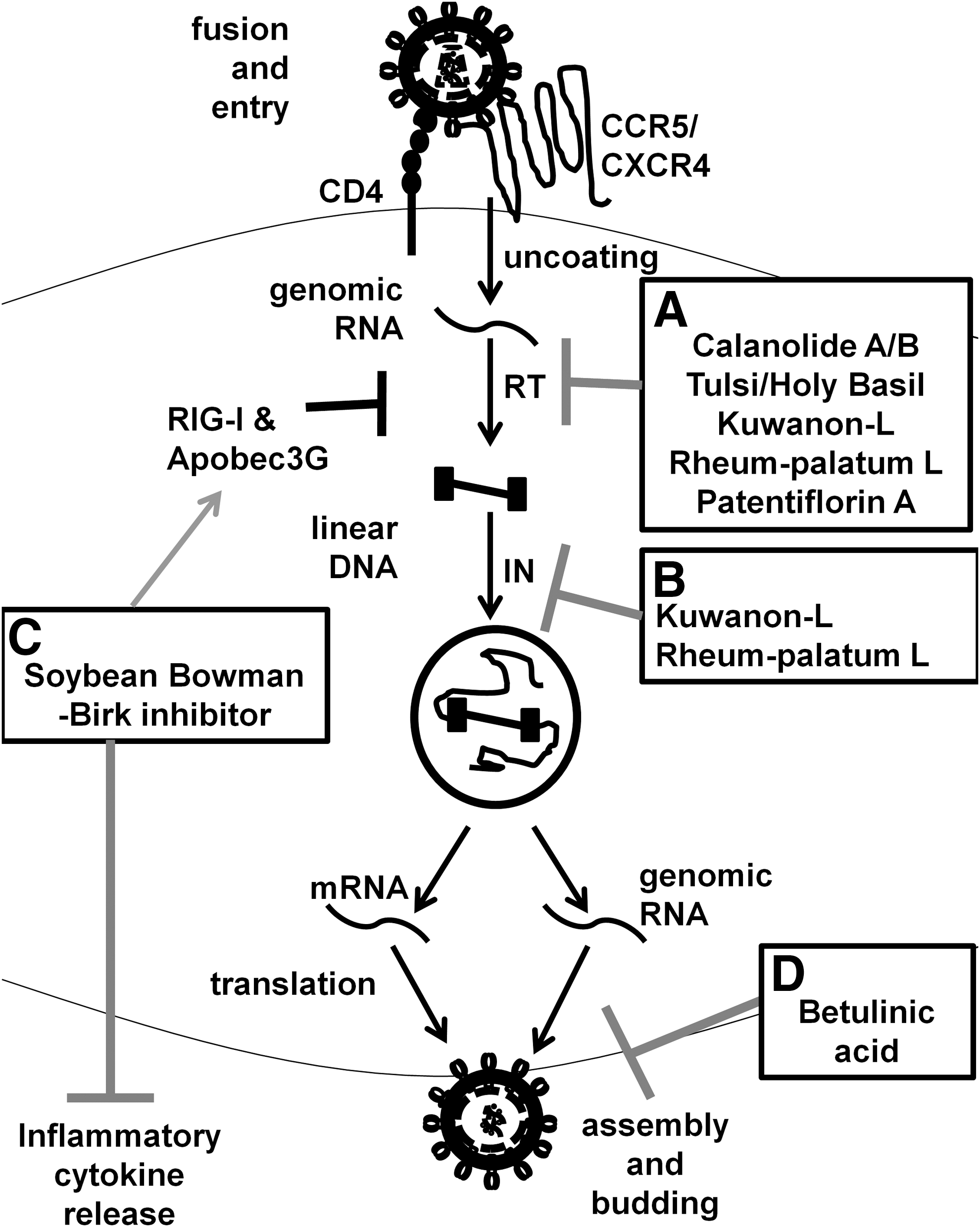
Natural products that suppress HIV replication. Natural product-derived compounds have been studied, which target multiple steps in HIV replication
Calanolides were among the first plant-based compounds described to have anti-HIV activity, 17,18 derived from Calophyllum lanigerum, a mangosteen family tree found in the tropical rainforests of Malaysia. The medicinal properties were discovered after a 1992 National Institute of Health (NIH)-sponsored sample-collecting study. Calanolide A and B, isolated from fruit and twigs of the tree, were purified and determined to have nonnucleoside reverse transcriptase (RT) inhibitor activity 17 (Fig. 1A). The scarcity of C. lanigerum, due to destruction of the natural rainforest habitat, made it necessary for Calanolide A and B to be synthesized. 19 Both the drugs are well tolerated and have been in development. 20
Promising research continues in a variety of natural plant-based therapeutics with anti-HIV activity. Tulsi or Holy Basil is traditionally used in Indian Ayurvedic medicine to treat a number of ailments and is generally regarded as promoting overall wellbeing. A combination of esters and amides isolated from tulsi have in vitro anti-RT activity 21 (Fig. 1A). Kuwanon-L, isolated from the black mulberry tree Morus nigra, has anti-RT and integrase (IN) activity comparable to ART 22,23 (Fig. 1A, B). Rheum palmatum L, a TCM plant, also showed potent anti-RT and IN activity comparable to ART 24 (Fig. 1A, B). Patentiflorin A, an arylnaphthaline lignin glycoside isolated from the Vietnamese medicinal plant Justica gendarussa had RT-inhibitor activity and inhibited azidothymidine (AZT) and Nevirapine-resistant HIV isolates 25 (Fig. 1A). A soybean-derived protease inhibitor, Bowman-Birk inhibitor, inhibits inflammatory cytokines and replication in macrophages in addition to increasing expression of antiviral factors, including RIG-I and Apobec 3G 26 (Fig. 1C).
Betulinic acid and dihydro betulinic acid were isolated from the Chinese herb Syzygium claviflorum, or trumpet satinash, in 1996. 27 Betulinic acid was effective at inhibiting late-stage processing Gag and resulted in the release of noninfectious viral particles 28 (Fig. 1D). It has been synthesized as the drug, Bevirimat, is well tolerated, and continues in development following clinical trials in 2007. 29 Possible candidates for ART may be discovered through further screens of medicinal plants as well as further development of these candidates currently under investigation.
HIV reactivation
An even more promising area of HIV research seeks to find natural products that activate HIV transcription with the goal toward achieving a functional cure 30,31 (Fig. 2). Activation is required to target reservoirs of latently infected cells and enables the killing and clearance of latently infected cells through immune clearance and targeting by ART. 16 A major hurdle toward reactivating latently infected cells is that these cells are quiescent and lack expression of important activating factors, which are required for host gene expression and efficient HIV transcription: nuclear factor kappa B (NF-κB), positive elongation factor b (P-TEFb), and cyclin-dependant kinase (CDK) 11. 32,33 NF-κB regulates transcriptional initiation, and is induced by multiple signaling pathways. 34 P-TEFb exists in the cell in equilibrium between an inactive complex (with 7SK-RNA and Hexim1) and an active complex of free P-TEFb. 35,36 However, without sufficient expression of P-TEFb components, CDK9 and cyclin T1 (CycT1), reactivation therapeutics that function by releasing P-TEFb from this inactive complex are unable to function. 32 CDK11 is important in proper 3′ end processing of HIV mRNA. Without appropriate cleavage and polyadenylation, HIV mRNA is degraded. 33

Natural products that activate HIV transcription. Natural product-derived compounds have been studied, which reactivate latent HIV by inducing HIV transcription.
To fully reactivate latent HIV, cellular expression of these factors must first be increased. 16 The caveat to increasing cellular transcriptional factors is that activation is not HIV specific and care must be given to prevent global T cell activation and inflammatory cytokine storm, while still delivering a potent-enough activation signal to trigger transcription of latent HIV. 37 Several groups are currently researching combination therapies, which will potentially reduce effective doses of each compound, so that nonspecific inflammatory activation is potentially reduced. 37 –39 Furthermore, reactivation while continuous ART administration is crucial to prevent uncontrolled viral rebound.
Activation through the protein kinase C (PKC) pathway has become the most well-studied method of latent HIV reactivation (Fig. 2). Several of the most prominent candidates are based on PKC agonists found in natural products. PKC agonists overcome the failing of the first studied reactivation compounds, primarily HDAC inhibitors (HDACi), which function through release of P-TEFb from its inactive complex 40,41 (Fig. 2C). These drugs alone fail to reactive latent HIV in primary CD4+ latency models or in clinical trials, due to low levels of P-TEFb in resting cells. 42,43 Because of the potent activation induced by PKC agonists, several groups are exploring combinatorial treatments which pair a low dose of a PKC agonist with a latency-reversing agent (LRA) (such as HDACi or a Bet bromodomain inhibitor). 37 –39,44 This treatment would allow for a nontoxic dose of the PKC agonist to prime the cell and allow for further activation by the LRA.
Prostratin, isolated from the bark of Homalanthus nutans, the Samoan mamala tree, was used by traditional medicine practitioners as a treatment for hepatitis. 45 Samples of mamala were sent to NIH in 1990 to isolate the active compounds. A partnership was created between UC Berkeley and the Samoan islands for the rights to these trees and whatever medicinal compounds were isolated from them. 46 Obtaining enough of the natural source of prostratin limits its wide-spread use as a therapeutic PKC agonist.
Bryostatin, from the marine bryozoans Bugula neritina, as discovered in 1968 after a marine biologist collected a sample of the seaweed-like Bugula and sent it to the National Cancer Institute to be analyzed for any possible anticancer properties. 47 Bryostatin proved to be an effective in vitro anticancer agent, and more recently was reported to help prevent memory loss in Alzheimer's disease. 47,48 However, synthesis of bryostatin is prohibitive to large-scale production and use as a therapeutic agent, as a ton of Bugula is required to make 1 g of bryostatin. 49
Plants of the Euphorbia species are the natural plant source of a third PKC agonist, ingenol. 50,51 Euphorbia are common plants found worldwide. Aveloz, or Euphorbia tirucalli, has been used in Brazil for the treatment of cancer. 52 Ingenol mebutate, from the sap of Euphorbia peplums, is an approved topical skin treatment against precancerous actinic keratosis. 53 Ingenol dibenzoate is a purified commercially available ingenol with very potent PKC agonist activity. 54
Several groups have shown the efficacy of purified bryostatin 55 (Fig. 2A, B), prostratin 56 (Fig. 2A, B), and ingenol 54,57 (Fig. 2A–C) as LRAs in cell lines, primary CD4+ T cells, and in HIV+ ART-suppressed patient cells in vitro. However, toxicity of these highly effective PKC agonists is an ongoing concern, as well as necessity to deliver the drugs through injection. Currently, synthetic analogs of bryostatin 58,59 and prostratin 60 are being explored, with reduced toxicity and cost of synthesis compared with their natural source counterparts. Ingenol B is a semisynthetic ingenol, which is less toxic and exhibits greater stability. 32,61,62 Ingenol B has been safely tested in macaques. 63
Euphorbia kansui (kansui), one of the plants of the Euphorbia species, has been used for thousands of years in TCM to treat fluid retention, 64 cancer, 52 and acities 65 with minimal reported toxicity, primarily loose stool. 66 Kansui contains 12 ingenols as well as sesquiterpenoids, triterpenoids, and euphols. 50,51,67 Euphols have anti-inflammatory properties, which may dampen the inflammatory toxicity induced by the PKC agonist activity of ingenol. 68 A crude extract of Euphorbia reactivates latent HIV by increasing cellular P-TEFb and CDK11 with similar efficacy to purified ingenol 39 (Fig. 2A–C). Kansui is currently being studied in a small clinical trial with human and NHP subjects as a potential clinical LRA. 69
Procyanidins are flavonoids found in a variety of plant sources, including grape, apple, cinnamon, and cacao. 70 –72 The antioxidant benefits of procyanidins have been reported, and plant source-derived procyanidin is available in supplement form. Procyanidin C1 isolated from Theobroma cacao, the plant source of cocoa reactivates latent HIV through the MAPK pathway, and shows synergistic activation when added in combination with the PKC agonist Phorbol 12-myristate 13-acetate (PMA) 73 (Fig. 2A). Cocoa itself has a number of reported health benefits, including cardiovascular and metabolic health benefits as well as potential anti-inflammatory and anticancer properties. 74,75 Procyanidin C-13,3′3″-tri-O-gallate was isolated from Polygonum cuspidatum Sieb. et Zucc, the Japanese knotweed plant. 76 Knotweed, which been used in TCM to maintain cardiac health, also reactivates latent HIV in cell lines through activation of P-TEFb (Fig. 2B).
Functional Cure
A recent report from AIDS and Human Retroviruses suggests an intriguing cure strategy following treatment with combination of traditional Chinese herbs. 77,78 A combination of 13 different plants, including Astragalus, Skullcap, and Ginseng, was administered to nine patients from 2001 to 2009. 77 Eight patents displayed below detection limit viral titers in 2016; four of these patients were ART naive. Unfortunately, it is unclear of the underlying mechanism at work due to lack of follow through and collapse of the company conducting the study. However, the overall outcome is incredibly encouraging in spite of lack of consistent records and proper controls throughout the study. A follow-up on this study would provide insight into the mechanisms controlling suppression of HIV in the absence of sustained therapy, which were hinted at in this study.
Summary and Conclusions
It is clear from the historical evidence presented in this review that the scientific community has a long and rich history of screening plant compounds and mining traditional medical practices for the discovery of anti-HIV compounds (Table 1). Researchers need to apply same rigorous research standards to natural products as to purified compounds, to ensure that good science is the basis for these natural product-based discoveries. This includes well-controlled experiments, using the same gold standard experimentation used to test and validate the safety and efficacy of drugs. Extensive high-performance liquid chromatography will ensure a full understanding of the composition of the raw natural product, and whether other active components exist in the crude preparations, which have additional therapeutic effects. Pharmacokinetic studies in animal models are important to determine where in the body these products target and how stable they are following administration. Most importantly, clinical testing is essential, to ensure safe and consistent application of these products. Thorough safety and efficacy studies will provide nontoxic dosage guidelines and dosing strategies. Traditional medicine uses may provide a basis for safely tolerated doses and administration methods in humans. Often these traditional practices have safe doses and procedures, which can be used to implement these products into a conventional medical treatment. Additionally, most of these raw natural products are not considered drugs by the Food and Drug Administration, which may shorten the time required to approve their use. However, only after meticulously testing, should these natural product-based therapies be integrated into a physician-supervised treatment, including continued ART.
IN, integrase; NF-κB, nuclear factor kappa B; PKC, protein kinase C; P-TEFb, positive transcription elongation factor b; RT, reverse transcriptase; TCM, Traditional Chinese Medicine.
Many natural products contain combinations of active ingredients, which may mitigate the toxic effects of the primary active compounds. Many traditional medicinal plants are consumed as a crude extract or tea, which are proven to be effective in the unprocessed/unpurified form. This natural-occurring mixture may be more effective than single isolated compound. As is the case with kansui, the presence of anti-inflammatory compounds in the crude extract may diminish the toxic side effects of the potent active compound. The basis of ancient medical practices and use of crude plant extracts may even prove a better strategy than creating a drug based on a single isolated active ingredient. It may be beneficial to integrate certain traditional medicine dosing practices when using these natural products.
One major hurdle to overcome in the application of natural product-based strategies is the negative perception of therapeutics perceived as “alternative medicine.” Integration of these new treatments into western medical regimes, under regular physician observation is the key to prevent misuse, abandonment of suppressive ART, and self-diagnosis and treatment. Newly discovered suppressive agents could be used to enhance current ART, or provide more affordable options. Any latency reversal strategy would need to be conducted while on ART. Additionally, researchers should strive to publish in journals not solely devoted to natural product or alternative medicine research, and in turn reviewers should not balk at the mention of natural products or traditional medicinal plants. With vigorous and extensive research, these therapeutics are not just an alternative, but rather hypothesis-driven, science-based discoveries, which should be regarded the same as isolated, purified, and druggable compounds.
The extensive history and success of natural product-based therapeutics should inform the future of this line of research. Moving forward, embracing research into natural products can only benefit HIV/AIDS research. Solid science into purified and natural compounds should be regarded as equal. Above all, the welfare and needs of the HIV+ patient population are more important than procuring a patented drug. For these reasons, emerging research should continue to contribute to the rich history of discoveries and scientific progress based on products found in nature. In pursuing these leads, one could envision a collaborative effort between NIH-funded and pharmaceutical research, possibly guided by agricultural research. In this way, large screens of plants could identify novel natural product sources; the identification of purified active compounds from natural sources could be further pursued; and continued effort could be made to move forward with innovative therapeutic strategies.
Footnotes
Author Disclosure Statement
No competing financial interests exist.