




Abstract
There have been no studies related to groups at the highest risk for HIV-1 infection in Korea before 1993. In this study, for the first time, we report the distribution of HIV subtypes in overseas sailors (OSs) and prostitutes who worked in brothels near U.S. military bases in Korea. We retrospectively determined the sequences of nef in 131 patients using reverse transcription polymerase chain reaction (RT-PCR). These patients composed of 102 OSs, 14 OS spouses, and 15 prostitutes. Phylogenetic analysis was performed using 128 Korean OSs, OS spouses, and prostitutes. The distribution of non-B subtypes (n = 105) was as follows: 39, CRF02_AG; 15, CRF01_AE; 7, A1; 7, A2; 6, D; 2, CRF06_cpx; 3, C; 6, G; 11, untypable; and 1 each for CRF09_cpx, CRF12_BF, CRF50_A1D, A3, AFG, H, F1, F2, and A. Of the 116 OSs and OS spouses, 101 (87%), 11 (9%), and 4 (3%) subjects had non-B, Western B, and Korean subclade B (KSB) HIV-1s, respectively. Among the 15 prostitutes, 10 had Western B (67%), 4 non-B (27%), and 1 KSB (7%) HIV-1s. All 14 couples, each comprising of an OS and his spouse, had the same subtype. KSB (5%) was detected in OSs and prostitutes in 1990 and 1994, respectively. Of the 131 patients analyzed in this study, 105 (80%), 21 (16%), and 5 (4%) were infected with the non-B, Western B, and KSB subtypes of HIV, respectively. In future, these data may provide an important foundation for analysis of HIV-1 subtypes in Korea.
Introduction
G
The molecular nature of HIV-1 in Korea was reported in 1998. 3,4 The Korean subclade B (KSB) was presumed to have originated from the USA subtype B through the founder effect. 4 –6 It has been the major circulating strain in Korea since 1992. 7 At present, it accounts for infection in 80%–85% of newly diagnosed patients. In particular, in the HIV-1 outbreak among Korean B hemophiliacs, the cause of HIV-1 transmission was intensively studied among those thought to be infected with KSB using epidemiological data. 7 –11 However, in-depth studies on non-KSB infected persons have not been conducted.
In the present study, we examined the overseas sailors (OSs) and prostitutes who worked in brothels near U.S. military bases because they were most likely to be infected with the non-KSB subtypes. A mandatory HIV test for OSs was conducted from 1988 to 1993. 12 It was observed that prostitutes and OSs represented the major risk groups for HIV-1 infection from 1986 to 1987 and 1988 to 1991, respectively. These two groups accounted for more than 50% of patients infected with HIV-1 diagnosed from 1988 to 1992. Thereafter, the proportion of OSs decreased to about 20% of the newly diagnosed HIV-1 patients (Fig. 1). About 161 OSs, 14 OS spouses, and 21 prostitutes were diagnosed with HIV-1 infection by the end of 1998 in Korea. 12 In addition, at least 12 individuals were infected with HIV-1 during overseas travel from 1985 to 1992. Thus, overseas tourists, OSs, and prostitutes introduced different subtypes of HIV-1 in 1988 and HIV-2 in 1991. 13,14
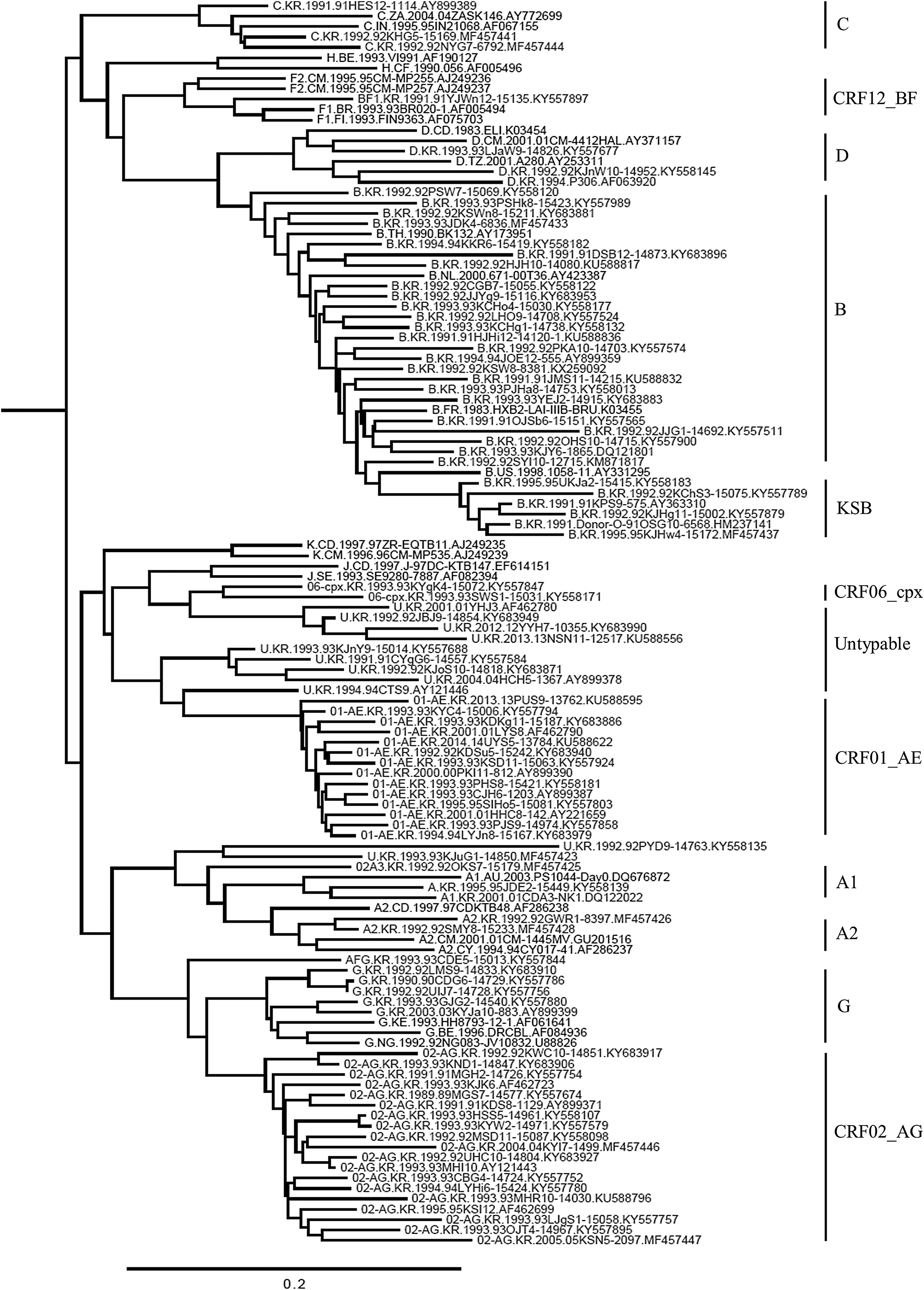
Phylogenetic analysis using nef gene sequences from OSs, OS spouses, prostitutes, and others in Korea. Sequences were aligned with the HIV-1 subtype reference set from the HIV Sequence Database, and a phylogenetic tree was constructed using PHYLIP Dnadist (using the F84 model and maximum likelihood method). Among the representative 99 Korean sequences, 69, 24, and 6 belonged to the non-B subtype, subtype B, and KSB, respectively. 06-cpx.KR.1993.93KYgK4-15072.KY557847 denotes that the sample obtained from the Korean patient KYgK in April 1993 showed the CRF06-cpx. OS, overseas sailor; KSB, Korean subclade B.
Recent reports indicated that the rates of progression to AIDS and the patterns of response to antiretroviral drug therapy and resistance mutations are considerably different for different subtypes. 15 –21 Therefore, along with genotyping, subtyping is essential for better clinical management. In the present study, we retrospectively determined the HIV-1 subtypes in OSs, OS spouses, and prostitutes. In future, these data may provide an important foundation for analysis of HIV-1 subtypes in Korea.
Materials and Methods
Patients and samples
Until the end of 1998, 876 patients were diagnosed with HIV-1 infection in Korea. Of these, around 161 were OSs and 14 were the spouses of OSs (Table 1). In addition, 15 were prostitutes who had sexual contact with American soldiers in brothels near U.S. military bases in Korea. Of the 161 OSs and 14 OS spouses, 3/161 and 1/14 were infected with HIV-2, respectively. 14 In the present study, excluding the 4 patients infected with HIV-2, we amplified HIV-1 nef from the serum of 102 OSs, 14 OS spouses, and 15 prostitutes using reverse transcription polymerase chain reaction (RT-PCR) (Table 2). Until April 1993, specimens were collected nationwide at the Center for AIDS Research, National Institute of Health, Seoul, Korea, and subsequently at the Department of Microbiology, University of Ulsan, College of Medicine, Korea. Specimens obtained from July 1989 to May 2005 were used. The months and years of sample collection are indicated in Figure 1. This study was approved by the Institutional Review Board of the Asan Medical Center.
Includes HIV-2 infection in 1991, 1994, and 1997. 14 Among the 116 OSs and spouses, HIV-1 subtyping was based on the env and gag genes in six patients 13 and husband's subtype in four patients. The first patient diagnosed in 1985 had returned home from Africa.
OS, overseas sailor; KSB, Korean subclade B.
Determined by env amplification (AF204258 and AF204264). 13
RNA preparation and nef amplification
Total RNA was extracted from 150 to 300 μl serum samples using the QIAamp UltraSens Viral RNA Kit (Qiagen, Hilden, Germany), as described previously. 7 –10,22 For each sample, 1 μg of genomic DNA was used in the first PCR containing 0.5 nM of each outer primer (Nef5′5 and LTR3), 23 2.5 mM dNTP mixture, 1 mM MgCl2, and 0.5 U of r-Taq polymerase (Takara Bio, Inc., Shiga, Japan) in 20 μl final volume. The cycling conditions were as follows: 95°C for 1 min followed by 35 cycles of 95°C for 30 s, 52°C for 30 s, and 72°C for 90 s, followed by a final extension at 72°C for 10 min. An aliquot of 1 μl of the first PCR was then added to the second PCR containing 0.4 nM of each inner primer (Nef5 and N10), 23 0.1 mM dNTP mixture, 1 mM MgCl2, and 0.5 U of r-Taq polymerase in a 50 μl final volume. The cycling conditions were equivalent to the first reaction except that the annealing step was at 57°C for 30 s. The PCR products from the second reaction were analyzed on a 1% agarose gel and visualized by ethidium bromide staining. In cases of amplification failure, the reactions were repeated with different primer sets as follows: Nef5′5/LTR3 and Nef3/N10, 585/LTR3 and Nef5/N10, 8395-MHR/LTR3 and Nef5/N10, and NE1/NE2 and NE3/NE4. Subsequently, the amplicons were directly sequenced using Applied Biosystems 3730XL (Macrogen, Inc., Seoul, Korea). The primer pairs used are listed in Table 3.
Phylogenetic analysis
Patients infected with the subtype B and KSB
3,7
as far as possible were excluded from this phylogenetic tree, and a total of 99 sequences obtained from 99 patients were aligned to the HIV-1 subtype reference set from the HIV Sequence Database (
Results
Patient demographics
Of the 131 participants, 121 (92.3%) were diagnosed with HIV-1 infection before 1994. Prostitutes and OSs accounted for more than 50% of all diagnoses during 1986–1987 and 1988–1991, respectively (Fig. 2). Modes of HIV transmission were as follows: heterosexual contact in 129/131 (98.5%) and bisexual contact in 2/131 (1.5%) participants. Twenty-seven and two subjects were administered zidovudine and highly active antiretroviral therapy, respectively. All samples showed the same HIV-1 subtype. The median age of patients at the time of diagnosis was 32 years (interquartile range = 28–41 years), and 78% patients (n = 102) were males.

Percentage of OSs, OS spouses, and prostitutes among HIV-1-infected patients in Korea. A mandatory HIV test for OSs was performed from 1988 to 1993. The first case of HIV-1 infection in Korea was reported in 1985. In 1989, only two women were diagnosed. One of them was the spouse of an OS, while the other was a transfusion-mediated case. In 1991, three women were diagnosed, all of whom were OS spouses.
Nef in 123 OSs, OS spouses, and prostitutes
We determined the subtype of HIV-1 based on the nef gene in 123 patients comprising 98 OSs, 11 OS spouses, and 14 prostitutes. Of the 116 OSs and OS spouses, subtyping was performed for 109 individuals. Of these, nef was present in samples from either the husband or wife in only four instances (Table 1). From 1985 to 1991, among the two major risk groups, non-B, Western B, and KSB subtypes were found in 105, 21, and 5 patients, respectively (Tables 1 and 2). Altogether, there were 14 heterosexual couples. Phylogenetic analysis confirmed that the paired samples were related in five cases (Fig. 1).
Distribution of subtypes in OSs and OS spouses
We detected 105 (80.1%) patients infected with HIV-1 non-B: 74 (70.4%) with recombinant viruses. Among the 116 OSs and OS spouses, non-B, Western B, and KSB were found in 101 (87%), 11 (10%), and 4 (4%) patients, respectively (Table 1). Among the five KSB-infected cases, four were OSs. All OSs were single (age = 19–33 years). In Korea, diagnosis of HIV-1 infection in homosexual men was frequently performed during blood donation. An OS was detected with HIV-1 infection during blood donation in 1990. Presumably, the subject was domestically infected with KSB following homosexual or bisexual contact.
Distribution of subtypes in prostitutes
We determined the sequence of nef in samples (obtained until 1998) from 15/21 prostitutes. Western subtype B was the most common subtype detected and was observed in 10/15 (67%) patients because the U.S. military personnel were the main patrons of these prostitutes. Three cases of CRF01_AE and one each of CRF02_AG and KSB were observed. Interestingly, KSB was first detected in a patient diagnosed with HIV-1 infection in 1994.
Distribution of subtypes
The distribution of subtypes observed was as follows: 39, CRF02_AG; 15, CRF01_AE; 7, A1; 7, A2; 6, D; 2, CRF06_cpx; 3, C; 6, G; 11, untypable, and 1 each for CRF09_cpx, CRF12_BF, CRF50_A1D, A3, AFG, H, F1, F2, and A. CRF02_AG was the most commonly present non-B subtype. It was first detected in a prostitute and an OS in 1987 and 1988, respectively. The prostitute had sexual contact with foreigners in Pusan. The earliest case of CRF01_AE infection was detected in 1990 in an OS. Among the 15 patients, 12 were OSs.
Discussion
We determined the distribution of HIV-1 subtypes in OSs and prostitutes, the two major risk groups for HIV-1 infection in Korea between 1986–1987 and 1988–1991, respectively. The non-B (80%) and B (16%) subtypes accounted for 96% cases, and KSB accounted for only 4% cases. In contrast, in 2016, the proportions of non-B (CRF01_AE), subtype B, and KSB in Korean isolates (n = 43) were 9%, 16%, and 74%, respectively. 25 In this respect, it is unlikely that non-B and subtype B-infected patients were active in HIV-1 transmission in the general population. The occurrence of non-B subtype infections in Korean OSs (87%) was higher than that in Croatia (71%). 26
OSs displayed high-risk behaviors for HIV-1 infection and other sexually transmitted diseases (STDs), although they are educated about STDs, including HIV-1. Due to periods of prolonged abstinence, they may consume alcohol, visit brothels, and avoid the use of condoms. During our consultation with many OSs, we found that they often leave their ships without condoms because they intend to return after only a glass of beer. Furthermore, after drinking alcohol, many have sex without using condoms. Alcohol consumption increases the behavioral risk for STDs. 27 Moreover, alcohol intake is a contributing factor for HIV infection and virologic failure 28 because it temporarily reduces immune functions and significantly increases HIV-1 replication in peripheral blood mononuclear cells. 29,30 Thus, the primary reason for HIV-1 infection in OSs is alcohol consumption after arrival at port. For prostitutes, multiple partners along with alcohol intake may be the important risk factors.
In the present study, six OSs and prostitutes were infected with KSB. To rule out the possibility that the PCR products might have been contaminated, we also amplified other genes. We confirmed that 4/5 patients were infected with KSB by amplification of vif and/or env (data not shown).
Two prostitutes, who were diagnosed in 1987 and 1993, were found to be infected with CRF02_AG and CRF01_AE, respectively. They had worked in Pusan, where these subtypes were predominantly found among OSs. Therefore, we believe that both these subjects were infected with HIV-1 following contact with OSs and not by the U.S. military personnel.
Patients infected with HIV-2 were observed in Korea. 13 We tried to amplify nef and vif using different primer sets; however, we could not obtain any PCR amplicon in samples from this patient.
Despite the high prevalence of non-B subtypes in Korea before 1992, their spread in public was limited. Notably, 90.7% of the new HIV cases in Korea are attributed to infection by subtype B, including 74% cases being attributed to KSB infection. 25 However, owing to the high proportion of bisexual men among the HIV-1-infected patients and the presence of non-B infections in non-OSs and prostitutes, non-B may spread in Korea, although there has been no report on CRF with KSB. 6,9
An increase in the number of overseas travelers may pose a risk and result in increased incidence of non-B subtype HIV infections in Korea. This may have implications while formulating prophylactic and therapeutic strategies. Furthermore, since this would bring different subtypes in contact, it may favor the generation of novel recombinant viruses due to the high percentage of bisexual men in the HIV-infected population.
Among the various HIV-1 genes, in the present study, we analyzed the nef gene. The reason was because we could extensively procure data on the nef gene for almost all patients who were diagnosed with subtype B infection from 1988 to 1993. 31 –33 About 4,182 nef genes have been registered in GenBank as of November 2017.
Our study had several limitations. First, the availability of data and samples after 1993 were limited. Second, subtype determination was not based on analysis of full-length sequences, although there are many circulating recombinant forms in full length level in Korea. 22 Further studies are required to determine whether there is a difference in the progression rates of non-B and subtype-B infections in Korea.
Sequence Data
GenBank accession numbers are as follows: AF063920, AF462699, AF462723, AF462780, AF462790, AY121443, AY121446, AY121453, AY221659, AY363310, AY584782, AY585695, AY899350, AY899359, AY899371, AY899378, AY899387, AY899389-90, AY899399, DQ121667, DQ121756, DQ121801, DQ122022, DQ122069, HM237141, HM369962, KC259079, KM871817, KY557511, KY557524, KY557532, KY557565, KY557574, KY557579, KY557584, KY557674, KY557677, KY557688, KY557751–2, KY557754, KY557756-7, KY557782, KY557786, KY557789, KY557794, KY557803, KY557844, KY557847, KY557858, KY557861, KY557879-80, KY557895, KY557897, KY557900, KY557924, KY557989, KY557996, KY558013, KY558095, KY558098, KY558107, KY558118, KY558120, KY558122, KY558132, KY558135, KY558138-40, KY558145, KY558171, KY558177, KY558181-83, KY583977, KY683871, KY683881, KY683883, KY683886, KY683894, KY683896, KY683906, KY683910, KY683917, KY683927, KY683949, KY683961, KY683979, KY683990, KY683940, KY683953, KU588556, KU588595, KU588622, KU588796, KU588817, KU588832, KU588836, KX259056, KX259068, KX259092, and MF457421-49.
Footnotes
Acknowledgment
This work was supported by a grant from the Korean Society of Ginseng (2015–2016).
Author Disclosure Statement
No competing financial interests exist.