




Abstract
Many new circulating recombinant forms (CRFs) and unique recombinant forms (URFs) of HIV-1 have been found in men who have sex with men (MSM) in recent years, in China. In this study, a unique HIV-1 recombinant genome (SN153) was characterized from an HIV-positive male infected through homosexual behavior in Shaanxi, China. The mosaic pattern had a complex intersubtype recombinant structure with six breakpoints, with three subtype C segments inserted into subtype B backbone. And three similar breakpoints with CRF07_BC were observed in the pol gene. The identification of the new URF suggested the genetic complexity of the HIV epidemic among MSM in Shaanxi province and the urgent need for epidemiological surveillance and their origin of the new recombination forms.
B
Men who have sex with men (MSM) were marked as one of the most important risk populations of HIV-1 in China. 10 From January to October in 2016, 46.4% cases of HIV-1 infection newly diagnosed in Shaanxi province were infected through MSM. 11 CRF01_AE, CRF07_BC, and subtype B were three predominant subtypes identified among MSM in a previous study. 12 In this study, the near full-length genome (NFLG) of a novel recombinant form (SN153) was harvested, deriving from subtypes B and C, which is different from any previously reported B/C recombinants.
Whole blood sample was collected from a 51-year-old man (SN153) on August 13, 2015, during a HIV-1 molecular epidemiology survey. The CD4+ T cell count was 57 cells/μL. Informed consent was signed before the sample collection. The patient (SN153) was married and diagnosed as HIV-1 positive in June 2015 through voluntary counseling and testing because of homosexual behavior. His CD4+ T cell count increased from 146 cells/μL in March, 2016, to 235 cells/μL in March, 2017, after receiving antiretroviral therapy in September, 2015. This study was reviewed by the Institutional Research Ethics Community of the Shaanxi Center for Disease Control and Prevention.
The viral RNA was extracted from plasma using QIAamp Viral RNA Mini Kit (QIAGEN) and then reversely transcribed into cDNA (SuperScript III Reverse Transcriptase; Invitrogen, Carlsbad, CA). The NFLG was amplified by nested polymerase chain reactions (nest-PCRs). The positive PCR products were sequenced and assembled by Sequencher v5.1. The NFLG sequence of SN153 was first codon aligned with subtyping reference sequences from the Los Alamos National Database (
The NFLG sequence of SN153 was 8954 bp corresponding to the HXB2 nucleotide positions: 634–9,597. As shown in Figure 1, SN153 was much closer to subtype B clade beyond subtype C and other BC strains. The recombinant pattern analyses by Simplot v.3.5.1 revealed that the NFLG of SN153 composed of three subtype C segments inserted into the subtype B backbone, with the subtype B sequence (RL42), subtype C sequence (95IN21068), and subtype K sequence (96CM) as references (Supplementary Fig. S1; Supplementary Data are available online at
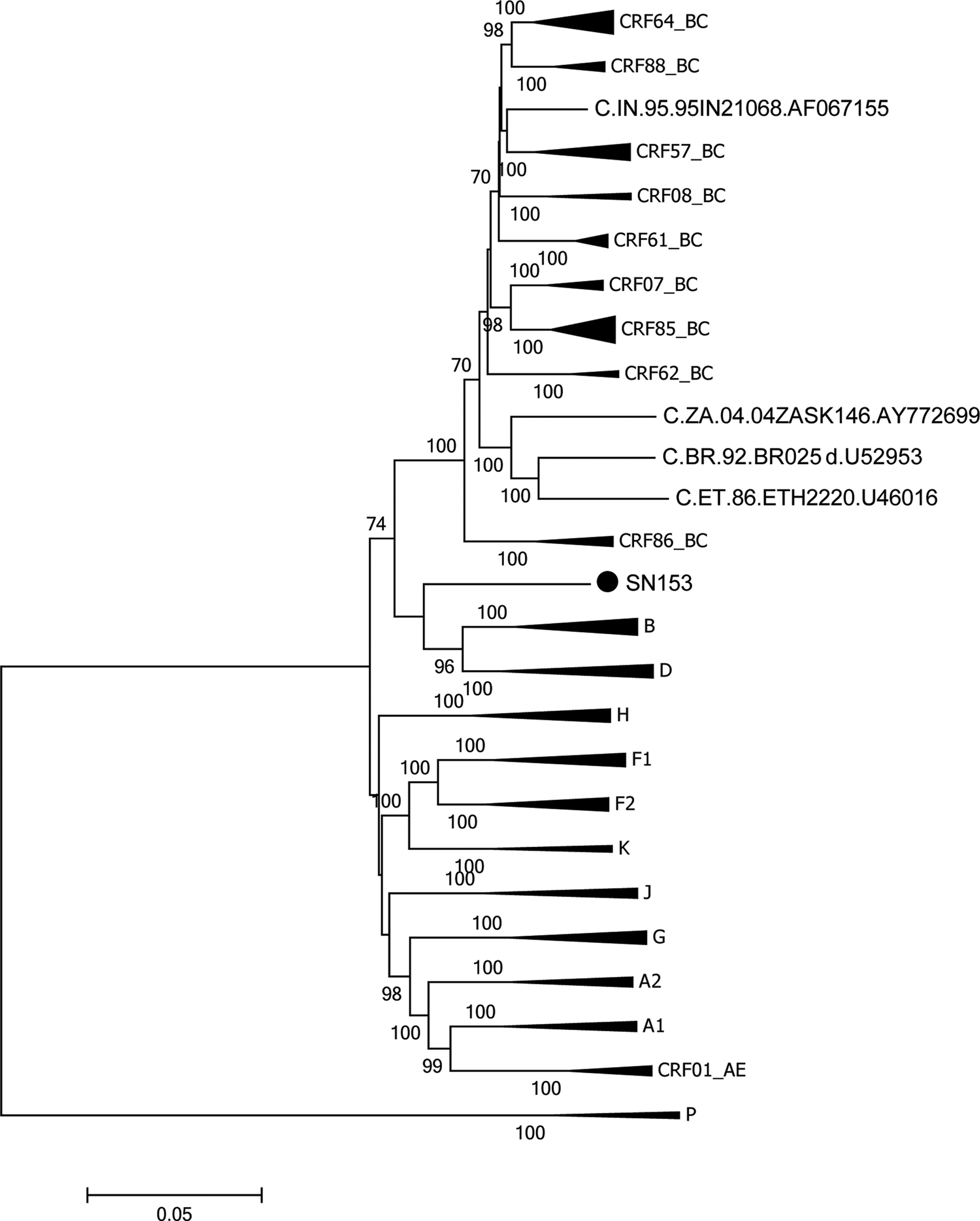
A neighbor-joining phylogenetic tree of SN153 was constructed using MEGA 6.05 with reference sequences where the solid circle represents SN153. The stability of each node was assessed by bootstrap tests with 1,000 replicates and the bootstrap values >70% are shown at the corresponding nodes.
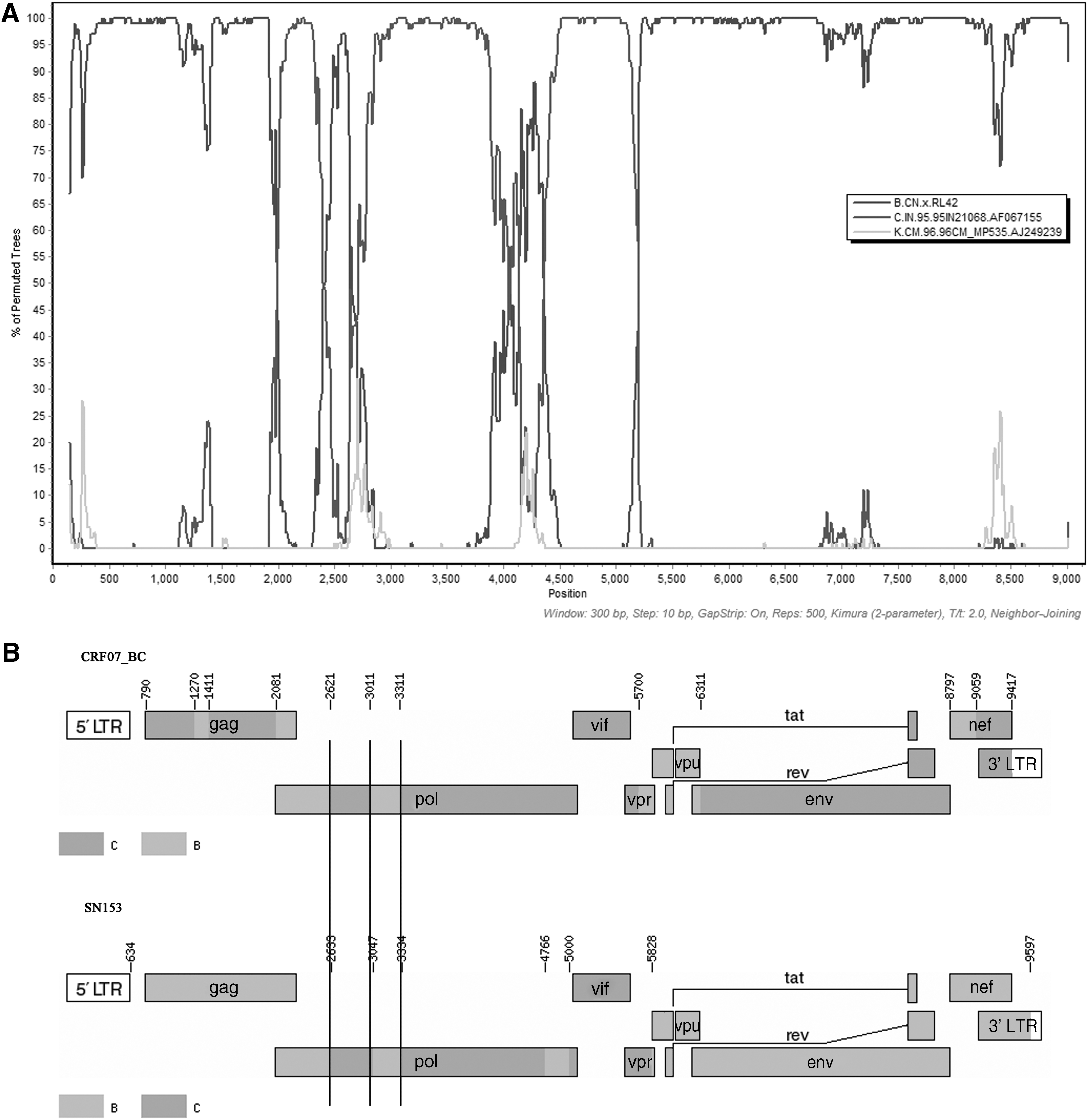
Unlike other BC recombinants, CRF07_BC, CRF08_BC, CRF57_BC, CRF61_BC, CRF62_BC, CRF64_BC, CRF85_BC, CRF86_BC, and CRF88_BC were substituted by subtype B fragments into the subtype C parental backbone, whereas SN153 was the subtype B parental backbone with three subtype C fragments. Three similar breakpoints were observed between CRF07_BC and SN153 (Fig. 2), suggesting that those sites were hot recombinant regions. B/C recombinants sharing similar recombinant breakpoints with CRF07_BC or CRF08_BC were also observed in a previous report. 13 It is still uncertain whether there has been a “parental” B/C recombinant creating the patterns of the shared recombinant positions. It needs to find more B/C recombinant forms for further investigation.
In this study, we reported a novel B/C recombinant form from the MSM population in Shaanxi province, with three segments from subtype C inserted into subtype B background. It suggested that the genetic lineages of HIV and newly recombinant strains found in MSM were comparatively complicated. 3 The new emerging recombinant forms indicated that the local HIV-1 epidemic was active and molecular epidemiology should be reinforced.
Sequence Data
The NLFG sequence of SN153 has been deposited in GenBank under accession number MG742702.
Footnotes
Acknowledgements
This study was supported by Shaanxi province key S&T special projects of disease prevention and control (2014A5), and the authors thank the staff of Weinan CDC, Shaanxi Province, for their kind efforts in case identification, sample and epidemic data collection.
Author Disclosure Statement
No competing financial interests exist.
References
Supplementary Material
Please find the following supplemental material available below.
For Open Access articles published under a Creative Commons License, all supplemental material carries the same license as the article it is associated with.
For non-Open Access articles published, all supplemental material carries a non-exclusive license, and permission requests for re-use of supplemental material or any part of supplemental material shall be sent directly to the copyright owner as specified in the copyright notice associated with the article.
