




Abstract
This study reported a new HIV-1 circulating recombinant form CRF65_cpx virus isolated from a man who have sex with men (MSM) in Jilin, China. The near full-length genome of this virus was composed of 14 mosaic gene fragments derived from CRF01_AE, subtype B′ (Thai B) and subtype C, highly similar to the CRF65_cpx viruses recently identified in Yunnan and Anhui of China. Phylogenetic tree analysis suggested that this CRF65_cpx strain was not generated among MSM in Jilin, but originated in southern regions of China and spread to Jilin by MSM population. The emergence of CRF65_cpx in Jilin indicated HIV-1 epidemic in this area was more and more complicated and the MSM population has become the important source for generation of new recombinant viruses. Real-time surveillance of new HIV-1 infections among MSM population is quite required.
T
Jilin province is located on the northeast of China. Since the first HIV-1-infected case was found in early 1990s, HIV-1 epidemic in Jilin is still in a low level, but new cases have been increasing slowly year by year. 3 The risk groups for HIV-1 infection in Jilin experienced a series of changes. Between 2004 and 2010, the major risk has changed from former plasma donors to persons infected through sexual transmission. 4 Also, more remarkably, HIV-1 infections among men who have sex with men (MSM) have sharply increased, from 1.8% in 20054 to 61.0% in 2010–2011. 5
Multiple subtypes and CRFs have been found in Jilin province, including subtype B, C, CRF01_AE, CRF07_BC, CRF08_BC, and CRF02_AG. 5 Co-circulation of these genotypes promoted the generation of new CRFs and URFs in Jilin. In recent years, CRF01_AE become the dominant genotype in Jilin and rapidly spread among MSM and heterosexuals. 5,6 Co-circulation of CRF01_AE and other subtypes speeded up the generation of more and more new CRFs and URFs, such as CRF01_AE/CRF07_BC, 7 CRF61_BC, 8 B′/C, 9 and CRF01/B′/C, 10 which further complicated the HIV-1 epidemic in Jilin province.
In this study, a new and more complex recombinant CRF65_cpx virus was identified by near full-length genome (NFLG) analysis from an HIV-1-infected MSM JL15030. The JL15030 virus consisted of 14 mosaic gene structures derived from CRF01_AE, subtype B′ (Thai B) and subtype C viruses. This study was approved by the institutional research board of Changchun Infectious Disease Hospital. A written informed consent was obtained from each participant.
The whole peripheral blood was collected from an antiretroviral treatment-naive, 28-year-old patient JL15030 shortly after he was diagnosed as HIV-1 serologically positive at Changchun Infectious Disease Hospital of Jilin province in 2015. Viral genomic RNA was extracted from the plasma by the QIAamp Viral RNA Mini kit (Qiagen, Valencia, CA) according to the manufacturer's instructions and then subjected to reverse transcription reaction to synthesize cDNA by the PrimeScript™ II First Strand cDNA Synthesis Kit (TaKaRa Bio, Inc., Beijing, China). The NFLG of JL15030 virus was amplified into two halves with an ∼500 bp overlapping region by the PrimeStar GXL DNA polymerase (TaKaRa Bio, Inc.), using the cDNA as the PCR template. Four pairs of primers 11 were used for the gene amplifications as shown in Table 1. The purified PCR products were subjected to direct sequencing.
The JL15030 NFLG sequence of 8,519 bp length was obtained and aligned with reference genome sequences using the Clustal W and manually adjusted using the BioEdit 7.2.5 (T. Hall, North Carolina State University, Raleigh, NC). The reference sequences of various subtypes (A–D, F–H, J, and K) and CRF01_AE and N group were downloaded from the Los Alamos National Laboratory (LANL) HIV Database (

Phylogenetic analysis of the near full-length genome of the JL15030 virus. The neighbor-joining tree was constructed with the near full-length genome of JL15030 (labeled with a black dot) and references of multiple subtypes in MEGA 6.06 based on the Kimura two-parameter model and 1,000 bootstrap replicates test. The bootstrap values higher than 70% are shown. The tree branches of CRF65_cpx and JL15030 are displayed as bold lines.
Recombinant breakpoints were analyzed using jpHMM (
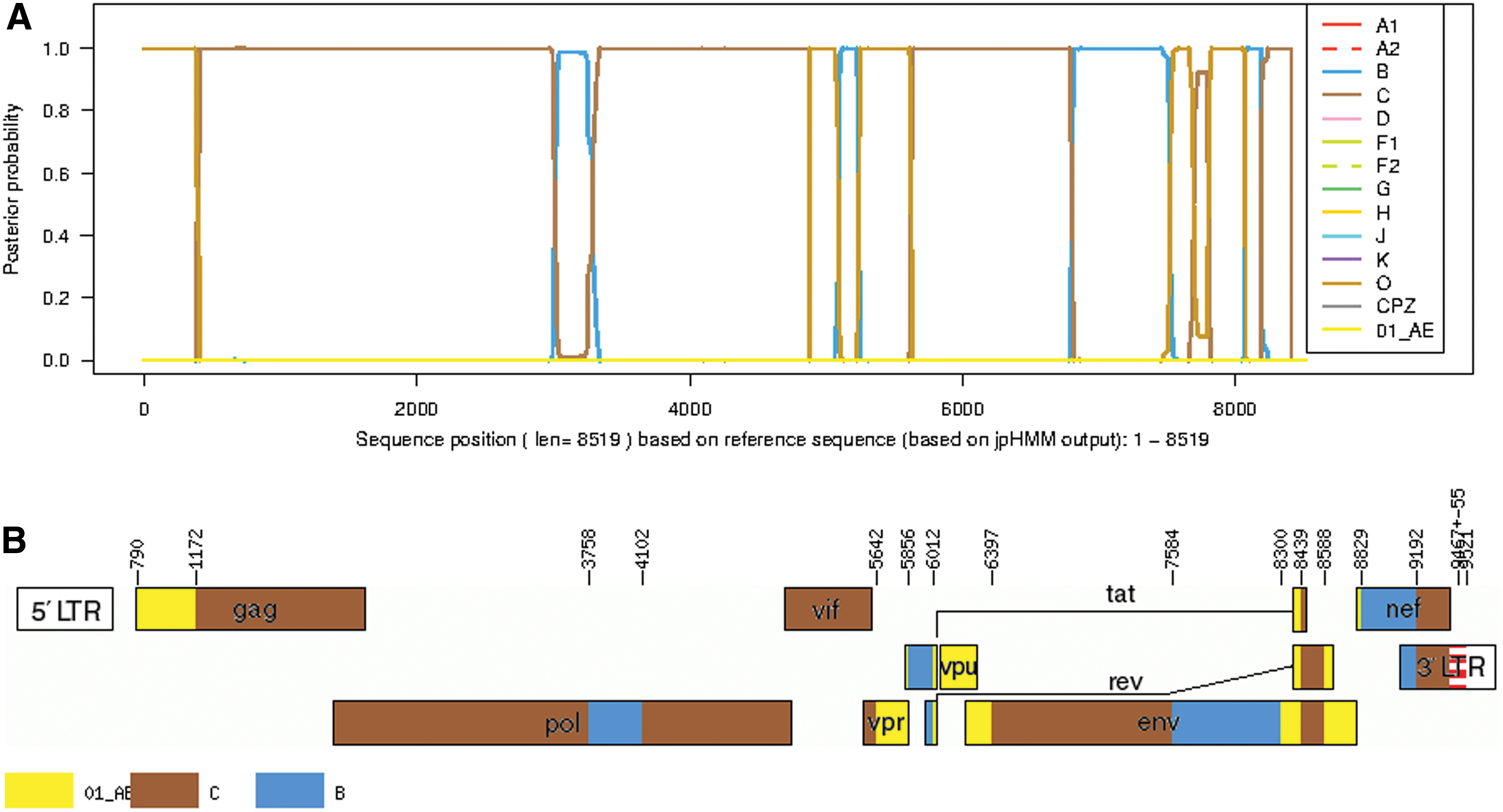
Recombinant analysis of the JL15030 genome.

Phylogenetic analysis of subregion gene fragments. The neighbor-joining trees were constructed with fourteen subregion mosaic genes of JL15030 (named as
Furthermore, the subregion phylogenetic analysis also showed that the subtype B gene fragments of the JL15030 virus (III, VI, and IX) were more closer with references of subtype B′ (Thai B, the Thailand variant of subtype B). The CRF01_AE fragments of the JL15030 virus (I, V, VII, X, and XII) were closer with CRF65_cpx references from heterosexuals in Yunnan and/or CRF01_AE references epidemic among heterosexuals in Fujian (CRF01–6) and Yunnan (CRF01–7), and distantly related to CRF01_AE references epidemic among MSM in Jilin, Liaoning (CRF01–5), Jiangsu, Tianjin, and Beijing (CRF01–4). 13
The circulating recombinant form CRF65_cpx was first reported among heterosexuals in Yunnan province by NFLG analysis. 12 And then, more CRF65_cpx sequences have been found in China, including an NFLG sequence from an HIV-1-infected MSM in Anhui, 12 and several gag-pol gene fragments from HIV-1-infected MSM in Beijing 14 and Hebei, 15 and from intravenous drug users (IDUs) in Yunnan. 14 Further phylogenetic analysis has shown that the CRF65_cpx viruses seemed to emerge in China in 2004, originally transmitted among heterosexuals in Yunnan province, and then spread to MSM population in other provinces of China. 14
In this study, we identified a new CRF65_cpx virus JL15030 from HIV-1-infected MSM in Jilin province. It was the first report of CRF65_cpx in this area. The NFLG of the JL15030 virus appeared highly similar to the NFLGs of CRF65_cpx found in Yunnan and Anhui provinces. More interestingly, the CRF01_AE gene fragments in JL15030 was phylogenetically closely related with the CRF01_AE references epidemic among heterosexuals in Yunnan and Fujian, but distantly related with references epidemic among MSM in Jilin and Liaoning. This result strongly supported the finding that the CRF65_cpx was not generated among MSM, but was spread to MSM after it was generated in Yunnan. 14 The high mobility of the MSM population promoted the spread of CRF65_cpx from the southern region to middle region and then to the northeast region of China.
So far, five recombinant forms have been found in Jilin province, including CRF61_BC, 8 B′/C, 9 and CRF01_AE/B′/C 10 among heterosexuals, and CRF01_AE/CRF07_BC 7 and CRF65_cpx (identified in this study) among MSM. The CRF65_cpx was the first complex recombinant virus identified in Jilin. This indicated that the HIV-1 epidemic in Jilin was more and more complicated. Real-time surveillance of new HIV-1 infections, especially among MSM population, in this area is quite required.
Sequence Data
The nucleotide sequence of the isolate JL15030 has been submitted to GenBank with the accession number MH051841.
Footnotes
Acknowledgments
This work was supported by National Megaproject on Key Infectious Diseases (2017ZX10202102), National Natural Science Foundation of China (81672003, 81602899), Natural Science Foundation of Heilongjiang Province (C2017043), and the grant of Harbin Science and Technology Bureau (2016RAXYJ059).
Author Disclosure Statement
No competing financial interests exist.