




Abstract
Lack of effective strategies for killing cells latently infected with HIV-1 limits the eradication of AIDS. Unfortunately, current antiretroviral inhibitors are designed to target virus production but not latent infection. Interestingly, some non-nucleoside reverse transcriptase inhibitors (NNRTIs) have shown off-design effects, specifically, premature activation of HIV-1 protease (PR) within virus-infected cells that induces apoptosis. Here, we analyze an equilibrium model of HIV-1 reverse transcriptase (RT) binding to NNRTIs to understand the optimal binding characteristics that enhance RT dimerization within embedded GagPol dimers. This would allow NNRTIs to act as PR autoactivation enhancers (PAEs). We compute that ∼700-fold enhancement is theoretically possible by PAEs. Both a strong drug–dimer binding affinity (KD 12 < 100 nM) and relatively weaker drug–monomer affinity (KD 2/KD 12 > 10) are required for significant enhancement (∼50-fold or more) relative to the drug-free dimer concentration within a drug concentration limit of 10 μM. Our approach rationalizes the observed effects of efavirenz on premature activation of PR and may be useful to guide the design of suitable drug candidates and their optimal dosage regimens for this therapy class.
D
NNRTIs are allosteric inhibitors designed to block nucleic acid synthesis in mature reverse transcriptase (RT) that kinetically trap the mature enzyme domains in a dysfunctional open state. 5 Mature RT is a heterodimer consisting of subunits p66 and p51. The p66 subunit in RT is composed of p51 and p15 domains, but the two p51 domains in the mature enzyme have distinct quaternary folds. This is extended in the p66 subunit (termed p51e), compact in the p51 subunit (termed p51c). The conformational equilibrium strongly favors p51c over p51e, and p51 homodimers are p51e-p51c asymmetric structural heterodimers, 6 despite being sequential homodimers. Furthermore, the NNRTI binding site is structurally close to the heterodimer interface, implicating NNRTIs in either enhancing or disrupting RT stability. 7 This supports the observation that NNRTIs also enhance GagPol dimerization 8 by stabilizing embedded RT dimers. It also consequently implies a mechanism that NNRTIs that favor mature-like p51e-p51c dimerization in GagPol precursors, in turn, favor juxtaposed PR dimerization and thus act as premature PR autoactivation enhancers (PAEs).
To provide a simple rationalization of this mechanism and to understand its thermodynamic determinants, we analyze an equilibrium model of GagPol-embedded RT heterodimerization in the presence of NNRTIs. The model consists of a protein domain R that exists in two interconvertible conformations R 1 and R 2 (analogous to the p51c and p51e conformations in RT, respectively) with conformational equilibrium KC . Only R 1 and R 2 can bind each other (R 1·R 2) with dimerization equilibrium constant KRN − in the absence of NNRTI, termed N. Drug N binds R 2 and R 1·R 2 with dissociation constants, KD 2 and KD 12, respectively, but not R 1. Thus R 1 also binds R 2·N with dimer equilibrium constant KRN + (Fig. 1A).

Equilibrium model of drug-modulated RT dimerization.
The concentration of each protein species can be expressed in terms of that of R
1, [R
1], and the free drug concentration, [Nf
] from the following equilibrium relations:
where [Nf
] is related to the total drug concentration, [Nt
], by:
where [R 1] exhibits a closed form polynomial solution in terms of the total initial concentration of protein monomers, [Rt ]:
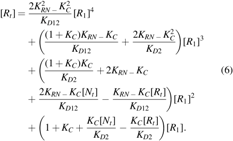
The total dimer concentration [Dt ] is then given by [Dt ] = [R 1·R 2] + [R 1·R 2·N]. To compare the degree of dimerization for any set of the mentioned parameters, we compute the mole fraction, ρ, of dimeric species, where ρ = [Dt ]/[Rt ] with a maximum theoretical value ρmax = 0.5.
Sensitivity analysis across a range of dimer equilibrium KRN − and conformational equilibrium KC constants shows symmetric variation of [Dt ] with KC in the absence of N (Fig. 1B). Increasing KRN − increases the dimer population, whereas a shift of conformational equilibrium away from unity results in symmetric decrease in [Dt ]. Thus, peak dimer concentration favors equal availability of R 1 and R 2 as well as a strong dimer equilibrium between the two. Based on experimentally known parameters: intracellular GagPol concentration ([Rt ] ∼10−7 M−1), 9 the conformational equilibrium between p51e and p51c (KC ∼0.03),6 and the RT dimer equilibrium constant (KRN − ∼2.5 × 10⁵ M−1),6 our model yields a small drug-free dimer mole fraction, ρ0 ∼ 0.0007. Thus, theoretically, the potential exists to enhance intracellular dimerization of GagPol-embedded RT by ∼700-fold.
Previous studies assigned KD 2 = KD 12 when analyzing the concentration of various species with increasing N 6 in a similar model. Here, we relax this constraint to explore the effect of differential drug binding strengths to the monomer versus the dimer. By performing a sensitivity analysis across a parameter space of several orders of magnitude, we find that the effect on the dimer mole fraction ρ upon addition of N crucially depends on the values of drug–monomer and drug–dimer dissociation constants, KD 2 and KD 12, respectively. Stronger binding of N to R 2 than to R 1·R 2 (KD 2 < KD 12) leads to monotonous decay of ρ upon increasing [N] (Fig. 1C). Significantly enhanced dimerization in contrast is only possible when KD 2 > KD 12. In this regime, ρ first peaks across a given concentration range before decaying. However, for a weak drug–dimer dissociation constant (KD 12 = 10 μM), this occurs well above [N] = 100 μM (Fig. 1C—i). For decreased values of KD 12, the qualitative profile of the ρ-[N] curve still follows the corresponding ratio of KD 2/KD 12. However, the region within which ρ peaks, shifts toward lower drug concentrations. For KD 12 = 2.93 nM, corresponding to the binding affinity of efavirenz (EFZ) to the mature wild type p66-p51 RT dimer, 10 this peak can be brought within a modest concentration range (100 nM < [N] < 10 μM) (Fig. 1C—ii).
Furthermore, we calculate that even for small increases in KD 2 above KD 12, significant drug-induced dimer enhancement is possible relative to the drug-free dimer concentration (ρ/ρ0). Our model suggests that even for KD 2 = 10 nM—within one order of magnitude from the above KD 12—a peak dimer concentration enhancement of ρ/ρ0 ∼27-fold (occurring at [N] = 390 nM) is possible. For KD 2 = 100 nM, this rises to ρ/ρ0 ∼169 at [N] = 3.16 μM—whereas increasing KD 2 excessively increases the peak but also shifts it to higher concentrations (Fig. 1C—iii). Interestingly, EFZ binding affinities are different for varying RT species. One experimental study yielded KD 12 = 250, 92, and 7 nM for EFZ binding to p66-p66, p66-p51, and p51-p51 RT, respectively, and KD 2 = 2.5 μM for both p66 and p51 EFZ–monomer binding. 11 According to our model, this still yields significant enhancement with ρ/ρ0 ∼30, 71, and 329, respectively, at [N] = 10 μM.
The model then shows that increasing KD 2 relative to KD 12 always increases the maximum attainable ρ/ρ0 within a given drug concentration limit. However, this is asymptotic for KD 2 >> KD 12, where the asymptote increases with drug–dimer binding strength. For example, with KD 12 = 100 nM and KD 2 = 1 μM, we attain a maximum ρ/ρ0 ∼52 within [N] < 10 μM, where in the regime KD 2 >> KD 12 we reach an asymptote at ρ/ρ0 ∼79.
Our analysis rationalizes the observations that EFZ enhances GagPol dimerization by binding monomers of GagPol-embedded p51e less strongly than p51e-p51c within Gag-Pol precursor dimers. More generally, it suggests that NNRTIs could achieve similar or even greater enhancement by having both a strong drug–dimer binding affinity (KD 12 < 100 nM) and a relatively weaker drug–monomer binding affinity (KD 2/KD 12 > 10). Furthermore, the stronger the drug–dimer binding affinity, the more pronounced the maximum effect of an ever weaker drug–monomer binding affinity.
Development of novel potent NNRTIs is a challenging but feasible pharmacological research effort that benefits from computational simulation-guided synthesis and quantitative evaluation of inhibition for a range of chemical variants. 12 This includes using structure-based approaches to suggest novel chemical moieties on a given drug scaffold that may increase contributions to binding. Our approach yields a strategy for rationally redesigning NNRTIs as PAEs that is consistent with the mentioned discovery process. First, ideal monomer–drug and dimer–drug binding affinities that enable substantial dimer enhancement within a desired concentration range could be optimized using our model. Chemical moieties on given drug scaffolds that potentially enhance drug–dimer binding, but limit drug–monomer binding, could then be suggested and evaluated by combining the mentioned pipeline 12 and established cytotoxicity assays. 1
Similarly, the effects of RT resistance mutations that arise in response to NNRTI therapy can be assessed in our model implicitly as variations in the values of KD 2, KD 12, or both compared with wild type. Although some such mutations (e.g., K103N and Y181C) likely reduce drug binding affinity for the RT dimer, through direct loss of structural interactions with inhibitors, their relative effects on drug–monomer disassociation may not correlate. Therefore, further studies may elucidate drug concentration windows that could take advantage of such differences to preserve functionality of NNRTIs as PAEs for patients in whom NNRTI resistance mutations arise.
Footnotes
Acknowledgments
S.K.S. acknowledges support from amfAR Mathilde Krim Fellowship in Basic Biomedical Research grant number 108680 and the Volkswagen Foundation “Experiment! Funding Initiative” grant no. 93874. A.M. is supported by a grant from the Spanish Ministry of Economy, Industry and Competitiveness and FEDER grant no. SAF2016-75505-R (AEI/MINEICO/FEDER, UE), and the “María de Maeztu” Programme for Units of Excellence in R&D (MDM-2014-0370).
Author Disclosure Statement
No competing financial interests exist.