




Abstract
HIV-1 recombinant forms contribute substantially to its genetic evolution. This study reports a novel HIV-1 second-generation recombinant form (AH150299) composed of CRF01_AE and subtype B, isolated from an HIV-positive female subject infected through heterosexual contact in Anhui province of eastern China. The analyses of the near full-length genome sequence showed that one subtype B segment was inserted into the CRF01_AE backbone, with two recombinant breakpoints observed in the vif/vpr and env/nef gene regions. Phylogenetic analysis demonstrated that the CRF01_AE region of the recombinant belongs to CRF01_AE cluster 4, and the B subregions were correlated with the B strains circulating among men who have sex with men in China. In recent years, the emergence of novel recombinant strains reflected the complexity of the HIV-1 epidemic in Anhui, suggesting the significance of continuous monitoring of the dynamic transmissions of HIV-1 in eastern China.
S
In China, the prevalence of HIV-1 CRFs was much more predominant than in other countries. The three main CRFs of HIV-1, CRF07_BC, CRF01_AE, and CRF08_BC, were responsible for >80% of the total HIV infections in China. 3,4 These major CRFs together with other HIV subtypes provide a favorite environment for generating new URFs. The occurrence of numerous novel HIV-1 URFs revealed that multiple genotypes of HIV-1 were circulating in the same risk population and more people have been coinfected or superinfected with different strains. 5 CRF01_AE and subtype B were the two main circulating HIV-1 strains in eastern China. 4 Subtype B strains were originally transmitted in the United States and Europe, as well as in some countries in Southeast Asia. It was also the predominant genotype among men who have sex with men (MSM) in eastern China in the 1980s and 1990s. 6,7 Multiple clusters of CRF01_AE were introduced into China's sexually active groups from Thailand in the early and middle 1990s. And the CRF01_AE strains continually spread through sexual transmission, predominantly circulated among homosexual group and formed a nationwide epidemic.
In this study, we identified a novel recombinant involving insertions of subtypes B and CRF01_AE, it was different from the recombinants reported before. This study collected a sample of AH150299, a native Anhui Province resident, who was diagnosed with HIV-1 infection in June 2015. Epidemiological data showed that the patient was a 53-year-old divorced female, Han ethnicity with primary school education, infected through sexual behavior, and with CD4+ T cell counts of 207 cells/μL. She participated in the national HIV molecular epidemiology surveys and the study was approved by the institutional review boards of the National Center for AIDS/STD Control and Prevention of China.
Amplification and sequencing procedures of near full-length genome (NFLG) were performed as described previously.
8
NFLG of 8,986-bp length from the patient was obtained. To prevent laboratory contamination, online Basic Local Alignment Search Tool (BLAST) was used to check the NFLG and found no evidence of contamination. Recombination breakpoints were identified using SimPlot.5 software and the online tools jpHMM (
Phylogenetic trees were constructed in RAxML by using the approximately maximum likelihood method with the generalized time-reversible model for the NFLG alignment. Branches with bootstrap values >0.9 were considered as phylogenetic clusters. Bootstrap values >0.7 were considered stable. As shown in Figure 1, the AH150299 sequence was close to CRF01_AE reference sequences (bootstrap value 1), but clustered outside of the monophyletic branch.
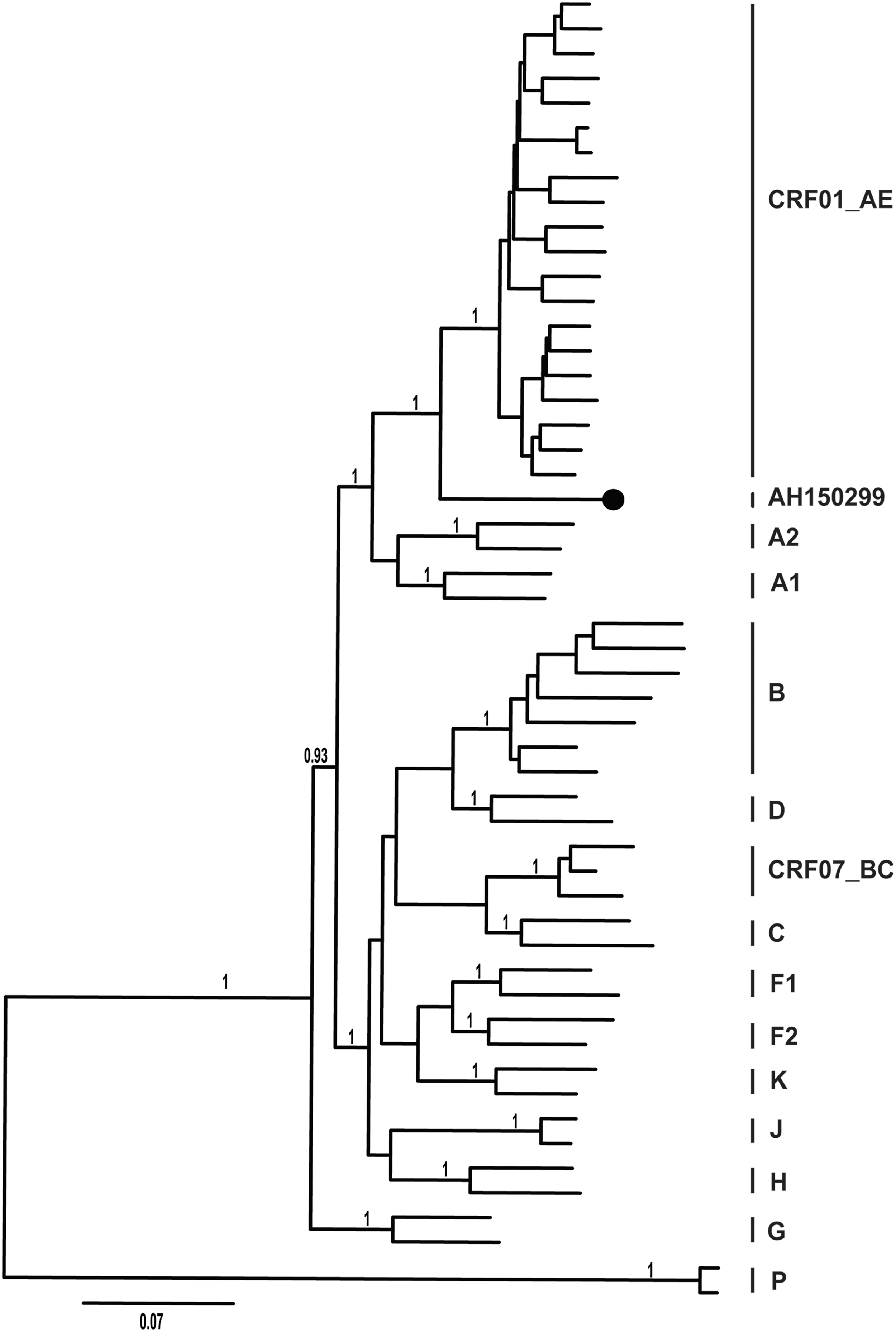
Phylogenetic analysis based on near full-length genome sequences of AH150299. HIV-1 group M subtypes (
Recombination analysis showed that the genome sequence is a recombinant, composed of CRF01_AE and subtype B (Fig. 2). The breakpoint positions refer to HXB2 coordinates and were located by HIV Sequence Locator. The recombination analysis was performed with Simplot 3.5.1 using several closely related sequences of the reference sequence set already described. Furthermore, analysis was set by a sliding window of 300 nucleotides (nt) advanced in 20 nt increments. With similarity results, it is verified that the genome was composed of subtype B and CRF01_AE (Fig. 2B). And bootscanning analysis of the NFLG sequence of AH150299 indicated that the recombination breakpoints corresponded to HXB2 nucleotide sequence positions 5,626 and 8,813, dividing the NFLG into three regions: region I (HXB2, 790–5,625 nt), CRF01_AE; region II (HXB2, 5,626–8,812 nt), subtype B; and region III (HXB2, 8,813–9,412 nt), CRF01_AE (Fig. 2B). Similar results were again obtained using online tool jpHMM-HIV (
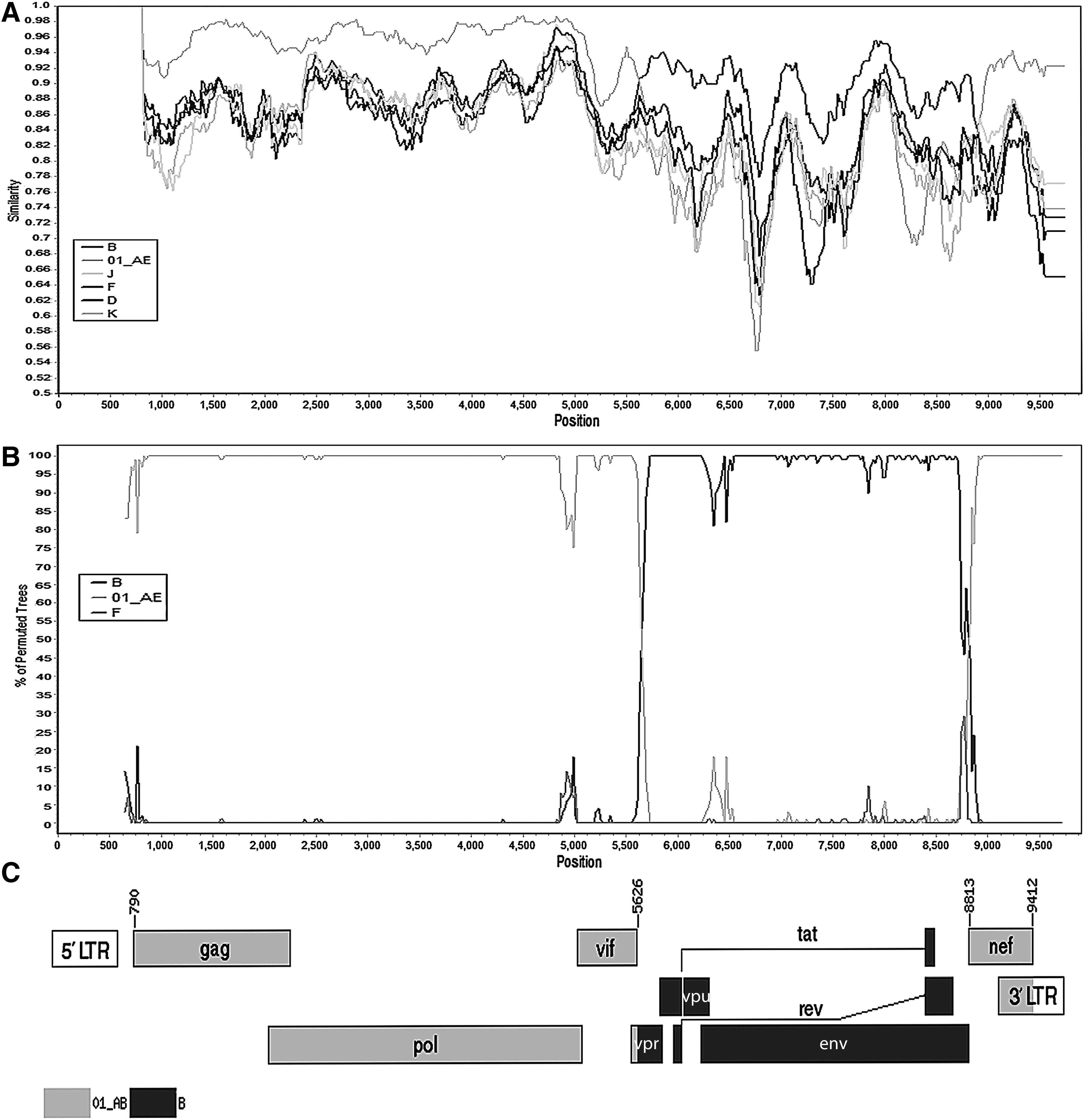
Recombinant analysis of the novel identified CRF01_AE/B.
Phylogenetic analysis of the subgenomic fragments also verified the two recombinant breakpoints that are confirmed by bootscanning analysis, which were well identified by bootstrap values >0.8 (Fig. 3). The analysis also revealed that the parental origin of the CRF01_AE regions (I and III) belonged to the CRF01_AE subcluster 4 lineage (designated CRF01-4), which was exclusively circulating among MSM in Beijing and eastern China (especially in Anhui and Jiangsu). 10 In addition, it was also noted that subtype B region II clustered with reference sequences subtype B that is the earliest HIV-1 strain around 1985 in MSM population in eastern China. 11 –13

Phylogenetic analyses of three mosaic segments (I–III) defined by bootscanning. The phylogenetic trees of subregions constructed by the neighbor-joining method, and bootstrap values of 0.7 and higher are revealed at the corresponding nodes. The sequences of AH150299 are marked in the solid circle. And the subtype references are those included in the seven unique CRF01_AE lineages detected in China, which are labeled CRF01-1 through CRF01-7. nt, nucleotides.
As described previously, CRF01_AE and B subtypes were the major subtypes prevalent in the MSM population and many recombinant forms (CRFs and URFs) were discovered in various regions of China, for instance, CRF55_01B, CRF59_01B, CRF67_01B, and CRF68_01B recombinant viruses. 14 –17 Even though located in eastern China, Anhui was in long time an agriculture province with labor exporting to nearby urban dominant coastal provinces, such as Jiangsu, Zhejiang, and Shanghai. There are two subtype B strains, prototype B and Thai-B(B′), in eastern China's AIDS epidemic in the 1990s, with B in MSM in major cities and B′ in injecting drug users (IDUs) and plasma donors in rural areas. CRF01_AE was initially transmitted into Chinese heterosexual groups and then subsequently spread to MSM as well in China. 15,18,19 Notably, with the expansion in the proportion of CRF01_AE in MSMs, cocirculation in both heterosexual and MSM population of CRF01_AE strains and subtypes B strains provides the opportunities for generating recombinant forms between the two HIV-1 strains. 20 In this study, the NFLG sequence of AH150299 was composed of cluster 4 of CRF01_AE and the MSM subcluster of subtype B, with one region of B inserted into a CRF01_AE backbone, which is significantly compliance with the local epidemic strain. It was noteworthy that there were many characteristics of the epidemiology of the subjects: middle-aged women, divorce, and acquired HIV-1 infection through sexual transmission. These may have indicated that the MSM subtype B has been diffused into the background of CRF01_AE in heterosexual populations. In China, numerous of MSM covered their sexual orientation by having female marital partners, due to high degree of social stigma and culture pressure. Such situations may demonstrate that the HIV-1 epidemic in China is more intricacy than what we identified in high-risk populations, and it increase the difficulty of determining the HIV-1 genotype work and HIV/AIDS epidemic prevention.
Taken together, we characterized a unique near full-length genomic sequence of the CRF01_AE and B recombinants of HIV-1 acquired from the Anhui province of China and that this recombinant form was distinct from the CRFs and URFs previously reported. The second-generation HIV-1 recombinants reveal the existence of complex transmission networks of different HIV subtype/CRF infections among sexual transmissions in this region. Meanwhile, it is necessary to continue investigating on HIV coinfection and molecular epidemiologic, as well as take effective prevention measures to control it in this region.
Sequence Data
The nucleotide sequence of AH150299 has been deposited to GenBank with accession no. MH431788.
Footnotes
Acknowledgments
This work was supported by grants from the Guangxi Bagui Honor Scholars, Ministry of Science and Technology of China (2017ZX10201101), the National Natural Science Foundation of China (81471962), and the Beijing Science and Technology Commission 2016 S&T Plan Major Project (SCW 2016–07).
Author Disclosure Statement
No competing financial interests exist.