




Abstract
This study reports a novel HIV-1 recombinant virus (GX2016EU10) isolated from a 24-year-old man, who was infected by homosexual sex in Guangxi, China. The near full-length genome analyses showed GX2016EU10 kept the CRF07_BC parental backbone with three CRF01_AE segments inserted into gag, pol, vpu, env, and nef genes, respectively. The recombinant breakpoints were completely different from the other CRF01_AE/CRF07_BC recombinant forms reported. GX2016EU10 was CCR5-tropic through GHOST cell identification. The emergence of GX2016EU10 indicates that the HIV-1 epidemic among men who have sex with men in Guangxi is increasing in complexity, which poses a serious challenge to prevention and control.
R
Guangxi province, bordering the Southeast Asia countries with severe HIV-1 epidemic, is one of the highest HIV-prevalent provinces in China. In this study, we isolated a novel CCR5-tropic HIV-1 recombination virus (GX2016EU10) from a 24-year-old man, who was infected by homosexual sex in Guangxi, China. The patient presented with CD4+ T cell count of 542 cells/μL and viral load of 116,000 copies/mL on July 30, 2014. Informed consent was signed before sample collection. This study was reviewed by the Institutional Research Ethics Committee of the Chinese Center for Disease Control and Prevention (No. 201334).
The viral RNA was extracted from the replication-competent virus using the QIAamp® Viral RNA Mini Kit (QIAGEN), and then reverse transcribed into complementary DNA (cDNA) using a Superscript III First-stand synthesis system (Invitrogen). Near-endpoint diluted cDNA templates were used to amplify the near full-length genome (NFLG) by nested polymerase chain reactions (nest-PCRs). The PCR reaction conditions of both rounds, including predenaturation of 94°C for 2 min wasfollowed by 35 cycles of 94°C for 30 s, 60°C for 30 s, 68°C for 4 min, and finally extended at 68°C for 10 min. 4 The positive PCR products were purified and then sequenced to obtain the near full-length genome. The sequences were spliced and assembled by Sequencher v4.9 (Gene Codes).
All HIV-1 group M subtype sequences (A–D, F–H, J, and K) and CRFs in China were selected as reference sequences from the Los Alamos HIV Sequence Database (
The NFLG sequence of GX2016EU10 was obtained with the length of 8,938 bp (relative to the HXB2 nucleotide numbering system: positions 631–9,603). Based on phylogenetic analysis, the NFLG sequence of GX2016EU10 was revealed to cluster with B/C recombinant form reference sequences, but a distinct branch was established (Fig. 1). Analyses of recombinant pattern performed by SimPlot identified that the genome of GX2016EU10 may consist of CRF01_AE and CRF07_BC fragments. From the bootscan result, GX2016EU10 was composed of at least six interlaced mosaic segments, including CRF01_AE (I, III, and V) and CRF07_BC (II, IV, and VI) with five unique recombinant breakpoints (Fig. 2A). The breakpoints relative to HXB2 nucleotide positions were defined by HIV Sequence Locator (
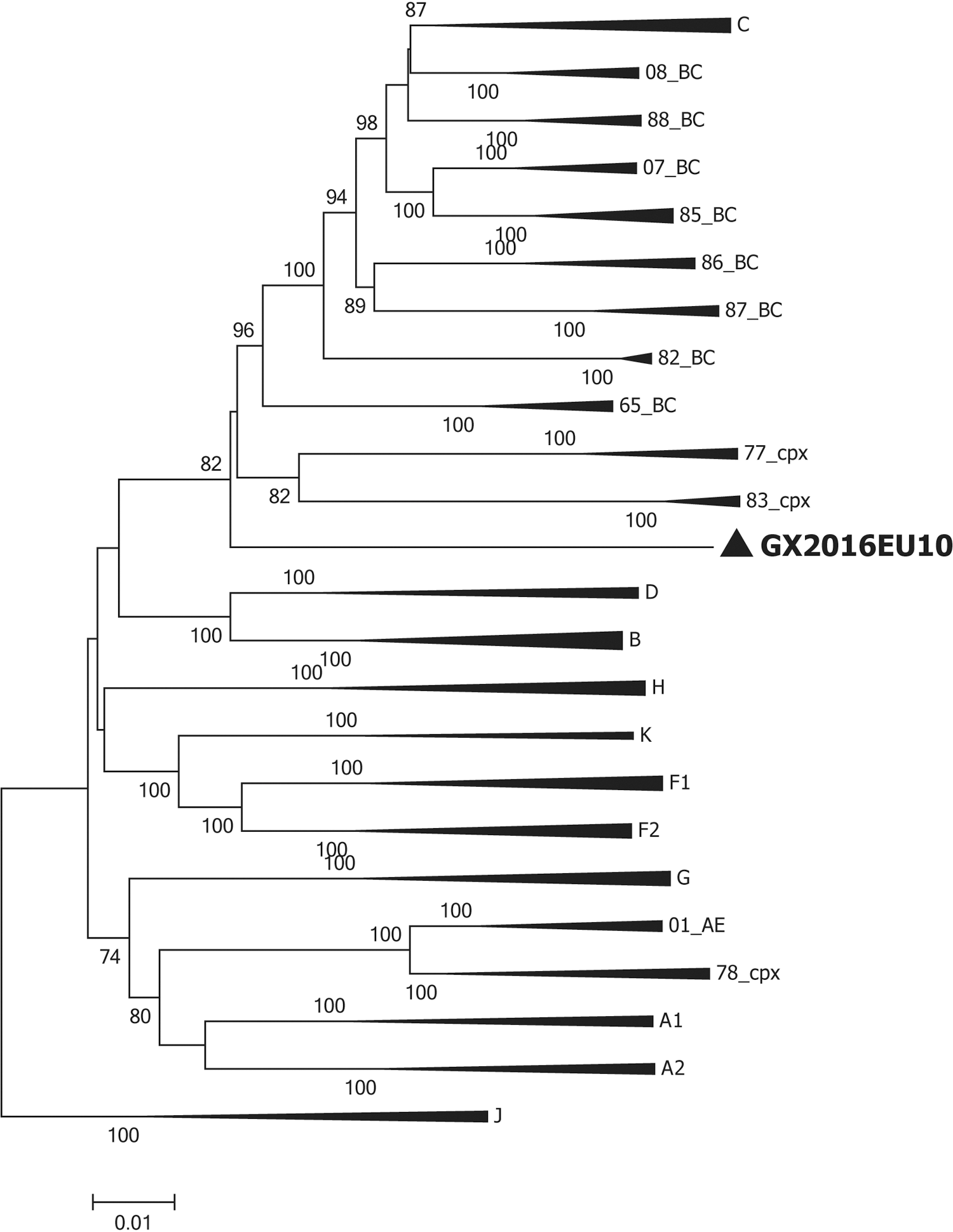
Phylogenetic tree analyses of the NFLG sequence of GX2016EU10. It was constructed with MEGA6 using the neighbor-joining method with the Kimura two-parameter model and 1,000 bootstrap replication test. A solid triangle marks GX2016EU10, which was displayed as a bold line throughout the article. Bootstrap values (>0.7) were shown at the corresponding nodes. NFLG, near full-length genome.
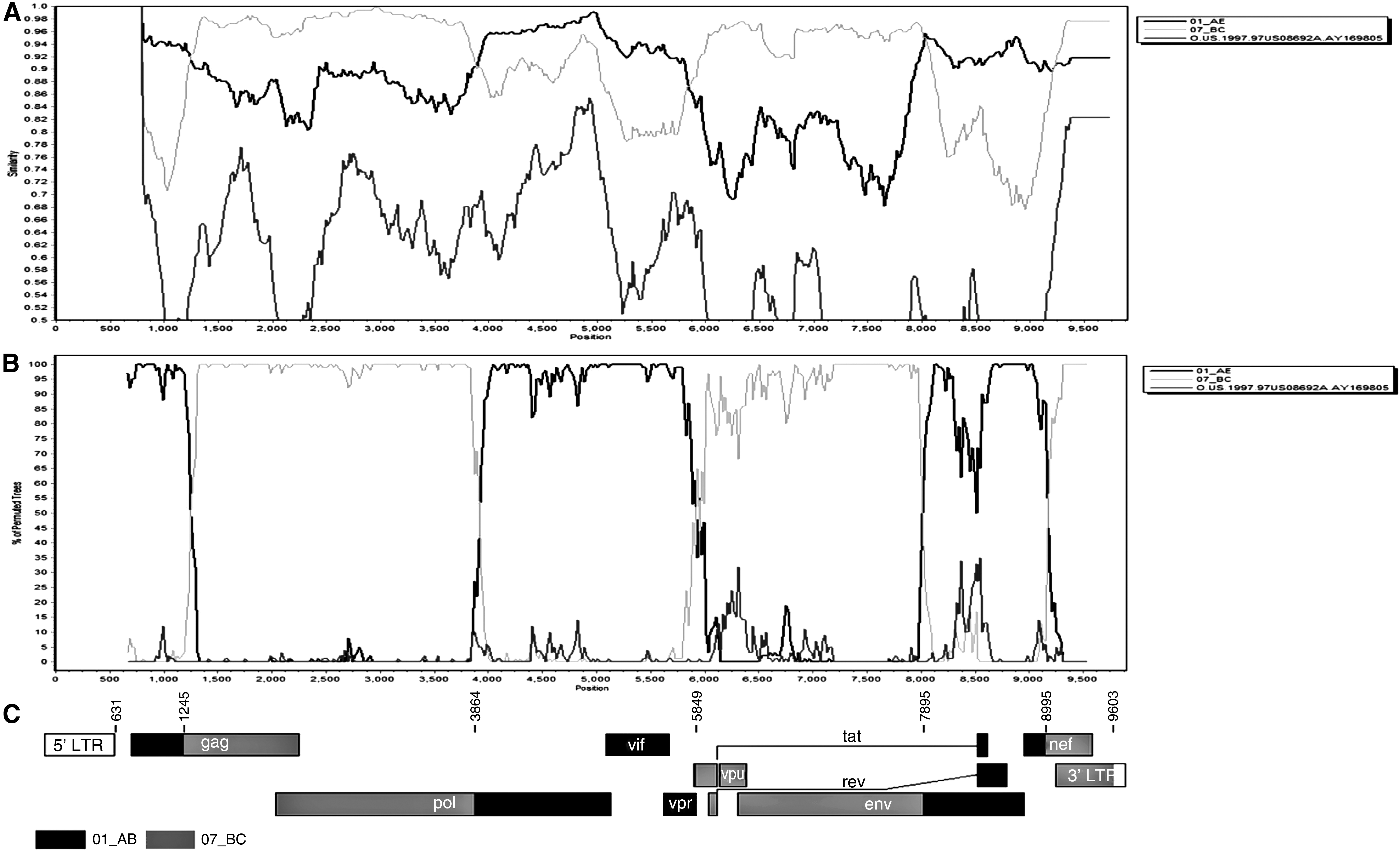
Bootscan plots and schematic representation of the GX2016EU10 near full-length genome's mosaic structure.

Subregion tree analysis of the novel identified GX2016EU10. Phylogenetic trees for six segments (I–VI) defined by bootscan plot analysis were constructed with MEGA6 using the neighbor-joining method with the Kimura two-parameter model and 1,000 bootstrap replication test. A solid circle marks each segment of the GX2016EU10, which was displayed as a bold line in each phylogenetic tree. The subtypes of all sequences were pointed on the right side of the trees. The scale bars were shown at the bottom of each tree. Bootstrap values (>0.7) were shown at the corresponding nodes. Figure 3 can be viewed in greater detail online.
The NFLG of GX2016EU10 kept the CRF07_BC parental backbone with three CRF01_AE segments inserted into gag, pol, vpu, env, and nef genes, respectively. The recombinant form of GX2016EU10 was similar to CRF79_0107, 7 whereas CRF79_0107 was three CRF07_BC segments inserted into the CRF01_AE backbone. Compared with CRF01_AE/CRF07_BC recombinant virus of GX2016EU09 among MSM in Guangxi, 8 GX2016EU10 has completely different recombination breakpoints on gag, pol, and env genes, respectively. The coreceptor use of HIV-1 is determined by the envelope glycoprotein, primarily in the V3 region. 9 According to previous studies, CRF07_BC CXCR4-tropic viruses were not found in nature. 10 In this study, GX2016EU10 was CCR5-tropic through GHOST cell identification. It was probably because V3 of env sequence of GX2016EU10 belonged to CRF07_BC.
The emergence of GX2016EU10 indicates that the HIV-1 epidemic among MSM in Guangxi is increasingly more complicated, and there is an urgent need to make plans to prevent and control it. Therefore, it is necessary to strengthen the HIV-1 molecular epidemiological investigation and identification and analysis of new recombinant strains. This will help us to better understand the different population spread of HIV-1, providing direct scientific evidence for the prevention and control of HIV-1.
Sequence Data
The NFLG sequence of GX2016EU10 has been submitted to GenBank with the accession no. MH377336.
Footnotes
Acknowledgments
This work was supported by the European Research Infrastructures for Poverty-Related Disease (grant no. 312661), National Natural Science Foundation of China (grant nos. 81561128006, 81261120384, and 81172733), and the Key Project of the State Key Laboratory of Infectious Diseases Prevention and Control (grant no. 2011SKLID102).
Author Disclosure Statement
No competing financial interests exist.