




Abstract
Manado, the capital city of North Sulawesi, is a unique region in Indonesia because of its religion. We collected peripheral blood samples from 63 individuals on antiretroviral therapy. The amplification of viral genomic fragments, viral subtyping, detection of HIV drug resistance-associated mutations (DRAMs), and phylogenetic analyses were performed. Viral subtyping revealed that the most prevalent HIV type 1 (HIV-1) subtype/circulating recombinant form (CRF) was CRF01_AE (84.1%), followed by subtype B (6.8%) and recombinants between CRF01_AE and CRF02_AG (4.5%). Although no major DRAMs were present in protease genes, they were detected in reverse transcriptase (RT) genes. Nine of 38 samples (23.7%) had major DRAMs against nucleoside RT inhibitors (NRTIs) and/or non-NRTIs. The results of phylogenetic analyses indicated that CRF01_AE in North Sulawesi is related to that in Bali. Therefore, Bali may play an important role in circulating CRF01_AE in North Sulawesi.
Introduction
HIV
Circulating recombinant form (CRF) 01_AE is one of the major CRFs of HIV-1 dominating the global epidemic and is prevalent throughout Southeast Asia. We previously reported that CRF01_AE was a dominant type of HIV-1 in Indonesia, whereas other subtypes and recombinants, including subtype B and the recombinant between CRF01_AE and subtype B have emerged in Indonesia. 2 –7
Indonesia has many islands, each of which has different cultures, religions, and ethnicities. Manado is the capital city of the North Sulawesi province. Although the major religion in Indonesia is Islam, it is Christianity in Manado. Thus, Manado is a unique region in Indonesia. Limited information is currently available on the genetic diversity of HIV-1 strains in HIV/AIDS patients in Manado.
In this study, we examined current HIV-1 genetic diversity and the appearance of mutations associated with viral resistance to protease (PR) inhibitors (PIs) and reverse transcriptase (RT) inhibitors in HIV-1-infected individuals living in Manado. We also investigated the molecular evolutionary dynamics of HIV-1 in Manado using phylogenetic analyses.
Sixty-three HIV-1-infected, antiretroviral therapy-experienced individuals were recruited in Manado. Ethical clearance was obtained from the Institutional Ethics Committees of Airlangga University (approval no.: 25–995/UN3.14/PPd/2013) and Kobe University Graduate School of Medicine (approval no.: 784). Informed consent and a questionnaire were provided to each participant for acceptance before their enrollment in this study. Sociodemographic, behavioral, and clinical data, including information on opportunistic infections, were retrospectively retrieved from medical records. The mean age of participants was 34.4 ± 8.28 years, whereas the gender distribution was 35 men (55.6%) and 28 women (44.4%) (Table 1). Regarding the ethnicity of participants, most individuals were Minahasa (68.3%). Minahasa is a local ethnic group in North Sulawesi. Fifty-seven participants (90.5%) were prescribed two types of nucleoside RT inhibitors (NRTIs) and one non-NRTI (NNRTI). Four participants (6.3%) were prescribed two types of NRTIs and a combination of protease inhibitors, lopinavir plus a booster dose of ritonavir (LPV/r). Twenty-eight participants (44.4%) were heterosexual. Eleven (17.5%) and six (9.5%) participants were homosexual and injecting drug users, respectively.
3TC, lamivudine; ART, antiretroviral therapy; AZT, zidovudine; EFV, efavirenz; LPV/r, lopinavir plus a booster dose of ritonavir; NVP, nevirapine; SD, standard deviation; TDF, tenofovir.
Ten milliliters of whole blood samples was collected from each individual. Peripheral blood mononuclear cells (PBMCs) were isolated using the BD Vacutainer CPT (Cell Preparation Tube) System (Becton, Dickinson and Company, Franklin Lakes, NJ). DNA was extracted from PBMC using the QIAamp DNA blood mini kit (Qiagen, Hilden, Germany). The HIV-1 pol gene encoding PR (PR gene) and RT (RT gene) and the gag and env genes were amplified by the Ex Taq (Takara, Shiga, Japan) or GoTaq green master mix (Promega, Madison, WI) and primer sets as follows. The PR gene was amplified by nested PCR with the primers DRPR05, 5′-AGACAGGYTAATTTTTTAGGGA-3′ corresponding to nucleotides (nt) 2074–2095 of the HIV-1 reference strain, HXB2 (GenBank accession no. K03455) and DRPR02L, 5′-TATGGATTTTCAGGCCCAATTTTTGA-3′ (nt 2691–2716) in the first round and DRPR01M, 5′-AGAGCCAACAGCCCCACCAG-3′ (nt 2148–2167) and DRPR06, 5′-ACTTTTGGGCCATCCATTCC-3′ (nt 2592–2611) in the second round. The RT gene was amplified by nested PCR with the primers RT1L, 5′-ATGATAGGGGGAATTGGAGGTTT-3′ (nt 2388–2410) and RT4L, 5′-TACTTCTGTTAGTGCTTTGGTTCC-3′ (nt 3402–3425) in the first round, and RT7L, 5′-GACCTACACCTGTCAACATAATTGG-3′ (nt 2485–2509) and RT6L, 5′-TAATCCCTGCATAAATCTGACTTGC-3′ (nt 3348–3372) in the second round. The viral gag gene was amplified by nested PCR with the primers H1G777, 5′-TCACCTAGAACTTTGAATGCATGGG-3′ (nt 1231–1255) and H1P202, 5′-CTAATACTGTATCATCTGCTCCTGT-3′ (nt 2328–2352) in the first round, and H1Gag1584, 5′-AAAGATGGATAATCCTGGG-3′ (nt 1577–1595) and G17, 5′-TCCACATTTCCAACAGCCCTTTTT-3′ (nt 2017–2040) in the second round. The viral env gene was amplified by nested PCR with the primers M5, 5′-CCAATTCCCATACATTATTGTGCCCCAGCTGG-3′ (nt 6858–6889) and M10, 5′-CCAATTGTCCCTCATATCTCCTCCTCCAGG-3′ (nt 7632–7661) in the first round, and M3, 5′-GTCAGCACAGTACAATGCACACATGG-3′ (nt 6948–6973) and M8, 5′-TCCTTGGATGGGAGGGGCATACATTGC-3′ (nt 7521–7547) in the second round. PCR conditions are available upon request. PCR products were electrophoresed on a 1% agarose gel and visualized under a UV light after staining with ethidium bromide. The PCR products amplified at the end-point dilution of DNA templates were subjected to a sequencing analysis to examine the genomic fragment of the major viral population in a sample. A sequencing analysis was performed using the BigDye Terminator v3.1 Cycle Sequencing kit and ABI PRISM3500xL genetic analyzer (Applied Biosystems, Foster City, CA). Sequencing data were then assembled and aligned using Genetyx version 10 software (Genetyx, Tokyo, Japan). The sequencing data of 33 PR genes [297 base pairs (bp); nt 2253–2549] the N terminus of 37 RT genes (762 bp; nt 2550–3311), the partial fragment of 38 gag genes encoding Gag p24 (381 bp; nt 1627–2007), and the partial fragment of 36 env genes encoding the gp120 C2–V3 region (390 bp; nt 7020–7409) were obtained from 63 peripheral blood samples. The nucleotide sequences of the PR, RT, gag, and env genes have been registered in the GenBank database under accession numbers MH727243–MH727275 (PR genes), MH727276–MH727312 (RT genes), MH727313–MH727350 (gag genes), and MH727351–MH727386 (env genes).
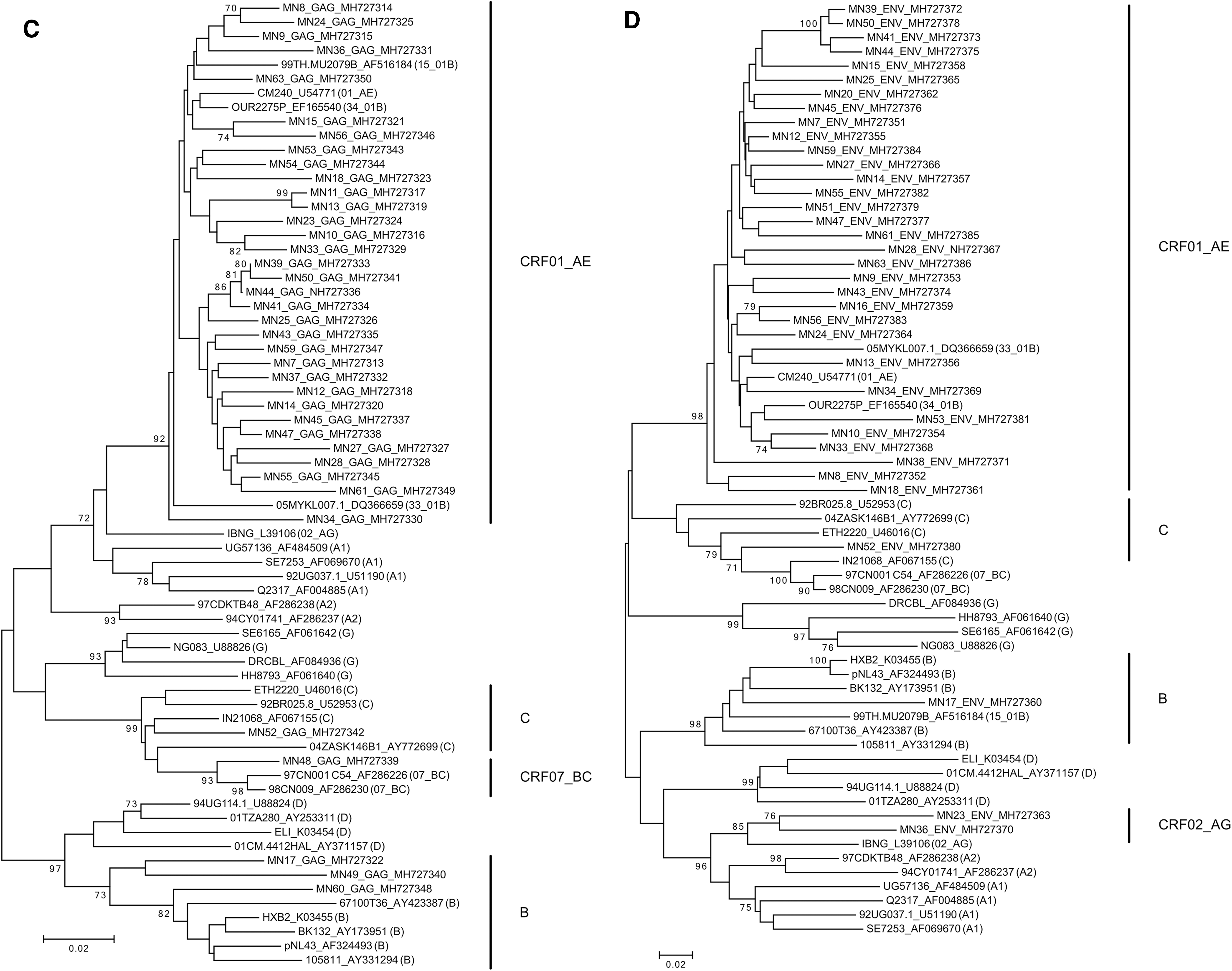
HIV-1 subtyping was performed using a phylogenetic tree analysis and recombinant identification program (RIP) available on the HIV sequence database website (
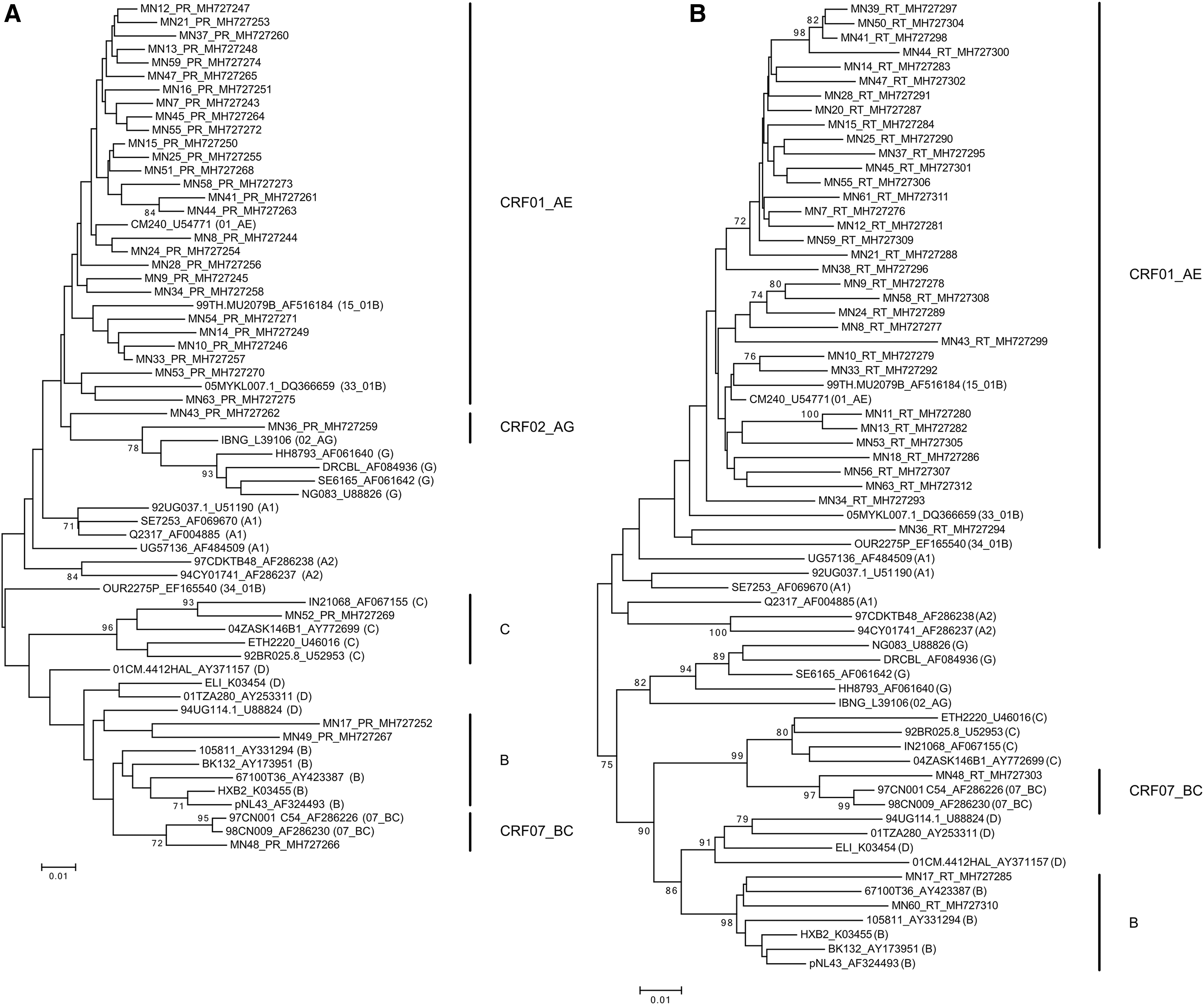
Phylogenetic tree analyses of HIV-1 PR, RT, gag, and env gene sequences collected in North Sulawesi, Indonesia. Phylogenetic trees were constructed for the HIV-1 PR
Major drug resistance-associated mutations (DRAMs) were searched for in PR and RT genes based on the Stanford University HIV Drug Resistance Database (
Mutations associated with drug resistance are shown according to the Stanford University HIV Drug Resistance Database.
NNRTI, nonnucleoside reverse transcriptase inhibitor; NRTI, nucleoside/nucleotide reverse transcriptase inhibitor.
Phylogenetic analyses were conducted to investigate the relationship of CRF01_AE between North Sulawesi and the rest of the world. We included HIV-1 CRF01_AE pol sequences (PR 1–99 and RT 1–250 amino acids) from our new samples collected in Manado. Twenty-five CRF01_AE sequences covering 1,054 bp (HXB2: 2253–3306) were included. All closely related publicly available CRF01_AE sequences were downloaded from the HIV sequence database of the Los Alamos National Laboratory (LANL,

Phylogenetic analyses of HIV-1 CRF01_AE in North Sulawesi. The phylogenetic tree was constructed using the approximately maximum likelihood method based on the pol region (HXB2: 2253–3306 nt) in PhyML
To reveal the potential source and transmission route of North Sulawesi CRF01_AE, Bayesian phylogeographic inferences were conducted using BEAST v.1.8.4. Closely related sequences from the same areas or sequences that have no information on collecting dates and regions were manually removed and African CRF01_AE sequences were included. The selected models were the GTR + relaxed clock (uncorrelated) with a constant size model. The Markov chain Monte Carlo analysis was performed for 100 million generations and sampled every 1,000 steps. The output was assessed for convergence by means of an effective sample size (ESS) after a 10% burn-in using Tracer. To minimize the effects of standard errors, only ESS >200 was included. Maximum clade credibility trees summarized the posterior distribution, and were generated with TreeAnnotator and visualized in FigTree v1.4.3. A posterior probability >0.9 was regarded as a cluster. North Sulawesi CRF01_AE strains were grouped into two distinct clusters (clusters 1 and 2) (Fig. 2b).The dates of the common ancestor of the African CRF01_AE, Thailand and Chinese CRF01_AE, CRF01_AE clusters 1, and CRF01_AE clusters 2 were estimated to be 1972.4 (95% credible region, 1960.6–1981.8), 1981.9 (1976.6–1986.3), 1997.4 (1993.9–2000.4), and 1999.6 (1994.2–2004.6), respectively (Fig. 2b). Estimations of the common ancestor of African CRF01_AE and Thailand and Chinese CRF01_AE were essentially similar to those reported previously. 11 The results of temporal and spatial dynamics analyses showed that the two clusters were both rooted within the Bali sequences. Although the introduced date from Bali to North Sulawesi was in the late 1990s, the two CRF01_AE clusters seemed to have been independently introduced into the North Sulawesi population. Cluster 1 contained additional CRF01_AE sequences from Malaysia, Thailand, China, and others. On the contrary, cluster 2 spread to Indonesia only. No significant differences in transmission risks (heterosexual/homosexual and injecting drug users) were identified between clusters 1 and 2. Cluster 1 strains seem to have high epidemic potential.
In conclusion, CRF01_AE viruses were the predominant HIV-1 strains in North Sulawesi, Indonesia. The predominance of CRF01_AE was consistent with that in other regions in Indonesia. In addition, subtype B, CRF07_BC, and recombinants between CRF01_AE and CRF02_AG were detected. A high prevalence of DRAMs against NRTIs and NNRTIs was also noted. The results of phylogenetic analyses indicated that CRF01_AE in North Sulawesi was related to that in Bali. Therefore, Bali may play an important role in circulating CRF01_AE in North Sulawesi. Further continuous surveillance studies are needed to identify the potential source and transmission route of Indonesian CRF01_AE and to develop effective treatments for HIV.
Footnotes
Acknowledgments
This work was supported in part by the program of the Japan Initiative for Global Research Network on Infectious Diseases (J-GRID) from the Ministry of Education, Culture, Sport, Science and Technology in Japan, and the Japan Agency for Medical Research and Development (AMED); and the Center of Excellence (COE) program of the Ministry of Research, Technology and Higher Education (RISTEKDIKTI) of Indonesia.
Sequence Data
Nucleoside sequences are available under GenBank accession numbers MH727243–MH727386.
Author Disclosure Statement
No competing financial interests exist.