




Abstract
HIV-1 CRF01_AE and CRF07_BC have been two mainly circulating HIV-1 strains in the men who have sex with men (MSM) population in Beijing for years. These two subtypes together were accounting for 78.1% of HIV-1 positive cases newly diagnosed in Beijing, 2016. In this study, we report a novel CRF01_AE/CRF07_BC second-generation unique recombinant form (URF) (named DT1427_NFLG) of HIV-1 identified in MSM population. The near full-length genome of DT1427_NFLG is about 8.8 kb with four CRF07_BC fragments inserted into the CRF01_AE backbone. In China, several novel second-generation URFs were reported in recent years and Beijing, as the capital of China, attracting a huge number of people all over the country to work and live, is confronted with the risk of the epidemic of recombinant HIV-1 strains. Therefore, it is necessary to take measures to monitor the emergency of novel recombinant of HIV-1.
The high genetic diversity of HIV-1 is one of the major obstacles to the prevention and control of the HIV epidemic for its error-prone replication and recombination. To date, 96 circulating recombinant forms (CRFs) and numerous unique recombinant forms (URFs) have been reported. 1 In China, CRF01_AE and CRF07_BC are two mainly circulating strains in the epidemic of HIV-1. 2 CRF01_AE is reported as the main subtype in the epidemic of HIV in recently infected men who have sex with men (MSM) population in China. 3 The CRF07_BC subtype was first found in intravenous drug users in China, 4 and then spread from intravenous drug users to the whole population through commercial sex workers. 2
Beijing has reported 17,476 people living with HIV at the end of October 2017 and seroprevalence in the Beijing population overall was ∼0.08%, which revealed a low-level prevalence of the HIV epidemic in Beijing. 5 However, high-level prevalence of HIV has been reported among MSM population in recent years. 6 It has been reported as high as 7% among Beijing MSM population in 2015. 7 In 2016, a total of 10 subtypes and 33 cases (4.6%) of URFs were detected in Beijing. Among them, CRF01_AE and CRF07_BC caused 49.3% and 28.8% of HIV-1 positive cases, respectively. 8 The co-circulating of CRF01_AE and CRF07_BC in Beijing may predict the generation of new recombination of HIV-1.
In this study, we separated a recombinant strain of HIV-1 (DT1423) from a 30-year-old man, who was infected through homosexual contacts in Beijing, China. The patient was diagnosed as HIV-1 positive in 2015 and the vein blood sample was collected before he accepted free antiretroviral therapy (ART) in Di Tan Hospital, Capital Medical University (CMU) in 2015. Participants' demographic data were obtained as a result of a face-to-face interview using a standard questionnaire. Ethical approval was issued by the local ethics committee at Beijing Center for Disease Control and Prevention. Blood sample with K2 EDTA was separated by centrifugation immediately, aliquoted, and then stored at −80°C. Near full-length genome (NFLG) amplification and sequencing were carried out as previously reported. 9
The length of DT1427_NFLG was 8,835 bp (from 780 to 9,588 according to the HXB2 genome). The sequence was aligned by using BioEdit with sequences of various HIV-1 reference subtypes (A–D, F–H, J, and K) and CRFs (CRF01_AE and CRF07_BC) obtained from the Los Alamos HIV Database
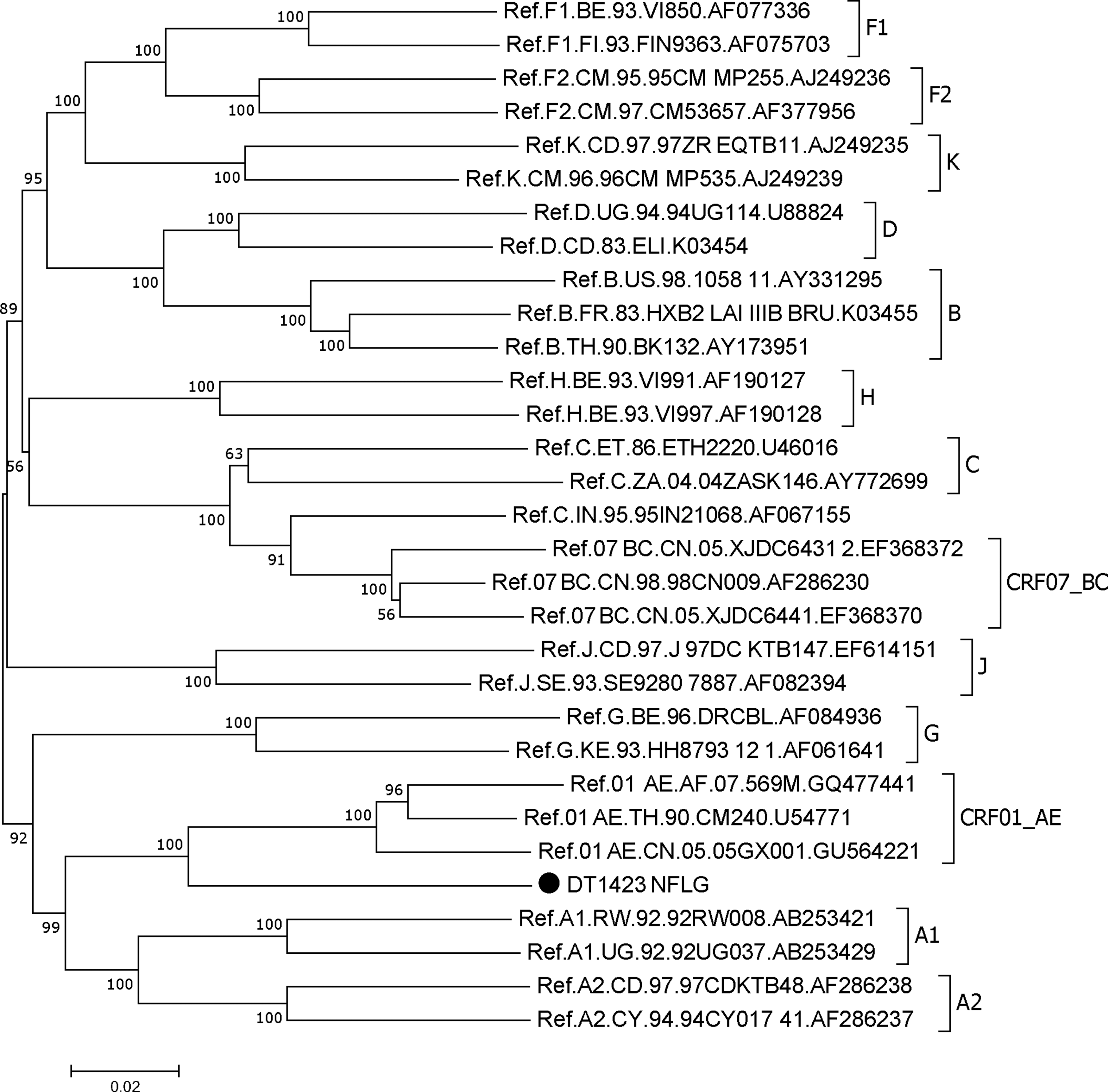
Phylogenetic analysis of DT1423_NFLG. The N–J tree was constructed with 1,000 bootstrap replicates using MEGA(V7.0.21). The reference gene sequences of subtypes A–D, F–H, J, K, CRF01_AE, and CRF07_BC were downloaded from the HIV database. Black dot denotes DT1423_NFLG. The scale length indicates 2% nucleotide sequence divergence. Bootstrap values (>0.7) are shown at the corresponding nodes. N–J, neighbor-joining.
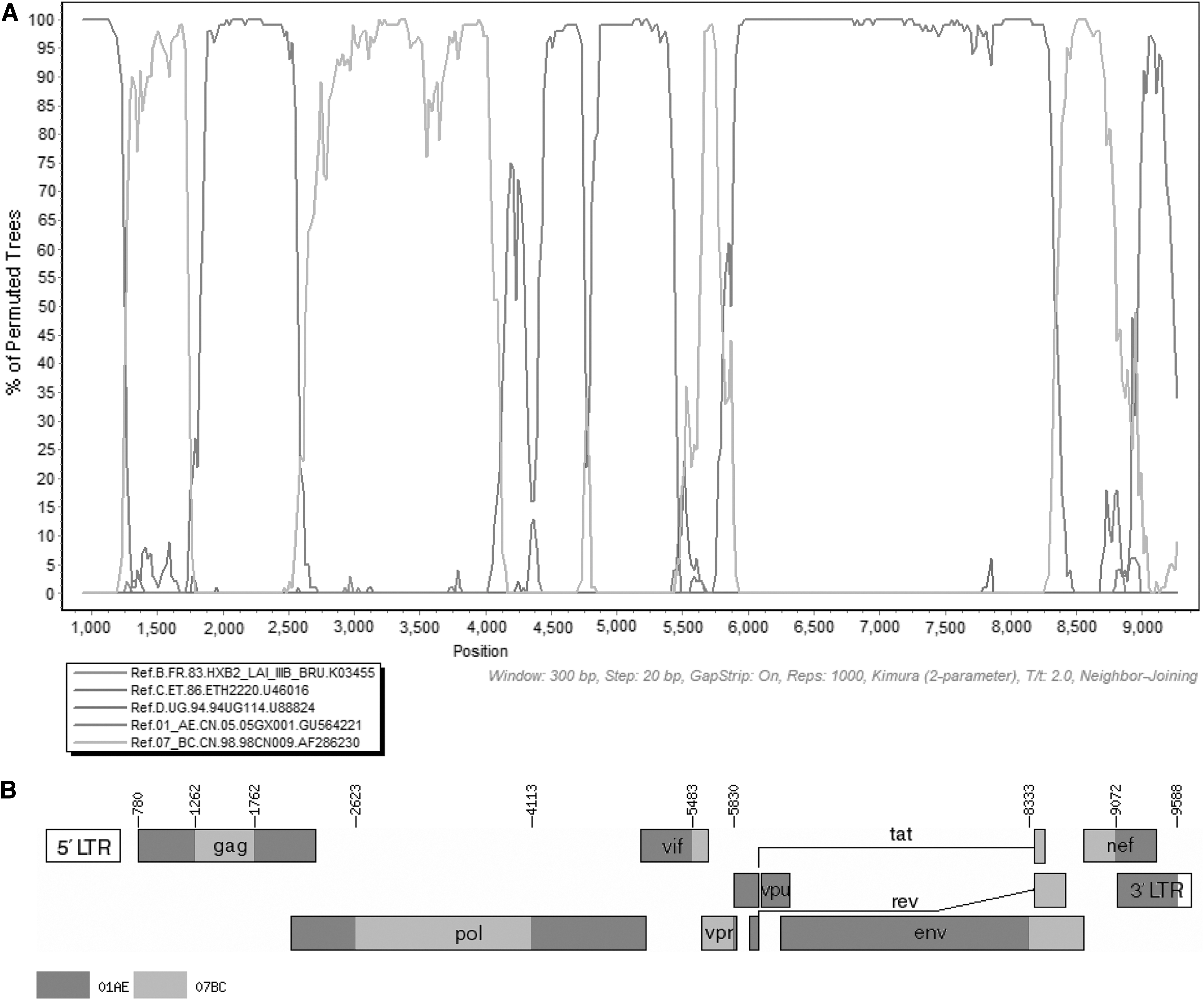
Bootscan analysis and genetic map of DT1423_NFLG.

Subgenomic phylogenetic analysis of DT1423_NFLG. Regions of sequence alignment were extracted according to the recombinant breakpoints shown in Figure 2B and used methods described in Figure 1. Regional fragments of DT1423_NFLG are labeled with a black dot. Bootstrap values (>0.7) are shown at the corresponding nodes. The scale length indicates 2% nucleotide sequence divergence. Fragment I: CRF01_AE (HXB2 780–1,261 nt); Fragment II: CRF07_BC(HXB2 1,262–1,761 nt); Fragment III: CRF01_AE (HXB2 1,762–2,622 nt); Fragment IV: CRF07_BC (HXB2 2,623–4,112 nt); Fragment V: CRF01_AE (HXB2 4,113–5,482 nt); Fragment VI: CRF07_BC (HXB2 5,483–5,829 nt); Fragment VII: CRF01_AE (HXB2 5,830–8,432 nt); Fragment VIII: CRF07_BC (HXB2 8,433–9,071 nt); Fragment IX: CRF01_AE (HXB2 9,072–9,588 nt). Figure 3 can be viewed in greater detail online.
Since 2015, five cases of CRF01_AE/CRF07_BC-related second-generation recombinant forms have been reported in Beijing. The genome of BJMP3002B, 12 BJMP3026B, 12 and YA1996 9 were constructed with several CRF07_BC fragments inserted into the skeleton of CRF01_AE. BJ2015EU16 13 and BJ2015EU19 14 were reported as URFs in which CRF01_AE fragments were inserted into the CRF07_BC parental backbone. In this study, we reported a novel URF derived from DT1423 that exhibits nine breakpoints with four CRF07_BC fragments inserted into the backbone of CRF01_AE. The fact that six strains of URFs that have different forms of recombination and breakpoints were reported in the recent 4 years may reflect a complex situation of the epidemic of novel recombination of HIV-1 being confronted with Beijing.
Sequence Data
Sequence has been deposited in GenBank under accession number MH715978.
Footnotes
Acknowledgments
We appreciate the doctors and nurses in Di Tan hospital for their admirable treatment and patient care. This study is funded by Beijing Science and Technology Planning Project of Beijing Science and Technology Commission (D161100000416002).
Authors' Contributions
The study was conceived and designed by H.L. and R.X. M.H. carried out the study, analyzed the experimental data, and wrote the article. J.W. and S.H. contributed to the acquisition of epidemiological data. Y.H. and J.Y. edited and assembled sequences. All the authors have read and approved the final article.
Author Disclosure Statement
No competing financial interests exist.