




Abstract
HIV-2 is important due to its unique challenges in diagnosis, treatment, and drug resistance. The data on Indian HIV-2 pol gene as well as resistance to antiretroviral drugs are limited. Here we report sequence data of protease (PR) and reverse transcriptase (RT) genes from HIV-2 infected treatment naive individuals (N = 32) from Maharashtra, India. These sequences were found to be closely related to HIV-2 subtype A sequences from Guinea Bissau. We observed two unique residues at positions 14 and 70 in the PR region specific to Indian HIV-2. Mutations associated with resistance to RT and protease inhibitors were observed in 3 of 32 (9.37%) samples. To our knowledge, this is the first study from India to report drug resistance among treatment naive HIV-2 infected individuals. The results emphasize need for larger nationwide surveillance for HIV-2 drug resistance to better understand the primary drug resistance among HIV-2 infected individuals.
Infection with HIV-2 is associated with slower disease progression, low plasma viral loads, and little or no signs or symptoms. Although epicenter of HIV-2 epidemic is believed to be in West Africa, over the years it has spread to other parts of Africa, Europe, United States, as well as India. In India, the prevalence of HIV-2 ranges between 0.29% and 0.8% 1 –3 of about 2.1 million HIV infected individuals with estimated 11,500 HIV-2 infections. 4 Antiretroviral therapy (ART) differs for HIV-2 infection as the virus possesses natural resistance to non-nucleoside reverse transcriptase inhibitors (NNRTIs). 5 Most studies on drug resistance are focused mainly on HIV-1 while limited information exists with regard to HIV-2 due to its low prevalence. Hence, it is difficult to monitor the effectiveness of treatment in HIV-2 infected individuals.
The Indian ART guidelines for HIV-2 include two nucleoside reverse transcriptase inhibitors (NRTIs), tenofovir (TDF) and lamivudine (3TC), along with protease inhibitors (PIs), lopinavir boosted ritonavir (LPV/r) in first line, and raltegravir (RAL) with boosted darunavir (DRV) in second line. These limited treatment options make it imperative to know the drug resistance before initiating the ART. Use of PIs and NRTIs makes it important to study the pol gene of HIV-2. Understanding the drug resistance in treatment naive individuals serves important criteria to be considered while determining the treatment policies. Data on the primary drug resistance in HIV-2 infected individuals are not available from India. Hence, in this study, we assessed the presence of drug resistance to NRTIs and PIs in ART naive HIV-2 infected individuals through sequencing the pol gene of HIV-2. The sequence analysis of pol gene showed presence of two unique residues in the protease gene that are specific for Indian HIV-2 viruses. Furthermore, the phylogenetic analysis of all samples confirmed that they belong to HIV-2 subtype A.
The study was carried out on frozen whole blood specimens (in ethylenediaminetetraacetic acid [EDTA]) collected (during January 2014 to August 2014) after obtaining the written informed consent from 32 individuals who were diagnosed with HIV-2 infection in the regional Integrated Counseling and Testing Centers from 13 districts of Maharashtra state. HIV-2 infection was confirmed by Western blot (NEW LAV BLOT II; BioRad, France). The ethics committee of National AIDS Research Institute, Pune, approved the study and use of stored samples. All study participants were ART naive adults with median age of 47 years (range 18–66 years) including 23 males and 9 females.
Total nucleic acids were extracted from 300 μL whole blood using automated NucliSENS® easyMAG (BioMérieux, France) platform. The pol gene was amplified by nested reverse transcription polymerase chain reaction and sequenced using primers and protocol described previously
6
with slight modifications. The primers used for amplification of pol gene covered 801 nucleotides spanning complete PR gene of 99 amino acids and partial RT gene of 168 amino acids. The details of primers and thermal cycling conditions are given in Table 1. Amplified products were sequenced by Sanger sequencing using BigDye Terminator Cycle Sequencing Ready Reaction kit (Applied Biosystem, CA). Sequences were compiled using SeqScape v2.7. The phylogenetic analysis of 32 sequences performed with 57 previously reported sequences in Los Alamos HIV database (
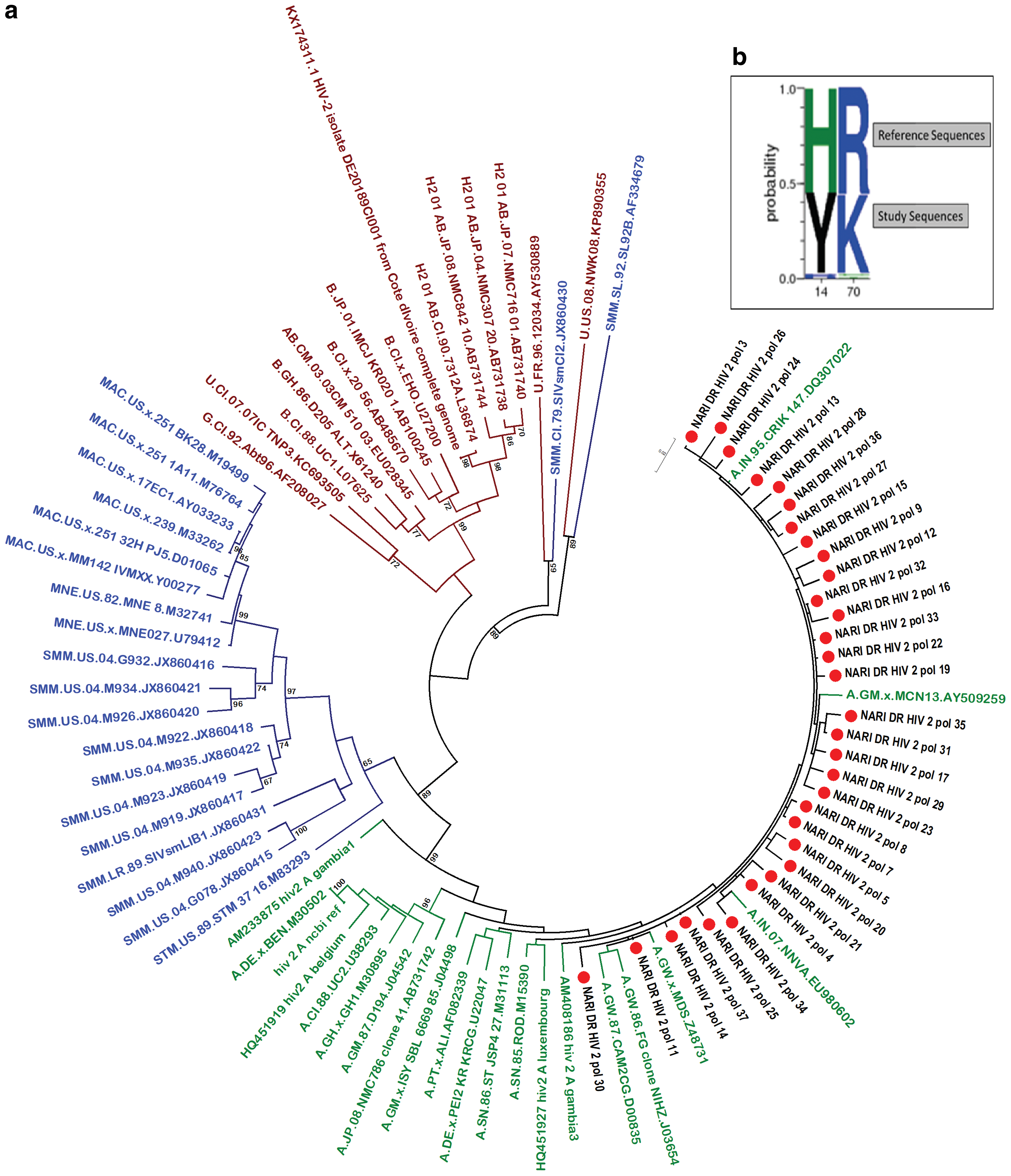
Phylogenetic relationship between HIV-2 isolates and signature amino acids.
Details of Primers and Thermal Cycling Conditions for Amplification and Sequencing
PCR, polymerase chain reaction.
The Viral Epidemiology Signature Pattern Analysis
11
of 32 study sequences against 87 HIV-2 subtype A sequences spanning pol region 2638–3650 (BEN coordinates; HIV-2 isolate [accession no: M30502]) from various countries excluding India (
Drug resistance mutations conferring resistance to PIs and NRTIs were analyzed using earlier reported online tool “HIV-2EU” (
Drug Resistance Mutations Associated with Protease Inhibitors and Nucleoside Reverse Transcriptase Inhibitors Resistance
3TC, lamivudine; ABC, abacavir; ATV, atazanavir; ATV/r, atazanavir boosted ritonavir; AZT, ziduvudine; D4T, stavudine; DDI, didanosine; FTC, emticitabine; IDV, indinavir; LPV/r, lopinavir boosted ritonavir; NRTIs, nucleoside reverse transcriptase inhibitors; PI, protease inhibitor; TDF/TAF, tenofovir alafenamide.
Information on ART drug resistance is crucial to achieve the primary goals to contain the spread of the virus. However, to our knowledge, no information on pretreatment drug resistance in HIV-2 infected individuals is available from India. The pretreatment drug resistance of 9.37% is slightly closer to the expected prevalence (10%) among the ART initiators. 16 Hence, findings from this study highlight the need for country-wide drug resistance analysis on larger number of samples to get a clear idea about HIV-2 drug resistance in the country, which will help the policy makers for deciding ART guidelines for HIV-2 infected individuals.
Sequence Data
The 32 pol sequences have been submitted to GenBank with accession numbers MG460633 to MG460664.
Footnotes
Acknowledgments
We thank all the study participants and the staff at the centers for providing us the samples and demographic information.
Author Disclosure Statement
No competing financial interests exist.