




Abstract
HIV perturbs the functionality of B cells resulting in defective humoral responses. As efficient humoral immune responses are important in controlling HIV-disease progression, we characterized the memory B cell population for its subsets and their activation (CD38 expression) and functional [interleukin (IL)-21R expression] profile in individuals with nonprogressive [long-term nonprogressors (LTNPs), N = 16] and progressive HIV disease (progressors, N = 16) along with 10 HIV uninfected healthy controls (HCs). The frequencies of total memory B cells were similar in HCs and HIV-infected individuals, whereas the frequencies of unswitched memory B (UMB) cells and CD38+ UMB cells were significantly higher in progressors than LTNPs and HCs (p < .03). LTNPs showed higher frequencies of class-switched memory B (SMB) cells and IL-21R expressing SMB cells than seen in progressors (p = .019), which were similar to that seen in HCs. The %UMB cells correlated inversely (p = .0002, r = −0.6053) and %SMB cells correlated positively (p = .0005, r = 0.5804) with CD4 count. IL-21/IL-21R interaction is required for class switching of B cells and differentiation into antibody-secreting plasma cells. The higher expression of IL-21R on class SMB cells from LTNPs might be resulting in efficient plasma cell differentiation and the functional humoral immune response that might be responsible for mounting efficient antibody response against the encountered infections. The more insights in this area might be required to further understand the role of IL-21R expressing class SMB cells in HIV infection.
Development of long-term effective humoral immunity is considered to be a major goal of protective and therapeutic vaccination in HIV infection. However HIV is known to perturb the functionality of B cell. It disrupts the B cell differentiation at all phases from immature B cells 1 to plasma cells 2 and is also responsible for reduced survival of B cells. 3,4 Compromised B cell responses to in vivo influenza vaccination have been observed in chronic HIV infection. 5 The memory B cells responding to the previously encountered antigen that show class switch and somatic mutation from immunoglobulin M (IgM) and IgD to other immunoglobulin classes IgG, IgA, or IgE are called switched memory B (SMB) cells, 6 whereas the memory B cells without mutation are referred as “unswitched memory B (UMB) cells.” 7 The SMB cells have been shown to be reduced in HIV infection. 8 –10 HIV-1 hampers the class switch recombination process leading to impairment in the generation of effective immune responses. 11 In addition, the expression of interleukin (IL)-21 receptors on memory B cells is shown to play an important role in the generation of efficient antibody responses. 12,13 IL-21 secreted by CD4+ T follicular cells is taken up by memory B cells through their IL-21 receptors resulting in class switching and differentiation into antibody producing plasma cells. 14 –16 IL-21-expressing Env-specific CXCR5+ CD4+ T cells were found to be associated with gp120-specific B cell memory subsets in HIV controllers. 17
We have previously reported that nonprogressive HIV infection showed presence of sound memory T cell compartment 18 ; however, very limited data are available on the memory B cell compartment in these individuals. We hypothesized that the memory B cells from individuals with nonprogressive HIV infection show efficient class switching, less activation, and optimum IL-21 receptor expression.
To test this hypothesis, using HIV-1-infected long-term nonprogressors (LTNPs) as a model of nonprogressive disease, we measured the frequencies of peripheral memory B cells and its subsets in these individuals and compared them with the frequencies observed in chronic progressors. The activation profile was assessed by CD38 expression 19 and the frequencies of IL-21 receptor expressing memory B cells and its subset were also assessed.
Sixteen (7 men/9 women) LTNPs (profile described previously 18 ) were enrolled from the ongoing LTNPs cohort and 16 (6 men/10 women) progressors (HIV-infected patients with CD4 count ≤500 cells/mm3 and not fulfilling the criteria for LTNPs) and 10 (2 men/8 women) age-matched HIV seronegative individuals were enrolled from the outpatient clinics of the Institute. The median age was 35 years for both LTNPs and progressors. The study was approved by the institutional ethical review board and the study participants provided written informed consent at enrollment.
The frozen peripheral blood mononuclear cells (PBMCs) from the study participants were revived as described previously 20 and rested overnight. The viability of the cells was assessed using trypan blue dye exclusion method. The samples showing >90% viability and >3 × 10⁶ live cells were considered for further analysis. 1 × 10⁶ PBMCs were surface stained with the antibodies anti-CD3 PerCP, anti-CD19 FITC, anti-CD27 PE, anti-CD38 PE/Dazzle, anti-IgD PECy7, anti-IL-21R APC (all from Biolegend, San Diego, CA) for 30 min at room temperature in the dark. Cells were then washed with 1 × phosphate-buffered saline, fixed with 3% paraformaldehyde, acquired on FACSAria-I (BD Biosciences, San Jose, CA), and analyzed using FlowJo software (version 7.6.5). Compensation parameters were set using single stained controls and fluorescence minus one controls were used to set gates. The gating strategy used to identify different memory B cell populations is given in Supplementary Figure 1A.
The total memory B (TMB) cells were identified as CD3−CD19
The frequencies of CD3−CD19+CD27+ TMB cells were similar in healthy controls (HCs), LTNPs, and progressors (p > .05) (Fig. 1A, left panel) and not associated with the CD4 counts (p = .5291, r = 0.1155). The LTNPs showed significantly higher frequencies of switched (p = .019) and lower frequencies of UMB cells (p = .0365) compared with progressors with similar frequencies in HCs (p > .6) (Fig. 1A middle and right panel). The CD4 counts were positively associated with the percentages of SMB cells (p = .0005, r = 0.5804) and negatively with UMB cells (p = .0002, r = −0.6053; Fig. 1B).
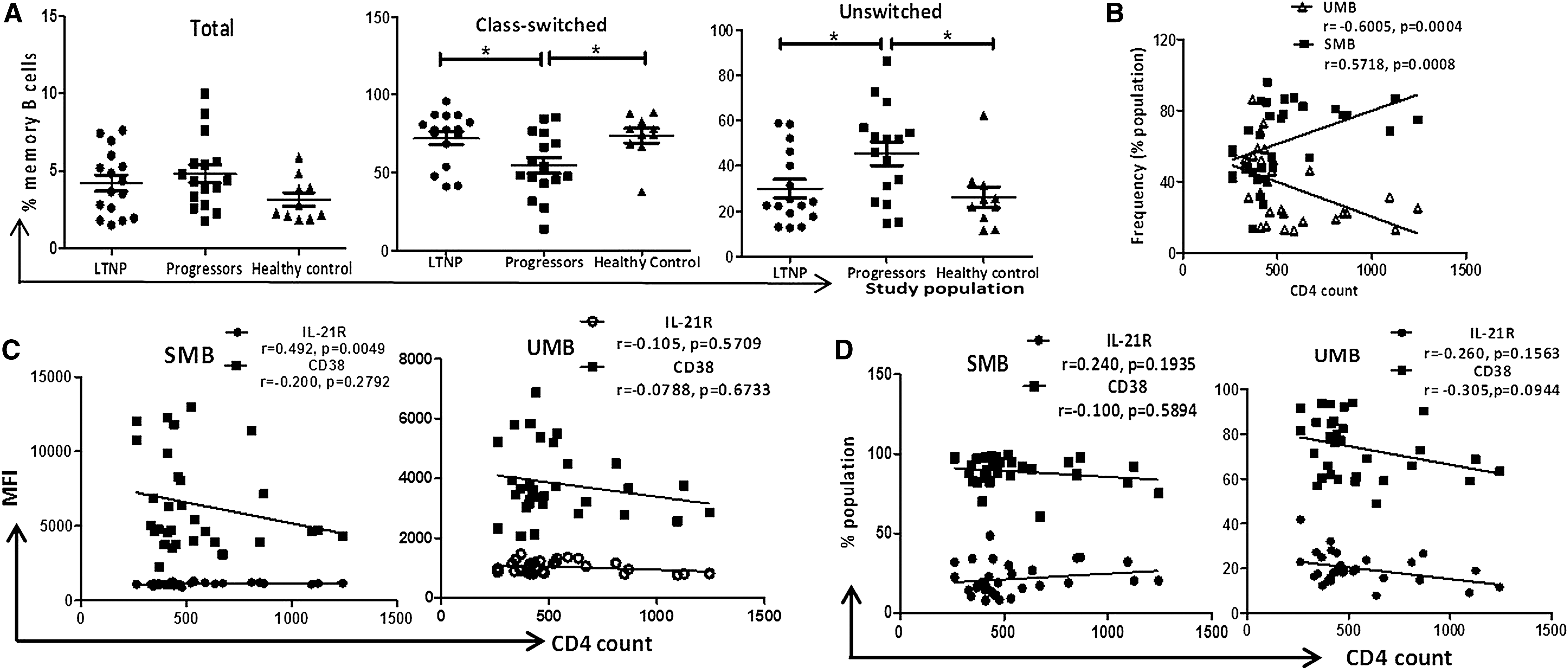
Assessment of memory B cell subsets in individuals with progressive and nonprogressive HIV infection.
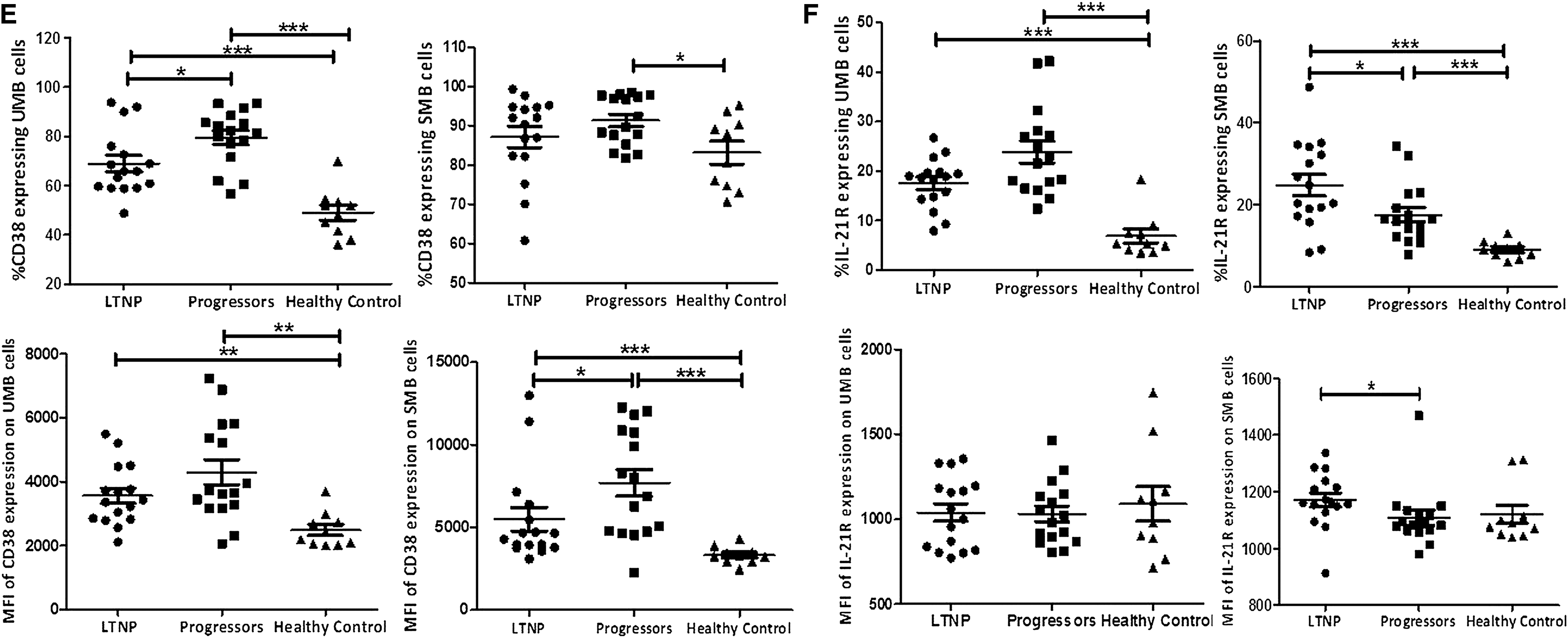
The percentages of CD38+UMB cells were significantly higher in progressors than in LTNPs (p = .0365) and HCs (p ≤ .0001), although the frequencies of CD38+ SMB cells were similar in LTNPs and progressors (p = .2743) (Fig. 1E, left and right panel). The MFI indicates the density of the receptor on the cell surface. The MFI of CD38 on UMB cells was similar between LTNPs and progressors but was significantly higher than HCs (p = .1809) (Fig. 1E, left panel), whereas it was higher on SMB cells from progressors than those from LTNPs (p = .0226), although both LTNPs and progressors showed higher CD38 expression on SMB cells compared with the HCs (p < .001) (Fig. 1E, right panel). The frequency and MFI of CD38 expression on switched and UMB cells did not correlate with CD4 count (Fig. 1C, D).
The percentages of IL-21R expressing UMB cells were significantly higher in LTNPs and progressors than HCs (p < .0001) with similar frequencies in LTNPs and progressors. The MFI of IL-21R was also similar in LTNPs (p = .0734) and progressors (p = .9549) (Fig. 1F, left panel). We found significantly higher frequencies of the IL-21R expressing SMB cells in LTNPs than progressors (p = .0302) and HCs (p = .0003). The MFI of IL-21R was also higher in LTNPs than progressors (p = .0042) and HCs (close to significance: p = .057) (Fig. 1F, right panel). The MFI of IL-21R expression on SMB cells correlated positively with the CD4 count (p = .0049, r = 0.4922) (Fig. 1C, left panel); however, the frequency and also MFI of IL-21R expression on UMB cells did not show any association with the CD4 count (Fig. 1C, D, right panel).
Studies to assess the correlates of effective immune response in HIV infection are of utmost importance to develop strategies for immune protection and therapies. Considering the importance of efficient humoral response in control of HIV and other infections, we assessed the frequency and functionality of memory B cell subpopulations in progressive and nonprogressive HIV infection. In line with the findings of D'Orsogna et al., 8 the observation of higher frequencies of class SMB cells in LTNPs from our cohort and their association with higher CD4 counts indicate the well-maintained memory B cells class-switching process that is probably responsible for generation of efficient antibody response against encountered infections in LTNPs. The lower frequencies of SMB cells in progressors might be an indication of impaired antibody production seen in disease progression as described previously. 8 Our observation of higher frequencies of activated (CD38+) UMBs in progressors is in accordance with our previous observation of higher CD38 expressing memory CD4 and CD8 cells in progressors compared with those seen in LTNPs. 18
IL-21 plays a major role in B-cell homeostasis 12 and is an essential factor for class-switch recombination and differentiation of human B cells into antibody-secreting plasma cells. 12,13 Hence, the higher expression of IL-21R on class SMB cells from LTNPs in this study might have rendered them more receptive to IL-21 leading to efficient plasma cell differentiation and functional antibody response supporting our previous finding of potent anti-HIV and anti-influenza Antibody Dependent Cellular Cytotoxicity responses in LTNPs. 21,22 The correlation between the MFI of IL-21R expression on SMB cells and CD4 counts further supports our hypothesis that the IL-21R expressing SMBs might play a role in controlling disease progression in HIV infection. Although causal relationship could not be assessed in this study, it might be possible that the sustained CD4 cells would provide sound immune environment providing the required help to B cells to produce efficient antibody response. Recent studies have shown that IL-21 secreting follicular CD4+ T helper cells provide crucial support to antigen-specific memory B cells to generate potent antibodies and pool of long-lived memory B cells. 15 So, it would be interesting to assess the IL21 secretion ability of follicular T helper cells in Indian LTNPs. In addition, the future insights into the understanding of IL-21/IL-21R pathway and associated gene and protein expression in memory B cell compartment in LTNPs might be beneficial for manipulation of humoral immune responses while designing strategies for vaccine development as suggested by Konforte et al. 12 Overall these findings indicate sustenance of sound immune system in nonprogressive HIV infection that might be useful in maintaining efficient defense against various infections.
To conclude, our findings suggest that presence of high IL-21R expressing class SMB cells in LTNPs might result in efficient plasma cell differentiation and thus the functional humoral immune response against the encountered infections. The more insights in this area would be required to further understand the role these IL-21R expressing class SMB cells in HIV infection.
Footnotes
Acknowledgments
The authors thank staff of immunology laboratory for their help. The authors also thank the staff of clinic for their assistance in sample collection and also the study participants for their time and participation in this study.
Author Disclosure Statement
No competing financial interests exist.
Supplementary Material
Supplementary Figure S1
References
Supplementary Material
Please find the following supplemental material available below.
For Open Access articles published under a Creative Commons License, all supplemental material carries the same license as the article it is associated with.
For non-Open Access articles published, all supplemental material carries a non-exclusive license, and permission requests for re-use of supplemental material or any part of supplemental material shall be sent directly to the copyright owner as specified in the copyright notice associated with the article.
