




Abstract
Jiangsu province has severe HIV-1 epidemic in China. Suqian which is located in north of the province has limited HIV epidemic information. Therefore, this study aimed to characterize the epidemic details in the area. A total of 196 plasma samples were collected from treated HIV-1-positive cases and viral RNA was extracted. Then HIV partial pol genes (nucleotide 2147-3462 by using HXB2 as calibrator) were amplified and sequenced. Finally, 84 partial pol genes were successfully obtained. The subtyping results indicate that multiple HIV-1 subtypes are circulating in Suqian district. Thereinto, CRF01_AE has been the dominant stains here and belonged to multiple lineages of CRF01_AE identified in China previously. Moreover, there is a high level of HIV drug resistance. All these results suggest HIV-1 epidemic in Suqian is rather complex and more measures must be performed for prevention and intervention in the area.
HIV-1
After 2007, sexual transmission became the primary route of transmission and HIV-1 infections through this route have increased dramatically. 4,5 Among the 134,512 newly reported HIV-1-positive cases in 2017, 69.4% belonged to heterosexual and 25.3% to homosexual transmission, 6 indicating that HIV-1 has spread out of initial high-risk population into general population in China. Thus, the HIV epidemic poses greater challenges than ever before. By the end of 2017 in China, there were ∼758,610 people living with HIV-1, with an estimated 321,233 cases of AIDS. 7
Suqian city is located in north of Jiangsu province (Fig. 1), which is a typical labor-import province and attracts lots of floating populations and has severe HIV-1 epidemic in China. 8 The permanent population of the city is 4.9 million. However, the molecular epidemiological characteristics in the district are very limited. 8 In this study, the epidemic details in the area are characterized.
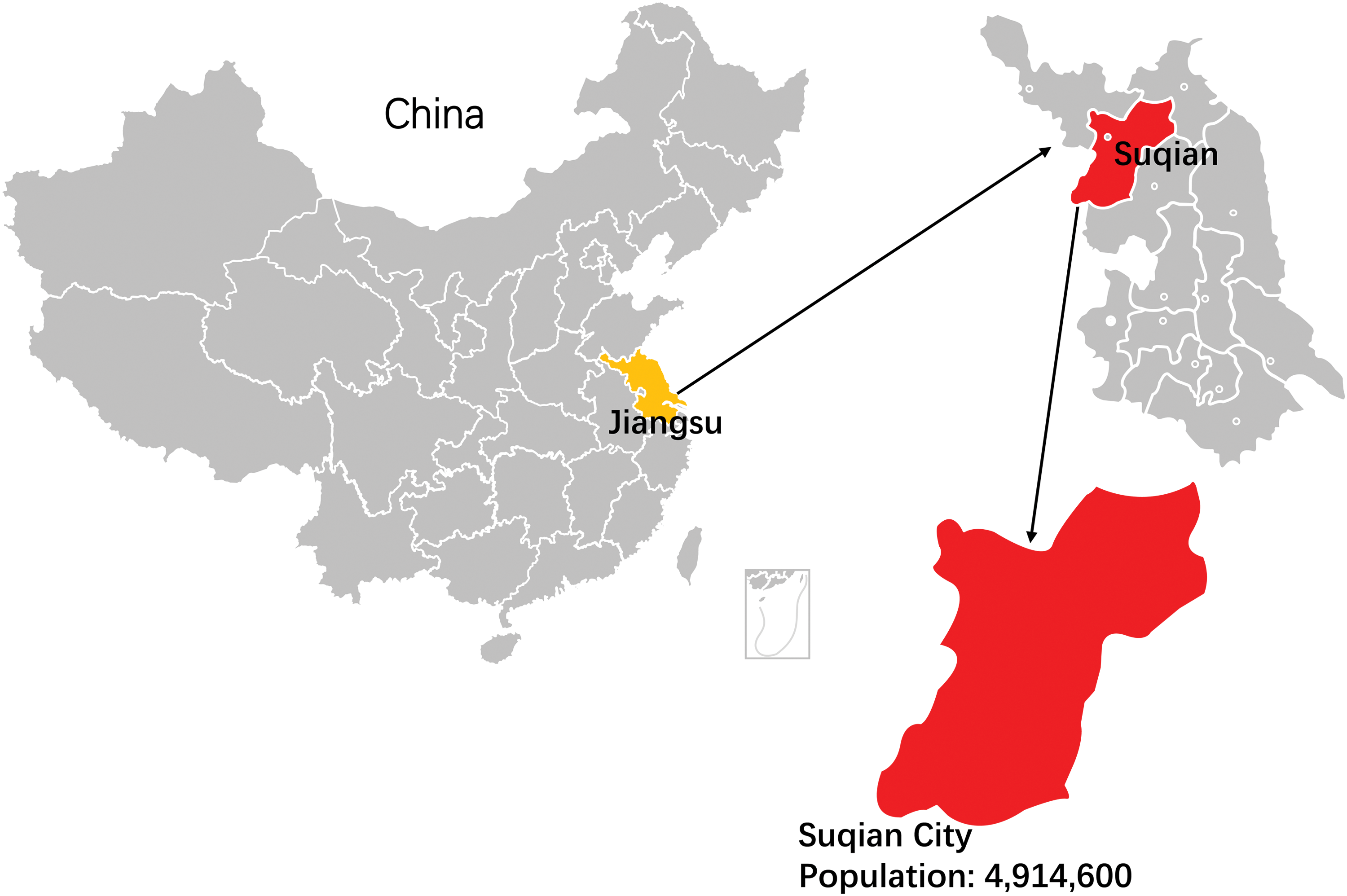
The geographic information of Suqian city. Color images are available online.
A total of 196 plasma samples were collected from treated HIV-1-positive cases by Suqian First Hospital of Jiangsu Province in 2018 and were enrolled into the study with informed consent. Demographic information was collected by sophisticated interviewers (Table 1). Male cases (159, 81.12%) were significantly more than female cases (36, 18.37%). The transmission routes were also counted. Sixty-five cases (33.16%) belonged to heterosexual transmission followed by men who have sex with men (MSM) (1, 0.51%). Transmission routes of the others were unknown (130, 66.33%).
Social Demographic Characteristics of Participants
MSM, men who have sex with men.
The plasma samples were stored at −80°C until use. Viral RNA was extracted from plasma. The HIV partial pol genes (nucleotide 2147-3462 by using HXB2 as calibrator) were amplified and sequenced as described previously.
9
Contiguous sequences were assembled with sequenced segments from same sample and edited manually according to the graph of ABI files.
10
Finally, 84 partial pol genes were successfully obtained. All assembled sequences were first submitted to the HIV-1 Sequence Quality Control Tool (
To determine HIV subtypes, all sequences were submitted to the HIV-1 Sequence Quality Control Tool (
Finally, all 84 strains successfully obtained their subtypes (Fig. 2). Forty two of them were CRF01_AE (50%), 19 were CRF07_BC (22.62%), 11 were CRF08_BC (13.10%), 7 were CRF67_01B (8.33%), and 5 strains were subtype B (5.95%). No unique recombination forms were found. The subtype composition is almost the same as that identified previously, 8 except that five strains of subtype B (5.95%) were discovered in the current cohort. Subtype B was predominant among former blood and plasma donors in central China. The recovery in Suqian indicated that the specific subtype restarted its transmission in the area. Similar to the situations in many other areas or populations, 14 CRF01_AE has surpassed CRF07_BC and CRF08_BC and has become the dominant circulating strain.
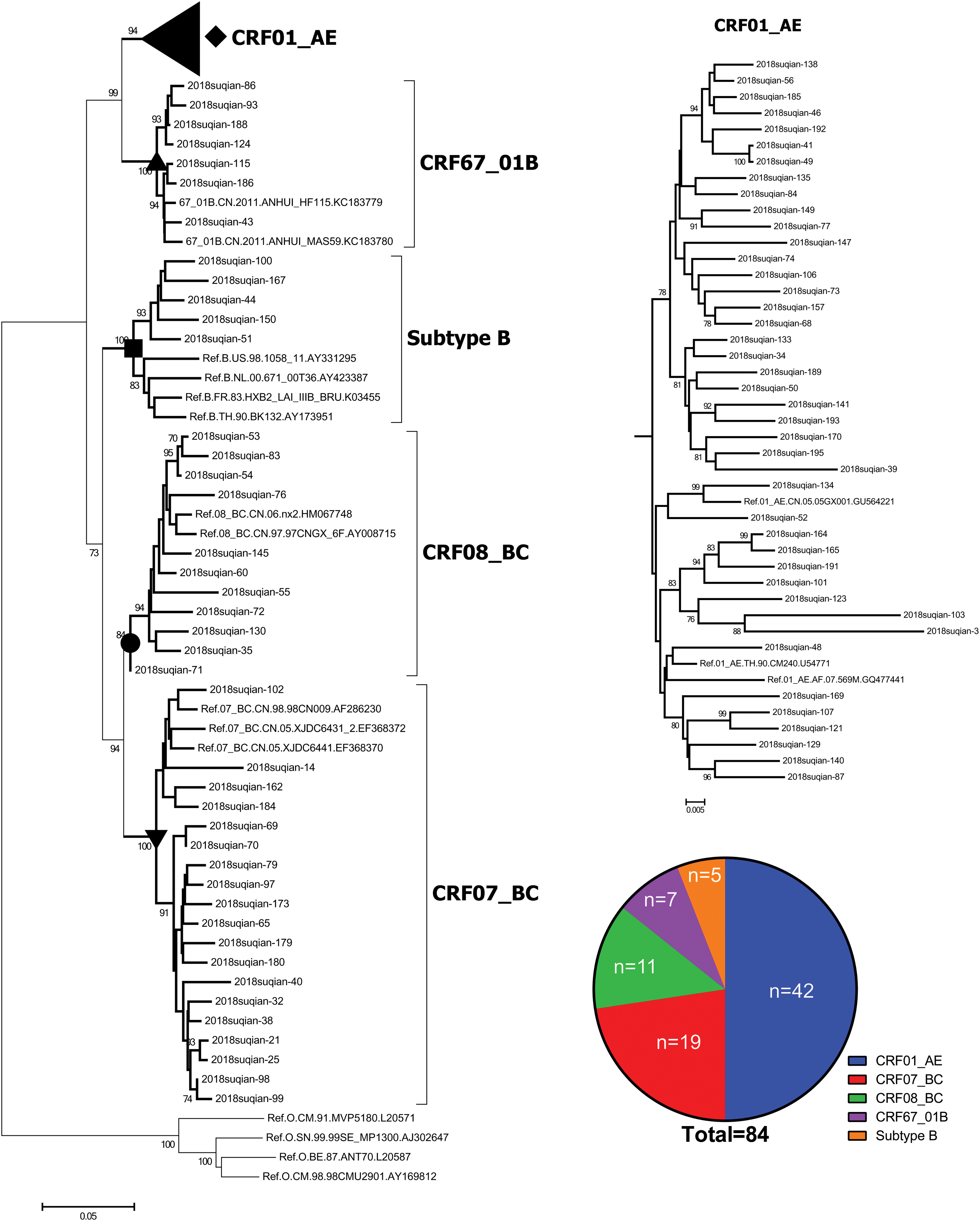
The NJ phylogenetic tree was built using 84 obtained sequences from treated HIV-1 infectors in Suqian. The reference gene sequences of subtypes B, CRF01_AE, CRF07_BC, CRF08_BC, CRF67_01B, and group O were downloaded from the HIV database (
Our previous work revealed that all CRF01_AE sequences in China can form five major epidemic clusters. 15 Thereinto, clusters I and III mainly contained sequences from patients infected by heterosexual contact (63% and 39%, respectively); sequences in clusters II and IV were mainly from MSM (80% and 78%, respectively); and cluster V mainly included sequences from injection drug users (IDUs) (29%) and heterosexuals (38%). 15 To verify the assortment of CRF01_AE sequences obtained in this study, an NJ tree based on the references of the previously identified major CRF01_AE epidemic clusters circulating in mainland of China was further constructed (Fig. 3).

The NJ phylogenetic tree was built using 42 CRF01_AE sequences from Suqian and references of previously identified major CRF01_AE epidemic clusters circulating in mainland of China. Bootstrap probabilities >70% are indicated at the corresponding nodes of the tree.
The phylogenetic analysis indicated that except the strain of 2018 suqian-48, all the other sequences were assigned to specific clusters. Thereinto, 26 of 42 CRF01_AE fell into cluster V; 6 of 42 fell into cluster IV; 7 of 42 dropped into cluster II and 2 dropped into cluster I. Multiple lineages of CRF01_AE strains cocirculating indicated that HIV-1 epidemic and the CRF01_AE epidemic in Suqian is rather complex. The domination of CRF01_AE has brought great challenge to effective intervention and control programs.
“Four Free and One Care” project was initiated in China in 2003. Since then highly active antiretroviral therapy (HAART) has been widely used and increasing level of HIV drug resistance in some specific areas or populations undertook antiretroviral therapy (ART) was revealed.
16
In this study, all participants accepted ART, which will be helpful to learn about the drug resistance level after treatment. Eighty-four sequences obtained from pol genes in this study were submitted to the online Calibrated Population Resistance tool (v5.0 beta) (
The Proportion of Drug Resistance in Individuals According to Drug Classes
NRTIs, nucleoside reverse transcriptase inhibitors; NNRTIs, non-NRTIs; PIs, protease inhibitors; the drug classes were exclusive of each other in the study population.
Among 84 strains, 1 strain (1.19%) contained mutations associated with drug resistance to protease inhibitors, nucleoside reverse transcriptase inhibitors (NRTIs), and non-NRTIs (NNRTIs). Three strains (3.57%) contained mutations conferred to NRTIs. Three strains (3.57%) contained drug-resistance mutations related to NNRTIs. In addition, there were 12 strains that contained mutations associated with drug resistance to both NRTIs and NNRTIs (Table 2). In total, the level of HIV drug resistance was as high as 22.62%.
In 2012, WHO updated the ART guidelines and each HIV-1-infected individual can obtain HAART, regardless of CD4+ T cell counts. Chinese government followed the ART strategy of HIV-1 infections treatment in June 2016. This study focused on treated HIV-1 infectors in Suqian city of Jiangsu Province in 2018 and characterized the subtype composition and the level of drug resistance mutations.
In summary, the work would provide new information of molecular epidemiology for the prevention and control of HIV-1 in Suqian and even in Jiangsu province. The analysis indicated that CRF01_AE has been the most predominant HIV-1 strain in Suqian. These CRF01_AE sequences can be assigned to multiple lineages of CRF01_AE identified in China previously, indicating HIV-1 epidemic in Suqian is remarkably complex. In addition, there is a rather high level of HIV drug resistance in the area. Both results suggest a greater challenge of HIV prevention and intervention in Suqian and more efforts must be made.
Sequence data
The gene sequences were deposited in the GenBank with the accession number: MK409760-MK409843.
Footnotes
Acknowledgments
This study was funded by the National Natural Science Foundation of China (No. 81773493), the National Key S&T Special Projects on Major Infectious Diseases (Grant No.2012ZX10002), the State Key Laboratory of Pathogen and Biosecurity (Academy of Military Medical Science). This work was supported by the grant 2017YFC1200800, 16CXZ030.
Author Disclosure Statement
No competing financial interests exist.