




Abstract
Surprisingly, more new unique recombinant forms (URFs) of CRF01_AE/CRF07_BC recombinant viruses were found in Tianjin, China, recently. Here we identified another novel HIV-1 recombinant virus (TJ20170315) isolated from an HIV-1 positive man who has sex with men in Tianjin, China. Phylogenetic analysis of the near full-length genome of TJ20170315 showed that it formed a monophyletic branch within the cluster of CRF01_AE reference sequences. Recombinant analysis showed that the virus kept the CRF01_AE parental backbone, and one CRF07_BC segment was inserted into gag, pol genes of the CRF01_AE backbone. Nowadays, multiple kinds of circulating recombinant forms (CRFs) and URFs were identified among men who has sex with men in China. The emergency of URFs highlights the complexity of HIV-1 infection in Tianjin, China, and implies that the next new CRF and HIV-1 epidemic are coming on the road.
Diverse human immunodeficiency viruses (HIVs) are found globally. HIVs are divided into types HIV-1 and HIV-2. HIV-1 contains M, N, O, P groups, and M group viruses, which consist of nine major subtypes (subtypes A to D, F to H, J, and K), are the most widely epidemic viruses in the world.
1
To date, at least 98 circulating recombinant forms (CRFs) have been reported (
The virus (TJ20170315) was isolated from an HIV-positive 26-year-old man. His CD4+ T cell count was 916 cells/μL, when he was diagnosed as HIV infected in March, 2017. Informed consent was signed before collecting patient's whole blood sample. This study was reviewed and approved by the Research Ethics Community of School of Medicine, Nankai University.
HIV-1 provirus was extracted from the whole blood using QIAamp® DNA Blood Mini Kit. The gradient DNA template was used to amplify full-length genome by nested PCR. The PCR contains an initial denaturation at 94°C for 3 min followed by 35 cycles of 94°C for 30 s, 60°C for 30 s, 68°C for 4 min, and final extension at 68°C for 10 min. The positive PCR products were purified using a QIAquick Gel Extraction Kit (QIGEN) and sequenced, and the sequence was spliced and assembled using Sequencher v4.10.1 (Gene Codes).
The near full-length genome (NFLG) sequence of TJ20170315 was aligned with HIV-1 group M reference of different subtypes and CRFs in China, obtained from the Los Alamos HIV Sequence Database. (
We finally obtained an 8,752 bp fragment of TJ20170315 (relative position to reference HXB2 790-9608). Phylogenetic analysis showed that the NFLG sequence of TJ20170315 was closely related to CRF01_AE reference sequence cluster, but formed a monophyletic branch supported by a bootstrap value of 100% (Fig. 1). The recombinant pattern analyzed by Recombinant Identification Program (RIP) and Simplot showed that the genome of TJ20170315 was composed of CRF01_AE and CRF07_BC. The bootscan results reflected that the virus contains three interlaced mosaic segments, including CRF01_AE (segments I, III) and CRF07_BC (segment II) with two recombination breakpoints (Fig. 2A). Similar results were obtained using online software jpHMM (

Neighbor-joining tree of the near full-length genome of TJ20170315 and group reference sequences were constructed by MEGA 7 with the Kimura two-parameter model and 1,000 bootstrap replications test. TJ20170315 sequence is marked with solid circle.

Recombination breakpoint analyses of TJ20170315.

Phylogenetic analyses of three mosaic segments
The HIV epidemic among MSM in China has been increasing in recent years. According to the 2015 China AIDS Response Progress Report, the nationwide average prevalence of HIV-1 infection among MSM population reached 7.7%. 14 The proportion of MSM among newly identified HIV cases from 2005 to 2014 increased from 0.3% to 25.8%. 15,16 Furthermore, most MSM engage in high-risk behaviors, such as multiple sexual partners and unprotected anal intercourse, which increases opportunities of HIV-1 dual infection and the generation of new recombinant strains. 17 –19
Next-generation sequencing and single-genome amplification were applied for detecting more low-frequency variants in the whole blood samples of this patient collected twice in the past 1 year. We obtained a large number of sequences of pol and env genes of this patient, which was clustered with cluster4 CRF01_AE and cluster5 CRF01_AE references, respectively, indicating dual infection occurrence within the man. Dual infection is related to high-risk behaviors, such as unprotected anal intercourse and multiple sexual partners.
In recent years, some URFs were found among MSM in Tianjin, China. Sequences published were downloaded for analyzing what the transmission relationships of those are, which may elucidate the partial mechanism of prevalence of URFs in Tianjin. The phylogenetic analyses show that genetic linkages are not related with each other, although all URFs were CRF01_AE/CRF07_BC recombinant strains (Fig. 4).
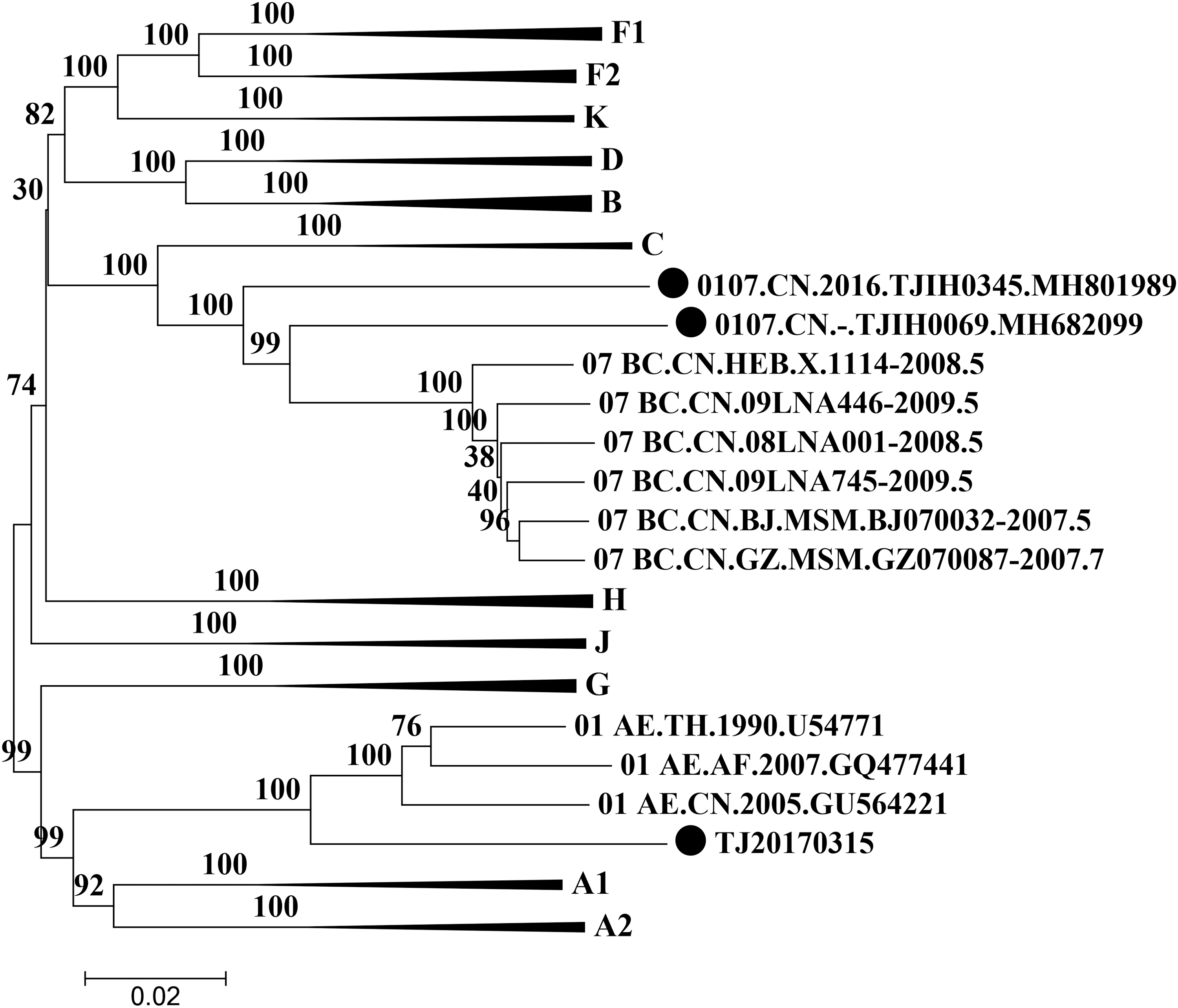
Neighbor-joining tree of the full-length genomes of TJ20170315, other sequences of Tianjin MSM published and group reference sequences were constructed by MEGA 7. TJ20170315 and sequences of Tianjin MSM are marked with solid circles. MSM, men who has sex with men.
Dual infection among MSM and the emergency of some new recombinant strains implied active high-risk sexual behaviors among MSM population in Tianjin, China. The effective HIV-1 molecular epidemiologic investigation among MSM population may provide important information to understand the dynamic of the HIV-1 epidemic in China.
In summary, we identified a novel CRF01_AE/CRF07_BC recombinant form TJ20170315 in Tianjin, China. TJ20170315 contains two breakpoints throughout the NFLG. The novel recombinant form reflected HIV genetic complexity in Tianjin. The emergence of more URFs in Tianjin, China, suggests that the next HIV-1 epidemic in Tianjin is coming. Therefore, a more effective strategy for preventing HIV-1 transmission among MSM is urgently needed.
Sequence Data
The NFLG sequences of this study have been directly deposited into GenBank as TJ20170315 (GenBank accession number MK634699).
Footnotes
Acknowledgments
This study was supported by National Natural Science Foundation of China (grant no. 81571991 to M.W.), Fundamental Research Funds for the Central Universities, Nankai University (grant no. 63191169 and 63191726 to M.W.), and 13th Five-year National Major Project for HIV/AIDS and Hepatitis B Control and Prevention, Chinese Ministry of Science and Technology (grant no. 2017ZX10202102005004 to P.M).
Author Disclosure Statement
No competing financial interests exist.