




Abstract
Rapid test (RT) is the principal screening method in the HIV control practice. However, this method may lead to inaccurate detection, primarily due to the more than 4 weeks of window phase. In the present study, we performed a HIV DNA screening method to show its application prospects in men who have sex with men (MSM). From July 2017 to April 2018, we recruited 1,301 MSM from Beijing who were not previously diagnosed as HIV positive. Both HIV DNA detection and RT were performed. In total, 141 and 135 HIV-positive results were detected by DNA detection and RT, respectively. By repetitive and confirmative tests (Western blot), we verified that DNA detection detected 10 more true positives than RT and 4 false positives were corrected from RT. This represents 14 inaccurate RT results that were corrected by DNA measurement. Therefore, DNA measurement should be fully considered as a screening method in the detection of HIV among MSM in the future.
Introduction
In 2014, UNAIDS set the “90–90–90” target—90% of all people living with HIV will know their HIV status, 90% of all people with diagnosed HIV infection will receive antiretroviral therapy, and 90% of all people receiving antiretroviral therapy will have viral suppression by 2020. 1 In China, it is estimated that only about 68% of people living with HIV knew their status in 2015. 2 Therefore, more effort should be carried out to close the gap between current results and the 90% target. The HIV epidemic in China was historically associated with female sex workers and injecting drug users. 3,4 Although the growth rate of HIV infections has decreased in recent years, the rate of newly infected men who have sex with men (MSM) have been rising rapidly. 5 –8 According to previous studies, the prevalence of HIV among MSM in China was about 10%, 7,9 –11 which is strikingly severe compared with other high-risk groups. 6
China has adopted multiple methods to fight HIV, including expanding the scope of HIV testing. 12 This method is one of the main screening methods according to the current national guideline for HIV detection. However, since the window phase is more than 4 weeks, this method easily leads to false-negative results. 13 According to previous studies, false-negative detection will result in increased onward transmissions. 14 –17 Therefore, shortening the window phase before the virus can be detected can prevent onward transmissions by identifying more HIV-positive individuals. Compared with rapid test (RT), nucleic acid detection has a shorter window phase of about 7–11 days. 13 This method has been widely used in blood screening in China and is proven to be highly effective. 18 –20 In the present study, we employed HIV DNA detection as a screening method to show its application prospect in MSM.
Materials and Methods
Ethics statement
This study was approved by the Beijing Center for Disease Control and Prevention. Informed consent was provided by all the participants, and samples were approved to be used in this study. Participants were assigned identification numbers that were unique to this study, and results could only be queried by themselves.
Sample collection
During July 2017 to April 2018, participants were recruited from hospitals or MSM organizations in Chaoyang, Haidian, and Fengtai Districts of Beijing. Eligibility criteria of participants were MSM without age limit and who were not diagnosed as HIV positive. Sample type was dried blood spots (DBS) in this study. Whole blood was spotted onto preprinted circles on DBS collecting cards (Kinghawk Pharmaceuticals Co., Ltd., Beijing, China) and air-dried at room temperature. DBS were prepared and mailed to the National HIV Reference Laboratory by nurses. DNA measurements were performed as soon as possible, and the DBS cards were stored at −20°C before use. Each DBS card was assigned a unique number that can be queried only by the participants.
RT and DNA detection
HIV status of the participant was tested by RT during the DBS preparations. Proviral HIV DNA was extracted using Nucleic Acid Extraction Kit (Supbio, China). For DNA measurements, a HIV-1 (Human Immunodeficiency Virus Type I) DNA Detection Kit (PCR-Fluorescent Probing) (Supbio) and a Fluorescent Quantitative PCR instrument, Bio-Rad CFX96 (Bio-Rad Laboratories, Inc.), were used.
Results reporting
Participants were informed the results of RT at the time of testing. DNA detection results were reported via the Internet (
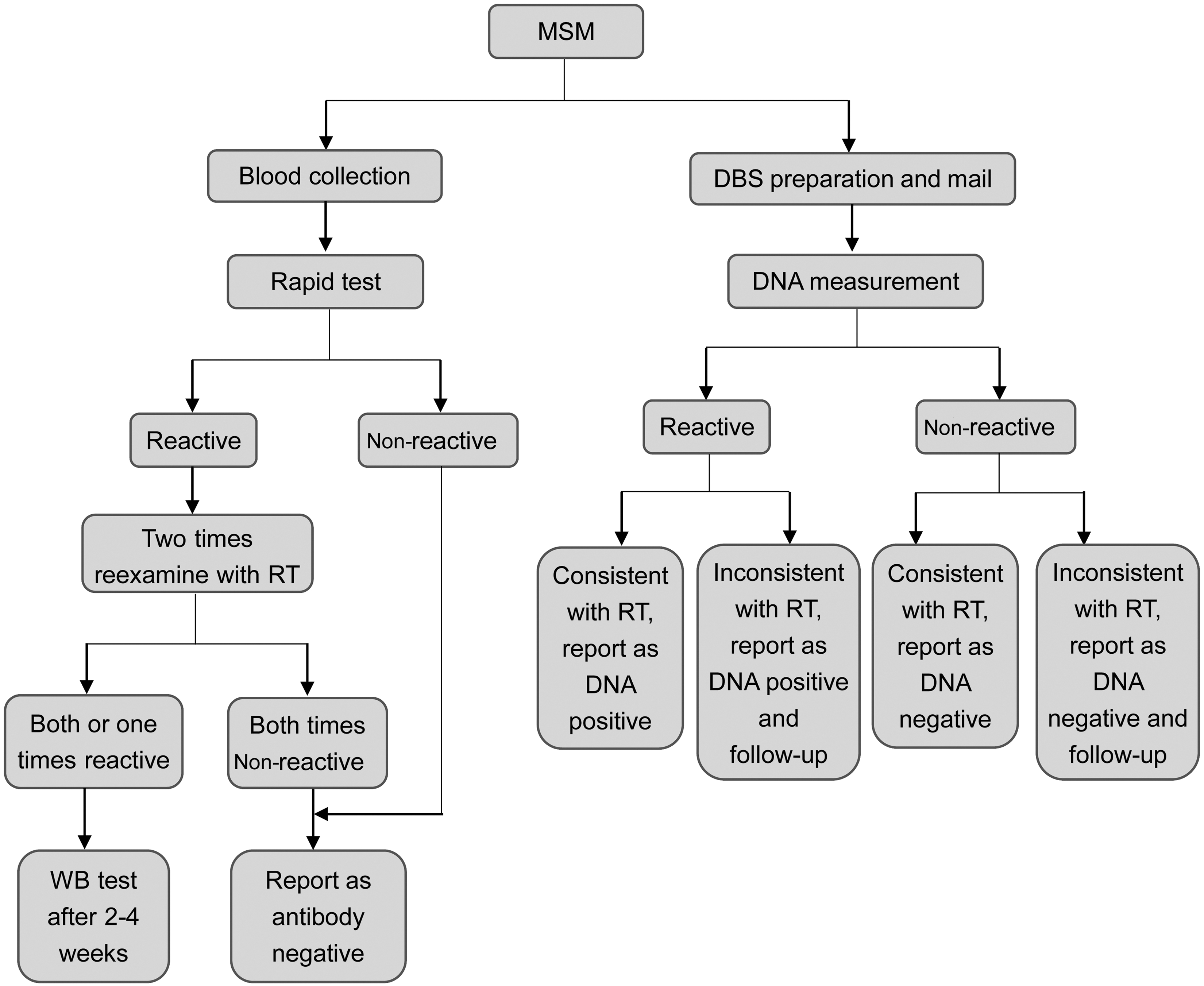
Flow chart illustrating the detection strategies of the study.
Results
Sample collection
A total of 1,301 MSM were recruited from July 2017 to April 2018. One thousand three hundred one DBS were collected, and 1,298 of them were qualified for the detection of HIV. Among the qualified samples, 505 were from Chaoyang District by Blued Organization, 393 were from Haidian District by Chengjian Hospital, and 400 were from Fengtai District by Youan Hospital and Military Hospital (302) of China.
RT and DNA measurement
Detection results are summarized in Table 1 and detailed in Figure 2. A total of 133 participants were confirmed positive by WB, and the HIV infection rate of MSM in Beijing in our study was 10.25% (133/1,298). For RT, 135 and 1,163 samples were tested reactive and nonreactive for HIV, respectively. Among the 135 RT reactive samples, 125 were confirmed HIV positive and 2 confirmed to be negative. The remaining eight samples were lost during follow-up. Among the 1,163 RT nonreactive samples, 10 were DNA reactive and 8 of the 10 samples were confirmed positive by WB. For DNA measurement, 141 and 1,157 samples were tested reactive and nonreactive for HIV, respectively. Among the 141 DNA reactive samples, 133 were confirmed positive by WB and 8 were lost during follow-up. Among the 1,157 DNA nonreactive samples, 4 were RT reactive and 2 were confirmed negative by WB.
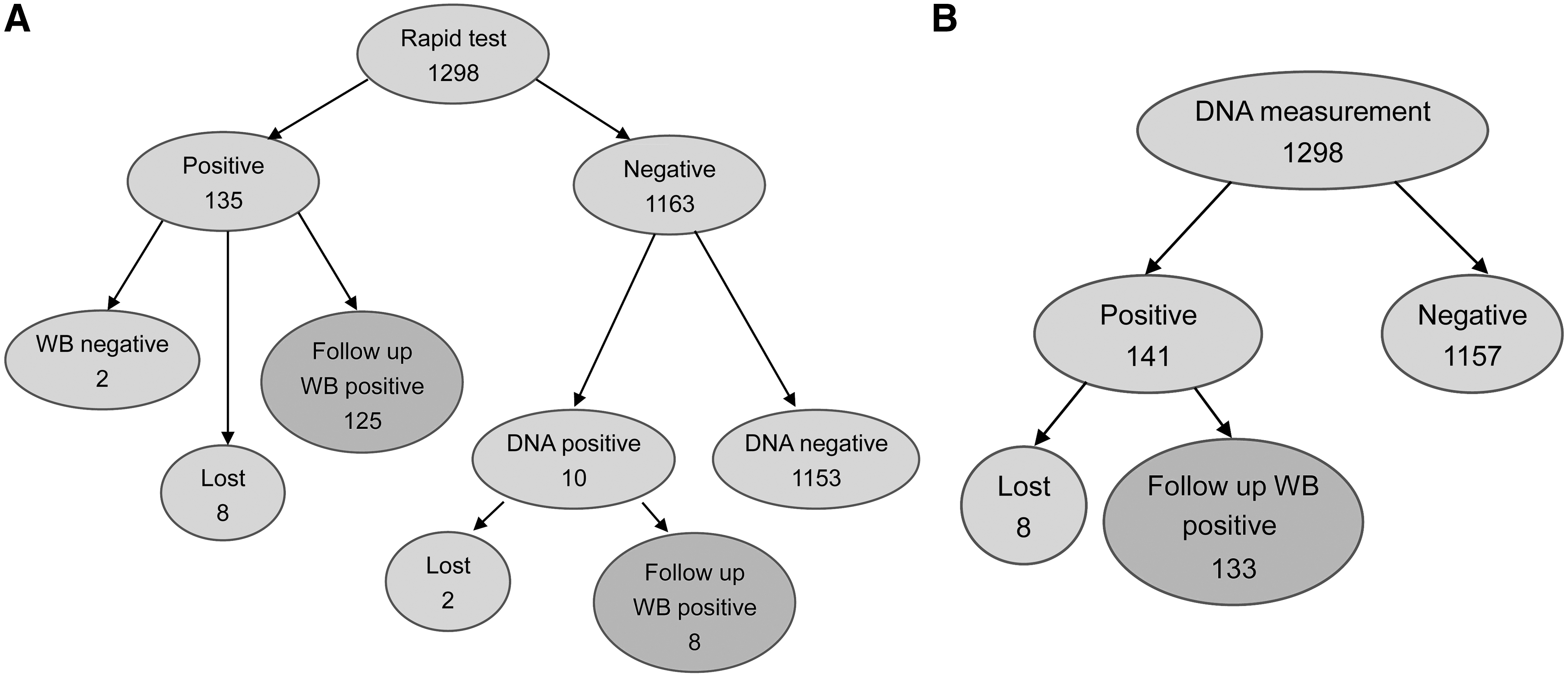
Detailed results of rapid test and DNA measurement.
Screening Results of Rapid Test and DNA Measurement Among 1,298 Men Who Have Sex with Men in Beijing
RT, rapid test.
Discussion
The HIV infection rate of MSM is 10.25% (133/1,298) in Beijing based on the samples enrolled in our study. Our results were consistent with previous studies, indicating that the HIV infection rate among this group is high. 3,7
Comparing the two screening methods, DNA measurement found 10 positives from the samples that were detected as negative by RT. Among the 10 samples, 8 were confirmed positive by WB. Therefore, we can draw a conclusion that eight more positives were found by DNA measurement than RT in the current study. As for the eight persons, there is a high probability that they were in acute HIV infection phase. Early diagnosis means not only early treatment but also a decrease of onward transmission since individuals who were diagnosed as HIV positive typically change their behaviors. 17,21 –23 In fact, HIV RNA has been used in HIV detection, for example, early infant diagnostics, and proved to be effective. 24,25 Although it takes more time than RT, the extra time is acceptable in consideration of the better performance in HIV early diagnosis. Furthermore, efforts have been made by researchers to shorten the time of DNA measurement. 25 –27
To develop an HIV detection strategy, cost cannot be ignored, especially in a developing country. DNA measurement kits in the present study cost much more than RT kits, making it apparently unreasonable. However, the nucleic acid screening method serves the high-risk MSM group, rather than the general population. Compared with its effectiveness, the extra cost can be justified as acceptable. In addition, data reveal an interesting phenomenon that MSM in China are concentrated in large cities such as Beijing, Shanghai, and Chengdu (unpublished data), in which MSM accounted for the majority of newly acquired HIV infections. 8 Unlike rural areas, large cities can afford the high cost of the nucleic acid detection kits. Therefore, DNA measurement should be considered as a screening method in MSM in the future.
Notable limitations of this study include a potential repeated collection of samples, although measures were taken to avoid recruiting one person two or more times. Furthermore, samples were only collected from Beijing, which is unrepresentative considering the size and widespread population of China. Therefore, broader studies should be performed in the future.
Footnotes
Acknowledgment
We thank Professor Tuofu Zhu (University of Washington) for his linguistic assistance during the preparation of this article.
Author Disclosure Statement
No competing financial interests exist.
Funding Information
This project was supported by the National Science and Technology Major Project (no. 2018ZX10732101-001-010), Science and Technology Planning Project of Guangdong Province, China (no. 2016B020238002), and Science and Technology Planning Project of Beijing, China (LXSQ20170807_001).