




Abstract
Editor: The target cells of HIV-1 are CD4+ T lymphocytes and, to a less extent, dendritic cells (DCs) and macrophages. 1 DCs express the HIV-1 receptor CD4 and are potential target cells for HIV-1. HIV-1 could infect myeloid DCs both in vivo and in vitro, 1 although this infection is inefficient compared with stimulated CD4+ T cells. The HIV-2/simian immunodeficiency virus (SIV) Vpx protein degrades deoxynucleoside triphosphate (dNTP) triphosphohydrolase SAMHD1 to enhance HIV-1 infection in monocyte-derived dendritic cells (MDDCs) in vitro, a cellular enzyme that can deplete intracellular dNTPs to block viral reverse transcription in the early steps of infection. 2 In addition to SAMHD1, the other mechanisms responsible for the limited replication of HIV-1 in DCs should also be elucidated.
Quite recently, we have identified cell membrane metalloprotease TRABD2A as a novel host restriction factor inhibiting HIV-1 assembly and production by degrading HIV-1 Gag protein in resting CD4+ T cells. 3,4 Interestingly, we also observed that TRABD2A is expressed in MDDCs but not in primary monocyte-derived macrophages (MDMs), although it is nearly 20–30 times lower in MDDCs than in resting CD4+ T cells; therefore, we also wanted to investigate the potential anti-HIV-1 activity of TRABD2A in MDDCs.
At first, we examined the TRABD2A and TRABD2B expression by performing high-throughput RNA-Seq for monocytes and MDDCs from two independent healthy donors. By using Integrative Genomics Viewer (IGV) software, we consistently observed that TRABD2A is expressed in MDDCs at a higher level than those in monocytes (Fig. 1a, b), whereas TRABD2B expression is not detected (data not shown). This suggests the potential anti-HIV-1 activity of TRABD2A in MDDCs. Furthermore, we were curious whether TRABD2A is translocated to the plasma membrane in MDDCs and thus performed immunofluorescence-based analyses for the TRABD2A protein in MDDCs. As a result, we found that the TRABD2A protein could also translocate to the MDDC plasma membrane (Fig. 1c).

TRABD2A restricts HIV-1 production in MDDCs.
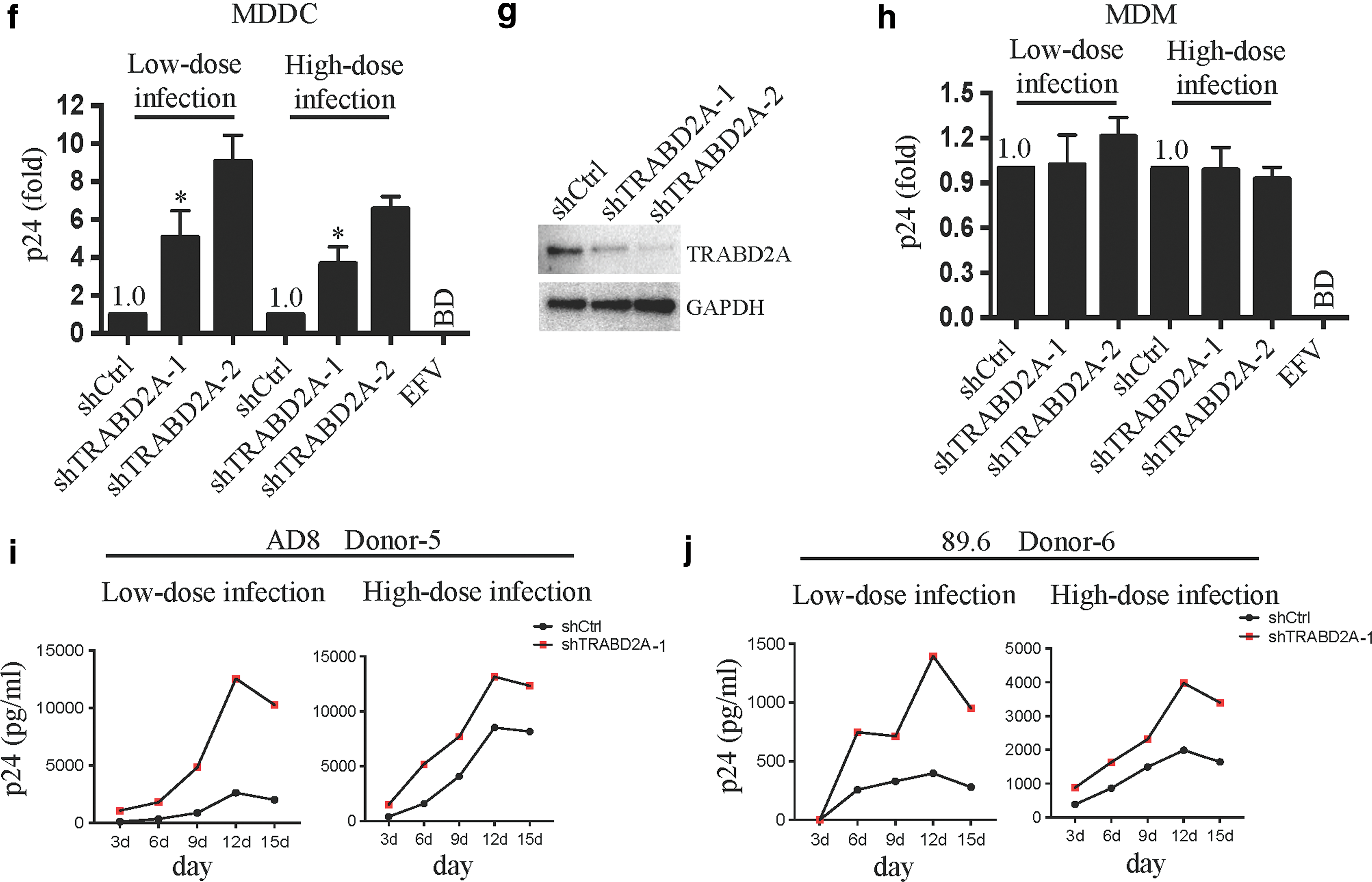
Next, we examined whether endogenous TRABD2A restricts HIV-1 production in MDDCs by employing two strategies to silence TRABD2A in MDDCs. We also utilized Vpx to antagonize SAMHD1 in MDDCs to promote viral production. We observed that small interfering RNA (siRNA)-mediated depletion of TRABD2A in MDDCs could enhance wild-type CCR5-trophic HIV-1AD8 production in the absence of efavirenz (EFV) or raltegravir (Fig. 1d, e). HIV-1 production was significantly increased either at low- or high-dose HIV-1 infection, and the expression levels of TRABD2A also inversely responded to HIV-1 production. Moreover, we employed lentiviral short hairpin RNA (shRNA) for TRABD2A to silence its expression into MDDCs and found a consistent upregulation of viral production in the absence of TRABD2A (Fig. 1f, g).
Meanwhile, because primary MDMs do not express TRABD2A, 3 we transduced these shRNAs and did not observe any effect on HIV-1 infection in MDMs (Fig. 1h), thereby indicating their specific usage in MDDCs. Collectively, this indicates that TRABD2A can also restrict HIV-1 production in MDDCs. To this end, we explored HIV-1 spreading infection in MDDCs for 15 days in the presence or absence of TRABD2A. Consequently, silencing of TRABD2A enhanced both CCR5-trophic proviral AD8 and dual-trophic 89.6 infection in MDDCs during viral spreading infection (Fig. 1i, j; knockdown effects are not shown). We found notable differences in virion production by MDDCs in the presence and absence of TRABD2A particularly at low inoculums in which wild-type HIV-1 was allowed to spread to saturation for 15 days.
Overall, TRABD2A is also likely to restrict HIV-1 production in MDDCs in addition to resting CD4+ T lymphocytes. Probably, as in resting CD4+ T cells, TRABD2A also degrades HIV-1 Gag at plasma membranes to destroy progeny assembly in DCs.
In summary, we have shown here that TRABD2A is expressed to restrict HIV-1 production in MDDCs. The detailed mechanism of TRABD2A combating HIV-1 in MDDCs has not yet been elucidated, including whether TRABD2A degrades the HIV-1 Gag protein at the plasma membrane in MDDCs and whether interferon can utilize TRABD2A to inhibit HIV-1 production.
Footnotes
Acknowledgments
We thank all our laboratory members for contributing to this study. We would also like to thank S. Li and Y. He for technical support. This study was supported by the Mega-projects of National Science Research for the 13th Five-Year Plan (Grant No. 2017ZX10201101), Mega-projects of National Science Research for the 13th Five-Year Plan (Grant No. 2017ZX09304025), Development Plan of Innovative Group of the Ministry of Education 2016, and the National Natural Science Foundation of China (Grant No. 81273238).
Author Disclosure Statement
The authors declare no competing financial interests.