




Abstract
In this study, we report a novel HIV-1 second-generation recombinant form composed of CRF01_AE and subtype B detected from a married HIV-positive male subject infected through homosexual behavior in Tianjin in northern China. The near full-length genome analyses showed that two regions of subtype B inserted into the CRF01_AE backbone with four recombinant breakpoints observed in the pol gene region. Subregion tree analyses demonstrated that the CRF01_AE regions of the recombinant were greatly clustered with the CRF01_AE subcluster 4 lineage, which was found primarily among men who have sex with men (MSM) in northern China. To the best of our knowledge, this is the first detection of a novel HIV-1 second-generation recombinant form (CRF01AE/B) in Tianjin, which indicates active transmission networks of HIV-1 infection among MSM in this region. The emergence of the novel second-generation recombinant form highlights the increasing complexity of HIV-1 epidemic among MSM population and the importance to monitor potential novel circulating recombinant forms.
AIDS is one of the most devastating infectious diseases in human history, and its cause, HIV, has undergone a variety of cross-species transmissions from nonhuman primates into humans and further was divided into HIV-1 and HIV-2.
1
HIV-1 exhibits an extremely high genetic diversity and is categorized into four distinct groups (M, N, O, and P). Group M play a major role in the global HIV-1 epidemic and are further classified into nine distinct subtypes (A–D, F–H, J, and K) and four sub-subtypes (A1, A2, F1, and F2), as well as various circulating recombinant forms (CRFs) and a large number of unique recombinant forms (URFs). To now, coinfection and recombination of different HIV-1 subtypes and CRFs have resulted in the emergence of as many as 98 CRFs (
In the past 25 years, the distribution of HIV-1 subtypes was highly diverse and complex in China, and an increasing number of HIV-1 CRFs with different genotypes and patterns of recombinant forms have been found in recent years. 2 –5 In addition, the proportion of HIV-1 infection among men who have sex with men (MSM) has increased rapidly, 6 –8 and CRF01_AE, CRF07_BC, and subtype B have become the three predominant genotypes among MSM populations in China. 9 The cocirculation and rapid transmission of CRF01_AE and subtype B strains in MSM population provide opportunities for the emergence of novel second-generation recombinants, and continuous URFs consisting of CRF01_AE and subtype B have been reported in recent years in China. 10 –14 In this study, we detected and characterized a novel HIV-1 second-generation recombinant consisting of gene regions from CRF01_AE and subtype B in MSM in Tianjin, designated as TJIH0214, which is highly distinct from the previously reported CRF01_AE/B recombinant by near full-length genome (NFLG) sequence analyses.
In this study, the plasma sample was collected from an HIV-positive consenting MSM during our cross-sectional HIV-1 molecular epidemiology survey in Nankai University Second People's Hospital in 2018. TJIH0214 is a Chinese citizen of Han ethnicity, residing in Tianjin, and was confirmed to be HIV positive on January 17, 2018, when he had a physical examination in hospital. The study subject was a 41-year-old man, married, however had been infected through homosexual behavior by self-report. He was not taking antiretroviral therapy and his CD4 T cell count was 397 cells/μL by the time of blood collection. He went on for antiviral treatment under the country's AIDS cost-free antiviral treatment program after diagnosis and his CD4 rose to 509 cells/μL after 68 weeks antiviral treatment. This study was approved by the institutional review boards of the National Center for AIDS/STD Control and Prevention, China CDC. Written informed consent was obtained from the subject before sample collection.
Methods used in this study for amplifying and sequencing the newly generated NFLG sequence of TJIH0214 were the same as previously described.
15,16
HIV-1 viral RNA was extracted from 200 μL of plasma using the column purification method (QIAamp Viral Mini Kit; Qiagen, Hilden, Germany). and then reversely transcribed into complementary DNA (cDNA) using the Superscript III First-strand synthesis system (Invitrogen). Furthermore, nested polymerase chain reactions with the gradient cDNA template were conducted in the conditions for the two rounds to amplify the NFLG, and the positive PCR products were purified using a QIAquick Gel Extraction Kit (Qiagen) and sequenced. The chromatogram data were edited manually and assembled using Sequencher v4.10.1. Recombination breakpoints were determined using SimPlot and the online software jpHMM (
In this study, we finally obtained a length of 8,966 bp (relative to the HXB2 nucleotide numbering system: positions 643–9,599) of the NFLG sequence of TJIH0214 and the blast search data indicated that no evidence of sample cross contamination was detected. In the phylogenetic tree analyses using the approximately maximum-likelihood method with the generalized time-reversible model for the NFLG alignment, the NFLG of TJIH0214 clustered with the CRF01_AE with a bootstrap value of 100%, but formed a distinct monophyletic branch distantly related to the CRF01_AE reference sequences (Fig. 1).
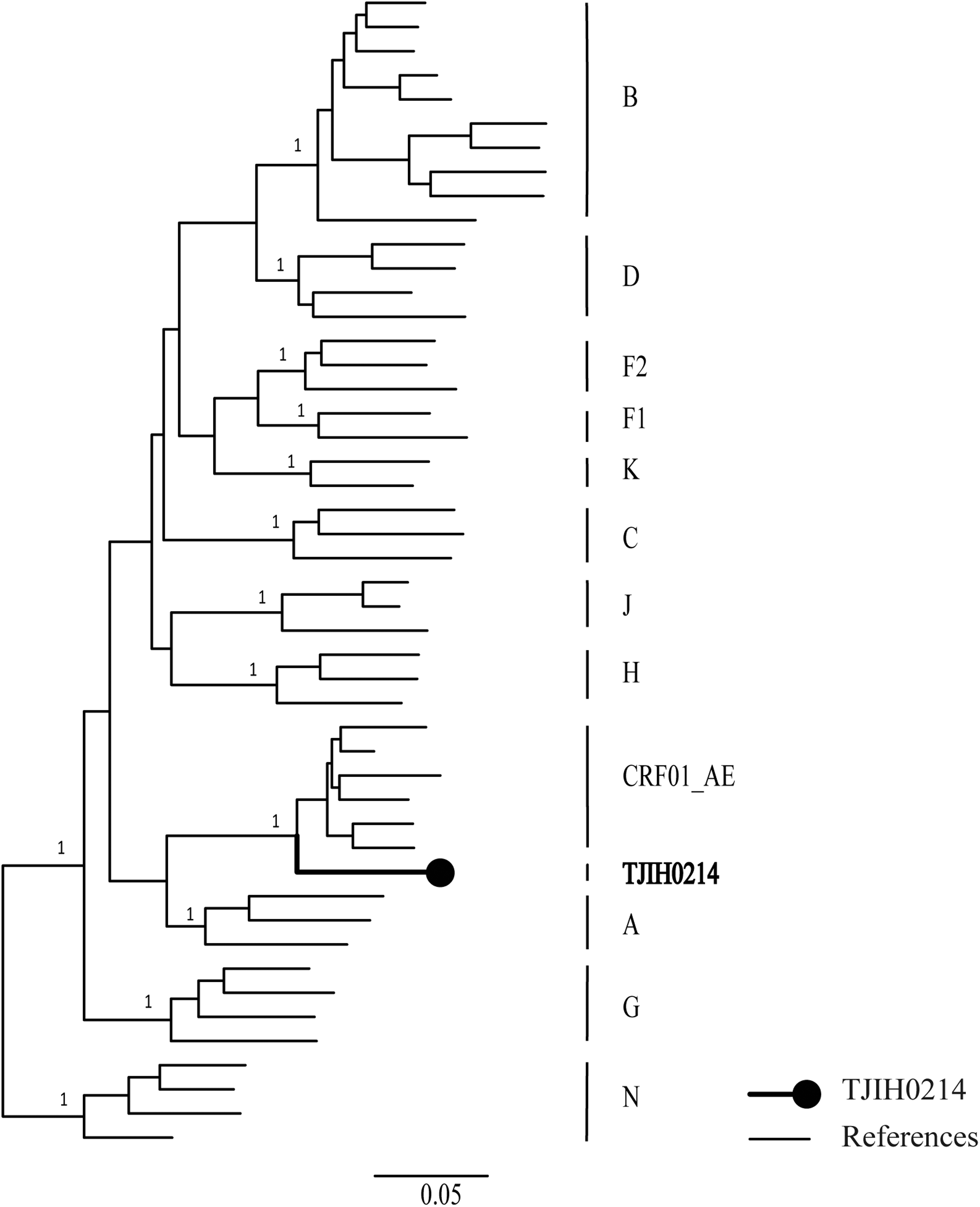
Phylogenetic analyses of the NFLG of TJIH0214 isolate. The neighbor-joining phylogenetic tree was constructed using FastTree with the GTR model. All reference sequences were downloaded from the Los Alamos National Laboratory HIV Sequence Database (
Both RIP and jpHMM analyses showed that the NFLG sequence of TJIH0214 was composed of CRF01_AE and subtype B, with two regions of subtype B inserted into the CRF01_AE backbone. jpHMM analysis of the NFLG sequence shows that four unique recombination breakpoints between CRF01_AE and subtype B at the nucleotide positions (relative to HXB2 genome) 2,948, 3,349, 3,702, 4,568, located in the pol gene region; similar results were obtained using SimPlot software (Fig. 2). To the best of our search, the recombinant structure of TJIH0214 is different from that of the CRF01_AE/B recombinants previously reported. 10 –13,17,18

Recombinant analyses of the TJIH0214 isolate.
Phylogenetic analysis of the nucleic acid sequences in these subregions further confirmed the parental origin of each region of the recombinant genome as follows: region I (HXB2, 790–2,948), CRF01_AE; region II (HXB2, 2,949–3,349), subtype B; region III (HXB2, 3,350–3,702), CRF01_AE; region IV (HXB2, 3,703–4,568), subtype B; region V (HXB2, 4,569–9,412), CRF01_AE (Fig. 3). Subregion tree analyses also demonstrated that the regions I, III, and V are greatly clustered with the CRF01_AE subcluster 4 lineage (designated cluster 4), which was found primarily among MSM in northern China in our previous study. 19 The parental origin of the subtype B regions (II and IV) were clustered with northern China subtype B lineage, which is also mainly circulating among MSM in northern China. 20

Subgenomic phylogenetic analyses of the novel HIV-1 recombinant isolate TJIH0214. The subregion tree analyses were performed to confirm the genotype within each region using methods described in Figure 1, based on recombinant breakpoints shown in Figure 2. The TJIH0214 is labeled with a black solid circle (●) and the scale bar represents 0.05 genetic distance.
In this study, to our best knowledge, we detected for the first time the NFLG sequence of a novel HIV-1 second-generation recombinant form composed of CRF01_AE and subtype B in Tianjin in northern China. CRF01_AE and subtype B strains were predominant circulating strains in the MSM population and cocirculation with CRF01_AE and subtype B in high-risk populations created opportunities for the emergence of new CRFs and URFs. As described previously, multiple CRFs composed of CRF01_AE and subtype B have been reported in various regions of China, for instance, CRF55_01B, CRF59_01B, CRF67_01B, and CRF68_01B recombinant viruses. 21 –24 Our previous study confirmed that the parental origin of the CRF01_AE regions of two novel HIV-1 second-generation recombinant forms (CRF01_AE/CRF07_BC) were also from CRF01_AE cluster 4 in northern China, 15,25 which indicated that recombination events may be more likely to occur between northern China CRF01_AE cluster 4 and other HIV-1 genotypes among MSM in Tianjin in northern China. In this study, the NFLG sequence of TJIH0214 was composed of CRF01_AE cluster 4 and the MSM subcluster of subtype B, with two regions of B inserted into a CRF01_AE backbone, which was very consistent with epidemic trends of the local strains. In addition, due to discriminations of the traditional value and family expectations in China, a large proportion of MSM were married to women during their lifetime. 26 Moreover, a majority of Chinese MSM had sexual relations with women in the past 6 months and only a minority of married MSM used condom with their wives, 27,28 hence leading female partners of married MSM to high risk of HIV infection. 26 This also suggests that the HIV-1 epidemic may spread into the general population from high-risk population through married MSM.
In summary, the emergence of the novel second-generation recombinant form (CRF01_AE/B) of HIV-1 in Tianjin of northern China indicates the presence of active transmission networks of HIV-1 among the MSM population in this region. This highlights the urgent need to further monitor the molecular epidemiology of the HIV-1 epidemic among the MSM population in Tianjin.
Sequence Data
The nucleotide sequence of TJIH0214 have been deposited to GenBank with the accession no. MN124512.
Footnotes
Author Disclosure Statement
No competing financial interests exist.
Funding Information
This study was supported by 13th Five-Year National Major Project for HIV/AIDS and Hepatitis B Control and Prevention, Chinese Ministry of Science and Technology (2017ZX10202102005004 to P.M). Additional support was provided by National Natural Science Foundation International/Inter-Organization Cooperation and Exchange Study-NSFC-VR Project (China and Switzerland) (81861138011), and the Beijing Science and Technology Commission 2016 S&T Plan Major Project (SCW 2016–07).