




Abstract
In recent 10 years, the sexual contact transmission has led to the consecutive upsurge of HIV in Hebei. Especially, the risk behaviors such as homosexual contact in Hebei have presented challenges for HIV prevention and treatment efforts. In this study, we found that 98.9% of subjects attributed their HIV-1 infections to sexual contact, and men who have sex with men (MSM) accounted for 77.5%. CRF01_AE (49.6%), CRF07_BC (29.7%), and subtype B (13.0%) were three main genotypes. AE_cluster 1 (73 cases), AE_cluster 2 (62 cases), and 1 large 07_BC cluster (75 cases) were identified, and only closely clustered with MSM sequences from Beijing. Further, all of HIV-1-resistant strains were circulating in transmission clusters. Particularly, 76.5% of subjects resistant to drugs were circulating in above three large transmission clusters associated with MSM from Beijing. Our study proved that the busy movement of MSM between Beijing and Hebei could meet conveniently, which might result in the bidirectional exchange of HIV-1 strains between Beijing and Hebei. As the most frequent genotypes, large transmission clusters associated with CRF01_AE and CRF07_BC have become one of the main factors resulting in the rapid increase of HIV in Hebei. Therefore, the enhanced surveillance for HIV should be planned early among the floating population traveling between Beijing and Hebei. Hebei should construct the cooperative mechanism for HIV prevention and control together with Beijing.
Since the first HIV-infected Argentinean reported by China, 1 it is estimated that there are 1.25 million people living with HIV/AIDS in China. For each year, ∼80,000 people were newly infected with HIV. According to consecutive annual case reports in China, the percentage of men who have sex with men (MSM) transmission indicated uptrend. 2 Study data showed that HIV prevalence among MSM increased from 1.0% to 8.0% between 2003 and 2015 in China. 2,3
Hebei is an economically underdeveloped area with >75 million people. At the same time, Hebei is the prerequisite gateway that people enter into and out of Beijing. By the end of 2018, 13,554 HIV/AIDS cases were reported in Hebei. Among the newly reported HIV-1 infections each year, the proportion of MSM increased from 4.9% in 2005 to 62.6% in 2018. So, MSM have become the key factor of HIV uptrend in Hebei. Our previous study revealed that CRF01_AE, CRF07_BC, and subtype B were the most common genotypes in Hebei. 4,5
As an international Metropolis, the capital of China, Beijing, is the political, economic, and cultural center of china, and closely surrounded by Hebei. Moreover, Beijing is one of the most populous cities in the worldwide scale. This city attracts people from all over the world. For each day, a lot of unregistered floating population from other countries and provinces swarm into and out of Beijing. In daily life, thousands of people who work in Beijing dwell in Hebei, and go to and from both provinces. With the comprehensive implementation of Beijing–Tianjin–Hebei integration formulated by the Chinese government, the movement of people between Beijing and Hebei is more and more frequent, which can create the chance of HIV-1 spread.
Similar to Hebei province, the homosexual contact behavior has also dominated HIV epidemic trend in Beijing 6 ; the proportion of MSM with newly imported HIV infections increased from 61.7% to 73.9% between 2011 and 2016, 6 significantly higher than that of Hebei (62.6%). Further, among accumulative HIV/AIDS cases reported in Beijing, the proportion of the floating population from other provinces remained a high level, accounting for 75%. 6
Thus, according to the above situation, it is necessary for us to investigate HIV spread between Beijing and Hebei. In this study, we have characterized viral genotypes, drug resistance (DR), and related transmission clusters, and assessed the factors associated with membership to large clusters based on partial pol (1.3 kb) sequences obtained from HIV-infected individuals before antiretroviral therapy (ART).
A total of 292 blood samples of HIV-1-infected individuals were obtained between January and June in 2018. In this cross-sectional study, a sampling method was used to screen study subjects: all of study subjects were >18 years old and had naïve ART. Their epidemiological history was investigated using the questionnaire method. Written informed consent was obtained from study subjects enrolled in this study before collecting blood samples. This study was approved by the local Ethics Committee at Hebei Provincial Center for Disease Control and Prevention.
HIV-1 genotypic DR assay was carried out using in-house method. Virtual RNA was extracted from 292 study subjects; HIV-1 partial pol gene (1.3 kb, HXB2: 2,147–3,462), containing the entire protease inhibitors (PIs) and reverse transcriptase inhibitors (RTIs) gene coding region, was amplified, sequenced, edited, and assembled.
7,8
HIV-1 genotypes were analyzed using methods reported previously by our study team.
5
Viral partial pol sequences were submitted to the Stanford HIV DR database (
Of 292 study subjects, 276 partial pol (1.3 kb) sequences, with each sequence acquired from a subject, were successfully amplified, sequenced, and genotyped, achieving a positive rate of 94.5% (276/292). Table 1 indicates that 276 subjects with partial pol were characterized according to gender, age, infection route, firs CD4 count, marital status, ethnicity, and education level.
Demographic Distribution of HIV-1 Genotypes Among HIV-1 Individuals Before Antiretroviral Therapy in Hebei
CRF01_AE cluster 3 was not indicated in this table, and only included two sequences.
The minorities included Hui (3 cases), Man (3 cases), Zhuang (1 case), and Mongolian (1 case).
MSM, men who have sex with men; URFs, unique recombinant forms.
Males comprised of 94.2% (260/276). Subjects aged 18–49 years accounted for 84.4% (233/276). About 98.9% (273/276) attributed their HIV-1 infections to having unprotected sex, whereas the remaining three subjects with unknown infection routes only accounted for 1.1% (3/276). MSM and heterosexuals accounted for 77.5% (214/276) and 21.4% (59/276), respectively. Almost all of females (15/16) attributed their HIV-1 infections to heterosexual contact except for one subject with unknown infection route. About 97.1% (268/276) were of Han Ethnicity; 63.0% (174/276) received secondary school education, followed by college or above (29.0%, 80/276) and primary school or below (8.0%, 22/276). About 47.8% (132/276) were married, 40.2% (111/276) were unmarried, and 12.0% (33/276) were divorced or widowed. Subjects with the first CD4 counts ≤200, 201–500, and >500 cells/μL accounted for 25.7% (71/276), 58.7% (162/276), and 15.6% (43/276), respectively.
As shown in Table 1, in total, eight HIV-1 genotypes were confirmed in 276 HIV-1 individuals in this study. Of eight genotypes, 49.6% (137/276) were classified as CRF01_AE, which was the most predominant, followed by CRF07_BC (29.7%, 82/276) and subtype B (13.0%, 36/276). The remaining five genotypes included CRF55_01B (2.9%, 8/276), unique recombinant forms (1.5%, 4/276), CRF08_BC (1.1%, 3/276), CRF68_01B (1.1%, 3/276), and CRF65_cpx (1.1%, 3/276). The remaining five genotypes distributed based on demographic characteristics such as male, the first CD4 counts ≤500 cells/μL, sexual contact, Han ethnicity, married, and secondary school. Particularly, CRF68_01B circulating in Jiangsu was first found in Hebei. Moreover, all of three individuals infected with CRF68_01B via sexual contact were male and Han ethnicity. Of three, heterosexuals and MSM accounted for 33.3% (1/3) and 66.6% (2/3), respectively.
The phylogenetic analysis based on HIV-1 partial pol (1.3 kb) sequences (Fig. 1) showed that 137 CRF01_AE sequences were grouped into three clusters designated AE_clusters 1–3. AE_clusters 1 and 2 were two large transmission clusters, containing 73 and 62 sequences, respectively. In AE_cluster 1 and AE_cluster 2, the number of MSM sequences accounted for 82.2% (60/73) and 77.4% (48/62), respectively, and was far more from MSM than heterosexual groups. In AE_clusters 1 and 2, subjects aged 18–49 years accounted for 91.8% (67/73) and 91.9% (57/62), respectively; further, subjects with first CD4 counts <500 cells/μL accounted for 86.3% (63/73) and 82.3% (51/62), respectively. Subjects found in AE_clusters 1 and 2 were distributed throughout almost all demographic characteristics as listed in Table 1. The study sequences closely clustered together with the reference MSM sequences from Beijing, suggesting that 98.5% (135/137) of the CRF01_AE sequences identified in this study are significantly associated with MSM from Beijing. The close transmission relationship of CRF01_AE strains through the sexual contact especially MSM between Beijing and Hebei was identified.
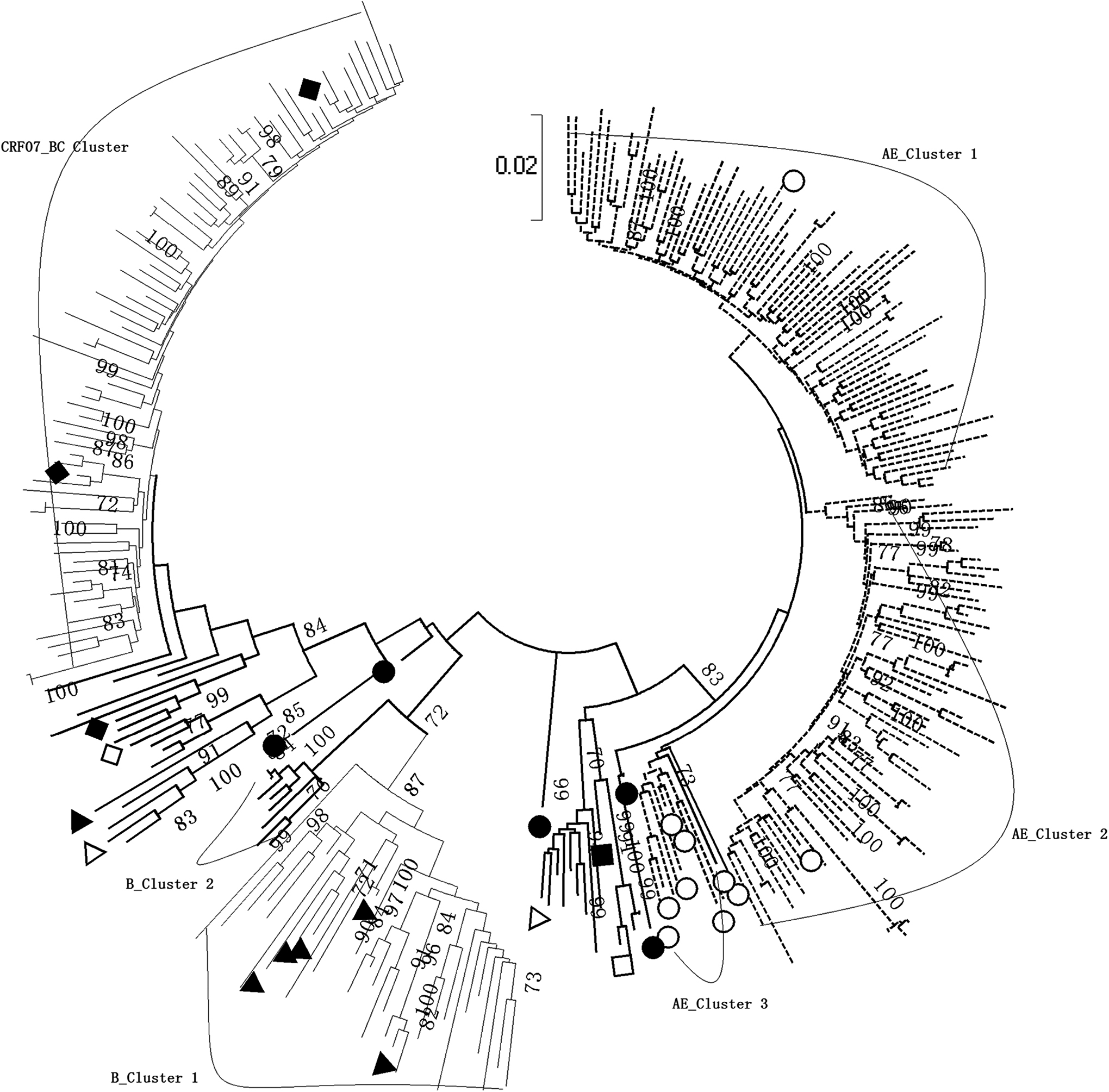
Phylogenetic tree analysis based on HIV-1 partial pol sequences obtained from HIV-1 individuals before antiretroviral therapy. The maximum-likelihood tree was constructed using MEGA 6.0 with 1,000 bootstrap replicates. The reference sequences (B, CRF01_AE, CRF07_BC, CRF08_BC, CRF55_01B, CRF65_cpx, and CRF68_01B) were obtained from the HIV database (
Only one large CRF07_BC cluster was observed in the maximum-likelihood (ML) tree, and contained 91.5% (75/82) of all CRF07_BC sequences. The number of MSM sequences was far more than heterosexuals, and our study sequences closely clustered together with the reference MSM sequence from Beijing. Thirty-six subtype B sequences constructed two clusters designated B_clusters 1–2. B_clusters 1 and 2 contained 28 and 8 study sequences, respectively. In B_cluster 1, our study sequences closely clustered together with the reference sequences from Shijiazhuang of Hebei, Ruili of Yunnan, and Thailand.
The overall prevalence of HIV-1 DR before ART was 6.2% (17/276), significantly higher than the prevalence of HIV primary drug resistance (PDR) in China (4.7%). 9 The low-, intermediate-, and high-level DR was 1.8% (5/276), 3.3% (9/276), and 1.1% (3/276), respectively. The prevalence of DR to non-nucleoside reverse transcriptase inhibitors (NNRTIs), PIs, and nucleoside reverse transcriptase inhibitors (NRTIs) was 4.7% (13/276), 1.4% (4/276), and 0.4% (1/276), respectively.
As shown in Table 2, the confirmed DR gene positions were as follows: 2 PI-resistance positions at codons 46 (3 cases) and 58 (1 case); 1 NRTI-resistance position at 74; 7 NNRTI-resistance positions at 103, 106, 108, 138, 179, 190, and 225. In NNRT gene coding region, 61.5% (8/13) contained two different codons mutations (double mutations) among subjects with NNRTI resistance. Moreover, five of eight double mutations occurred, V179 and K103R. K103R is a polymorphic mutation that alone has no effect on NNRTI susceptibility; however, in combination with V179D, it causes intermediate resistance to EFV and NVP. In protease gene coding region, three subjects with M46I/L and one with Q58E were identified, and found resistant to NFV and TPV, respectively. In NRT gene coding region, only one subject with L74I was found, presenting an intermediate-level resistance to ABC and a high-level resistance to DDI.
Information on Subjects Harboring HIV-1 Drug Resistance Among HIV-1 Individuals Before Antiretroviral Therapy in Hebei, China
Bold/underline values highlight drug resistance mutation.
K103R is a polymorphic mutation that alone has no effect on NNRTI susceptibility. However, in combination with V179D, it causes intermediate resistance to EFV and NVP.
“1” and “2” after 01_AE denote AE_cluster 1 and AE_cluster 2, respectively.
BD, Baoding; CD, Chengde; CZ, Cangzhou; H, high-level drug resistance; HD, Handan; HS, Hengshui; HT, heterosexual contact; I, intermediate-level drug resistance; L, low-level drug resistance; MSM, men who have sex with men; NNRTIs, non-nucleoside reverse transcriptase inhibitors; NRTIs, nucleoside reverse transcriptase inhibitors; PIs, protease inhibitors; SJZ, Shijiazhuang; ZJK, Zhangjiakou.
Except for 8 of 17 subjects harboring two mutation points in NNRT gene coding region, the remaining nine only harbored single-gene point mutation in partial pol gene region. No multidrug resistance, which included not only PI mutations but also RTI mutations, was observed in this work. Surprisingly, 76.5% (13/17) of subjects containing DR mutations were MSM and 23.5% (4/17) were heterosexuals. Further investigation indicated that subjects resistant to drugs had the following characteristics: sexual contact infection accounting for 100% (17/17), male for 88.2% (15/17), middle school or above for 88.2% (15/17), and single for 52.9% (9/17).
DR gene mutations were found in five of eight genotypes identified in this study, including CRF01_AE (64.7%, 11/17), CRF07_BC (11.8%, 2/17), CRF65_cpx (11.8%, 2/17), CRF55_01B (5.9%, 1/17), and B (5.9%, 1/17). The prevalence of DR before ART in five genotypes was 66.6% (2/3) in CRF65_cpx, followed by 12.5% (1/8) in CRF55_01B, 8.0% (11/137) in CRF01_AE, 2.8% (1/36) in subtype B, and 2.4% (2/82) in CRF07_BC. All of HIV-1-resistant strains were circulating in transmission clusters. Of 17 subjects with DR, 64.7% (11/17) was circulating in two large AE_clusters designated AE_clusters 1–2.
AE_cluster 1 included three members with NNRTI mutations and one member with PI mutation. AE_cluster 2 included four members with NNRTI mutations, one member with NRTI mutation, and two members with PI mutations. Other subjects with DR mutations were circulating in clusters designated large CRF07_BC cluster (2 cases), large B_cluster 1 (1 case), 65_cpx cluster (2 cases), and 55_01B cluster (1 case). Figure 2 shows that HIV-1-resistant strains were circulating in seven prefectures of Hebei, and HIV-1 DR prevalence before ART was the highest in Hengshui (22.2%, 2/9), followed by Zhangjiakou (20.0%, 4/20), Chengde (11.1%, 1/9), Cangzhou (8.7%, 4/46), Baoding (6.1%, 3/49), Handan (5.3%, 2/38), and Shijiazhuang (2.3%, 1/44). However, HIV-1-resistant strains were not observed in the sexual contact transmission population before ART in Qinhuangdao, Langfang, and Xingtai.

Demographic distribution of HIV-1-resistant strains circulating in Hebei. NNRTIs, non-nucleoside reverse transcriptase inhibitors; NRTIs, nucleoside reverse transcriptase inhibitors; PIs, protease inhibitors.
In this study, we found that 98.9% of these subjects attributed their HIV-1 infections to sexual contact, and MSM and heterosexuals accounted for 77.5% and 21.4%, respectively. The phylogenetic analysis indicated that CRF01_AE (49.6%), CRF07_BC (29.7%), and subtype B (13.0%) were the three main predominant genotypes. In the ML tree, two large AE_clusters and one large 07_BC cluster were identified, and only closely clustered with the reference MSM sequences from Beijing. Further, HIV-1-resistant strains were circulating in five of eight genotypes identified in this study. All of HIV-1-resistant strains were circulating in transmission clusters.
Particularly, 76.5% of subjects resistant to drugs were circulating in above three large transmission clusters associated with MSM from Beijing, which included two large AE_clusters and one large 07_BC cluster. Our study proved that MSM could meet conveniently due to the busy population mobility between Beijing and Hebei, which might result in the bidirectional exchange of HIV-1 strains between Beijing and Hebei. Importantly, the utilization rate of condom was only 34% among the floating population. 10
In this study, people aged 18–49 years accounted for 84.4%, having an active sexual ability. Large clusters, good communications, the floating population with an active sexual ability, and the higher infection rate (8.0%) among MSM 3 could accelerate HIV-1 dissemination, especially HIV-1-resistant strains through sexual behaviors between Beijing and Hebei. As the most frequent genotypes, large transmission clusters associated with CRF01_AE and CRF07_BC have become one of the main factors resulting in the rapid increase of HIV in Hebei. Therefore, the enhanced surveillance for HIV should be planned early among the floating population traveling between Beijing and Hebei. Hebei should construct local cooperative mechanism for HIV prevention and control together with Beijing. We must take effective measures to cutoff HIV spread between both provinces; for instance, the changing of risk sexual behaviors.
Sequence Data
The related sequences reported in this study have been submitted to GenBank with the accession numbers MN462702–MN462839.
Footnotes
Authors' Contributions
X.L. conceived the study project. X.L., Y.L., Y.W., A.N., and M.L. completed the whole study, and X.L., J.Z., and M.L. analyzed experimental data. X.L. drafted the article. X.L. and L.M. carried out epidemiological investigation. All authors read and approved the final article.
Author Disclosure Statement
No competing financial interests exist.
Funding Information
This study was implemented with the support of the Natural Science Fund of Hebei Province (grant no. H2016303006).