




Abstract
Latinx people living with HIV (PLWH) experience disparities in health outcomes and face unique barriers to care related to language, intersectional stigma, and immigration status. We aimed to explore the lived experience of Spanish-speaking Latinx PLWH in the nonurban South to better understand how to improve care for this minority language population. We conducted semistructured interviews with 22 participants (10 men, 10 women, 2 transgender women) who were recruited from a Ryan White HIV/AIDS program (RWHAP) and a community-based organization. Almost all participants were foreign born. Emerging themes included language barriers, cultural differences, inadequate interpreter services, HIV-related and intersectional stigma, isolation, and relationships as a source of support. These barriers may contribute to disparities in outcomes for Latinx PLWH. New interventions are needed to overcome barriers, foster community, and ensure culturally tailored models of care. Potential clinic-level interventions include the development of specialized training for RWHAP interpreters and inclusion of interpreters in care teams.
Introduction
Latinxs are disproportionately affected by HIV, accounting for 27% of new HIV diagnoses in the United States in 2018, but only 18% of the population. 1,2 Latinx people living with HIV (PLWH) are diagnosed at a more advanced stage of disease 3,4 and have lower rates of retention in care 5 than non-Hispanic white PLWH. Currently, only half of Latinx PLWH are virally suppressed, 6 far below national goals for viral suppression. 7 Improving and optimizing HIV care for Latinx PLWH is essential if the United States wants to end the HIV epidemic.
In the United States, Latinx PLWH are a diverse population representing varied native countries, lifestyles, and cultural norms, but, as a group, they face unique barriers to care. 8,9 Latinx PLWH encounter intersectional stigma related to HIV, ethnicity, gender, sexual orientation, and immigration. 10 Language barriers for those who are limited English proficient (LEP) impact access to care, quality of care, satisfaction with care, and patient safety. 11 Structural racism affects individual-level health decisions and behaviors among Latinx PLWH. 12 Foreign-born Latinx PLWH have additional immigration-related barriers, including fear of deportation, lack of health insurance coverage, poverty, mistrust of support services, and limited support systems. 13 –15
The HIV epidemic continues in the United States and over half of new HIV cases are occurring in the South, 16 with a disproportionate increase in diagnoses among Latinx men. 16,17 A higher proportion of cases in the South are nonurban, 18 and Latinx PLWH in rural areas of the South may experience higher mortality than urban counterparts. 19 As the HIV epidemic shifts to nonurban regions, a better understanding of the rural HIV epidemic is needed. 20
Our Ryan White HIV/AIDS program (RWHAP) clinic in the South serves a predominately nonurban population with a low density of LEP Spanish speakers. Our objective was to explore the lived experience of Latinx PLWH in our region. Using a qualitative approach, we aimed to understand how linguistic and cultural differences may impact the care of Latinx PLWH.
Methods
Study design and population
This study was approved by the University of Virginia Institutional Review Board for Health Sciences Research. The study population was Spanish-speaking Latinx PLWH ages 18 and older. Participants could speak English in addition to Spanish. Participants were recruited over the telephone and in person from two sites, (1) a RWHAP clinic located at a tertiary care hospital in the nonurban South and (2) a Latinx-serving community health organization. Convenience sampling was used. Informed consent was obtained from all participants.
Data collection
Semistructured interviews were performed in the clinic by two bilingual Spanish-speaking study personnel, one male and one female. Interview questions included basic demographic information, including age; place of birth; education level; time in the United States; language spoken at home, at work, and with friends; as well as time since HIV diagnosis.
Participants were then asked a series of open-ended questions regarding their experience living with HIV using an interview guide. The interview guide was developed based on health disparity frameworks for HIV care, which emphasize the interconnection of individual-level factors and social-structural factors on outcomes 21,22 These factors include socioeconomic position, stigma, discrimination, stress, and social capital, all of which impact health behaviors and access to care, especially for vulnerable populations. The guide included items related to barriers that PLWH face in engagement in care and treatment, the role of social support in HIV care, and health care disparities for Latinx PLWH (Supplementary Table S1). Interviews ranged in length from 21 to 65 min.
Interviews were audiotaped, transcribed, and translated. Two members of the study team, one a native Spanish speaker and the other a native English speaker with national medical interpretation certification, performed the translations. All translated interviews were reviewed by a second Spanish-speaking team member, and when concerns arose regarding the translation, team members returned to the audio transcript for clarification.
Data analysis
Translated interviews were imported into Dedoose for analysis [Dedoose Version 8.0.35 (2018); SocioCultural Research Consultants, LLC, Los Angeles, CA,
Results
Participant characteristics
Twenty-eight individuals were invited to participate and 22 (79%) enrolled in the study. Reasons given for nonparticipation included a focus on honing English language skills (n = 1), a general lack of interest in the study (n = 2), work conflicts (n = 1), transportation burden (n = 1), and confidentiality concerns (n = 1).
The 22 participants included 10 men, 10 women, and 2 transgender women (Table 1). The average age was 41.1 years [standard deviation (SD) 11.6 years]. All participants were born outside the continental United States, with the most common countries of origin being Honduras (n = 7), Mexico (n = 4), and El Salvador (n = 4). Participants had lived in the United States for a mean of 12.2 years (SD 9.8 years) with a range of 0.5 to 45 years. Fourteen participants (64%) reported limited or no English proficiency, and 20 (91%) spoke only Spanish at home. Participants reported a mean of 9.2 years since HIV diagnosis, with a range of 5 months to 35 years.
Participant Characteristics
GED, general education diploma; SD, standard deviation.
Emerging themes from qualitative analysis
Using grounded theory for analysis, emerging themes included language, cultural differences, inadequate interpreter services, stigma, isolation, and immigration (Table 2).
Emerging Themes Preventing Equitable Care Among a Minority Language Population in an Area with a Low Density of Limited English-Proficient Spanish Speakers
LEP, limited English proficient; PLWH, people living with HIV; RWHAP, Ryan White HIV/AIDS program.
Language
Language was the most commonly identified theme, impacting most aspects of participants' health care, including access to care, communication with providers and support staff, and connection to other PLWH. Participants described challenges accessing care, including clinic phone recordings in English only and lack of Spanish-speaking scheduling staff.
Patient/provider language discordance impacted the quality of communication with providers. The inability to fully explain medical needs to providers resulted in hesitancy to raise concerns or confide in providers. “I can't be myself with the doctor,” one participant admitted, “for the simple reason that she doesn't speak Spanish well, [and] I don't speak English well…She's not going to understand me. I'm better off not telling her anything.”
Even when providers had intermediate Spanish proficiency, barriers arose during communication. One participant described an interaction with their doctor in the following way: “She takes out the translator on the computer and she translates a word that she doesn't understand and, then, done. But it's more time-consuming, because I know—I have the idea that there are more patients after me, so she has to go. So, that's why I tell her, ‘No, well, I'm fine.’…I can't express to her everything that I'm feeling. Not really—feeling, I mean in terms of my health.”
Due to the frustration of being unable to communicate with health care providers, participants expressed a desire to learn English. One participant pursued English courses to advocate for himself: “If we are [expecting] for everyone to translate all the time, at the end of the day we'll never get the truth…That's why I went to school three years ago. I can't speak English perfectly, but I can get by.”
Cultural differences
While language presents a formidable barrier to optimal patient/provider communication, cultural differences in the expression of health concerns may also impede communication, and communication may lack the warmth desired by patients.
For one patient whose provider speaks Spanish, “Even though [my doctor] speaks Spanish, she doesn't understand a lot of things the way I am expressing them to her. So, that's a limitation because it doesn't allow for good communication or fluid communication with her…the contact I have with the doctor or with the providers isn't as charismatic as one is used to [in my home country].” Another participant described modifying her behavior to meet typical cultural expectations in the United States: “There's also a communication barrier because we [Latinos] don't know how to communicate. We usually go around in circles before getting to the point. And thanks to this culture, we've been taught to cut to the chase.”
Interpretation services
Interpretation services were frequently used. For some participants, readily available professional interpreter services were sufficient to meet their needs and overcome the language barrier. However, for many, use of interpreter services brought about additional challenges. A common concern regarded the faithfulness of the interpreted message to the original. One participant noted that, “when you don't speak in English, it can be difficult because you can get frustrated when the message is not translated as expected, and if the interpreter can't use the words, it loses some strength and information.”
The presence of the interpreter during a private medical visit led participants to question the confidentiality of the visit and hesitate to confide personal information to their providers. One participant described a time when he did not fully disclose his recent sexual activity, in part due to misinterpretation: “The doctor just asks me, ‘Do you have a new partner?’ My answer is no. But…maybe she's not asking the right questions? Maybe she isn't going deep enough to get at the information in a way that inspires trust? I mean, whether or not my sexual life is active, she doesn't know. She just asks, ‘Do you have a partner or not?’ Well, no. But… I mean, I'm sexually active…I'm having sex.” The word “partner,” often used in the phrase “sexual partners” to inquire about anyone with whom the patient has engaged in sexual activity, was interpreted as “pareja,” which in Spanish connotes a long-term relationship. The patient, while possibly aware of this incomplete translation, chose to answer the question as it was literally posed, leading to miscommunication of medically relevant information.
While most participants reported helpful and professional interactions with medical interpreters, two participants had experienced negative, stigmatized interactions with interpreters, including one participant who recalled: “The [clinic interpreter] who told me [about my HIV diagnosis], she said to me, ‘Listen, girl! You're going to die.’ And it was very hard. I think they should have told me some other way.” Another participant, diagnosed earlier in the AIDS epidemic, remembered: “The interpreter would wear an astronaut suit just to be in the same room as us, not even touching us. Even the social worker thought that was shocking, but he told me: ‘This is what we have,’ and those were the requests of the translator.”
HIV-related and intersectional stigma
Internalized, anticipated, and experienced stigma affected participant experiences of living with HIV, from the initial diagnosis to their current care. For most participants, the initial reaction to receiving a diagnosis of HIV included feelings of uncertainty, shock, isolation, and a pervasive sense of imminent death. One participant explained, “The first thing you think is, ‘I'm going to die.’ It's what you hear everywhere. HIV/AIDS is associated with death.” For those diagnosed early in the AIDS epidemic, feelings of imminent death were reinforced by health care providers. One participant recalled: “The doctor who gave me my results told me in a cold way that it was AIDS and that it was a disease that had no cure, and since there was practically no treatment, that I had more or less three months left to live.”
Denial of the diagnosis was a common response. “I've never wanted to accept that it exists inside of me,” admitted one participant, while another recounted, “I call it, ‘my inner enemy.’” After diagnosis, many participants reported mental health concerns associated with the stigma of HIV, including depression, anxiety, and suicidal ideation. One participant recalled, “I want to die and people will say he committed suicide or something, instead of saying he died of HIV. Instead of saying he died of AIDS.”
Stigma led participants to be cautious about how they seek care and to avoid bringing home resources or medication bottles that may result in inadvertent disclosure. One participant described each clinic visit as a potential opportunity for disclosure, noting that “more than anything, when I came here for the first time to see the doctor, I was afraid that there would be people here that knew me and that they'd ask me, because I know that there are Hispanic people here—there are people close to me who work here, who work in cleaning services, cleaning up. So, every time that I come, I'm careful about that, so that they don't see me.”
Anticipated stigma prevented many participants from disclosing their status to family and friends. Others felt that disclosing their HIV status would place a burden on family members due to the associated stigma and expressed concerns for their family members’ reactions. Despite advances in knowledge regarding HIV transmission, people are “still living in the old days, when someone says HIV—‘Don't hang out with him!’ or ‘Don't drink from the same glass,’ or ‘Don't touch him,’ or ‘Don't kiss him because he's going to infect you.’ People still have that mentality…there's a lot of ignorance.”
In addition to stigma related to HIV, participants also faced intersectional stigma related to limited English proficiency, gender or sexual orientation, and immigration status. For one participant, “When you are a transgender woman, like myself, it's hard for doctors to understand you. It is more degrading than [when they are] treating a gay person; there is more rejection. They don't care about you. And you feel really depressed about that.” One participant was able to access care, but perceived being a Spanish speaker to be a source of stigma in the medical setting. She explained that there are “people who don't like it when we speak Spanish. It bothers them… And you feel like you don't have a right to say anything because you're receiving assistance, and this is the only thing that should matter—no matter how they treat you. But this is false—it's the language barrier.”
Isolation
Feelings of isolation were common and attributed to limited disclosure of participants' HIV diagnosis and a limited support network. Most participants described a limited number of family members to whom they had disclosed their status. One participant felt he was “drifting apart” from family “due to the problem I am facing” and the stress of keeping his diagnosis a secret. Support groups for PLWH were found to be inaccessible due to limited English proficiency. One participant noted that “not many people who speak Spanish talk about their illness, not that I know of anyway, so, no, I don't believe I have a support network.”
Immigration
The impact of immigration on HIV care differed based on time since immigration and immigration status. Recent immigrants noted inability to work or access resources. One described the challenges faced as an undocumented immigrant after HIV diagnosis: “Here, you are illegal. You don't have documents, you don't have insurance. Here, you just have God and nothing else.” Two participants, who immigrated over a decade ago, were aware of prior regulations prohibiting people with HIV from entering the United States. Other participants who were engaged in HIV care in their home countries lost their support systems upon immigrating, leading to depression, anxiety, and lack of motivation to remain adherent with treatment.
Sources of support and motivation
Relationships were identified as participants' primary source of support and motivation. Positive relationships included people who were aware of the HIV diagnosis and able to provide support as family members, friends, care team members, or other Spanish-speaking PLWH. Participants who were able to share their diagnosis with family and friends found considerable support in these relationships. One participant whose family accepted his diagnosis shared: “The most important thing has always been my family… That's what has sustained me up to this moment with the motivation to keep living.”
Counseling provided at the time of diagnosis can aid in acceptance of the diagnosis, be a source of comfort, and provide a way to “get a little bit of hope back,” as one participant described. She continued, “they explained to me that HIV wasn't like it used to be before, because there didn't used to be very many medications. So, they said, ‘If you take your medications as directed, you're going to be fine’…And I took the advice and that's what I've done for all these years.” Ongoing support and resources from the clinic eased barriers preventing access to care after immigrating to the United States. “Here, they help you; here, they send you a taxi; here, they look for you.”
Encountering positive examples of people living well with HIV can help overcome fear, combat stigma, and improve one's mood. One participant recalled, “What really did help me a lot was when I spoke with [a peer with HIV] because he was in my same situation and I saw him in such good spirits. I said to myself, ‘He doesn't look sick [laughter]. He's moving a thousand miles an hour!’ I'd say, ‘No. I can do it, too,’ and it helped me a lot to talk to him.” The connection among peers with HIV was identified as a unique relationship, separate and distinct from the relationship between patients and providers. As one participant stated, “Sometimes, with the title of doctor or social worker, psychologist—I have always thought that they're barriers. Sometimes the titles put a person living with HIV in a different rank… There's a connection; I can identify more and want to talk more with a person who is HIV-positive because I think that I will feel more at ease than I will with a provider.”
Discussion
Among this population of Latinx PLWH in care, themes of language barriers, cultural barriers, inadequate interpreter services, intersectional stigma, and isolation were common (Fig. 1). Many of these challenges to care have previously been seen in studies of Latinx PLWH, 10,13 –15,23 –25 although the pervasive sense of isolation and lack of community may be more pronounced in our nonurban population with a low density of LEP patients. The current system of care for Spanish-speaking Latinx PLWH is not meeting this population's needs. Systematic changes are needed to provide equitable care to all PLWH (Table 2).
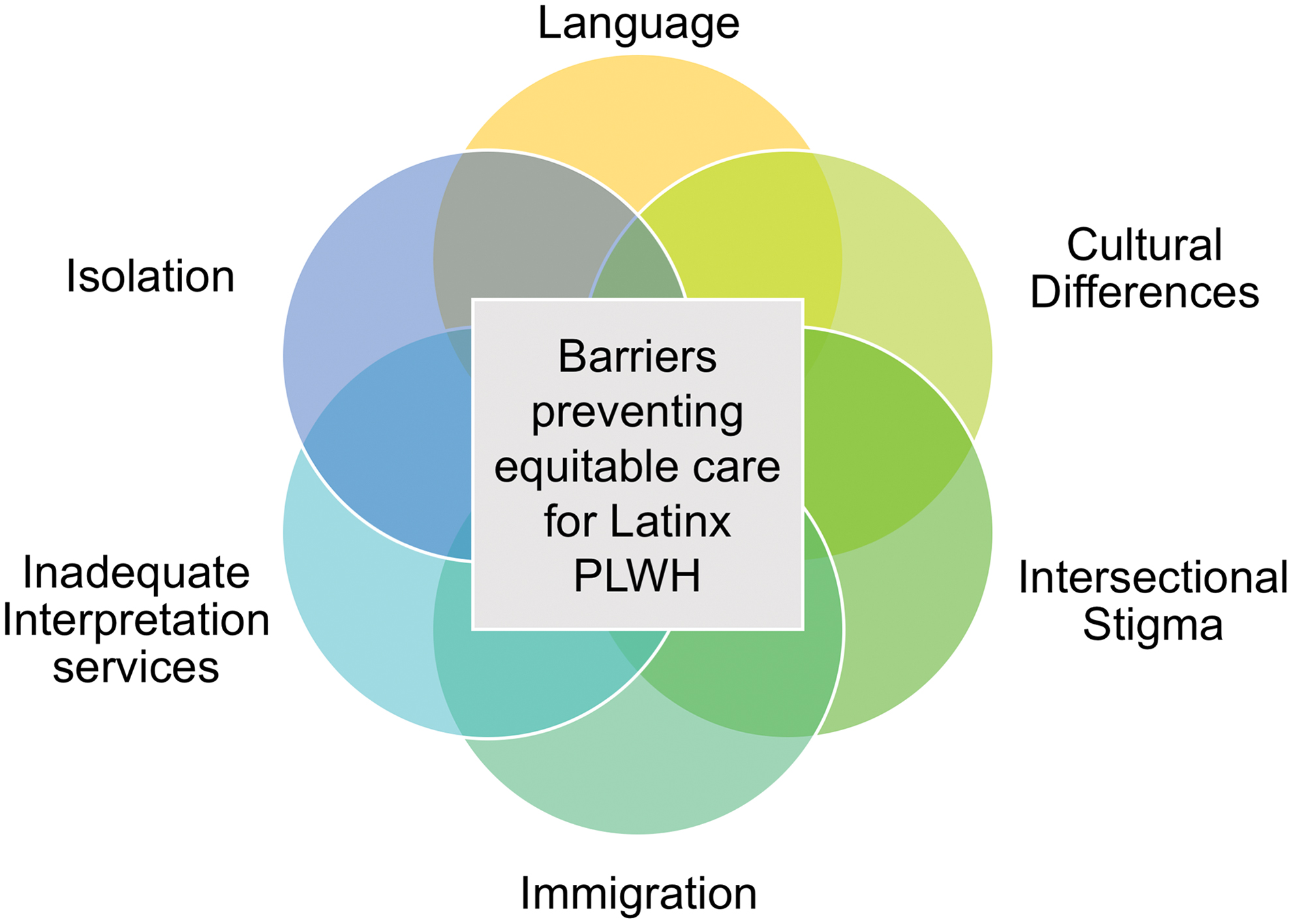
Intersectional barriers for Latinx PLWH in nonurban South. PLWH, people living with HIV. Color images are available online.
Language was the most commonly cited barrier. Language discordance between providers and patients results in poorer quality of care, 26 and Latinx patients may attempt to “get by” with inadequate English for fear of discrimination or being a burden. 27 The ideal solution is language concordance between providers and patients. 28,29 However, bilingual providers may not be readily available for low-density minority language populations. Increasing the bilingual provider workforce is a worthy goal, 25 but this change cannot be enacted immediately. Additionally, language impacts all stages of care, not only the patient/provider interaction.
Ensuring equitable access to care requires that language services are available at every interaction, from telephone encounters, through registration, to delivery of follow-up instructions. In addition, all staff providing language services must be properly credentialed. For patients who are motivated and interested in learning English, active referrals to language classes should be provided, as some patients identified learning English to be an empowering experience.
In this population of primarily foreign-born Latinxs, cultural differences in the expression of medical concerns and illness impacted patient/provider relationships. While closely tied to language, low quality care among LEP patients also stems from cultural differences. 30 Literature on HIV prevention among Latinxs describes how cultural norms related to sexuality, gender roles, and social reluctance may limit discussion related to sexual identity and sexual activity. 25 Diversifying care teams to include members of minority language populations may provide a broader range of perspectives. It is also important for providers to recognize the diversity within minority language populations, given the heterogeneity of cultures among Spanish-speaking individuals.
Interpreter services are often suggested as the solution to address language and cultural barriers among LEP patients. While access to interpreter services is mandated under law 31 for the 8.7% of the U.S. population who are LEP, 32 reimbursement for language services is variable 11 and language services remain underutilized. 33 –38 LEP patients who receive care with professional interpreters have higher satisfaction with care, higher quality of care, and attend more visits than those using untrained interpreters, such as family members. 11,39 Yet, interpreters alone cannot overcome language barriers, 23 as seen in the underutilization and inadequate interpretation services experienced by our participants. This is despite our clinic being located in a large tertiary care health system where interpreters are available at all times. Unanticipated challenges included patient concerns regarding confidentiality and insensitive behavior by interpreters. HIV, a disease associated with a high degree of stigma, may be more impacted by concerns regarding confidentiality and privacy than other medical conditions. The resulting mistrust in interpreter services can impact engagement with care. 24
We suggest structural changes to the provision of interpreter services for PLWH. First, we recommend that the RWHAP develop specialized training for interpreters who provide services for a highly stigmatized population to ensure accurate interpretation and interpreter familiarity discussing HIV and other sexually transmitted infections.
Specialized training may help address the intersectional stigma these patients face. RWHAPs provide interdisciplinary care, and national guidelines regarding care of Latinx patients recommend including interpreters as members of the care team. 30,40 The presence of specially trained interpreters embedded in the clinic would meet these recommendations. Second, care teams should acknowledge that patients will be differentially affected by the presence of an interpreter in the room, and particularly in low-density nonurban populations, interpreters may be known to patients. For certain patients, alternative methods of interpretation, including telephone interpreters, or interpretation through certified language technology programs, such as video interpretation, may be preferred to in-person interpreters. There should be a specially trained pool of interpreters available for this option. This could be a centralized resource supported by the RWHAP. A telehealth alternative to access trained interpreters may also be more practical for low-density populations that may not have sufficient patient volume for a dedicated specially trained in-person interpreter. Third, interpreters can serve as cultural brokers, 41 and training could ensure interpreters are well poised to recognize and address the culturally diverse Spanish-speaking population. Additionally, visits requiring interpretation services require more time. 42 Clinics should create a policy that allows more time for visits with LEP patients, as this may help mitigate barriers. Finally, to ensure improvement in the use of language services, the appropriate utilization of interpretation services should be evaluated, tracked, and reported as a quality metric for patient care and safety within the clinic. 30,31
Relationships were the primary source of motivation to overcome isolation and barriers. In the Latinx population, “familismo,” a cultural value that emphasizes close family connections and loyalty, is a central cultural concept. The sense of isolation felt by many Latinx PLWH may be particularly pronounced given the cultural importance of familismo. 25 Social support and disclosure of status to members of one's social network improves retention in care. 43 “Confianza,” or trusting relationships, is a cultural theme in care, as supported by our participants who sought a sense of warmth with providers. 44 Case management can be an effective means to build social support in Latinx PLWH. 45
For our participants, positive examples of people living well with HIV were transformative in their lives. Opportunities to interact with peers living with HIV and to build community can be limited in low-density minority language populations. Mobile health interventions, such as virtual support groups or smart phone applications allowing for interaction among Spanish-speaking PLWH as well as between PLWH and care providers, could provide an opportunity to build a virtual community of peer support. 46 Virtual support groups that include peers living well with HIV can also provide examples of positive self-image to help others who may be struggling with internalized stigma. 47
Finally, while directly mentioned by only a handful of patients to be a barrier, immigration underpins many of the emerging themes. Immigration is one part of the intersectional stigma faced by this population. Stigma, a high concern among Spanish-speaking Latinx PLWH, 48 results in worse outcomes for PLWH. 49 Before 2010, HIV infection could be a reason to bar entry into the United States, 25 a fact known by at least two participants. Under the public charge rule, immigrants who utilize some public programs, or those with certain illnesses commonly impacting PLWH, may be deemed ineligible for entry into the United States or adjustment to legal permanent resident status. 50,51 Particularly for undocumented immigrants, fear of deportation impacts social determinants of health. Undocumented immigrants face food insecurity, limited access to health care, unstable housing, difficulty finding employment, and mistrust available services. 25,52 Following expansion of the Affordable Care Act (ACA), the national uninsured population decreased. However, undocumented immigrants were excluded from ACA, 53 and Latinxs are the racial/ethnic group with the highest uninsured rate at 17%. 54 Recent changes to the public charge policy are predicted to result in decreased insurance coverage among immigrant families. 55 Provision of immigration legal services has been proposed as a structural intervention for HIV care. 52
Our study has few key limitations. Our participants are all born outside the continental United States and recruited from two sites. Therefore, the results may not be generalizable to native-born Latinx PLWH or a broader region. Some participants spoke English as well as Spanish, which may influence their perceptions of care particularly as related to language and interpreter services.
Conclusions
To end the HIV epidemic in the United States and reach 90-90-90, we must improve care for populations disproportionately affected by the HIV epidemic, including Latinx PLWH and PLWH in the South. Health care systems must acknowledge the mistrust and perceptions of discrimination that Latinx patients feel in health care settings, diversify the workforce, and increase access to culturally and linguistically competent care 25 to create a culture where the equitable care of minority language populations is expected. 56 Developing specialized training in HIV and sexually transmitted infections for interpreters in RWHAP HIV clinics and creating a centralized pool of specially trained interpreters available for telehealth interpretation may be valuable investments to achieve these goals and help end the HIV epidemic.
Footnotes
Author Contributions
J.E.S., K.A.M., T.F., and R.D. conceived of the study. K.P.G. and D.A.V. performed the interviews. K.P.G., S.K., T.F., and J.E.S. coded and analyzed the data. R.D. supervised. J.E.S. wrote the initial article, which was revised and reviewed by all authors. All authors approve of the final version.
Acknowledgments
The authors thank the University of Virginia Ryan White HIV Clinic patients. They also thank the University of Virginia Ryan White HIV Clinic staff, the PositiveLinks team, and Nova Salud. Special thanks to Ava Lena Waldman for assistance with developing the study protocol and Eeshani Thomas for her work in data coding.
Author Disclosure Statement
K.A.M. reports stock ownership in Gilead Sciences, Inc., R.D. provides consulting services to Warm Health Technologies, Inc., on activities unrelated to this work. K.A.M., R.D., and J.E.S. have received funding from Gilead Sciences, Inc., for an investigator-initiated trial unrelated to this work. The other authors report no disclosures.
Funding Information
This work was supported by the National Institute of Allergy and Infectious Diseases at the National Institutes of Health (grant number T32 AI007046-41 to J.E.S., grant number K08AI136644 to K.A.M.). The Virginia Department of Health (VDH) also provided funding through Ryan White Part B special projects funding. The content is solely the responsibility of the authors and does not necessarily represent the official views of the NIH or of VDH.
Supplementary Material
Supplementary Table S1
Supplementary Table S2
References
Supplementary Material
Please find the following supplemental material available below.
For Open Access articles published under a Creative Commons License, all supplemental material carries the same license as the article it is associated with.
For non-Open Access articles published, all supplemental material carries a non-exclusive license, and permission requests for re-use of supplemental material or any part of supplemental material shall be sent directly to the copyright owner as specified in the copyright notice associated with the article.
